

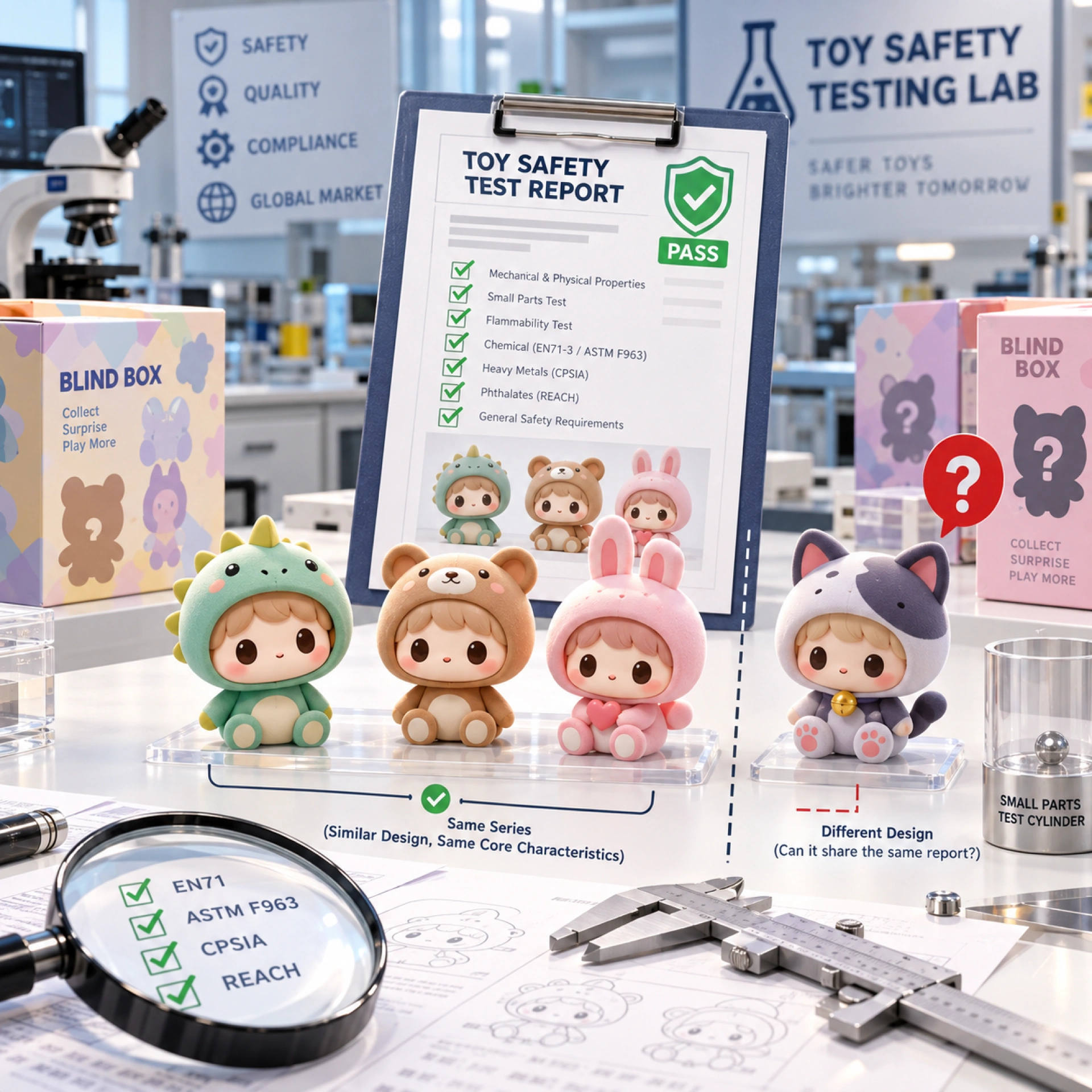
Yes, multiple blind box figures can sometimes be covered by one toy safety test report, but only when the testing scope and supporting evidence adequately cover every included design. In Blind Box Toy Safety Testing, figures with the same PVC material, paint system, intended age group and similar construction may qualify for shared component testing or a coordinated testing program. However, different accessories, structural features, coatings, pigments or secret figures may require additional samples and tests. One report does not automatically mean that only one figure needs to be tested.
For buyers developing 6, 8 or 12 blind box designs, the most important question is not how many figures belong to the same collection. It is whether the laboratory can demonstrate that every model meets the applicable safety requirements.
A laboratory may issue one report covering several identified models, multiple reports covering different test categories, or a combination of finished-product and component-level reports. The appropriate arrangement depends on the designs, materials, intended age, target market and laboratory’s documented assessment.
The practical approach is to prepare a complete figure comparison table before requesting a Blind Box Toy Safety Testing quotation. Buyers should identify which components are shared, which materials differ, which figures introduce additional hazards and which models must be included in the testing scope.
This article explains how brands, importers, licensed IP companies and sourcing teams can plan testing coverage, review laboratory reports and avoid paying for unnecessary duplicate testing without leaving compliance gaps.
For a broader production overview, read our blind box figure manufacturing process guide, which explains how character design, tooling, PVC production, painting, assembly, packaging and random packing are coordinated before mass production.
1. Can Multiple Blind Box Figures Share One Test Report?
Multiple figures may be included in one report when the laboratory has evaluated the applicable requirements and clearly identifies the designs and materials covered.
However, buyers should distinguish three different concepts.
| Question | Practical Answer | What Buyers Should Confirm |
|---|---|---|
| Can multiple figures appear in one laboratory report? | Yes, when supported by the laboratory’s testing program and report scope | Are all covered models explicitly identified? |
| Can multiple figures share testing results? | Sometimes, particularly for qualifying common materials or components | Which tests and materials are shared? |
| Can one tested figure represent an entire series? | Only for applicable risks when the sampling and evidence adequately support coverage | Have all design-specific hazards been evaluated? |
| Does one report automatically certify every figure? | No | What certification or conformity documentation is required? |
| Does every new color require full retesting? | Not necessarily | Are the pigments, paints and coatings adequately covered? |
| Does a secret figure need testing? | It must be included in the safety assessment and may require additional testing | Does it introduce unique materials, parts or hazards? |
This distinction is fundamental to Blind Box Toy Safety Testing.
For example, six figures might share the same molded PVC material. Chemical testing information for that material may be reusable under applicable requirements.
However, if each figure has a different shape and detachable accessories, the finished-product mechanical hazards may not be adequately represented by a single design.
The U.S. Consumer Product Safety Commission explains in its official component part testing guidance that component-level testing can be appropriate for certain requirements, while tests involving the structural integrity or accessibility of parts must be performed on finished products.
Therefore, a buyer should never accept the statement “all figures use PVC, so one test is enough” without checking the actual test scope.
2. One Test Report Is Not the Same as One Test Sample
This is a common misunderstanding in Blind Box Toy Safety Testing.
A laboratory report is a document that records testing information and results.
A test sample is the physical product or component evaluated.
One report may reference multiple submitted samples, different tests and several identified models, depending on the laboratory’s procedures.
Consider a blind box series with eight figures.
The laboratory might require:
- Multiple finished figures for physical and mechanical testing
- PVC component samples for applicable chemical testing
- Paint or coating samples from different color systems
- Accessories representing different structural risks
- Additional samples of the secret figure
The laboratory may organize the resulting information into one consolidated report or separate reports.
Neither reporting format automatically makes the test program more or less compliant.
What matters is whether the evidence covers the products being placed on the market.
Example: Eight Figures Using Shared PVC Material
Suppose a brand develops eight characters with:
- The same PVC body material
- The same ABS base material
- The same approved paint supplier
- Different character poses
- Different facial printing
- Three figures with detachable accessories
Certain common materials may qualify for shared component testing.
However, the different poses and accessories still need risk evaluation. The laboratory may require additional finished-product samples to address mechanical hazards.
This is why the laboratory quotation should describe both the proposed test coverage and the required samples.
3. Blind Box Toy Safety Testing Decision Table
The following table helps buyers evaluate whether different designs may share test evidence.
| Design Difference | Shared Testing Potential | Possible Additional Testing |
|---|---|---|
| Same PVC formulation, supplier and colorant | Potentially high for relevant material tests | Finished-product mechanical tests where required |
| Same ABS base across all figures | Common component evidence may be reusable | Base attachment or structural evaluation |
| Different PVC colors | Depends on pigment composition and testing coverage | Chemical testing for uncovered colorants |
| Different facial pad printing | Depends on ink and coating systems | Chemical review of new inks |
| Different body poses | Common material evidence may be shared | Design-specific mechanical testing |
| Detachable accessory | Material evidence may be shared | Small parts, attachment and breakage evaluation |
| Metallic paint | Not automatically covered by standard paint results | Chemical and coating-related review |
| Glow-in-the-dark pigment | May introduce a different material formulation | Additional chemical or physical assessment |
| Flocking | Different material and adhesive system | Fiber, adhesive and mechanical risk review |
| New secret figure mold | Shared components may still qualify | Assessment of unique geometry and accessories |
| Magnet | Requires specific assessment | Applicable magnet safety testing |
| Battery or electronic function | Different functional risk profile | Additional electrical, battery and other applicable testing |
These are procurement-planning examples, not automatic regulatory exemptions. The responsible manufacturer or importer and qualified laboratory must determine the appropriate test program.
For special finishes, read our Blind Box Special Editions guide, which covers glow effects, metallic painting, flocking and secret figure development.
4. Shared PVC Materials: When Component Testing Can Reduce Cost
Material selection is one of the first areas buyers should examine when planning Blind Box Toy Safety Testing.
A typical PVC blind box figure may contain:
- Injection-molded PVC
- Soft PVC components
- ABS base
- Paint
- Pad printing ink
- Adhesive
- Clear coating
- Metal components
- Separate accessories
Two figures may look completely different but use the same approved PVC compound.
In that situation, component-level test data may help avoid unnecessary repeated testing of identical materials, subject to applicable rules.
What Buyers Should Ask the Factory
Request a material comparison table identifying:
| Component | Figure A | Figure B | Same Specification? |
|---|---|---|---|
| Main body | PVC grade P01 | PVC grade P01 | Yes |
| Base | ABS grade A02 | ABS grade A02 | Yes |
| Main paint | Paint system C01 | Paint system C01 | Yes |
| Facial ink | Ink F01 | Ink F02 | No |
| Accessory | None | Small PVC hat | No |
| Adhesive | Adhesive G01 | Adhesive G01 | Yes |
The buyer can then identify which components are identical and which require additional assessment.
However, shared material descriptions are not sufficient by themselves.
The supporting documentation should confirm relevant details such as material identity, formulation consistency, supplier, colorants, coatings and applicable testing conditions.
For material selection, our PVC vs Vinyl vs ABS Figures guide explains how these materials differ in structure, flexibility, surface finishing and production.
Supplier Test Reports Must Be Valid and Relevant
A supplier may provide an existing material test report.
Before relying on it, the buyer should confirm:
- What component was tested?
- Who supplied the component?
- Does the tested material match production material?
- Does the report cover the applicable requirement?
- Was the testing performed by an appropriate laboratory?
- Are the full supporting records available?
- Has the material or supplier changed?
For U.S. children’s products, CPSC third-party testing guidance explains how component testing may be used and the conditions under which supplier evidence can be relied upon.
5. Different Paint Colors Do Not Automatically Share Chemical Test Coverage
Painting is an important variable in Blind Box Toy Safety Testing because one series may contain many colors even when all figures use the same PVC material.
For example, a six-character collection might use:
- Red
- Yellow
- Blue
- Green
- White
- Black
- Metallic silver
- Transparent coating
The figures may share molds and some paint suppliers, but different pigments or coatings can introduce different chemical considerations.
Same Mold, Different Paint
Suppose Figure A and Figure B use identical molds.
Figure A uses standard matte paint.
Figure B uses metallic silver paint.
The buyer should not assume Figure B is fully covered by Figure A’s chemical test results.
The metallic paint may use different pigments, binders or other formulation components.
The laboratory should review whether the existing evidence covers those materials.
Common Painting Questions
Before testing, confirm:
- How many paint systems are used?
- Are the paints supplied by the same manufacturer?
- Are pigments different?
- Are special coatings included?
- Are new inks used for facial printing?
- Is transparent coating added?
- Are all relevant coatings covered by supporting data?
Our article on Color Matching for Custom PVC Figures explains how manufacturers control Pantone references, paint selection, approved samples and mass-production consistency.
Color consistency and chemical test coverage are different topics, but both depend on accurate records of approved materials.
6. Different Accessories Can Change the Testing Requirements
Accessories are one of the most common reasons blind box figures need additional safety review.
Examples include:
- Small hats
- Handheld tools
- Glasses
- Bags
- Food accessories
- Weapons
- Decorative bases
- Pets
- Removable clothing
- Small connecting parts
Accessories may create different hazards depending on their design and intended use.
For example, one character may have a large fixed hat while another includes a detachable miniature cup.
Even if both accessories use the same PVC material, their mechanical risks differ.
Small Parts Risk
For products intended for children under three, U.S. requirements prohibit small parts under specified conditions, including parts liberated during applicable use-and-abuse testing.
The official CPSC toy safety guidance explains requirements relating to small parts, lead and other applicable toy safety issues.
Blind Box Toy Safety Testing should therefore consider not only the accessory’s material but also:
- Its size
- Attachment method
- Strength
- Shape
- Potential breakage
- Applicable intended age
A small-parts warning does not replace compliance with a prohibition that applies to a particular toy.
Why Finished-Product Testing Matters
Component material testing cannot fully demonstrate that a finished figure will withstand the required mechanical evaluation.
A PVC arm may contain compliant material but still break and create a hazardous component during testing.
This is why manufacturers should coordinate material testing with design-specific mechanical assessments.
7. Can the Secret Figure Share the Same Test Report?
A secret figure can share relevant test evidence with the normal lineup, but it should never be excluded from the safety assessment simply because it is rare.
The important question is:
Is the secret figure materially and structurally different?
Consider three examples.
Scenario A: Secret Figure Uses the Same Mold With Different Paint
This is a relatively straightforward variant.
The buyer should focus on:
- Paint formulation
- New pigments
- Coatings
- Surface treatment
- Existing material evidence
If the shape and assembly remain unchanged, some mechanical testing evidence may still be relevant.
However, the laboratory must confirm whether additional testing is needed.
Scenario B: Secret Figure Uses a Different Head
The body and base may be shared, but the head is new.
The new head could introduce:
- Thin projections
- Different joints
- Sharp edges
- Weak components
- Changed weight distribution
The laboratory may require additional assessment or testing of those features.
Scenario C: Secret Figure Has a Completely New Sculpt
A fully new secret figure may have:
- New molds
- Different accessories
- New materials
- New paint
- Different assembly methods
In this case, significant additional testing may be necessary.
Secret Figure Testing Comparison
| Secret Version | Possible Shared Evidence | Main Additional Review |
|---|---|---|
| Repaint version | Molded materials and existing structural data | New paint and pigment coverage |
| Different head | Common body, base and materials | Head geometry and attachment |
| New accessory | Common figure materials | Accessory safety |
| Metallic edition | Existing body structure | Coating formulation |
| Flocked edition | Existing molded parts | Fibers, adhesive and attachment |
| Fully new sculpt | Some common components | Complete design-specific risks |
The secret figure must be documented even when its appearance is kept confidential from customers.
A testing laboratory can work with confidential design and product information without that information being disclosed on consumer packaging.
8. Does a Different Age Grade Affect Shared Testing?
Yes. Intended age is a fundamental part of Blind Box Toy Safety Testing.
Before requesting a laboratory quotation, buyers should clarify whether the product is:
- Intended for children under three
- Intended for children aged three and older
- Intended for older children
- Positioned as an adult collectible
Age grading affects which safety requirements apply.
It should not be selected simply to avoid testing.
A product described as “14+” is not automatically excluded from toy rules if its design, presentation and intended use indicate otherwise.
For U.S. children’s products, testing and certification requirements depend on the applicable product category and age classification.
For the EU, the product’s intended use and toy classification also determine its safety obligations.
Brands selling into Europe can review the European Commission’s placing toys on the EU market guidance and our article on EN71 for Custom Toys.
If different figures genuinely have different intended ages, they may need different testing and documentation even when sold under a common character brand.
9. U.S. vs EU: Is One Test Report Enough?
Blind Box Toy Safety Testing should always be planned for the target market.
A U.S. test program and an EU conformity assessment may overlap in some material and mechanical areas, but they are not interchangeable.
| Topic | United States | European Union |
|---|---|---|
| Main framework | Applicable CPSC rules and mandatory toy standards | Applicable EU toy safety legislation |
| Common technical references | ASTM F963 and other applicable rules | Relevant EN 71 standards and other requirements |
| Product classification | Intended use and age-related criteria | Toy definition, intended use and exclusions |
| Shared component evidence | Possible under relevant rules, including 16 CFR Part 1109 | May support conformity documentation where appropriate |
| Finished-product hazards | Must be evaluated under applicable requirements | Must be evaluated through the applicable safety assessment |
| Main documentation | Test reports and CPC when required | Technical documentation, conformity assessment and EU declaration requirements |
| Who carries responsibility? | Relevant manufacturer/importer | Relevant economic operators under EU law |
For EU projects, buyers should also consider the transition to EU Toy Safety Regulation 2025/2509 and confirm which legal requirements apply on the planned date of placing the toy on the market.
The purpose of this comparison is not to create one universal global testing formula.
It is to show why buyers should confirm the destination markets before determining sample quantities, laboratory scope and documentation.
10. One Test Report vs One Children’s Product Certificate
These are not the same document.
For U.S. children’s products, the laboratory conducts the relevant testing and issues test reports.
The responsible domestic manufacturer or importer issues the Children’s Product Certificate (CPC) based on the required passing test results.
The official CPSC Children’s Product Certificate FAQ explains that multiple products, particularly products similar in design and tested together, may be listed on one CPC.
However, the certifier must be able to identify every product covered and maintain adequate supporting evidence.
What This Means for Blind Box Buyers
Suppose a U.S. importer develops six blind box figures.
The importer should not simply request:
“Please put all six designs on one CPC.”
Instead, the importer should first determine:
- Which test reports support each design?
- Are the six models sufficiently similar?
- Which requirements apply?
- Are the tested samples representative?
- Can every model be identified?
- Are any variants missing from the evidence?
The CPC should accurately describe the products it covers.
Also, one CPC covering multiple similar products does not automatically mean a single electronic customs filing can cover every distinct product. The applicable eFiling requirements should be reviewed separately.
For U.S. import planning, our CPSC eFiling for Custom Toys guide explains how buyers should organize certificate data, product identification, testing records and shipment information.
11. What Should a Shared Test Report Actually Show?
For procurement, this is one of the most important sections.
A blind box test report should make its coverage clear enough that the brand, importer and technical team can identify which products and requirements the results support.
Buyers should look for:
| Report Information | What Buyers Should Verify |
|---|---|
| Product description | Does it accurately describe the blind box series? |
| Model / SKU | Are the covered figures identifiable? |
| Sample photographs | Can submitted samples be matched to the products? |
| Sample quantity | Were sufficient samples submitted for the tests? |
| Material information | Are relevant PVC, ABS, paint and other components identified? |
| Test standards | Do they match the applicable market requirements? |
| Test results | Which requirements were evaluated and passed? |
| Exclusions or limitations | Are any figures, materials or tests outside the scope? |
| Laboratory details | Is the laboratory suitable for the applicable testing? |
| Dates | When were the samples tested? |
| Additional reports | Does the file reference separate component tests? |
| Product changes | Is the tested version still the production version? |
A report with the title “Blind Box Toy Series” is not enough by itself.
The buyer must be able to establish which figures were tested and which others, if any, are supported by a documented representative-sample or component-testing rationale.
Example
A report identifies:
Series: Fantasy Character Collection
Models: F01–F06
Submitted finished figures: F01, F03, F05 and F06
Supporting component reports: PVC compound P01, ABS base A01, paint systems C01 and C02
The buyer must ask why these particular samples were selected and whether the evidence adequately covers F02 and F04.
The fact that all six model numbers appear on the report does not, by itself, answer that question.
12. How to Prepare a Figure Comparison Matrix Before Testing
Buyers can make Blind Box Toy Safety Testing more efficient by preparing one comparison matrix for the full collection.
Below is an illustrative procurement example.
| Model | PVC Body | Paint System | Unique Accessory | Special Feature | Laboratory Review |
|---|---|---|---|---|---|
| A | P01 | C01 | None | Standard | Baseline design |
| B | P01 | C01 | Fixed hat | Standard | Geometry comparison |
| C | P01 | C02 | Detachable cup | Small accessory | Additional mechanical review |
| D | P01 | C01 | None | Different pose | Structural comparison |
| E | P01 | C03 | None | Metallic paint | Additional coating review |
| F | P01 | C01 | Fixed base | Standard | Base attachment review |
| Secret G | P01 | C04 | Special accessory | Glow paint | Additional material and structural review |
This table does not decide the laboratory’s test plan.
Instead, it gives the laboratory the information needed to determine:
- Which chemical tests may share component evidence
- Which new materials need testing
- Which finished figures require mechanical tests
- Whether the secret figure needs additional samples
- Whether a consolidated report is appropriate
A complete matrix also reduces quotation misunderstandings.
The buyer and laboratory can see what is included in the original scope and what would create additional costs.
13. How to Reduce Blind Box Testing Cost Without Increasing Risk
The best way to control Blind Box Toy Safety Testing cost is not to ask the laboratory to test fewer figures regardless of risk.
It is to reduce unnecessary product differences and prepare better technical documentation.
Use Consistent Materials
Where appropriate, use the same approved PVC compound, ABS grade and adhesive across multiple designs.
This may simplify component documentation.
Reduce Unnecessary Paint Systems
Different color designs do not always require entirely different paint suppliers or technologies.
Using consistent approved paint systems can simplify supplier records and help identify which chemical evidence is reusable.
Avoid Unnecessary Detachable Parts
Accessories can increase mechanical testing needs.
If a detachable accessory adds little customer value, the brand can consider integrating it into the main figure.
Plan Secret Figures Early
Do not add a fully new secret figure after the normal lineup has already been submitted for testing.
Review its structure and materials during initial development.
Ask the Laboratory for a Test Matrix
Instead of requesting one vague price for the whole collection, ask for a matrix identifying:
- Test requirement
- Relevant models
- Material/component coverage
- Required samples
- Shared evidence
- Additional testing
- Report format
For a broader cost comparison, our Blind Box Manufacturing Cost article explains how 6, 8 and 12 designs affect tooling, painting, packaging, testing, QC and random packing.
14. What Changes Can Make an Existing Report Insufficient?
Testing is not always finished permanently after the first report is issued.
A product change may affect previous safety conclusions.
Changes requiring review may include:
- New PVC formulation
- New colorant
- New paint supplier
- New coating
- Different plasticizer
- New accessory
- New body geometry
- Different adhesive
- New magnet
- New production process
- Different manufacturing factory
- New intended age group
Under applicable U.S. children’s product rules, a material change affecting compliance can trigger additional testing and a new CPC.
CPSC’s official material change testing guidance explains how changes to product design, manufacturing processes or component sources can affect retesting requirements.
For example, changing only a paint formulation may justify targeted testing of the changed material where the applicable rules and evidence support it.
Changing a component that affects the finished product’s mechanical safety may require additional finished-product testing.
The correct response depends on the change and the applicable requirement.
This is why brands should document changes after sample approval.
15. Testing Is Not the Same as Production Quality Control
A toy may have a valid test report and still suffer serious production quality problems.
For example:
- Eye printing is misplaced.
- Accessories are missing.
- Glue is poorly applied.
- The base is unstable.
- Paint is scratched.
- The wrong figure is packed.
- The wrong warning label is applied.
Laboratory testing addresses specified safety requirements.
Production quality control checks whether actual manufactured products match the approved specifications and remain consistent.
Both are necessary.
Before Mass Production
The factory should confirm:
- Approved sample
- Material specifications
- Paint specifications
- Accessory structure
- Age grading
- Testing scope
- Packaging information
During Production
The factory should monitor:
- Incoming materials
- Injection molding
- Painting
- Assembly
- Accessory attachment
- Material substitutions
- Process consistency
Before Shipment
The factory should verify:
- Correct model
- Correct packaging
- Correct warning information
- Correct accessories
- Correct batch
- Approved product appearance
- Required documentation
Our Custom PVC Figure Quality Control Checklist explains how buyers can inspect appearance, painting, assembly, packaging, labels and cartons before shipment.
16. Buyer Checklist Before Sending Blind Box Figures to a Laboratory
Before requesting Blind Box Toy Safety Testing, brands should prepare the following information.
| Buyer Preparation | Why It Matters |
|---|---|
| Full lineup | Identifies every regular and secret figure |
| Product classification | Determines the appropriate regulatory path |
| Intended age | Identifies age-related safety requirements |
| Target markets | Determines applicable standards |
| Figure dimensions | Supports mechanical risk evaluation |
| 3D models and photos | Shows structural differences |
| Material BOM | Identifies PVC, ABS, paints, adhesives and other materials |
| Paint comparison | Shows different color and coating systems |
| Accessory list | Identifies fixed and detachable components |
| Secret figure information | Ensures hidden designs are not omitted |
| Existing test reports | Supports potential reuse of valid evidence |
| Packaging artwork | Supports warnings and product identification |
| Model/SKU mapping | Connects test evidence to actual products |
| Approval samples | Establishes the production reference |
Buyers should send the matrix to the testing laboratory before submitting physical samples.
A useful request is:
“Please review the attached blind box lineup and advise which models require separate finished-product testing, which materials may share component-level evidence, what additional testing is needed for the secret figure, and whether the results can be issued in one consolidated report identifying all covered models.”
This is more effective than simply asking:
“Can all eight figures share one test report?”
17. What the OEM Factory Should Provide
The toy manufacturer plays an important supporting role in Blind Box Toy Safety Testing.
The factory should be able to provide accurate production information for the brand, importer and laboratory.
Relevant information includes:
- Figure model list
- Material specifications
- PVC and ABS component information
- Paint and coating supplier details
- Accessory specifications
- Product structure and dimensions
- Sample preparation
- Approved production samples
- Packaging information
- Batch identification
- Quality control records
- Manufacturing change information
The manufacturer may also help coordinate sample submission and technical questions with the laboratory.
However, the factory should not guarantee that one report covers an entire series before the testing scope has been evaluated.
The laboratory and responsible manufacturer or importer must confirm what evidence is needed for the products and target markets.
For buyers reviewing production partners, our Blind Box Toy Manufacturer guide explains how factories manage character development, molding, painting, assembly and packaging for multi-design collectible series.
18. How Jiahong Creative Supports Blind Box Toy Safety Testing Preparation
Jiahong Creative supports custom blind box and PVC collectible projects from artwork review, 3D development, prototype making, mold planning, injection molding, painting, pad printing, assembly, packaging, quality inspection and production preparation.
For Blind Box Toy Safety Testing, we can support buyers by organizing relevant manufacturing information and preparing physical samples for third-party laboratory evaluation.
Our preparation work can include:
- Full character lineup review
- Regular and secret figure identification
- Shared component analysis
- PVC and ABS material records
- Paint and coating information
- Accessory comparison
- Product photos and dimensions
- Approved physical samples
- Packaging versions
- Production and QC records
For a six-, eight- or twelve-design collection, we can also help buyers identify which parts are shared and which design differences should be highlighted for the laboratory.
This makes it easier to discuss the testing plan before full production begins.
If you are developing a new blind box collection, send us the character artwork, number of figures, target size, intended age, destination market, materials, special finishes, accessories, secret figure plan and estimated quantity.
You can contact our team through the Jiahong Creative blind box project inquiry page.
Final Thoughts
Blind Box Toy Safety Testing should not be reduced to a simple question of whether six, eight or twelve figures can share one laboratory report.
Multiple figures may be covered by one report, but the report must be supported by appropriate testing evidence for the models and requirements it covers.
Shared PVC materials may support shared component testing.
Identical structural components may allow certain evidence to be reused where permitted.
Different accessories may require additional mechanical testing.
New paints, coatings or pigments may require additional chemical assessment.
Secret figures must be included in the evaluation even when their appearance is confidential.
Most importantly, one laboratory report is not the same thing as one physical test sample or one compliance certificate.
For buyers, the best approach is to prepare a full design comparison matrix and request a documented laboratory test plan before mass production.
This can help reduce duplicate testing, control costs, maintain traceability and prevent a situation where only part of the blind box collection is supported by the available evidence.
FAQ
1. Can multiple figures share one Blind Box Toy Safety Testing report?
Yes, multiple figures may be included in one report when the laboratory’s testing scope and supporting evidence adequately cover the identified models. The buyer should confirm that all relevant designs, materials, accessories and applicable safety requirements are addressed.
2. Does one test report mean only one figure needs to be tested?
No. One report may include results from multiple physical samples and several types of tests. The number of samples depends on the product designs, test methods, applicable rules and documented sampling plan.
3. Can six blind box figures with the same PVC material share chemical test results?
Possibly. Qualifying common materials may share component-level evidence under applicable rules. However, different pigments, paints, coatings, adhesives or other components may require additional testing.
4. Do different blind box colors require separate testing?
Not necessarily every color requires a completely separate test program. However, each relevant colorant and paint formulation must be adequately covered. The laboratory should evaluate whether existing results can be reused or whether additional tests are necessary.
5. Can figures with different accessories share the same report?
They may share some material-related testing evidence, but different accessories can introduce new mechanical hazards. The relevant finished-product risks must be evaluated and may require additional testing.
6. Does a secret figure need separate toy safety testing?
Not automatically, but it must be included in the safety assessment. If the secret figure uses new geometry, detachable accessories, materials, coatings or other features, additional testing may be necessary.
7. Can a metallic or glow-in-the-dark version share the normal figure’s test report?
Some evidence may be reusable, but special pigments and coatings can introduce material differences. Buyers should confirm whether those materials are covered by existing chemical testing and whether the finished design introduces additional hazards.