

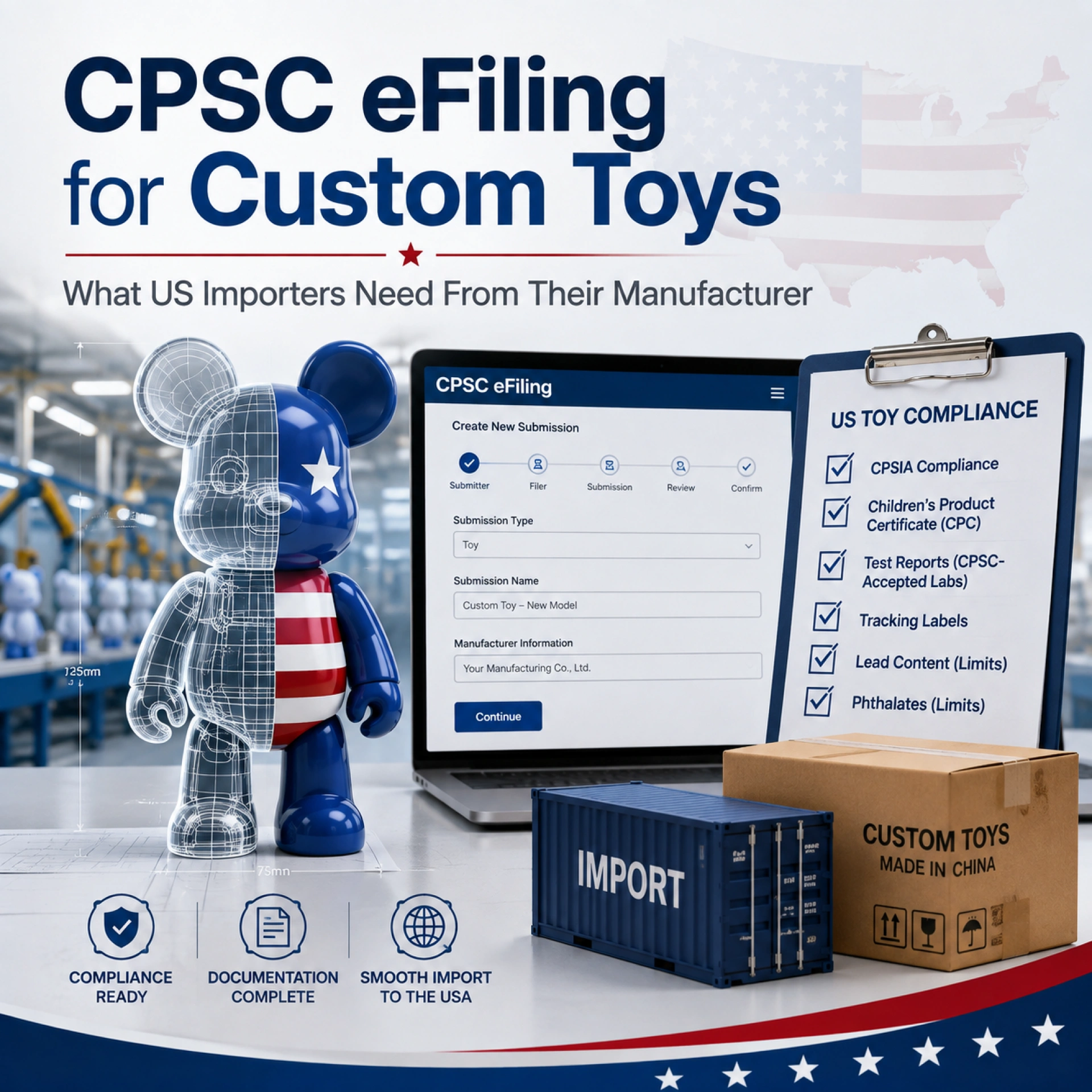
CPSC eFiling for Custom Toys means US importers need accurate certificate data, product identification, testing information, manufacturing details, and shipment coordination before regulated toy products enter U.S. commerce. For custom PVC figures, blind box toys, mascot figures, licensed IP toys, collectible figures, and character electronic toys, importers should collect the right information from their manufacturer before production, testing, packaging, and shipping.
The direct answer is this: for CPSC eFiling for Custom Toys, US importers need product SKU and model identification, intended age and product classification, applicable CPSC rules, third-party testing records, Children’s Product Certificate information, manufacturing batch details, test report holder details, shipment and broker coordination, and a clear review process when design, material, paint, coating, packaging, or supplier changes occur.
CPSC eFiling for Custom Toys should not be treated as a final customs document only. It is a data preparation process. If the manufacturer cannot provide accurate product IDs, manufacture date, manufacture place, test date, testing laboratory information, applicable citation codes, and point of contact information, the importer may face delays, document confusion, or difficulty connecting the shipment with the correct certificate.
For buyers sourcing custom toys from overseas factories, the most important step is to organize product and compliance data before shipment. A finished toy order may include multiple SKUs, secret figures, variant colors, mixed cartons, licensed packaging, and different production batches. If this information is not structured early, eFiling coordination becomes more difficult later.
If your project is still at the sample approval stage, our custom PVC figure sample approval checklist can help you review shape, size, color, painting, assembly, packaging, and safety before mass production begins.
What Is CPSC eFiling for Custom Toys?
CPSC eFiling for Custom Toys is the process of electronically filing required certificate information for imported consumer products that are subject to CPSC certification requirements. For custom toys, this often connects with children’s product testing, applicable CPSC rules, Children’s Product Certificates, product identification, manufacturing records, and U.S. Customs and Border Protection entry coordination.
Buyers can review the official CPSC eFiling page for current program information. CPSC also provides an eFiling FAQ that explains product identifiers, PGA message sets, Product Registry use, and implementation details.
For custom toy importers, the key point is practical: eFiling depends on accurate data. The factory does not usually file the entry for the importer, but the manufacturer must provide reliable production and testing information so the importer, broker, and compliance team can prepare the correct certificate data.
CPSC eFiling for Custom Toys may apply when the imported product is subject to a CPSC rule, ban, standard, or regulation requiring certification. A children’s toy is a common example, but the exact requirements depend on product classification, intended age, materials, functions, and applicable rules.
Why Importers Should Prepare Before Manufacturing
Many importers think about CPSC eFiling only when the goods are ready to ship. That is risky. By that time, product information, batch records, test reports, material details, and packaging versions may already be difficult to correct.
CPSC eFiling for Custom Toys should start during project development because custom toys often change during sampling. A buyer may revise the 3D model, change PVC material, adjust paint color, add accessories, replace packaging, or change the target age. Each change may affect testing, certificate information, or documentation.
For example:
- A blind box figure may start as an adult collectible but later be marketed to children.
- A PVC figure may add a small detachable accessory.
- A painted figure may switch paint supplier after testing.
- A toy may add batteries, sound, or Bluetooth functions.
- A secret figure may use a different mold or material.
- A packaging version may change warning labels or age grading.
These changes matter because certificate information should match the final product placed on the U.S. market. A professional custom PVC toy manufacturer should help buyers keep production records, approved samples, material information, and shipment details organized.
CPSC eFiling for Custom Toys: Buyer Preparation Checklist
Before shipment, US importers should prepare a complete checklist. This table summarizes the main information buyers should request from the manufacturer.
| Procurement Item | What the Importer Needs | Why It Matters for CPSC eFiling for Custom Toys |
|---|---|---|
| Product identification | SKU, model number, UPC, GTIN, or alternate product ID | Connects the shipment, certificate, invoice, packing list, and product registry record |
| Product classification | Toy, children’s product, collectible, electronic toy, or promotional item | Determines whether CPSC rules and certification requirements apply |
| Intended age | Age grading, target user group, and packaging claims | Affects toy safety testing, small parts review, warning labels, and CPC needs |
| Applicable rules | ASTM F963 sections, lead, phthalates, small parts, electrical toy rules, or other CPSC rules | Supports accurate certificate citation codes |
| Third-party testing | CPSC-accepted lab test reports where required | Supports certification for children’s products |
| CPC information | Children’s Product Certificate data and responsible certifier information | Required for covered children’s products |
| Manufacturing batch | Date, place, factory, production lot, and batch information | Supports certificate data, traceability, and shipment matching |
| Test report holder | Who owns or controls test reports and can share them | Prevents last-minute documentation problems |
| Shipment coordination | Invoice, packing list, HTS code, broker communication, PGA message set method | Connects certificate data with customs entry |
| Change review | Process for design, material, supplier, paint, coating, or packaging changes | Helps decide whether testing or certificate data must be reviewed |
This checklist turns CPSC eFiling for Custom Toys into a sourcing workflow instead of a last-minute customs task.
1. Product SKU and Model Identification
Product identification is one of the most important data points in CPSC eFiling for Custom Toys. The importer must be able to connect the physical product, certificate record, purchase order, invoice, packing list, packaging, and shipment entry.
Product identifiers may include:
- SKU
- Model number
- UPC
- GTIN
- Serial number
- Registered number
- Alternate ID
- Product name
- Collection name
- Variant name
For custom PVC figures and blind box toys, product identification can become complicated. A blind box series may include multiple characters, colorways, secret figures, and carton assortments. The importer should decide whether each design has its own SKU or whether the full assortment is handled under one product identity.
Buyers should confirm product identification early:
- Does every figure have a unique SKU?
- Does the blind box assortment have one SKU or multiple SKUs?
- Does the secret figure require separate tracking?
- Does the packaging show the same product ID as the invoice?
- Does the carton mark match the packing list?
- Does the broker have the correct product ID?
CPSC eFiling for Custom Toys becomes easier when product identifiers are consistent across all documents. The manufacturer should not create informal product names that differ from the importer’s SKU system.
2. Intended Age and Product Classification
The next step is product classification. Not every PVC figure is automatically treated the same way. A custom figure may be a children’s toy, an adult collectible, a promotional display item, a licensed IP toy, or an electronic product with toy-like features.
US importers should confirm:
- Is the product intended for children?
- Is it designed or marketed as a plaything?
- What age group is shown on packaging?
- Does it have small parts?
- Does it include detachable accessories?
- Is it sold as a collectible for adults?
- Is it sold in toy channels, gift channels, or collector channels?
- Does the marketing language attract children?
- Does the product include electronics, batteries, sound, or lights?
CPSC toy safety guidance defines a toy as an object designed, manufactured, or marketed as a plaything for children under 14, while CPSC testing and certification requirements for children’s products focus on products designed or intended primarily for children 12 years old or younger. Importers should review the official CPSC toy safety guidance and confirm the product category with qualified compliance professionals.
For custom toys, classification should be decided before testing and packaging approval. If the product is later repositioned, test planning and certificate records may need review.
If your buyer team also sells toys in Europe, our EN71 for Custom Toys guide explains how age grading, toy classification, testing, and documentation are handled in EU-focused projects.
3. Applicable CPSC Rules
CPSC eFiling for Custom Toys requires the importer to know which CPSC rules, bans, standards, or regulations apply to the product. This is not the same as saying “ASTM passed.” The certificate must identify applicable rules and legal citations.
For custom toys, possible CPSC-related areas may include:
- Children’s toys under ASTM F963
- Lead in paint and surface coatings
- Total lead content in accessible substrate materials
- Phthalates, where applicable
- Small parts
- Sharp points
- Sharp edges
- Battery-operated toy requirements
- Electrically operated toy requirements
- Sound-producing toy requirements
- Tracking label requirements
- Product-specific rules, if applicable
The exact list depends on the product. A simple solid PVC figure may have a different testing and certification scope from a figure with batteries, lights, sound, magnets, small accessories, or electronic functions.
Buyers can review CPSC’s rules requiring third-party testing and a Children’s Product Certificate to understand which children’s product safety rules require third-party testing. Importers should work with qualified testing laboratories or compliance partners to identify the correct rules for each custom toy.
4. Third-Party Testing
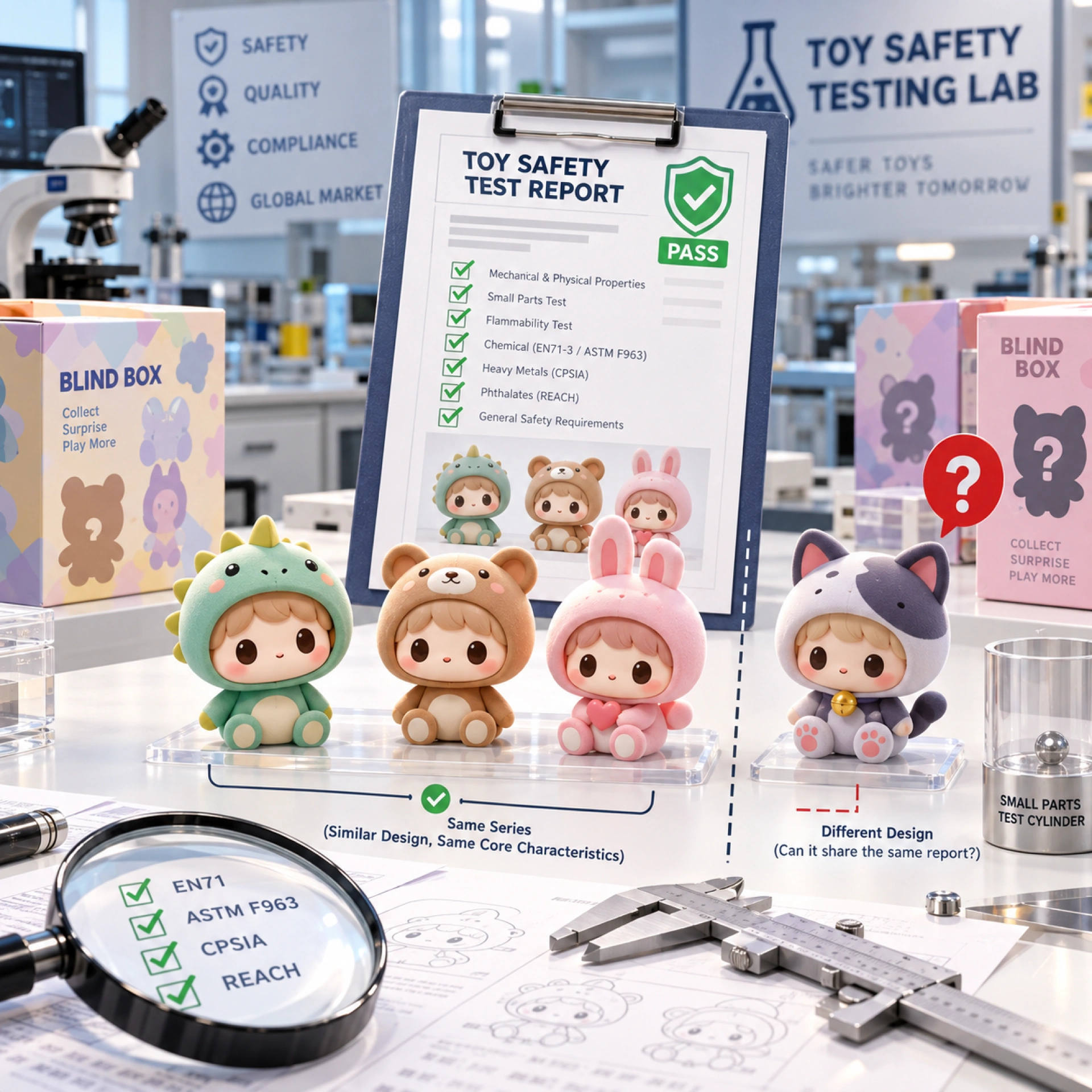
Third-party testing is a key part of CPSC eFiling for Custom Toys when the product is a children’s product subject to CPSC testing and certification requirements. The manufacturer should provide samples that represent the final product, including materials, paint, coatings, accessories, packaging, and functional components where relevant.
Importers should confirm:
- Which laboratory will test the product?
- Is the laboratory CPSC-accepted for the required test scope?
- Which product sample will be tested?
- Does the sample match final production?
- Are all colors, coatings, accessories, and materials included?
- Are multiple SKUs or variants covered?
- Are secret figures covered?
- Are battery or electronic functions included?
- Who receives and stores the test report?
Testing should not be based on an outdated sample if the final product changes later. For example, if the approved test sample uses one paint system but mass production uses another, the importer should review whether the original test still supports the certificate.
For final shipment quality review, our custom PVC figure quality control checklist can help buyers compare final goods with approved and tested samples.
5. Children’s Product Certificate
A Children’s Product Certificate, or CPC, is central for children’s products that require certification. For CPSC eFiling for Custom Toys, importers should not wait until goods arrive at the port to prepare CPC data.
Buyers can review CPSC’s official Children’s Product Certificate page for CPC guidance.
A CPC generally needs information such as:
- Product identification
- Citation to each applicable CPSC rule
- Importer or domestic manufacturer certifying compliance
- Contact information for the person maintaining records
- Date and place of manufacture
- Date and place of testing
- Third-party laboratory information
- Test report basis for certification
For custom toys, the CPC should match the actual imported product. If the shipment contains multiple variants, the importer should confirm whether one certificate covers the group or whether separate certificates are needed for different SKUs, materials, or designs.
A factory can help provide manufacture date, manufacture place, production batch, sample details, material information, and product photos. However, the importer should confirm who issues the CPC and who maintains the final certificate records.
6. Manufacturing Batch Information
Manufacturing batch information is important for traceability, CPSC eFiling for Custom Toys, quality control, and recall management. For custom PVC figures and blind box toys, the manufacturer should record production batches clearly.
Importers should request:
- Factory name
- Factory address
- Production date or date range
- Production batch number
- Product SKU or model number
- Material batch information
- Paint or coating batch information
- Packaging version
- Quantity produced
- Carton count
- Shipment batch
- Approved sample reference
- QC inspection record
This information helps connect the certificate data with the physical goods. If a quality issue appears later, batch data helps identify which products are affected.
For custom blind box projects, batch control is especially important because one shipment may include multiple characters, secret figures, accessories, and carton assortments. If the manufacturer cannot identify which batch contains which SKU, shipment and eFiling coordination becomes more difficult.
7. Test Report Holder
Before production begins, importers should confirm who holds the test reports. This is often overlooked. A factory may arrange testing, a trading company may hold the report, the importer may pay for testing, or the brand owner may store the report internally.
For CPSC eFiling for Custom Toys, importers should know:
- Who ordered the test?
- Who is named on the report?
- Who can share the report with the importer?
- Does the report identify the correct product?
- Does the report include the correct SKU or model?
- Does the report match the final material and design?
- Does the report cover all variants?
- Is the lab CPSC-accepted for the relevant rules?
- Is the report available before shipment?
If the importer cannot access the report, certificate preparation becomes difficult. The buyer should define report ownership and access before sending samples to the laboratory.
For licensed IP toys, report access should also be handled carefully because product photos, character details, and packaging artwork may be confidential. A clear NDA and document control process may be needed.
8. Shipment and eFiling Coordination
CPSC eFiling for Custom Toys requires coordination between the importer, manufacturer, freight forwarder, customs broker, and compliance team. The manufacturer may not directly submit eFiling data, but factory information is needed for the importer and broker to file correctly.
Importers should coordinate:
- HTS code review with broker
- Product ID used for eFiling
- Certificate data
- Manufacture date
- Manufacture place
- Product test date
- Testing laboratory
- Point of contact
- Citation codes
- Packing list
- Commercial invoice
- Carton marks
- Shipment date
- Entry filing timing
- Full PGA Message Set or Reference PGA Message Set approach
CPSC’s eFiling FAQ explains that a Full PGA Message Set includes the required product certificate data elements, while a Reference PGA Message Set references certificate data already entered in the CPSC Product Registry. Buyers should decide which workflow fits their business.
For repeat imports of the same custom toy, using a product registry workflow may be more efficient. For one-time projects or frequently changing custom products, importers should confirm the best approach with their customs broker and compliance team.
9. When Design or Material Changes May Require Review
Custom toys often change during development. For CPSC eFiling for Custom Toys, buyers should build a change review process. Any change that affects product safety, testing scope, certificate information, or product identity should be reviewed before shipment.
Changes that may require review include:
- New PVC material
- New ABS part
- New paint supplier
- New coating
- New adhesive
- New accessory
- New magnet
- New battery
- New electronic component
- New small detachable part
- New packaging warning
- New age grading
- New factory
- New production location
- New SKU or model number
- New colorway
- New secret figure
- New packaging structure
Not every change automatically means full retesting, but every change should be reviewed. The importer should decide with the lab or compliance partner whether the existing test report and certificate remain valid.
For example, changing only outer box artwork may not affect toy safety testing, but changing warning labels can affect packaging compliance. Changing a paint supplier may affect chemical testing. Adding a small accessory may affect small parts review. Adding batteries or sound may affect additional rules.
If your project involves special finishes such as glow, flocking, metallic paint, or secret figures, our Blind Box Special Editions guide explains how special production choices can affect cost, packaging, QC, and testing planning.
10. Packaging and Label Review
Packaging is part of the compliance and eFiling preparation process. A custom toy package may include age grading, warning labels, tracking labels, SKU, barcode, importer information, brand legal text, and instructions.
Importers should review:
- Product name
- SKU and model number
- Age grading
- Small parts warning, if applicable
- Tracking label information
- Manufacturer or distributor markings
- Barcode
- Batch or lot number
- Country of origin
- Instruction sheet
- Battery information, if applicable
- Packaging version
- Inner bag or blind box format
For blind box toys, packaging may include outer boxes, foil bags, collection cards, inner trays, and master cartons. The buyer should make sure packaging records match the product certificate and shipment documents.
Our guide on working with a custom toy packaging manufacturer explains how toy packaging should support product protection, retail presentation, labeling, and carton packing.
Practical Data Sheet for Manufacturers
US importers can send the following data sheet to the manufacturer before shipment.
| Data Field | Manufacturer Should Provide |
| Product name | Full product name used on invoice and packaging |
| SKU / model number | Product ID used for eFiling and documents |
| Product description | Custom PVC figure, blind box toy, electronic toy, keychain, or other category |
| Intended age | Packaging age grade and target user |
| Materials | PVC, ABS, paint, coating, ink, adhesive, packaging materials |
| Factory name | Actual manufacturing location |
| Factory address | Manufacture place for certificate data |
| Manufacture date | Date or date range of production |
| Batch number | Production lot or batch code |
| Test sample reference | Which sample was tested |
| Test date | Date of testing from report |
| Testing laboratory | Laboratory name and address |
| Applicable rules | Rules confirmed by importer, lab, and compliance team |
| Packaging version | Artwork version, warning labels, carton mark version |
| Shipment details | Quantity, carton count, invoice number, packing list |
This data sheet helps make CPSC eFiling for Custom Toys more organized and reduces last-minute questions before entry filing.
Common Mistakes Importers Should Avoid
1. Waiting Until Shipment to Ask for Data
The manufacturer may need time to collect production records, batch details, material information, and test sample references. Ask early.
2. Using Inconsistent SKUs
The SKU on the certificate, packaging, invoice, packing list, and product registry should be consistent. Inconsistent product IDs can create confusion.
3. Testing a Sample That Does Not Match Final Goods
If final production changes material, paint, accessory, or packaging after testing, the importer should review whether the report still supports the product.
4. Not Defining the Intended Age
Age grading affects testing, warnings, and classification. It should be confirmed before packaging artwork and testing.
5. Assuming the Manufacturer Files eFiling
The importer and broker usually coordinate entry filing. The manufacturer provides necessary production and testing information.
6. Ignoring Secret Figures and Variants
Blind box variants and secret figures may have different molds, colors, materials, or accessories. Confirm whether they are covered by testing and certification.
7. Not Keeping Change Records
Custom toys often change during development. Keep records of approved changes and review whether they affect testing or certificate data.
How Jiahong Creative Supports CPSC eFiling Preparation
Jiahong Creative supports custom toy projects from artwork review, 3D modeling, prototype sampling, mold making, PVC injection molding, painting, printing, assembly, packaging, quality inspection, and shipment preparation.
For CPSC eFiling for Custom Toys, we can help US importers organize manufacturer-side information such as product identification, manufacturing batch data, approved sample records, material information, packaging version, factory details, QC records, and shipment preparation. We can also help prepare samples for third-party testing and coordinate production information needed by importers, brokers, and compliance teams.
We support custom PVC figures, blind box toys, mascot figures, licensed IP toys, promotional figures, character keychains, and character electronic products. If you are preparing a custom toy project for the U.S. market, please share your artwork, product category, intended age, target quantity, packaging plan, testing requirements, and shipment timeline.
You can contact us through our custom toy project inquiry page.
Final Thoughts
CPSC eFiling for Custom Toys is not only a customs filing topic. It is a procurement data management process. US importers need accurate product IDs, intended age, product classification, applicable CPSC rules, third-party testing records, CPC information, manufacturing batch details, test report access, shipment coordination, and change review before products enter U.S. commerce.
For custom PVC figures, blind box toys, licensed IP products, mascot figures, and character electronic toys, the best preparation starts before sampling and mass production. The importer should define product identity, confirm testing scope, control material changes, organize certificates, and coordinate with the customs broker before shipment.
When the importer and manufacturer work together early, CPSC eFiling for Custom Toys becomes easier to manage. Accurate records reduce confusion, support compliance, and help keep custom toy shipments aligned with U.S. import requirements.
FAQ
1.What is CPSC eFiling for Custom Toys?
CPSC eFiling for Custom Toys is the electronic filing of required certificate information for imported custom toys that are subject to CPSC certification requirements. It helps CPSC review certificate data before products enter U.S. commerce.
2.Who is responsible for CPSC eFiling?
The U.S. importer is generally responsible for eFiling certificate data through the customs entry process. The manufacturer should provide accurate production, testing, product, and shipment information to support the importer.
3.What product identification is needed?
Importers should prepare a consistent product ID such as SKU, model number, UPC, GTIN, serial number, registered number, or alternate ID. The same ID should appear consistently across certificate data, packaging, invoices, and packing lists.
4.Why is intended age important?
Intended age affects whether the product is treated as a children’s product, whether third-party testing is required, which warnings apply, and whether a Children’s Product Certificate is needed.
5.What rules may apply to custom toys?
Applicable rules may include ASTM F963, lead in paint, total lead content, phthalates, small parts, sharp points, sharp edges, battery-operated toy rules, electrically operated toy rules, sound-producing toy requirements, and tracking label requirements.
6.What is a Children’s Product Certificate?
A Children’s Product Certificate is a certificate showing that a children’s product complies with applicable CPSC rules based on required testing. It includes product identification, applicable rules, manufacture details, test date, lab information, and certifier contact information.
7.Does every custom PVC figure need CPSC eFiling?
Not every custom PVC figure is automatically covered. CPSC eFiling may apply if the imported product is subject to CPSC certification requirements. Importers should confirm product classification, intended age, and applicable rules with compliance professionals.