

Introduction
Choosing the right custom toy packaging manufacturer is not only about making a box for a product. For toy brands, collectible brands, IP owners, promotional gift companies, and retail buyers, packaging is part of the complete product experience. It protects the toy, explains the brand, improves shelf presentation, supports shipping safety, and helps customers understand the value of what they are buying.
Many buyers focus heavily on the toy itself during the early development stage. They spend time on character design, material selection, 3D modeling, tooling cost, painting details, and mass production price. These are all important. However, packaging should not be treated as a last-minute step. If packaging is considered too late, the final product may look inconsistent, cost more than expected, or face problems during shipping and retail display.
A professional custom toy packaging manufacturer helps brands plan packaging together with the toy product. This is especially important for PVC figures, blind box toys, mascot figures, licensed character products, promotional toys, and small IP-related homeware products. Good packaging should match the product size, product position, sales channel, target market, and brand style.
If you are still planning the toy itself, you can first review how a custom PVC toy manufacturer supports design, mold making, painting, assembly, and mass production. Once the product direction is clear, packaging should be developed at the same time instead of waiting until the final production stage.
Why Toy Packaging Is So Important
Toy packaging has several important functions. The first function is protection. A custom toy may go through long-distance transportation, carton stacking, warehouse handling, retail display, and final delivery to the customer. If the packaging is too weak, the product may be scratched, deformed, broken, or stained before it reaches the buyer.
The second function is presentation. For collectible toys and character products, packaging is often the first thing the customer sees. A strong box design can make the product feel more premium. A weak or generic package can make even a well-made toy look less valuable.
The third function is communication. Packaging tells customers what the product is, what brand it belongs to, what series it belongs to, and why it is worth buying. For blind box products, packaging also creates mystery and surprise. For licensed IP products, it helps present the character world in a more complete way.
The fourth function is consistency. A toy and its packaging should feel like one complete product. If the figure is cute, colorful, and playful, but the box is plain and disconnected, the final product experience becomes weaker. If the toy is positioned as a premium collectible, but the packaging looks like a low-cost promotional box, customers may not trust the value.
This is why working with a custom toy packaging manufacturer is valuable. The manufacturer should not only ask for box dimensions. A good supplier should understand the product, sales channel, target users, and brand positioning before recommending the packaging structure.
Packaging Should Match the Product
One of the most important points in toy packaging development is keeping the packaging consistent with the product. The package should not feel separate from the toy. It should support the same visual language, same brand message, and same customer expectation.
For example, if you are developing a cute mascot figure for a food brand, the packaging should probably use friendly colors, simple graphics, and a playful layout. If you are producing an anime-style collectible figure, the box may need stronger character artwork, a display window, series information, and a more collectible feeling. If you are producing blind box toys, the packaging must support mystery, series identity, and repeat purchase behavior.
This is also why product design and packaging design should communicate closely. The figure size affects box size. The figure pose affects inner tray structure. The paint finish affects protection requirements. The accessories affect insert design. The sales channel affects whether the packaging should be a blind box, window box, color box, blister pack, display box, or gift box.
If the toy and packaging are handled by completely separate suppliers, communication can become slower. The packaging supplier may not fully understand the figure structure, fragile points, paint surface, or assembly method. The toy factory may not fully control how the package protects the product. This can create repeated revisions, wrong dimensions, poor fit, and higher hidden costs.
When the same factory or the same project team can coordinate both product manufacturing and packaging development, the process is usually smoother. The product sample, inner tray, color box, carton, barcode label, and final packing method can be checked together. For brands, this reduces communication gaps and makes the finished product more consistent.
Common Types of Custom Toy Packaging
A custom toy packaging manufacturer may support different packaging formats depending on the product type and sales channel. The best choice depends on your toy size, budget, retail environment, and brand positioning.
1. Blind Box Packaging
Blind box packaging is widely used for collectible toy series. It creates surprise and encourages customers to collect multiple designs. For this type of packaging, the box artwork, series information, hidden figure ratio, inner bag, product card, and carton packing logic all need careful planning.
If your project is a blind box series, you can also read our guide on the blind box figure manufacturing process to understand how figure production, packaging, QC, and mass production should be coordinated.
2. Window Box Packaging
Window box packaging allows customers to see the product before buying. This is useful for retail shelves, gift products, character figures, and collectible products where visual appeal is important. The transparent window must be designed carefully so it shows the best angle of the toy while still protecting the product.
3. Color Box Packaging
Color boxes are common for PVC figures, promotional toys, homeware gifts, small electronic toys, and character products. They are flexible, cost-effective, and suitable for branding. A color box can include product images, instructions, warnings, barcode, QR code, logo, and series information.
4. Blister Packaging
Blister packaging is often used for smaller toys, accessories, and retail hanging products. It allows the product to be displayed clearly, but it may not suit every premium collectible because it can feel more mass-market.
5. Gift Box Packaging
Gift boxes are suitable for premium toys, limited-edition collectibles, festival products, licensed IP merchandise, and brand collaboration products. They usually require stronger paperboard, better printing, inserts, and a more refined unboxing experience.
6. Inner Tray and Insert Packaging
The inner tray is not always visible, but it is very important. It keeps the toy stable inside the box. For painted PVC figures, a good inner tray helps prevent rubbing, paint scratches, and movement during transportation.
What Brands Should Prepare Before Contacting a Custom Toy Packaging Manufacturer
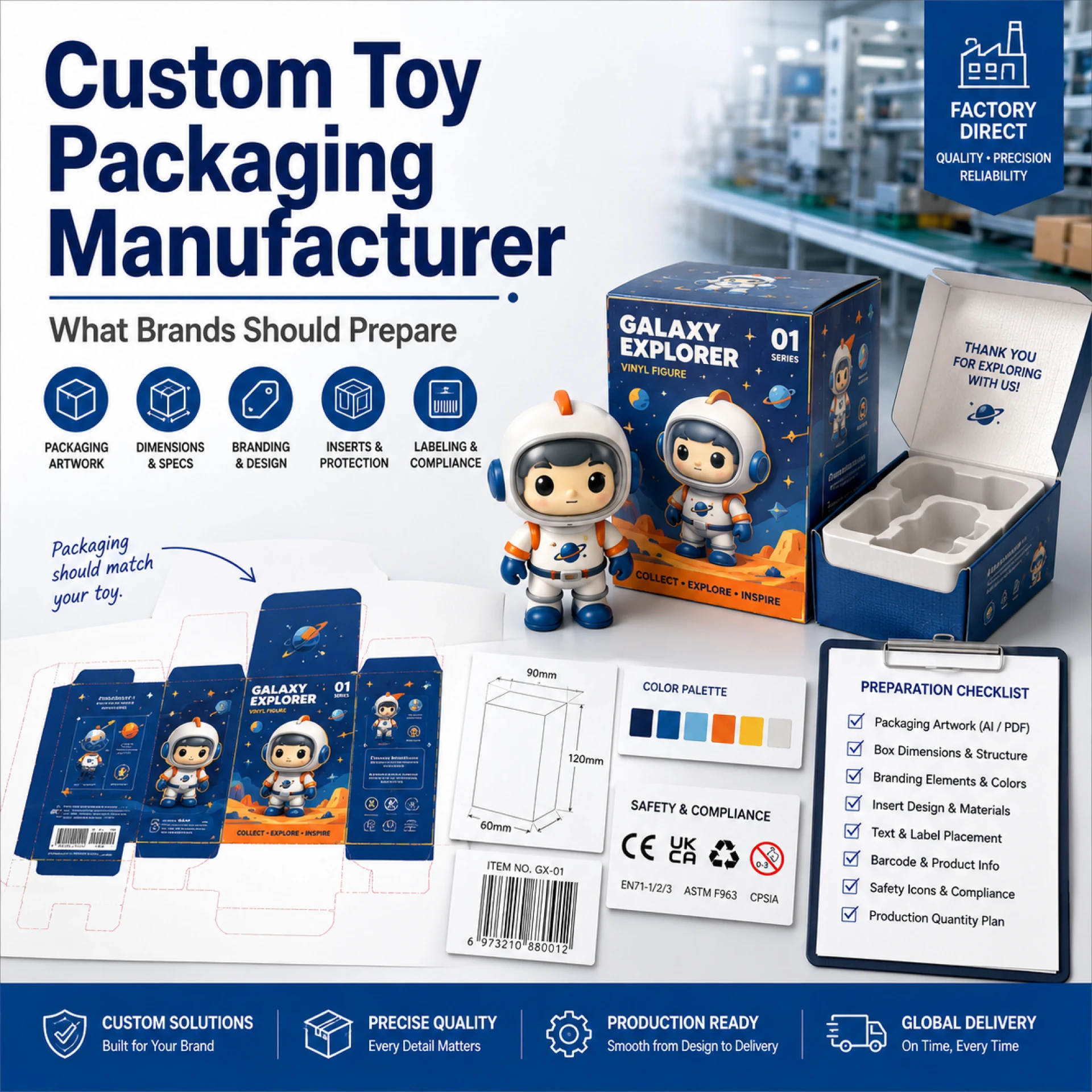
To get accurate suggestions and quotations, buyers should prepare clear project information before contacting a custom toy packaging manufacturer. The more complete the information, the faster the supplier can evaluate structure, cost, and production feasibility.
1. Product Size and Shape
The packaging manufacturer needs to know the exact toy size, including height, width, depth, pose, accessories, base, and any fragile parts. A standing figure, sitting figure, figure with wings, and figure with small accessories may need very different inner packaging.
2. Product Material and Surface Finish
Different materials and finishes require different protection. A glossy painted PVC figure may need stronger anti-scratch protection. A soft vinyl figure may need space to avoid deformation. A product with flocking, metallic paint, or special coating may require more careful inner support.
For figure decoration planning, you can also review our article on PVC figure painting methods to understand how painting and surface finishing affect final product quality.
3. Sales Channel
Packaging for online sales, retail stores, supermarkets, toy shops, vending machines, exhibitions, and brand campaigns may be different. Online sales require more shipping protection. Retail stores need stronger shelf appeal. Blind box channels need mystery and series recognition. Promotional campaigns may need cost efficiency and fast packing.
4. Brand Artwork and Visual Direction
Brands should prepare logos, character artwork, brand colors, typography preferences, product photos or renders, and any required legal text. If the packaging should match a licensed IP style guide, that guide should be shared early.
5. Packaging Type
Before production, buyers should confirm whether they want a blind box, color box, window box, blister pack, gift box, display box, or simple export packaging. If you are not sure, a custom toy packaging manufacturer can suggest options based on your product and budget.
6. Quantity and Budget Range
Packaging cost depends heavily on quantity. Low quantities usually have higher unit costs because printing setup, die-cutting, material preparation, and labor are spread across fewer units. If buyers provide a realistic quantity range, the supplier can recommend a packaging solution that fits the project.
If your project also needs early cost planning for the toy itself, our custom PVC figure quotation guide explains what information usually affects quotation accuracy.
7. Target Market Requirements
Different markets may require different warning labels, language versions, barcode systems, recycling marks, importer information, and safety notices. If the product is for the U.S., EU, UK, Japan, or other markets, this should be confirmed before artwork approval.
For transportation-related packaging reference, buyers can also review ISTA packaging testing standards, which are commonly used to evaluate how packaged products perform during shipping and handling.
8. Shipping Method
Air shipping, sea shipping, courier delivery, and retail distribution may require different carton strength and packing methods. A product sold online through direct delivery may need stronger drop protection than a product shipped in bulk to a distributor.
Why One Factory Handling Product and Packaging Can Be Easier
For custom toy projects, one common problem is that the product factory and packaging supplier work separately. This can be manageable for simple projects, but it often becomes inefficient for complex custom toys.
When the same factory or same coordinated team handles both the toy and packaging, several things become easier.
First, the package size can be developed based on the real product sample, not only a rough drawing. This helps avoid a box that is too loose or too tight.
Second, the inner tray can be adjusted according to the actual figure shape. If the figure has a large head, thin arms, a tail, wings, accessories, or a base, the packaging team can create better support.
Third, the artwork can match the product more accurately. Product color, character expression, logo placement, series name, and packaging layout can be reviewed together.
Fourth, QC becomes more complete. The factory can check not only the toy quality but also packaging fit, box printing, label position, carton packing, and final product presentation.
Fifth, communication is faster. Buyers do not need to send product samples back and forth between different suppliers. The development team can review product and packaging details internally.
At Jiahong Creative, packaging planning can be discussed together with custom toy development, figure production, painting, assembly, and final packing. This helps brands create a more complete product instead of treating packaging as a separate afterthought. You can also review our custom manufacturing services to understand how product development, mold making, production, assembly, and packaging are connected.
Key Details a Custom Toy Packaging Manufacturer Should Check
A professional custom toy packaging manufacturer should check more than box artwork. Packaging development should include both visual and technical details.
Important checking points include:
- Box structure and opening method
- Paper material and thickness
- Printing method and surface finish
- Color consistency with product and brand
- Inner tray fit
- Product movement inside the box
- Protection for painted surfaces
- Logo and barcode placement
- Warning labels and market information
- Carton size and packing quantity
- Drop, compression, or transport protection needs
- Retail shelf display effect
- Final unboxing experience
For collectible toys, the unboxing experience is especially important. Customers often keep the box, take photos, share the product online, or display the packaging together with the toy. This makes packaging part of the product value.
How Packaging Affects Cost
Packaging can affect total project cost more than many buyers expect. A simple color box is usually more cost-effective than a rigid gift box. A window box may require additional plastic window material and more complex assembly. A premium box with special coating, foil stamping, embossing, magnetic closure, or custom inserts will increase cost.
However, the cheapest packaging is not always the best choice. If the product is premium, weak packaging can lower perceived value. If the product is fragile, weak packaging can increase damage risk. If the product is for retail, poor packaging may reduce shelf appeal.
A good custom toy packaging manufacturer should help buyers balance cost, protection, and brand presentation. The goal is not always to choose the most expensive box. The goal is to choose packaging that fits the product positioning and sales channel.
For buyers trying to control total project cost, our guide on how to reduce custom PVC figure cost also explains how packaging decisions can affect the overall budget.
Final Thoughts
A custom toy packaging manufacturer plays an important role in turning a toy idea into a complete retail-ready product. Packaging protects the toy, strengthens the brand, improves shelf appeal, supports logistics, and creates a better customer experience.
For custom PVC figures, blind box toys, mascot figures, promotional toys, and licensed character products, packaging should be planned early. It should match the product design, material, surface finish, sales channel, and target market. Most importantly, packaging and product should feel consistent. When customers see the box and open the product, the experience should feel like one complete brand story.
Working with a factory that can coordinate both toy manufacturing and packaging development can make the process easier. It reduces communication gaps, improves package fit, supports better QC, and helps brands control both quality and cost.
If you are preparing a custom toy project, the best next step is to collect your product artwork, target size, estimated quantity, packaging style, sales channel, and target market requirements. With this information, a custom toy packaging manufacturer can help you choose a practical packaging solution that protects the product and supports your brand value.
Need Help with Custom Toy Packaging?
If you are developing PVC figures, blind box toys, mascot figures, licensed character products, or promotional toys, Jiahong Creative can help review your product and packaging needs together.
You can send your artwork, product size, target quantity, packaging ideas, and sales market, and our team can help evaluate suitable packaging options for your custom toy project.
FAQ
1. What does a custom toy packaging manufacturer do?
A custom toy packaging manufacturer helps brands develop packaging for custom toys, PVC figures, blind box toys, mascot figures, promotional toys, and licensed character products. The work may include box structure, artwork layout, inner tray planning, printing, packing method, carton planning, and quality checking.
2. Why is toy packaging important?
Toy packaging is important because it protects the product, improves brand presentation, supports retail display, and creates a better customer experience. For collectible toys and blind box products, packaging also helps build excitement and perceived value.
3. Should toy packaging be designed before or after the product sample?
Toy packaging should be planned during product development, not after everything is finished. The final box size and inner tray should usually be confirmed based on the product sample, but the packaging direction, artwork style, and sales channel requirements should be discussed early.
4. Why should packaging match the toy product?
Packaging should match the toy product because customers see the package as part of the full product experience. If the toy and box use different styles, colors, or quality levels, the product may feel inconsistent. A good custom toy packaging manufacturer helps keep the packaging and product visually aligned.
5. Is it better to use the same factory for toy production and packaging?
For many custom toy projects, using the same factory or one coordinated team for both product and packaging can be easier. It helps improve communication, package fit, inner tray design, QC, and final product consistency.
6. What information should I send to a custom toy packaging manufacturer?
You should prepare product size, artwork, brand logo, target quantity, packaging type, sales channel, target market, shipping method, and any required warning labels or barcode information. If you already have a product sample or 3D file, that will also help.
7. What packaging is best for blind box toys?
Blind box toys usually need a printed blind box, inner bag, product card, and proper carton packing. The box should support mystery, series identity, and product protection. A custom toy packaging manufacturer can help plan the structure based on the figure size and series design.
8. Does custom toy packaging affect the total product cost?
Yes. Packaging type, material, printing method, box size, insert structure, quantity, and special finishes all affect cost. A professional custom toy packaging manufacturer should help buyers choose packaging that balances protection, branding, and budget.