

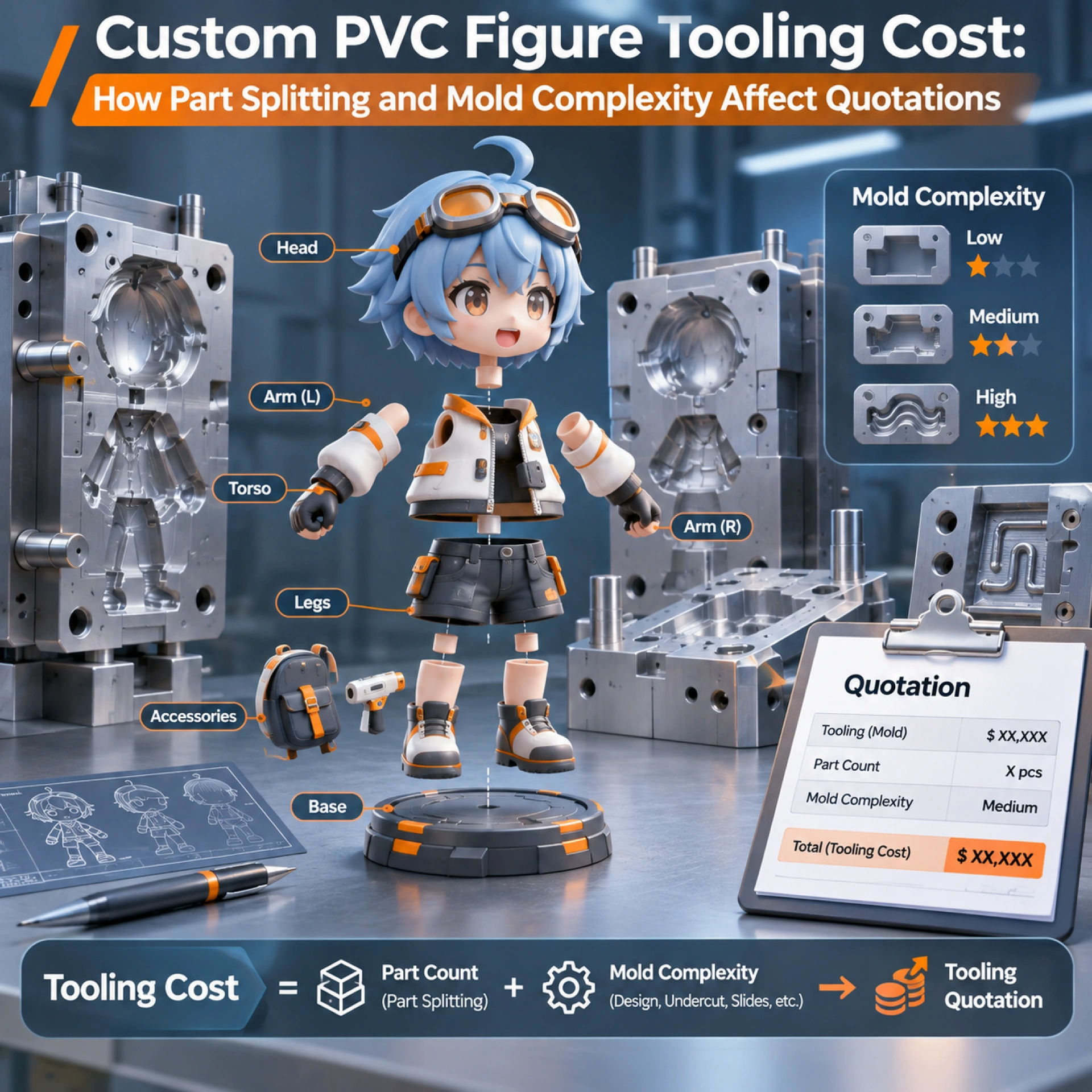
Custom PVC Figure Tooling Cost is mainly determined by the number of molded components, part geometry, undercuts, mold structure, cavity configuration, machining requirements and expected production volume. Two PVC figures with the same height can have very different tooling quotations because their internal structures and manufacturing requirements may be completely different.
For example, a 12 cm PVC figure with a simple body, two arms and a basic base may require relatively straightforward tooling. Another 12 cm figure with separate hair, clothing layers, weapons, accessories, complex hand positions and multiple assembly connections may require more complicated mold structures and additional tooling investment.
The number of character designs alone does not determine mold cost. A more important question is how many individual components need to be manufactured and how difficult each component is to produce.
When evaluating Custom PVC Figure Tooling Cost, buyers should pay particular attention to:
- Number of separate molded parts
- Part splitting and assembly structure
- Undercuts and side-action mechanisms
- Mold parting line design
- Mold cavities and family mold possibilities
- Product dimensions and geometry
- Mold material and machining requirements
- Surface texture and dimensional accuracy
- Mold trial and correction requirements
- Expected production quantity and mold life
Understanding these factors before requesting a quotation helps buyers avoid unnecessary tooling expenses and make better design decisions.
This guide explains how manufacturers calculate Custom PVC Figure Tooling Cost, why complex character structures increase mold investment, and how brands can optimize their designs without sacrificing the appearance of the final collectible figure.
1. What Is Included in Custom PVC Figure Tooling Cost?
Custom PVC Figure Tooling Cost refers to the investment required to design, manufacture, test and prepare production molds for custom PVC figure components.
It is important to distinguish tooling cost from 3D design fees, prototype costs and mass-production unit prices.
A typical tooling quotation may include several activities.
| Tooling Cost Item | What It Covers | Main Cost Factors |
|---|---|---|
| Mold Design | Mold structure and engineering drawings | Part geometry and complexity |
| Mold Base | Main mold supporting structure | Mold dimensions and configuration |
| Steel Preparation | Cutting and preparation of mold materials | Material specification and size |
| CNC Machining | Machining mold cavities and cores | Geometry and machining time |
| EDM Machining | Creating detailed or difficult features | Detail complexity and electrode quantity |
| Wire Cutting | Precision machining of selected mold components | Shape and dimensional requirements |
| Mold Polishing | Surface finishing and texture preparation | Required surface appearance |
| Slides and Lifters | Mechanisms for releasing undercuts | Number and complexity of mechanisms |
| Mold Assembly | Fitting and adjusting mold components | Number of components and precision |
| Mold Trial | Initial molding and mold adjustment | Trial results and correction requirements |
Not every PVC figure mold requires every operation listed above.
The actual tooling process depends on the selected manufacturing method. PVC casting molds and injection molds, for example, have different tooling structures and production considerations.
Therefore, a professional Custom PVC Figure Tooling Cost quotation should identify the molding process and explain which tooling operations are included.
For a broader understanding of product development expenses, see our Custom Collectible Figure Cost Breakdown guide.
2. How Part Splitting Affects Custom PVC Figure Tooling Cost
Part splitting is one of the most important factors affecting Custom PVC Figure Tooling Cost.
A custom character figure is rarely manufactured as one complete piece. Depending on its design and production process, the figure may be separated into multiple components.
Common components include:
- Head
- Body
- Left arm
- Right arm
- Left leg
- Right leg
- Hair
- Clothing accessories
- Weapons
- Decorative accessories
- Display base
Each component must be evaluated from a tooling and manufacturing perspective.
Example: Simple Figure vs Complex Figure
Consider two fictional PVC figures, both measuring 12 cm in height.
| Design Feature | Figure A | Figure B |
|---|---|---|
| Height | 12 cm | 12 cm |
| Head | Integrated with body | Separate component |
| Arms | Simple structure | Separate articulated-looking positions |
| Hair | Simple shape | Multiple independent sections |
| Accessories | None | Three separate accessories |
| Base | Simple flat base | Customized decorative base |
| Assembly | Limited | Multiple connection points |
| Tooling Complexity | Relatively simple | More complicated |
Although both figures have the same overall dimensions, Figure B may require more mold development and assembly work.
Does Every Separate Part Need Its Own Mold?
Not necessarily.
This is an important point buyers should understand when reviewing Custom PVC Figure Tooling Cost.
A separate molded component does not always mean a completely separate mold set.
Several compatible small components may sometimes be arranged within one family mold, allowing different parts to be produced using the same mold structure.
However, family mold feasibility depends on:
- Material compatibility
- Part dimensions
- Filling requirements
- Shrinkage behavior
- Production cycle
- Cavity arrangement
- Color requirements
- Production quantity
For example, several small decorative accessories made from the same material may be suitable for a shared tooling arrangement.
However, a large body component and several tiny accessories may have different filling and production requirements, making a shared mold less practical.
The engineering team must evaluate the actual 3D structure before confirming whether parts can share tooling.
Why Too Many Split Parts Increase Costs
More components can increase several manufacturing expenses:
- More mold cavities or separate tooling requirements.
- Additional CNC and EDM machining.
- More mold assembly and fitting work.
- More individual molding operations.
- Additional trimming and finishing.
- More assembly labor.
- More opportunities for fitting defects.
For this reason, the objective should not be to create the maximum number of individual parts.
The better approach is to split the figure only where manufacturing, painting, structural design or appearance requires it.
Our How to Turn 2D Character Art into a Custom Toy Figure guide explains why production structure should be evaluated during the conversion from character artwork to a manufacturable 3D figure.
3. Undercuts: One of the Biggest Factors Increasing Mold Complexity
Undercuts are among the most important factors affecting Custom PVC Figure Tooling Cost.
An undercut is a feature that prevents a molded component from being released directly along the mold opening direction.
In simpler tooling structures, the mold can generally open in a straightforward direction.
However, complicated character shapes may prevent the component from being removed easily.
Common examples include:
- Hair extending behind the head
- Arms positioned across the body
- Deep clothing folds
- Bent fingers
- Hooks and holes
- Complex accessory connections
- Recessed decorative structures
- Protruding character details
Why Do Undercuts Increase Tooling Cost?
When an undercut cannot be resolved through part redesign or a suitable parting-line arrangement, the mold may require additional mechanisms.
These may include:
- Side-action slides
- Lifter mechanisms
- Movable cores
- Additional mold inserts
- Special release structures
Each mechanism introduces additional engineering and machining requirements.
It may also increase mold assembly, maintenance and adjustment work.
According to Protolabs’ injection molding design guide, undercuts can add mold cost and complexity, while redesigning the part or adjusting the parting line may eliminate some unnecessary mechanisms.
Example: Character Hair Structure
Imagine a character with long hair flowing behind its shoulders.
If the hair is designed as one complicated integrated structure, the mold may require additional release mechanisms.
An alternative is to separate the hair into front and rear components.
This may simplify individual mold structures, although it introduces additional assembly and fitting requirements.
The manufacturer must compare both solutions.
A more complicated character design does not always require more expensive tooling if the part structure is optimized correctly.
This is why engineering review is important before confirming Custom PVC Figure Tooling Cost.
4. Parting Line Design: Where Should the Mold Split?
Parting line design is another important consideration.
A mold parting line is the interface where different sections of a mold meet.
It is not the same thing as splitting a character into separate components.
Even a one-piece molded component can have a parting line.
For collectible figures, parting line placement affects both tooling feasibility and the final appearance.
Visible vs Hidden Parting Lines
A poorly positioned parting line may create visible marks on:
- Character faces
- Hair
- Clothing
- Arms
- Legs
- Accessories
These areas may require additional finishing or more complicated tooling solutions.
A better parting line may follow natural design boundaries such as:
- Clothing edges
- Hair contours
- Character body outlines
- Accessory boundaries
- Rear surfaces
- Hidden structural edges
This can help reduce visible mold marks without adding unnecessary tooling complexity.
Can Parting Line Design Reduce Mold Cost?
Yes, in some cases.
If a parting line can be adjusted to release a feature directly, the manufacturer may avoid certain side-action mechanisms.
However, the proposed position must also consider:
- Surface appearance
- Draft requirements
- Mold strength
- Part removal
- Flash control
- Assembly alignment
The cheapest mold structure is not necessarily the best if it creates unacceptable visible seams on the finished figure.
For premium collectibles, appearance requirements should be agreed before tooling.
5. Mold Cavities: Single-Cavity vs Multi-Cavity Tooling
Mold cavity configuration also affects Custom PVC Figure Tooling Cost.
A cavity is the space that forms the molded component.
Depending on the design and manufacturing method, a mold may contain one cavity or several cavities.
Single-Cavity Mold
A single-cavity mold produces one component per molding cycle.
Potential advantages include:
- Simpler mold structure
- Easier component-specific adjustments
- Less complicated cavity arrangement
- Greater flexibility for certain customized parts
However, output per cycle may be lower.
Multi-Cavity Mold
A multi-cavity mold produces multiple components in one cycle.
Potential advantages include:
- Higher production output
- Better production efficiency for suitable parts
- Potentially lower processing cost per component
However, the initial mold investment may be higher.
The manufacturer must consider:
- Part dimensions
- Filling balance
- Cooling or solidification behavior
- Mold layout
- Ejection
- Production quantity
- Component consistency
Can Different Character Parts Share One Family Mold?
Sometimes.
For example, several small accessories may be suitable for one family mold.
But different parts must have compatible molding conditions and production requirements.
A family mold should not be selected simply because it appears cheaper on a quotation.
If different components have significantly different filling or shrinkage behavior, the mold may become difficult to balance and maintain.
For a multi-character project, buyers should also distinguish shared components from unique components.
Our Blind Box Manufacturing Cost guide explains why six character designs do not necessarily require six completely separate sets of tooling, especially when bodies, bases or accessories can be shared.
6. Figure Size and Geometry: Why Dimensions Are Not Everything
Many buyers assume that a larger PVC figure must always have a much higher tooling cost.
Size certainly matters, but it is not the only factor.
The mold quotation also depends on the complexity of the geometry.
For example:
A 15 cm figure with a simple standing pose may have relatively straightforward mold requirements.
A 10 cm figure with complicated hair, small accessories, multiple undercuts and tight assembly connections may require more engineering and machining.
Main Geometry Factors
| Design Feature | Potential Tooling Impact |
|---|---|
| Overall Figure Size | Larger mold dimensions and material requirements |
| Deep Recesses | More difficult machining and release |
| Thin Structures | More demanding filling and dimensional control |
| Complex Hair | More complicated parting and undercuts |
| Small Accessories | Additional cavities or precision inserts |
| Hollow Structures | More complicated core and mold arrangements |
| Deep Texture | More demanding machining and release |
| Tight Fitting Connections | Greater dimensional precision requirements |
For molded plastic parts, dimensional requirements should also be realistic.
The ISO 20457:2026 standard for plastic moulded parts provides a framework for geometrical and dimensional tolerances and acceptance conditions.
The relevant tolerances should be agreed according to the component’s function, material, molding process and assembly requirements.
Unnecessarily tight tolerances can increase manufacturing effort and cost.
7. Mold Material and Machining: What Should Buyers Confirm?
Mold material is another factor in Custom PVC Figure Tooling Cost.
The appropriate tooling material depends on:
- Molding process
- Production quantity
- Required mold life
- Component geometry
- Surface finish
- Machining requirements
- Maintenance expectations
A buyer may ask whether a lower-cost aluminum mold is possible.
However, aluminum tooling is not automatically suitable for every custom PVC figure project.
The manufacturer should evaluate the expected production volume, material compatibility, mold design and required product consistency before recommending a tooling material.
For higher-volume projects, an appropriate tool steel solution may provide better durability and production stability.
Important Machining Processes
Mold manufacturing can involve:
CNC Milling
Used to machine mold cavities, cores and structural components.
EDM Machining
Useful for detailed features and geometries that are difficult to achieve through conventional machining.
Wire Cutting
Used for precision cutting of selected mold components.
Grinding
Used to achieve required dimensional accuracy and surface conditions.
Polishing
Used to prepare the final mold surface according to the product’s appearance requirements.
The amount of machining and finishing work depends on the mold structure.
For example, a figure requiring fine facial details and smooth visible surfaces may need more precise mold finishing than a simple internal structural component.
8. How Mold Complexity Affects Tooling Lead Time
Custom PVC Figure Tooling Cost and tooling lead time are closely related.
More complicated tooling usually requires additional engineering, machining, assembly and trial adjustments.
Common factors that increase tooling development time include:
- Multiple split components
- Complicated undercuts
- Additional side-action mechanisms
- Complex mold inserts
- Tight fitting requirements
- Detailed surface textures
- Repeated mold corrections
A simple mold may move through machining and trial stages more efficiently.
A complex figure may need additional trial rounds to confirm component fitting, surface quality and demolding performance.
For a more detailed explanation of the development schedule, read our PVC Figure Lead Time guide.
Why Design Changes After Tooling Are Expensive
Once mold machining begins, changing the character’s structure can create additional work.
For example:
- Increasing head size may require cavity modifications.
- Moving an arm may change the parting structure.
- Changing an accessory connection may require new inserts.
- Adding a deep recess may require additional machining.
- Changing the body split may affect the entire mold arrangement.
This is why buyers should complete structural reviews before approving tooling.
Our Custom PVC Figure Sample Cost article explains why prototype development and sample approval are important before committing to mass-production tooling.
9. How to Reduce Custom PVC Figure Tooling Cost Without Hurting Quality
Reducing Custom PVC Figure Tooling Cost does not mean removing every detail from the character.
The goal is to simplify unnecessary engineering complexity while protecting the features that make the character recognizable.
Here are six practical approaches.
1. Reduce Unnecessary Part Splitting
If a decorative feature can be integrated into an existing component without affecting painting or molding, consider combining the parts.
Fewer unnecessary components can reduce tooling and assembly requirements.
2. Optimize Undercut Structures
Review whether difficult undercuts can be removed through small design changes.
For example, adjusting the position of a decorative feature may allow a simpler mold opening direction.
3. Use Shared Components
For multi-character series, consider sharing:
- Body structures
- Display bases
- Common accessories
- Connection components
This can reduce the number of unique tooling requirements.
However, shared components should not compromise character proportions or fitting quality.
4. Optimize Parting Lines
Position parting lines along natural character boundaries wherever possible.
This may reduce visible mold marks and avoid unnecessary complex mechanisms.
5. Review Mold Cavities Before Quotation
Small compatible components may sometimes be combined into a family mold.
However, the manufacturer must confirm whether their dimensions, material and production requirements are suitable.
6. Confirm the Design Before Tooling
Complete the 3D review, physical prototype evaluation and structural approval before starting mold fabrication.
Avoid changing important geometry after tooling begins.
For additional cost-saving ideas, see our guide to reducing custom PVC figure cost without hurting quality.
10. What Should a Custom PVC Figure Tooling Cost Quotation Include?
A professional tooling quotation should provide enough information for buyers to understand what they are paying for.
Buyers should avoid comparing quotations based only on the final mold price.
Instead, request a detailed tooling breakdown.
| Quotation Item | Buyer Should Confirm |
|---|---|
| Mold Quantity | Number of mold sets required |
| Part List | Components covered by each mold |
| Mold Type | PVC casting, injection molding or other process |
| Mold Material | Proposed material and specification |
| Cavity Configuration | Single cavity, multi-cavity or family mold |
| Mold Structure | Slides, lifters and special mechanisms |
| Machining | CNC, EDM, wire cutting and finishing |
| Mold Trial | Number of trial and adjustment stages |
| Mold Ownership | Who owns the tooling after payment |
| Mold Storage | Where molds are stored |
| Maintenance | Who is responsible for maintenance |
| Design Changes | How additional modifications are charged |
| Delivery | Estimated tooling completion time |
Are Mold Costs Refundable?
Generally, custom tooling is a separate development investment rather than a refundable production deposit.
The mold is developed for a specific product structure and manufacturing requirement.
Buyers should confirm the commercial agreement, ownership rights, storage arrangements, maintenance responsibilities and transfer conditions before payment.
A clear agreement helps avoid disputes when the buyer changes suppliers or develops future product versions.
11. Example: Why Two 12 cm PVC Figures Have Different Tooling Quotations
Consider two fictional character projects.
Both figures are 12 cm tall and use PVC as their primary material.
However, their structures are different.
Project A: Simple Character
- One main body
- Simple head structure
- Two basic arms
- One simple base
- Limited accessories
- Straightforward assembly
The tooling design may use relatively simple component structures and fewer complicated release mechanisms.
Project B: Premium Character
- Separate head and body
- Multiple hair sections
- Layered clothing
- Two weapons
- Several decorative accessories
- Complex hand positions
- Customized display base
- Multiple fitting connections
Project B may require additional mold components, more complicated parting-line arrangements and additional machining.
It may also require more sample adjustment and assembly validation.
| Cost Factor | Project A | Project B |
|---|---|---|
| Part Count | Lower | Higher |
| Undercuts | Limited | More complex |
| Mold Structure | Simpler | More complicated |
| Machining Requirements | Lower | Higher |
| Assembly Points | Fewer | More |
| Tooling Adjustment | Potentially simpler | Potentially more extensive |
| Overall Tooling Investment | Relatively lower | Potentially higher |
The exact quotation must still be based on the production-ready 3D design.
The important lesson is that Custom PVC Figure Tooling Cost is determined by the engineering difficulty of producing the components, not simply by the character’s height.
12. How Jiahong Creative Supports Custom PVC Figure Tooling
Jiahong Creative provides custom figure development and manufacturing services, including mold design, mold machining, PVC production, injection molding, painting, assembly and quality inspection.
Our manufacturing facility has dedicated tooling capabilities covering mold design, CNC machining, EDM, wire cutting, grinding and milling.
Our tooling workshop supports hard plastic molds, soft plastic molds, PVC casting molds and silicone molds, with a stated monthly mold production capacity of approximately 40 sets.
This allows our engineering team to evaluate different tooling requirements according to the actual product structure and manufacturing process.
From Artwork to Production Tooling
Our custom figure development process can include:
- Character artwork review.
- 3D modeling and structural optimization.
- Part splitting and tooling feasibility review.
- Prototype development.
- Mold design and manufacturing.
- Mold trial and adjustment.
- PVC component production.
- Painting and printing.
- Assembly and quality inspection.
- Mass production and packaging.
The purpose of this process is to identify unnecessary tooling complexity before mold investment begins.
What We Evaluate Before Quoting
For Custom PVC Figure Tooling Cost, our engineering team needs to understand:
- Finished figure dimensions
- Character structure
- Number of individual components
- Undercut requirements
- Material and molding process
- Surface details
- Assembly connections
- Expected order quantity
- Required product finish
- Target production schedule
A 3D file is particularly helpful because it allows the engineering team to evaluate part splitting, mold feasibility and potential tooling risks more accurately.
Request a Custom PVC Figure Tooling Quotation
If you are developing a custom collectible figure, please provide:
- 2D character artwork or 3D files
- Target figure height
- Estimated quantity
- Preferred material
- Surface finishing requirements
- Packaging requirements
- Target delivery date
Our team can review the structure and recommend a suitable tooling approach before confirming the quotation.
Visit Jiahong Creative or contact our team for a custom PVC figure tooling quotation.
Final Thoughts
Custom PVC Figure Tooling Cost is not determined by figure size or character quantity alone.
Part splitting, undercuts, parting-line design, mold cavities, machining requirements and production expectations all influence the final quotation.
A well-designed figure does not necessarily need the simplest possible structure. It needs a structure that balances character appearance, molding feasibility, assembly efficiency and tooling investment.
Before approving a mold quotation, buyers should ask the manufacturer to explain:
- Why the figure needs to be split into specific parts.
- Which components can share tooling.
- Whether undercuts require additional mechanisms.
- Where the mold parting lines will be located.
- Whether a family mold is technically suitable.
- Which machining and finishing processes are included.
- What happens if design changes are required after tooling.
The best way to control Custom PVC Figure Tooling Cost is to involve the engineering team before the mold is opened, rather than trying to reduce expenses after the structure has already been finalized.
FAQ: Custom PVC Figure Tooling Cost
1. What determines Custom PVC Figure Tooling Cost?
The main factors include figure dimensions, number of molded components, part geometry, undercuts, mold cavities, mold materials, machining requirements and expected production volume. The selected molding process also affects the tooling structure.
2. Does every PVC figure part need a separate mold?
No. Some compatible components can share a family mold. However, parts with different materials, sizes, filling requirements or production conditions may need separate tooling.
3. Why do undercuts increase mold cost?
Undercuts can prevent components from being released directly from a conventional mold structure. Additional slides, lifters or movable cores may be necessary, increasing machining, assembly and maintenance requirements.
4. Can two PVC figures with the same height have different tooling costs?
Yes. A simple figure with fewer parts and straightforward geometry may require much simpler tooling than a figure with multiple accessories, separate hair sections and complicated undercuts.
5. Can buyers reduce Custom PVC Figure Tooling Cost?
Yes. Buyers can optimize part splitting, simplify unnecessary undercuts, share suitable components, improve parting-line positions and confirm the 3D structure before tooling. These changes can reduce tooling complexity without sacrificing important character details.
6. Is aluminum tooling suitable for custom PVC figures?
It depends on the molding process, production volume, required mold life and product specifications. Buyers should ask the manufacturer to evaluate whether aluminum or an appropriate tool steel solution is more suitable.
7. What files are needed for a Custom PVC Figure Tooling Cost quotation?
A production-ready 3D file is the most useful starting point. Buyers should also provide figure dimensions, material requirements, estimated order quantity, surface finishing details and any special structural requirements. These details help the manufacturer prepare a more accurate tooling quotation.