

Character Humidifier OEM: Existing Platform Customization vs Full ODM Development
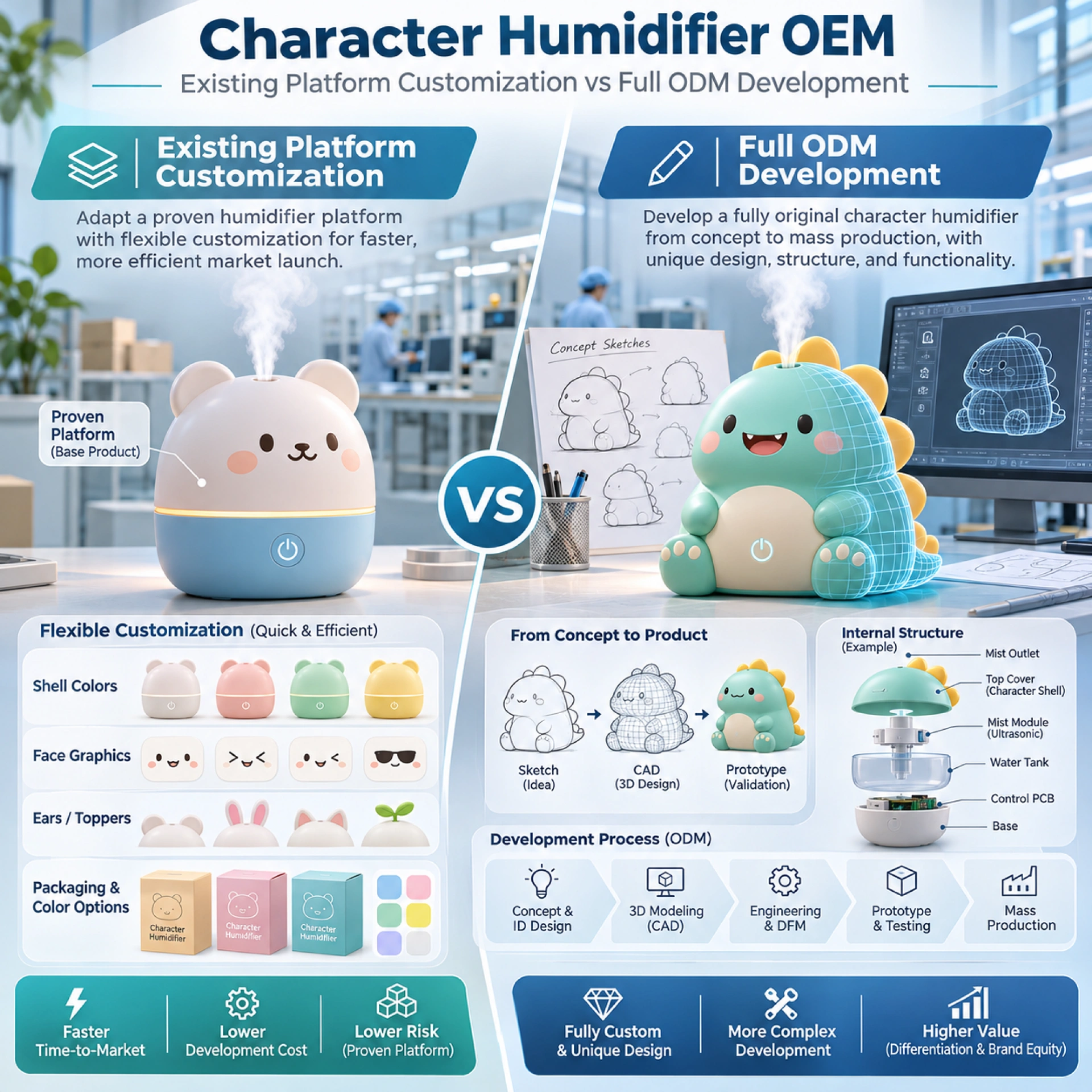
For most Character Humidifier OEM projects, customizing an existing humidifier platform is the more efficient option when the brand mainly needs a unique character appearance, colors, lighting effects or packaging. Full ODM development is more suitable when the project requires a new water tank, different humidification technology, custom mist outlet, redesigned internal structure or new electronic functions.
The most important decision is not whether the outside of the humidifier looks different. It is whether the character design can work with the existing internal functional system.
An existing humidifier platform may already include a water tank, humidification module, control PCBA, LED lighting, power supply and automatic water-level protection. A manufacturer can potentially reuse these components while developing a new character-shaped housing.
However, if the character requires mist to come out of its mouth, ears, hat or decorative accessories, the internal water system and mist pathway may need to be redesigned.
For brands, IP owners, gift companies and homeware buyers, choosing the right Character Humidifier OEM development method can directly affect tooling investment, product cost, development time and manufacturing risk.
This guide explains how to evaluate existing humidifier platforms, when full ODM development is necessary, and what buyers should confirm before starting tooling and mass production.
1. Character Humidifier OEM: Existing Platform vs Full ODM
Before requesting a quotation, buyers should understand the difference between platform customization and full custom development.
| Development Area | Existing Platform Customization | Full ODM Development |
|---|---|---|
| Product concept | Based on an existing humidifier | New product architecture |
| Character appearance | Customized exterior | Fully customized structure and appearance |
| Water tank | Existing tank may be reused | New tank may be developed |
| Humidification system | Existing system may be retained | New system can be selected |
| Mist outlet | Limited by existing structure | Greater design flexibility |
| PCBA | Existing board may be reused | New or modified PCBA |
| Firmware | Existing functions or minor changes | Custom functions possible |
| LED lighting | Existing lighting or adjustments | Custom lighting architecture |
| Tooling | New exterior molds may be needed | More extensive tooling may be needed |
| Prototype | Platform adaptation and validation | More comprehensive development |
| Initial investment | Generally lower | Generally higher |
| Development risk | Lower if the original system remains unchanged | Higher due to new engineering |
| Product exclusivity | Depends on customization scope | Greater potential for exclusivity |
The actual cost difference depends on the amount of engineering required. An existing platform that needs major structural modifications may become almost as complicated as full ODM development.
For Character Humidifier OEM sourcing, buyers should ask the manufacturer to identify which components can genuinely be reused.
2. What Is Existing Platform Customization?
Existing platform customization means using an established humidifier structure as the starting point for a new character-themed product.
The manufacturer may already have developed:
- Water tank and filling structure
- Humidification module
- Mist outlet
- Main control PCBA
- USB charging interface
- Button control
- LED lighting
- Water-level detection
- Automatic shut-off function
- Internal assembly structure
Instead of developing every component again, the engineering team evaluates which existing components can remain unchanged.
There are three common levels of customization.
Level 1: Appearance Customization
This is the simplest Character Humidifier OEM approach.
The original humidifier structure remains unchanged, while the brand customizes:
- Product colors
- Character graphics
- Logo
- Decorative printing
- Surface finish
- Outer packaging
- Instruction manual
This approach is suitable for brands that want to introduce a character-themed humidifier quickly without developing an entirely new product.
However, the product may have limited structural differentiation.
Level 2: Custom Character Housing
The internal humidifier system remains substantially unchanged, but the external housing is redesigned.
For example, an existing desktop humidifier may be transformed into:
- A bear-shaped humidifier
- A flower-shaped humidifier
- A snow house humidifier
- A bathtub-shaped character humidifier
- A cartoon animal humidifier
The manufacturer may need new injection molds for the exterior while retaining the original water tank, humidification module and PCBA.
This is often an attractive option for licensed IP projects.
However, the character housing must provide sufficient space for internal components and allow convenient water filling, cleaning and maintenance.
Level 3: Functional Platform Modification
This approach retains part of the existing functional architecture but introduces additional engineering changes.
Examples include:
- New LED lighting effects
- Different mist outlet positions
- Modified water tank capacity
- Additional spray modes
- New button functions
- Different charging interfaces
- Updated firmware
- Additional sensors
This approach sits between simple customization and full ODM development.
It can offer a good balance between product differentiation and development investment, provided that the original platform can support the required modifications.
3. Humidification Technology: Ultrasonic vs Cotton-Wick Systems
One important consideration in Character Humidifier OEM development is the actual humidification technology.
Buyers should not assume that every character humidifier uses the same internal system.
Two common approaches are ultrasonic humidification and cotton-wick-based humidification.
Ultrasonic Humidification
Ultrasonic humidifiers use high-frequency vibration to generate fine water droplets.
Common product features include:
- Visible cool mist
- Compact humidification modules
- Adjustable mist output
- Continuous and intermittent operation
- Electronic water-level protection
For character humidifiers, ultrasonic systems can provide attractive visual effects because the mist can be integrated into the character design.
However, the manufacturer must consider condensation, water quality, cleaning access and the position of the atomization module.
Cotton-Wick-Based Humidification
Cotton-wick systems use an absorbent wick to transfer water through the humidification structure.
Depending on the specific architecture, airflow and other components may also be involved.
Buyers should confirm:
- Wick material
- Wick dimensions
- Replacement requirements
- Water absorption performance
- Operating noise
- Maintenance instructions
- Expected service life
A cotton-wick platform should not automatically be treated as interchangeable with an ultrasonic platform. Their internal structures and maintenance requirements can be different.
Which System Is Better for Character Humidifier OEM?
| Comparison | Ultrasonic System | Cotton-Wick System |
|---|---|---|
| Humidification method | Ultrasonic atomization | Wick-based water delivery |
| Visible mist | Common | Depends on the actual design |
| Main components | Atomizer and control system | Wick and associated humidification structure |
| Maintenance | Tank and atomizer cleaning | Wick maintenance and replacement |
| Product design | Requires atomizer and mist outlet space | Requires wick access and suitable water delivery |
| Engineering focus | Atomization, condensation and water protection | Water absorption, airflow and wick performance |
There is no universally better solution.
The manufacturer should select the technology according to the product’s intended performance, dimensions, power supply, target price and maintenance requirements.
4. Water Tank Design: The Most Important Structural Consideration
A character humidifier is not simply a decorative PVC or ABS figure with an electronic component inside.
It needs a properly designed water storage and humidification system.
The water tank affects:
- Product dimensions
- Water capacity
- Product weight
- Center of gravity
- Filling method
- Cleaning access
- Internal sealing
- Assembly structure
- Electronic component placement
For example, a character with a large head and narrow body may have limited internal space for a conventional water tank.
The engineering team must determine whether the tank should be located in the body, head or another section.
Existing Water Tank vs Custom Water Tank
An existing tank can reduce development work if its dimensions and operating specifications fit the character housing.
A custom water tank may be necessary when:
- The character has unusual proportions.
- The brand requires a larger capacity.
- The water filling position must be redesigned.
- The mist outlet needs a different position.
- The original tank cannot fit inside the character.
- The internal structure needs additional sealing.
Top-Fill vs Removable Water Tank
| Design | Advantages | Engineering Considerations |
|---|---|---|
| Top-fill | Convenient daily water filling | Lid sealing and opening structure |
| Removable tank | Easier filling and cleaning | Detachable joints and leakage prevention |
| Integrated tank | Compact product structure | Cleaning access and drainage |
| Side-fill | Can suit certain character shapes | Opening and sealing requirements |
For Character Humidifier OEM projects, water tank design should be confirmed before releasing the final exterior mold.
Otherwise, a character design may look perfect in a 3D rendering but leave insufficient space for the actual water system.
5. Mist Outlet Design: How to Integrate Mist Into a Character
The mist outlet is another important engineering decision.
A character humidifier can use the mist function as part of its visual identity.
For example:
- A dragon releases mist from its mouth.
- A bear releases mist from a decorative cloud.
- A snow house releases mist from its roof.
- A character bathtub releases mist from the water surface.
- A flower humidifier combines a decorative flower with the humidification function.
However, a longer or more complicated mist pathway can create condensation and water accumulation.
The manufacturer should evaluate:
- Mist outlet dimensions.
- Internal channel geometry.
- Condensation collection.
- Water leakage risks.
- Mist direction.
- Airflow requirements.
- Cleaning accessibility.
- Functional performance during continuous operation.
A prototype should be tested under agreed operating conditions before the tooling is finalized.
The visual effect must not compromise the actual humidification function.
6. PCBA, Battery and Electronic Functions
Electronics are another major consideration in Character Humidifier OEM development.
A typical character humidifier may include:
- Main control PCBA
- Humidification driver
- LED lighting
- USB-C charging
- Rechargeable battery
- Power management
- Water-level detection
- Automatic shut-off
- Button or touch control
When Can an Existing PCBA Be Reused?
An existing PCBA may be suitable when the new product uses the same:
- Electrical specifications
- Humidification module
- Power requirements
- Control functions
- LED configuration
- Physical board dimensions
However, the completed character product must still be tested.
A new enclosure can change the internal layout, wiring arrangement, ventilation and water exposure risks.
When Is a New PCBA Required?
A new or modified PCBA may be necessary when the buyer requests:
- Additional LED channels
- New lighting animations
- Different battery specifications
- New sensor functions
- Additional operating modes
- Modified charging requirements
- Bluetooth or Wi-Fi connectivity
Firmware development may also be necessary when the control logic changes.
For more complex electronic projects, see our guide to PCBA Firmware App Development.
One important distinction: PCBA development and mobile app development are separate responsibilities. A basic character humidifier does not need an app unless the brand specifically requires remote or mobile control.
7. Tooling, Cost and MOQ: What Changes Between OEM and ODM?
The main commercial advantage of existing platform customization is that some functional components may already be developed.
However, this does not mean every project can avoid tooling costs.
Existing Platform Customization Costs
A typical project may include:
- Character design adaptation
- Structural modifications
- 3D modeling
- Prototype development
- New exterior molds
- Painting and printing
- Assembly
- Packaging
- Functional testing
If the original tank, PCBA and humidification module can be retained, some development investment may be reduced.
Full ODM Development Costs
A full custom project may additionally require:
- New industrial design
- New internal structure
- Custom water tank
- New humidification layout
- PCBA development
- Firmware modifications
- Multiple functional prototypes
- More extensive tooling
- Additional validation
Cost Comparison
| Cost Item | Existing Platform | Full ODM |
|---|---|---|
| 3D Design | Partial redesign | Full product design |
| Structural Engineering | Limited modifications | New architecture |
| Water Tank | Reuse if suitable | New design possible |
| PCBA | Reuse or modify | New development possible |
| Mold | Exterior mold may be required | Multiple new molds may be required |
| Prototype | Platform adaptation | Functional prototype development |
| Testing | Change-based assessment | Broader validation |
| Development Investment | Generally lower | Generally higher |
Does Existing Platform Customization Mean Lower MOQ?
Not necessarily.
MOQ also depends on:
- Plastic material purchasing
- Custom colors
- New mold investment
- Electronic component purchasing
- Packaging quantities
- Assembly requirements
- Production efficiency
A custom character housing may still require a substantial production quantity even if the internal electronic platform is already available.
Buyers should request quotations based on actual quantities and customization requirements.
8. Product Safety, Cleaning and Target-Market Requirements
Character humidifiers combine water, electricity and decorative product structures.
These three elements must be considered together during development.
Water Tank Hygiene
The water tank should be designed for convenient filling, emptying and cleaning.
The U.S. Environmental Protection Agency’s humidifier cleaning and maintenance guidance explains that ultrasonic and impeller humidifiers can disperse minerals and microorganisms from their water tanks into indoor air.
For product designers, this makes cleaning access and maintenance instructions important considerations.
Buyers should confirm:
- Can the tank be emptied completely?
- Can users reach the internal surfaces?
- Are there areas where water can remain stagnant?
- Can the product dry properly?
- Are the cleaning instructions clear?
- Are replacement wicks or filters required?
Electrical Product Safety
For household humidifiers, buyers should review the applicable safety standards for their target market.
The IEC 60335-2-98 humidifier safety standard specifically covers household and similar electrical humidifiers.
The 2023 edition also includes additional requirements addressing humidifiers shaped or decorated like toys.
This is particularly relevant to character-themed products.
An existing platform’s previous test report does not automatically establish compliance for a newly modified finished product. Changes to the housing, structure, electrical arrangement and intended use should be evaluated.
For EU electronic products, buyers may also need to assess the EU RoHS Directive and EU EMC Directive, according to the product’s scope and applicable requirements.
The final testing plan should be confirmed with a qualified laboratory.
9. Prototype Approval: What Should Buyers Test Before Tooling?
One common mistake in Character Humidifier OEM projects is approving only the appearance sample.
A 3D model or cosmetic prototype cannot prove that the water system and electronics work reliably.
Before mass production tooling, buyers should evaluate the functional prototype.
| Test Item | What Buyers Should Confirm |
|---|---|
| Humidification | Stable operation and agreed output |
| Water Tank | Correct filling and drainage |
| Leakage | No unacceptable water leakage |
| Water-Level Protection | Correct response when water is insufficient |
| Mist Outlet | Correct direction and performance |
| Condensation | No unacceptable internal water accumulation |
| PCBA | Stable electronic functions |
| LED | Correct brightness and lighting modes |
| Battery | Charging and operating performance |
| Power Input | Correct electrical operation |
| Noise | Meets agreed requirements |
| Stability | Suitable for normal placement |
| Cleaning | Convenient access to water-contact areas |
| Assembly | No unacceptable gaps or interference |
| Packaging | Suitable protection during transportation |
The testing conditions and acceptance criteria should be agreed before sampling.
Why Production-Intent Samples Matter
A sample using different internal components from the final mass-production product may not represent actual production performance.
Before approval, buyers should confirm:
- Final or representative water tank
- Actual humidification module
- Production PCBA
- Final battery specification, if applicable
- Production-intent wiring
- Sealing components
- Internal mounting structure
- Final exterior housing
Any major component substitution after approval should be reviewed.
10. Real Character Humidifier Product Examples
Different character humidifier concepts demonstrate why one existing platform cannot necessarily satisfy every design.
For example, a snow house humidifier may prioritize decorative lighting and a larger water capacity, while a compact bathtub-shaped humidifier may prioritize desktop placement and a smaller tank.
The following examples illustrate different product configurations.
Snow House Humidifier
A snow house design can combine a decorative character-themed housing with:
- Cotton-wick humidification
- 400 mL water tank
- 1500 mAh rechargeable battery
- Two intelligent operating modes
- Automatic shut-off when water runs out
- Anti-dry-burn protection
- Seven-color lighting
The main engineering considerations include the internal water structure, lighting arrangement and integration of the decorative exterior.
Bathtub-Shaped Humidifier
A bathtub-shaped design can use a more compact configuration.
Example product specifications include:
- 300 mL water tank
- Two humidification modes
- Automatic water-level detection
- Automatic shut-off
- Anti-dry-burn protection
The key challenge is integrating the water tank and electronic components into the bathtub-shaped exterior without making filling and cleaning inconvenient.
Flower Humidifier
A flower-themed design combines a functional humidifier with a soft decorative component.
Example features include:
- 350 mL water tank
- 1100 mAh rechargeable battery
- Top-fill structure
- Dual humidification modes
- Soft silicone flower decoration
The engineering team needs to consider the relationship between the water tank, silicone decorative component, internal structure and lighting.
These examples show why Character Humidifier OEM development should begin with the product’s actual function and structural requirements rather than relying only on appearance.
11. Buyer RFQ Checklist for Character Humidifier OEM
Before requesting a quotation, brands should prepare the following information.
| RFQ Item | Information Required |
|---|---|
| Character Artwork | 2D artwork or 3D files |
| IP Authorization | Approved product category and territory |
| Product Dimensions | Target height, width and depth |
| Development Method | Existing platform or full ODM |
| Humidification Technology | Ultrasonic, cotton-wick-based or other |
| Water Capacity | Target tank volume |
| Mist Outlet | Preferred position |
| Operating Modes | Continuous, intermittent or other |
| Power Supply | USB-C, adapter or rechargeable battery |
| Battery | Required capacity and runtime |
| Lighting | Warm white, RGB or other effects |
| Controls | Button, touch or remote |
| Materials | ABS, silicone, PVC decorative parts |
| Cleaning | Tank access and maintenance |
| Target Market | USA, EU, UK, Japan or other |
| Testing | Applicable product safety requirements |
| Packaging | Color box, tray and accessories |
| Quantity | Expected order volume |
| Tooling | Mold cost and ownership |
| Timeline | Sample and mass-production schedule |
The more information provided during the RFQ stage, the easier it is for the manufacturer to recommend the correct development method.
12. How Jiahong Creative Supports Character Humidifier OEM Projects
Jiahong Creative provides OEM/ODM development and manufacturing services for character-themed electronic products, including humidifiers, night lights, Bluetooth speakers, aroma diffusers, alarm clocks and other creative homeware products.
Our manufacturing capabilities cover several important stages:
- Product concept and design review
- 3D modeling
- Structural engineering
- Mold design and manufacturing
- Plastic injection molding
- Silicone processing
- Spraying and painting
- Pad printing and decorative finishing
- PCBA integration and SMT
- Final product assembly
- Functional testing
- Quality inspection
- Packaging
This integrated manufacturing structure helps coordinate the character exterior with the internal electronic system.
For brands developing a wider IP merchandise program, our Character Electronic Gift Manufacturer guide explains how characters can be developed into functional electronic products.
You can also read Character Figure to Lifestyle Product to understand how one licensed character can expand from PVC collectibles into humidifiers, night lights, speakers and other household products.
Jiahong Creative’s existing product range includes several humidifier concepts, including snow house, bathtub-shaped and flower-shaped designs. These provide practical references for evaluating different character structures, humidification functions and exterior customization possibilities.
Request a Character Humidifier OEM Quotation
To evaluate your project, please prepare:
- Character artwork or 3D files.
- Target product dimensions.
- Required water tank capacity.
- Preferred humidification technology.
- Mist outlet position.
- Lighting and electronic functions.
- Target market.
- Estimated order quantity.
- Packaging requirements.
- Expected launch schedule.
Our engineering team can review whether an existing platform is suitable or whether full ODM development would be more appropriate.
Visit Jiahong Creative to discuss your character humidifier project.
Final Thoughts
Choosing between existing platform customization and full ODM development is one of the most important decisions in Character Humidifier OEM sourcing.
An existing platform can reduce development investment and technical complexity when the original water tank, humidification system, PCBA and internal structure already meet the brand’s requirements.
Full ODM development is more appropriate when the character design requires a different water tank, new mist outlet, unique internal structure or additional electronic functions.
The best approach is not necessarily the one with the lowest initial cost. It is the one that achieves the required product appearance and functionality without creating unnecessary engineering complexity.
Before tooling, buyers should confirm the humidification technology, tank capacity, mist outlet, PCBA, cleaning structure, safety requirements, tooling ownership and testing plan.
For successful Character Humidifier OEM development, the principle is simple: reuse proven functional systems when they fit, and develop new structures when the product genuinely requires them.
FAQ
1. What is Character Humidifier OEM?
Character Humidifier OEM is the development and manufacturing of customized humidifiers featuring licensed IP, cartoon characters, mascots or original brand designs. The project may involve customizing an existing humidifier platform or developing a completely new product structure.
2. What is the difference between existing platform customization and full ODM?
Existing platform customization reuses an established functional humidifier system while modifying the exterior, character design or selected functions. Full ODM development involves creating a new or substantially redesigned product architecture to meet unique requirements.
3. Which Character Humidifier OEM solution is cheaper?
Existing platform customization is generally more economical when the water tank, humidification module and PCBA can be reused. Full ODM usually requires additional engineering, tooling and functional validation. Actual costs depend on the project.
4. Can a character humidifier use an existing water tank?
Yes, if the existing tank fits the new character structure and meets the required capacity, filling, cleaning and sealing requirements. Otherwise, a customized water tank may be necessary.
5. What humidification technology is suitable for character humidifiers?
Ultrasonic and cotton-wick-based systems are common options. The right choice depends on product dimensions, humidification performance, maintenance, power consumption, mist requirements and target cost.
6. Can the mist come out of a character’s mouth or head?
Yes. However, the internal mist pathway must be engineered to manage condensation, water accumulation, leakage and output performance. A customized mist channel may be necessary.
7. What information is needed for a Character Humidifier OEM quotation?
Buyers should provide character artwork, product dimensions, water capacity, humidification technology, mist outlet position, electronic functions, target market, order quantity and packaging requirements.