

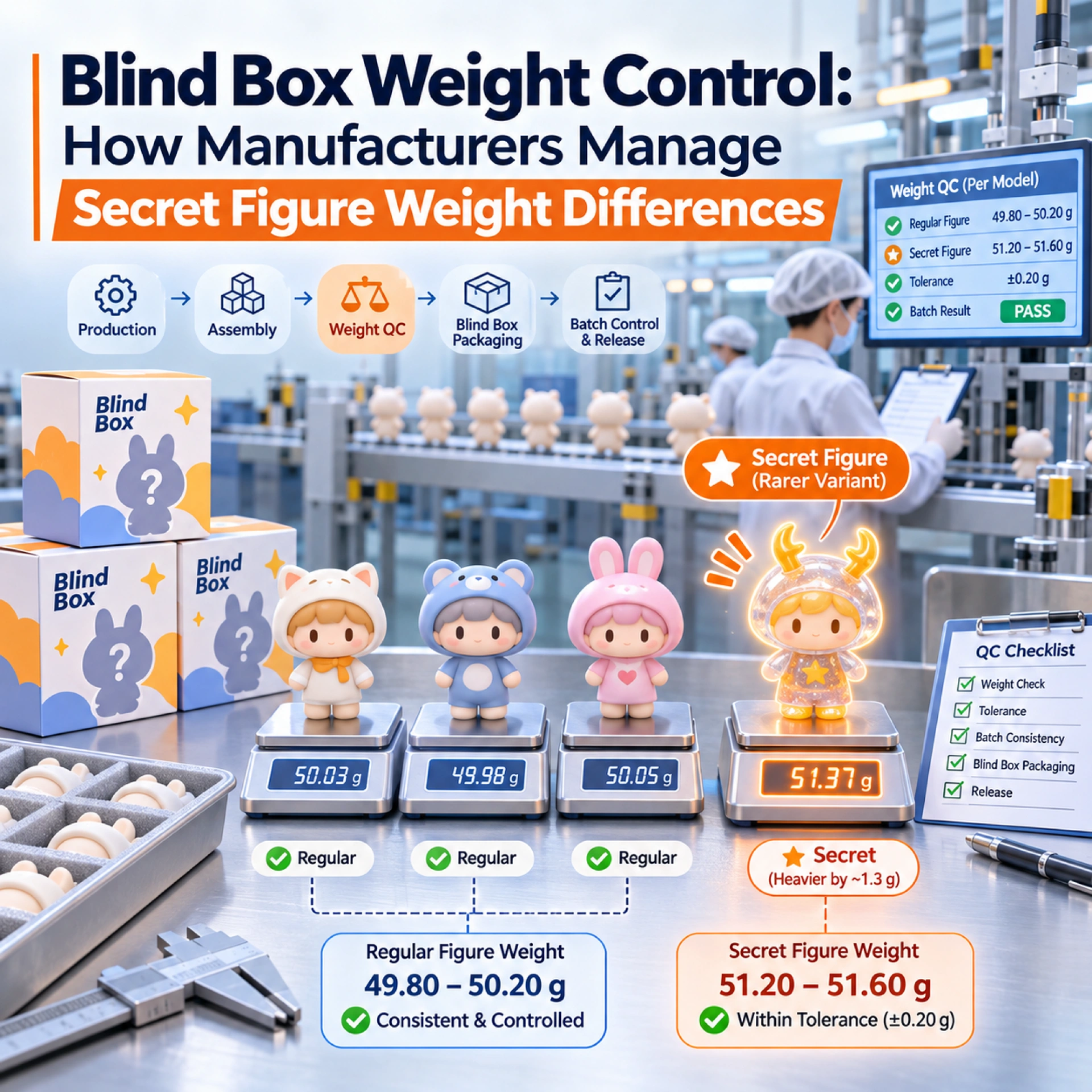
Blind Box Weight Control is the process of managing weight differences between regular figures and secret figures so customers cannot easily identify the hidden character by weighing sealed packages. Manufacturers should control weight differences from the product design stage, rather than trying to correct them only after packaging. The most effective approach combines shared figure components, optimized material usage, consistent accessories, standardized packaging, prototype weighing and production quality checks.
For example, if regular blind box figures weigh approximately 90g after packaging but a secret figure weighs 120g, customers may quickly discover the difference using a digital scale. Even if the outer boxes look identical, a 30g weight difference can make the secret figure easier to identify.
However, Blind Box Weight Control does not mean every figure must have exactly the same weight. Different character designs naturally have different dimensions, materials and accessories. The objective is to reduce unnecessary weight differences and prevent obvious weight patterns from revealing the secret figure.
For brands developing blind box collections, manufacturers should evaluate:
- Figure weight differences between regular and secret designs.
- PVC, ABS and accessory material density.
- Shared body and base structures.
- Hollow and solid component designs.
- Metal accessories and decorative components.
- Inner bags, trays, cards and outer box weight.
- Actual sealed-box weight distribution.
- Weighing procedures during prototype approval and mass production.
A reliable Blind Box Weight Control plan should be established before tooling and packaging are finalized. This helps protect the mystery experience, maintain product quality and avoid expensive design changes after mass production begins.
1. Why Is Blind Box Weight Control Important?
Weight is one of the easiest physical characteristics for customers to compare without opening a blind box.
Collectors may use digital scales to compare packages before purchasing. If one character consistently weighs more than the others, customers can potentially identify the hidden figure without opening the package.
This creates several commercial problems:
- Customers may select packages based on weight instead of purchasing randomly.
- Secret figures may lose their surprise value.
- Retailers may have difficulty maintaining a genuinely random buying experience.
- Customers may complain that certain boxes have already been selected.
- The brand’s secret figure distribution strategy may become less effective.
For manufacturers, Blind Box Weight Control is therefore not simply a weighing inspection requirement. It is part of product engineering and packaging design.
Common Reasons for Weight Differences
| Weight Difference Source | Example | Potential Impact |
|---|---|---|
| Figure dimensions | Secret figure has a larger body | Higher figure weight |
| Material | Solid PVC vs hollow structure | Different mass |
| Accessories | Secret figure includes metal accessories | Higher total weight |
| Display base | Larger or thicker base | Additional weight |
| Internal structure | Different internal supports | Weight variation |
| Paint and coating | Different finishing systems | Additional mass variation |
| Inner packaging | Different tray or bag | Different packed weight |
| Collector card | Different paper or card components | Packaging weight variation |
The most important point is that weight differences can originate from both the figure and its packaging.
A manufacturer should not evaluate only the finished figure. The complete sealed retail box must also be considered.
2. Figure Weight vs Packed Box Weight: What Should Manufacturers Measure?
One common mistake in blind box production is measuring only the finished figure and assuming that the packaging will not affect the final result.
In reality, customers weigh the entire sealed retail package.
Blind Box Weight Control should therefore separate two measurements:
Figure Weight: The weight of the completed figure, including its fixed accessories and display base.
Packed Box Weight: The total weight of the figure, removable accessories, inner bag, collector card, inner tray, outer box, labels and sealing materials.
The basic calculation is:
Packed Box Weight = Figure Weight + Accessories + Inner Packaging + Outer Packaging
Example: Regular Figure vs Secret Figure
The following is an illustrative weight comparison for a blind box series.
| Component | Regular Figure | Secret Figure |
|---|---|---|
| Main figure | 52g | 68g |
| Display base | 10g | 10g |
| Accessories | 5g | 12g |
| Collector card | 2g | 2g |
| Inner bag | 1g | 1g |
| Inner tray | 6g | 6g |
| Outer box | 18g | 18g |
| Labels and sealing | 1g | 1g |
| Total Packed Weight | 95g | 118g |
<text>This example shows a 23g difference between the regular and secret versions.</text>
Even though both products use identical outer packaging, the secret figure is significantly heavier.
This is why Blind Box Weight Control must begin with the complete product structure.
Why Packaging Weight Must Be Included
Consider a different situation.
The regular figure and secret figure have similar weights, but the secret figure requires a larger inner tray because of its special accessory.
The complete packed weights may still be different.
Manufacturers should therefore establish separate weight records for:
- Individual figure.
- Figure with accessories.
- Inner packaging assembly.
- Complete sealed retail box.
- Master carton.
This makes it easier to identify where weight differences originate.
For more detailed packaging weight management, see our Packaging Bill of Materials for Toys guide.
3. Material Selection: How PVC, ABS and Metal Affect Blind Box Weight Control
Material selection has a direct effect on product weight.
Two components with similar external dimensions can have different weights because their material densities and internal structures are different.
For example, a solid metal accessory will generally weigh more than a similarly sized hollow plastic accessory.
When designing secret figures, manufacturers should review both the material and the volume of each component.
PVC Components
PVC is commonly used for custom collectible figures because it supports detailed character shapes, flexible design possibilities and different surface finishes.
However, different PVC component structures can produce different finished weights.
Factors include:
- Overall component volume.
- Wall thickness.
- Solid or hollow construction.
- Material formulation.
- Internal cavities.
- Additional structural components.
For Blind Box Weight Control, the manufacturer should evaluate whether the regular and secret figures can share a common structural core.
ABS Components
ABS is commonly used for rigid structural parts, display bases and selected accessories.
A large ABS base or thick structural component may add considerable weight to the complete product.
If the secret figure uses a different base design, the manufacturer should compare its weight with the regular version.
A shared base can help simplify both manufacturing and weight management when the character structures allow it.
Metal Accessories
Metal accessories are another potential source of weight differences.
Examples include:
- Metal weapons.
- Decorative chains.
- Metal badges.
- Small metal ornaments.
- Metal connection components.
If only the secret figure contains a metal accessory, the difference may become noticeable when customers weigh sealed boxes.
Where appearance allows, the engineering team can evaluate alternative materials or redesigned structures.
However, the alternative must still meet the required strength, appearance and safety specifications.
Material Selection Comparison
| Material | Common Application | Weight Consideration |
|---|---|---|
| PVC | Character body and accessories | Depends on volume and structure |
| ABS | Bases and rigid components | Depends on component dimensions |
| Silicone | Soft decorative components | Depends on formulation and volume |
| Metal | Chains and decorative accessories | Can create noticeable weight differences |
| Paperboard | Collector cards and boxes | Depends on paper specification and size |
| PET/PP | Packaging trays | Depends on thickness and structure |
Blind Box Weight Control should consider the entire material combination instead of focusing on the main figure material alone.
4. Shared Body and Base: A Practical Way to Control Weight Differences
One of the most practical solutions is using shared structural components across different blind box designs.
For example, a collection may contain six regular figures and one secret figure.
The characters may have different:
- Hair styles.
- Facial expressions.
- Clothing colors.
- Decorative accessories.
- Handheld items.
However, they may share the same main body structure and display base.
This approach can help manufacturers control weight differences because the largest structural components remain consistent.
Shared Body Structure
A shared body can provide several benefits:
- Similar main component weight.
- More consistent product dimensions.
- Reduced tooling investment.
- Easier component inventory management.
- More predictable assembly.
- Simpler production planning.
The heads, accessories and paint finishes can still create different character identities.
Shared Display Base
Display bases are often overlooked during blind box design.
A secret figure with a larger base may become noticeably heavier even when the main figure is similar to regular designs.
Using a shared base, where technically appropriate, can reduce unnecessary variation.
When Shared Components Are Not Suitable
Not every character can use the same body or base.
For example:
- One character may be sitting.
- Another may be flying.
- A third may have an oversized costume.
- The secret figure may have a completely different pose.
In these cases, the manufacturer should focus on the weight budget of the unique components rather than forcing an unsuitable shared structure.
For more information about shared components and design count, see our Blind Box Manufacturing Cost guide.
5. Hollow vs Solid Figure Structures: Can Design Optimization Reduce Weight?
The internal structure of a figure can significantly influence its weight.
A solid component generally uses more material than a properly designed hollow or cored structure with comparable external dimensions.
However, reducing material without considering structural performance can create new problems.
Potential issues include:
- Thin walls.
- Weak connection points.
- Deformation.
- Sink marks.
- Poor assembly strength.
- Inconsistent molding results.
Why Wall Thickness Matters
Manufacturers should review wall thickness during 3D structural development.
If a secret figure has a large head or oversized accessory, unnecessary solid material may increase its weight.
Where the molding process allows, the engineering team can evaluate:
- Internal cavities.
- Core-out structures.
- Optimized wall thickness.
- Reinforced connection areas.
- Reduced unnecessary material volume.
The aim is to remove unnecessary material without weakening the figure.
Protolabs’ injection molding design guidance explains how wall thickness and coring affect part weight, strength and molding quality.
For Blind Box Weight Control, this is especially relevant when one secret figure has a substantially larger body or accessory than the regular lineup.
Do Not Reduce Weight at the Expense of Quality
A figure should not become fragile simply to achieve a lower weight.
The manufacturer must still consider:
- Drop resistance.
- Accessory attachment strength.
- Structural stability.
- Paint durability.
- Assembly performance.
- Intended product use.
Weight optimization should be a design improvement, not a shortcut that creates future quality problems.
6. How to Manage Heavy Secret Figure Accessories
Secret figures often have additional decorative features that make them more collectible.
These may include:
- Larger weapons.
- Special display bases.
- Metal ornaments.
- Extra clothing elements.
- Transparent effects.
- Special molded accessories.
- Additional decorative components.
These features create visual value but can also increase weight.
Compare Accessory Materials
For example, a secret figure may have a large metallic-looking sword.
The original design may use a solid metal component.
The manufacturer can evaluate whether the appearance can be achieved using:
- PVC with metallic paint.
- ABS with metallic finishing.
- A lighter internal structure.
- A smaller metal insert combined with a plastic exterior.
The final decision depends on the required appearance, strength and manufacturing process.
Reconsider Accessory Quantity
Sometimes the secret figure includes several small decorative components that are not essential to its overall appearance.
The brand and engineering team can review whether these components can be simplified or integrated into the main figure.
Do Not Add Unnecessary Ballast
One solution sometimes considered is adding extra weight to lighter figures to make all boxes similar.
However, adding unnecessary metal pieces or filler materials simply to disguise a secret figure can increase cost, material usage and potential safety risks.
If additional weight is genuinely required for product stability, the insert should be properly engineered, securely fixed and included in the approved BOM.
For most projects, it is better to optimize the actual figure design and packaging structure first.
7. Packaging Weight Control: The Secret Figure Should Not Have Different Packaging
Even when figure weights are well controlled, packaging differences can reveal the secret version.
For this reason, Blind Box Weight Control must include packaging engineering.
Standardize the Packaging Components
Where possible, regular and secret figures should use the same:
- Outer box dimensions.
- Paperboard specification.
- Inner bag material.
- Inner tray material.
- Collector card format.
- Sealing method.
- Protective components.
If the secret figure requires different protection because of its size, the manufacturer should evaluate whether the change creates a noticeable weight or physical difference.
Packaging Components That Affect Weight
| Packaging Component | Potential Weight Variation | What Manufacturers Should Control |
|---|---|---|
| Outer box | Different paperboard thickness | Same material and specification |
| Inner bag | Different film structure | Same material and size |
| Inner tray | Different thickness or shape | Consistent tray design |
| Collector card | Different paper weight | Same paper specification |
| Accessory bag | Different size or quantity | Standardized packaging |
| Sealing sticker | Different quantity | Same sealing method |
| Protective insert | Additional material | Review necessity and weight |
The packaging supplier should provide material specifications and approved samples.
A packaging change during mass production should trigger a review of the packed weight.
Our Packaging Bill of Materials for Toys article explains how buyers can record packaging material, unit weight, supplier, dimensions and alternative materials.
Same Packaging Does Not Automatically Mean Same Weight
Even if all blind boxes use identical packaging specifications, the internal figure weight can still differ.
Packaging standardization reduces one source of variation, but it cannot replace product-level weight optimization.
The manufacturer must evaluate the complete sealed product.
8. Prototype Weighing: How to Test Blind Box Weight Differences Before Mass Production
Blind Box Weight Control should be validated during prototype development.
Do not wait until mass production to discover that the secret figure is substantially heavier than the regular figures.
A practical prototype weighing process should involve three stages.
Stage 1: Weigh the Individual Figures
Measure each approved figure without packaging.
Record:
- Main figure weight.
- Base weight.
- Accessory weight.
- Total assembled figure weight.
This identifies which design components create the largest weight differences.
Stage 2: Weigh the Complete Packaging Assembly
Pack each figure using its actual production-intent packaging.
Record:
- Inner bag weight.
- Collector card weight.
- Tray weight.
- Outer box weight.
- Sealed box weight.
This helps identify whether packaging is contributing to the difference.
Stage 3: Compare the Weight Distribution
Do not rely on only one sample per design.
Select representative samples from each regular and secret figure variant.
Record the average, minimum, maximum and variation within each group.
The manufacturer should then compare the weight ranges.
Example: Prototype Weight Comparison
The following values are illustrative.
| Version | Average Packed Weight | Minimum | Maximum |
|---|---|---|---|
| Regular A | 96g | 94g | 98g |
| Regular B | 97g | 95g | 99g |
| Regular C | 95g | 93g | 97g |
| Regular D | 98g | 96g | 100g |
| Secret Figure | 119g | 117g | 121g |
In this example, the secret figure has a substantially higher weight range than the regular figures.
The manufacturer should investigate the main sources of the difference before approving the final product structure.
How to Evaluate Weight Leakage
A useful starting point is comparing the average weight of the secret figure against the average weight of the regular figures.
Weight Difference = Secret Figure Average Weight − Regular Figure Average Weight
However, the average alone is not enough.
Manufacturers should also examine:
- Variation within each design.
- Overlap between weight ranges.
- Measurement resolution.
- Packaging consistency.
- Whether the difference is repeatable across production samples.
If the secret figure consistently weighs more than every regular figure, the weight difference may be an obvious identification clue.
If the distributions overlap, the weight clue may be less reliable, but this does not guarantee that customers cannot identify the secret figure through other methods.
The acceptable weight difference should be agreed between the brand and manufacturer based on the actual product and packaging design.
9. Mass Production Weight Inspection and QC
Prototype approval is only the first step.
Blind Box Weight Control must continue during mass production because materials, accessories and packaging components can change between production batches.
A practical QC process should include several checkpoints.
Incoming Material Inspection
Check whether the incoming components match the approved specifications.
Examples include:
- PVC material.
- ABS components.
- Metal accessories.
- Display bases.
- Inner trays.
- Packaging materials.
In-Process Weight Checks
During production, the QC team can periodically check representative completed figures.
This helps identify unexpected changes caused by:
- Material substitutions.
- Component changes.
- Missing accessories.
- Incorrect assembly.
- Different base structures.
- Rework.
Finished Box Weight Checks
After packaging, inspect representative sealed blind boxes from each relevant production batch.
Record:
- Design or internal SKU.
- Production batch.
- Packaging version.
- Measured weight.
- Inspection date.
- Inspection result.
The detailed mapping between a secret figure and its weight should be restricted to authorized personnel if the brand wants to protect the mystery experience.
What If the Weight Suddenly Changes?
If a production batch shows an unexpected weight difference, the factory should investigate before continuing packing.
Possible causes include:
- Wrong accessory.
- Missing component.
- Incorrect packaging material.
- Different paperboard specification.
- Material substitution.
- Unapproved design revision.
- Incomplete assembly.
Weight inspection is therefore useful for both secret figure protection and ordinary product quality control.
For more detailed inspection requirements, see our PVC Figure Quality Control guide.
10. Weighing Equipment and Measurement Accuracy
A weight control process is only useful if the measuring equipment provides reliable results.
A digital scale should have suitable:
- Weighing capacity.
- Readability.
- Repeatability.
- Stability.
- Calibration or verification records.
The measurement procedure should also be consistent.
For example:
- Place the scale on a stable surface.
- Check the zero reading.
- Use an appropriate reference weight to verify performance.
- Weigh the sample in the same condition.
- Record the measurement.
- Repeat readings where necessary.
- Investigate abnormal results.
Different scales may show different readings because of resolution, measurement uncertainty or equipment condition.
For production measurement systems, buyers can refer to ISO 10012:2026 measurement management requirements, which addresses the reliability and validity of measurement results.
For projects using continuous weight measurements in lot inspection, ISO 3951-1:2022 sampling procedures provide a reference for variable-based acceptance sampling under defined conditions.
These standards are technical references, not automatic requirements for every blind box project. The manufacturer and buyer should agree on the appropriate inspection method and acceptance criteria.
11. Weight Control Is Not the Same as Random Packing
An important distinction is that weight control does not determine whether the blind box assortment is random.
A manufacturer may successfully reduce weight differences but still pack the wrong figure ratio.
For example, a collection may contain:
- Six regular figures.
- One secret figure.
- A specified secret allocation.
- A defined carton assortment requirement.
The factory must separately manage:
- Figure production quantities.
- Secret figure inventory.
- Random packing instructions.
- Carton allocation.
- Packing reconciliation.
- Finished product QC.
Weight control reduces one potential way of identifying the contents. Random packing controls how the figures are distributed.
Both processes must be managed together.
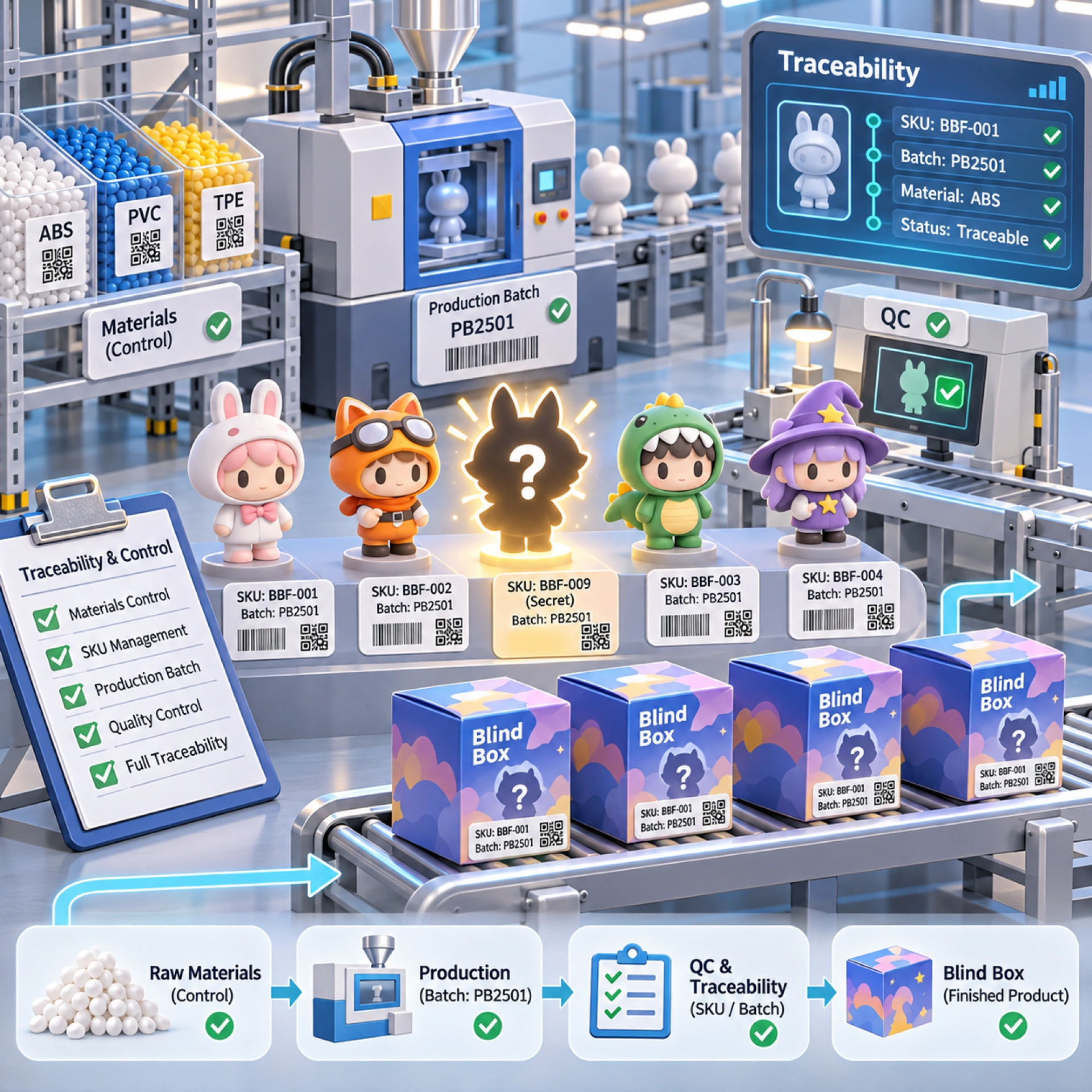
Our Blind Box SKU Traceability guide explains how manufacturers connect figure SKUs, secret figure inventory, production batches and packing records.
12. Other Ways Customers May Identify Secret Figures
Weight is not the only potential clue.
Even if Blind Box Weight Control is successful, customers may identify figures through other physical differences.
Common examples include:
| Identification Method | Potential Clue | Manufacturing Control |
|---|---|---|
| Weight comparison | Secret figure is heavier | Product and packaging weight review |
| Shaking | Different internal movement | Secure accessories and inserts |
| Touching | Different package shape | Consistent packaging structure |
| Box dimensions | Different figure requires larger tray | Standardize external dimensions where possible |
| Sound | Loose or heavier accessories create different sounds | Review internal fixing |
| Packaging codes | Different printed codes | Control consumer-visible coding |
| Tray structure | Secret uses a different tray | Review packaging design |
| Card position | Different card arrangement | Standardize card placement |
No single control guarantees complete secrecy.
The manufacturer should evaluate the entire retail package and its physical characteristics.
For more information, see our Blind Box Unboxing Experience guide, which explains how packaging structure, concealment and reveal order affect the consumer experience.
13. Buyer RFQ Checklist for Blind Box Weight Control
Buyers should discuss weight requirements before approving the final 3D designs and packaging.
The following checklist can be included in a manufacturing RFQ.
| RFQ Item | What Buyers Should Confirm |
|---|---|
| Regular Figure Weight | Target weight for each design |
| Secret Figure Weight | Expected weight difference |
| Material | PVC, ABS, silicone or metal components |
| Shared Components | Common body, base and accessories |
| Figure Structure | Solid or hollow construction |
| Accessory List | Material, quantity and dimensions |
| Display Base | Shared or unique design |
| Packaging Material | Box, tray, bag and collector card |
| Packaging Weight | Target weight per retail unit |
| Prototype Weighing | Weight records for all variants |
| Measurement Equipment | Scale capacity and readability |
| Acceptance Criteria | Agreed weight range and variation |
| Mass Production QC | Sampling frequency and inspection records |
| Secret Protection | Restricted access to internal weight mapping |
| Change Control | Approval process for material and packaging changes |
The manufacturer should provide a clear explanation of how weight differences will be evaluated.
Do not simply ask the supplier to make every box weigh the same.
Instead, request a prototype weight comparison and a practical weight control plan.
14. How Jiahong Creative Supports Blind Box Weight Control
Jiahong Creative provides custom PVC figure and blind box manufacturing services, including 3D development, mold making, plastic molding, painting, pad printing, assembly, packaging and quality inspection.
For Blind Box Weight Control projects, our engineering and production teams can work with buyers to review:
- Character dimensions and 3D structure.
- Shared body and base possibilities.
- PVC and ABS component structures.
- Accessory materials.
- Special figure designs.
- Packaging component specifications.
- Prototype weight comparisons.
- Production batch inspection.
- Random packing requirements.
The objective is to identify potential weight differences before mass production and evaluate whether they can be reduced through design or packaging optimization.
Request a Blind Box Manufacturing Evaluation
If your brand is developing a blind box collection with regular and secret figures, please provide:
- Character artwork or 3D files.
- Number of regular designs.
- Secret figure design.
- Target figure dimensions.
- Main materials.
- Accessory requirements.
- Packaging structure.
- Expected order quantity.
- Secret figure allocation.
- Target market and launch schedule.
Our team can review the product structure and discuss suitable manufacturing and packaging solutions.
Visit Jiahong Creative or contact us about your custom blind box project.
Final Thoughts
Blind Box Weight Control is an important part of secret figure planning because customers can use weight differences to identify hidden products before opening them.
The best solution is not simply to add extra material to lighter figures or force every design to have exactly the same weight.
Manufacturers should manage weight from the beginning through shared structural components, optimized material usage, accessory selection, consistent packaging and prototype validation.
During mass production, weight inspection should be combined with SKU management, random packing records and finished product QC.
For brands developing collectible blind box series, the principle is straightforward: the secret figure should deliver a unique collectible experience without creating unnecessary physical clues that reveal its identity before opening.
A well-planned Blind Box Weight Control process helps manufacturers protect that experience while maintaining product quality, manufacturing efficiency and packaging consistency.
FAQ: Blind Box Weight Control
1. What is Blind Box Weight Control?
Blind Box Weight Control is the process of managing weight differences between regular and secret figures and their packaging. It helps reduce the possibility of customers identifying hidden figures by weighing sealed packages.
2. Why are secret figures sometimes heavier than regular figures?
Secret figures may have larger bodies, additional accessories, metal components, thicker bases or different internal structures. These differences can increase the total figure and packed box weight.
3. How can manufacturers reduce secret figure weight differences?
Manufacturers can review shared body structures, common bases, accessory materials, hollow components and packaging specifications. The goal is to reduce unnecessary weight variation without compromising product strength or appearance.
4. Should every blind box have exactly the same weight?
Not necessarily. Different character designs naturally create some variation. Manufacturers should establish realistic weight targets and acceptance ranges based on prototype measurements and production capability.
5. Can packaging make a secret figure easier to identify?
Yes. Different trays, bags, cards, box materials or protective inserts can create noticeable weight differences. Manufacturers should standardize packaging components wherever possible and measure the complete sealed retail box.
6. How do manufacturers test Blind Box Weight Control before mass production?
They weigh individual figures, accessories, packaging components and complete sealed boxes. They then compare average weights and weight distributions across regular and secret variants using an agreed sampling and measurement procedure.
7. Does weight control guarantee that customers cannot identify secret figures?
No. Weight control reduces one potential identification clue, but customers may also compare package shapes, sounds, codes and internal movement. Manufacturers should evaluate the complete packaging and product design.