

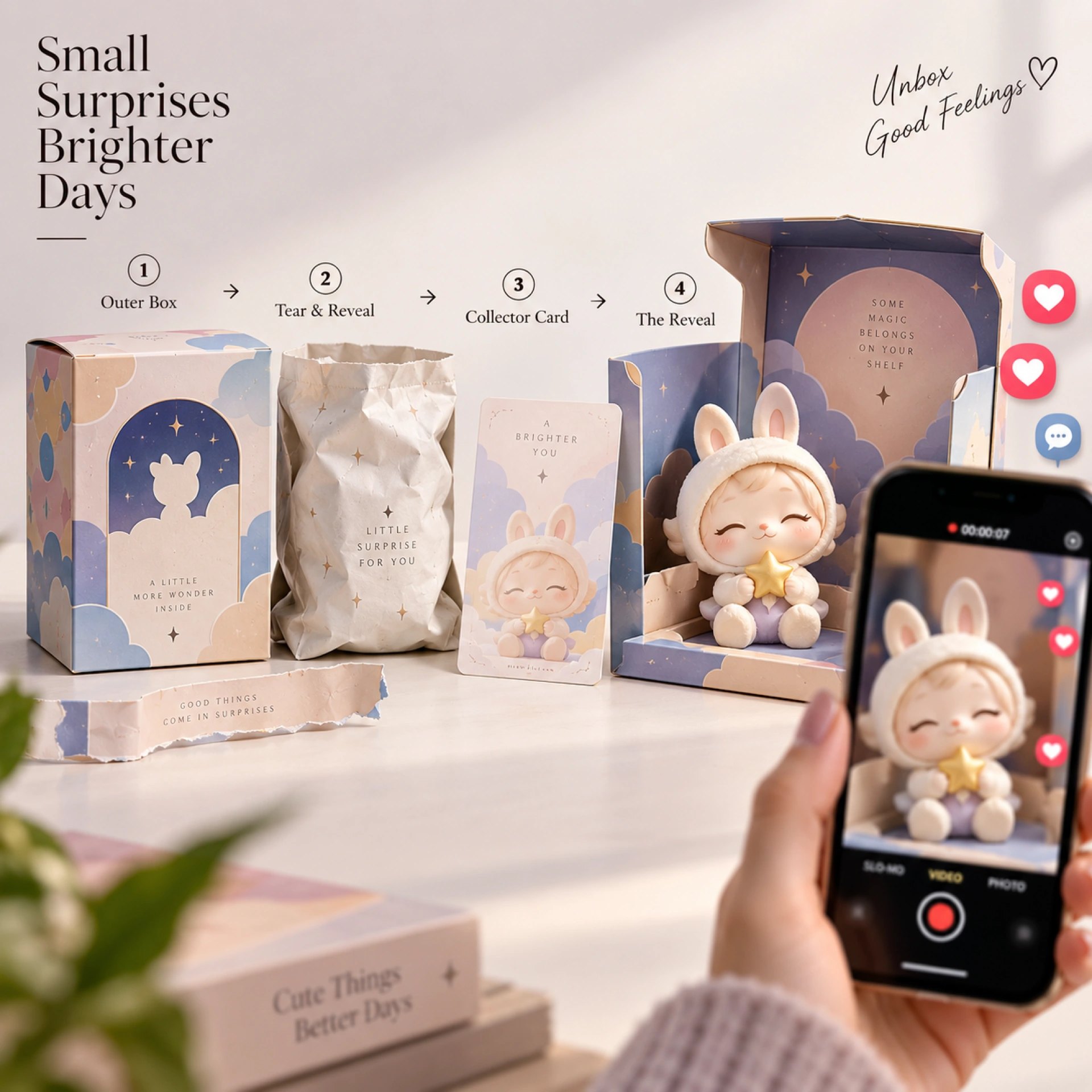
A strong Blind Box Unboxing Experience is designed through manufacturing decisions, not added later by marketing. The outer box must be recognizable on camera, the inner packaging must protect the blind effect, the reveal order should create a clear sequence, the collector card should add information without spoiling the figure, the materials should create a satisfying opening feel and sound, secret versions must not be identifiable from the package, and the full opening process should be easy to understand in a 10–20 second short video.
For brands developing blind box toys, the key question is therefore not only, “Does the packaging look good?” It is:
What does the customer see, touch, hear, open, and reveal—in what order?
That sequence should be considered together with box structure, inner bag, tray, card position, printing, figure protection, random packing, QC, and master carton planning.
A Blind Box Unboxing Experience that looks exciting in a rendering can still fail in production if the inner bag is difficult to open, the collector card reveals the character too early, the secret figure has a different weight, the tray blocks the figure from camera view, or the packaging creates too many unnecessary opening steps.
For buyers, the best approach is to design the Blind Box Unboxing Experience at the same time as the figure and packaging—not after the figure mold has already been completed.
If you are still planning the complete product workflow, our guide to the blind box figure manufacturing process explains how figure design, tooling, painting, packaging, assortment control, QC, and mass production work together.
Blind Box Unboxing Experience: Manufacturing Decisions at a Glance
| Unboxing Element | Manufacturing Decision | Main Risk |
|---|---|---|
| Outer Box | Shape, artwork, color, opening direction | Weak visual recognition |
| Inner Concealment | Foil bag, opaque film, paper blind bag | Figure can be identified before opening |
| Reveal Order | Card first, figure first, or staged reveal | Surprise is spoiled too early |
| Collector Card | Name, story, number, QR code | Wrong card or premature reveal |
| Packaging Sound | Paperboard, tear strip, film, friction | Opening feels cheap or awkward |
| Secret Version | Weight, bag, code, tray, carton ratio | Secret figure becomes detectable |
| Display Packaging | Fold-out panel, diorama, display tray | Structure becomes too complex |
| Social Media | Opening steps and camera orientation | Reveal takes too long or is visually unclear |
This table should be reviewed before the packaging BOM is locked.
1. Outer Box: Create Visual Recognition Before the Box Is Opened
The outer box is the first frame of the Blind Box Unboxing Experience.
In a retail store, it needs shelf recognition. On social media, it needs camera recognition.
A user may hold the package in front of a phone for only one or two seconds before opening it. The viewer should be able to identify:
- Brand
- Series
- Character universe
- Product category
- Visual style
without needing to read a long paragraph.
For manufacturing, that means the outer box should consider:
- Front-panel hierarchy
- Character artwork
- Series logo
- Brand logo
- Main background color
- Matte or gloss finish
- Spot UV
- Foil stamping
- Embossing
- Box orientation
- Opening direction
Color Consistency Matters
If six, eight, or twelve boxes form one blind box series, their packaging should feel visually connected.
Brands should define:
- Main series colors
- Accent colors
- Character colors
- Logo color
- Print finish
- Color tolerances
Using standardized references such as the Pantone Color Systems can help designers, brands, printers, and manufacturers communicate packaging colors more consistently.
But the factory should still approve physical printed samples because the same color can look different on:
- Uncoated paper
- Coated board
- Matte lamination
- Gloss lamination
- Metallic material
For licensed IP projects, color accuracy is especially important because the package often becomes the first visual touchpoint before the figure itself is revealed.
Outer Box Recognition Should Work Vertically
A common mistake is designing packaging only for a flat artwork file.
For a Blind Box Unboxing Experience intended for social media, the brand should also look at the real box through a vertical phone camera.
Ask:
- Is the logo visible when one hand holds the box?
- Is the series name readable?
- Does the main artwork sit on the front rather than the side?
- Does a thumb cover important information?
- Is the opening flap obvious?
- Does the box still look attractive in close-up?
These are small packaging decisions, but they directly affect user-generated opening videos.
For a wider packaging-development workflow, our custom toy packaging manufacturer guide explains how box structure, artwork, trays, labels, and production packaging should be planned before mass production.
2. Inner Concealment: Protect the Blind Effect
The second critical part of the Blind Box Unboxing Experience is concealment.
A blind box stops feeling “blind” if the customer can determine the figure before opening the inner pack.
Common concealment materials include:
- Opaque foil laminate bags
- Printed opaque plastic bags
- Paper blind bags
- Opaque mono-material film
- Wrapped inner packs
The manufacturer should evaluate:
- Opacity
- Tear strength
- Sealing
- Size
- Thickness
- Surface friction
- Product protection
- Opening feel
Concealment Is More Than Opacity
The inner package must prevent more than visual identification.
Customers may try to identify variants by:
- Feeling the shape
- Comparing bag dimensions
- Shaking the box
- Listening to loose accessories
- Comparing package weight
- Looking at production codes
That means concealment should be reviewed together with figure engineering and packing.
For example, if one character has a very long accessory, its inner bag should not suddenly be 20 mm longer than every other variant.
If the secret figure uses a different inner tray, buyers should check whether the outer box feels different when squeezed or shaken.
The Blind Box Unboxing Experience depends on keeping the surprise intact until the intended reveal moment.
Avoid Over-Packaging Just to Create Mystery
More layers do not automatically create a better experience.
A package with:
Box → plastic sleeve → tray → bag → second bag → card → figure
may feel unnecessarily complicated.
The better question is:
What is the minimum number of packaging layers needed to protect the figure and preserve secrecy?
This is where your packaging BOM becomes useful. Our guide to Packaging Bill of Materials for Toys explains how buyers should record the box, inner bag, tray, card, label, and master carton before production.
3. Reveal Order: Card First or Figure First?
Reveal order is one of the most overlooked decisions in a Blind Box Unboxing Experience.
There are three common options.
Option A: Figure First
Sequence:
Open box → Open inner bag → Reveal figure → Read collector card
This gives the strongest immediate surprise.
Advantages:
- Character appears quickly
- Strong for short-form video
- Collector card becomes secondary storytelling
- Less chance of the card spoiling the reveal
This is often the safest structure when the card shows the exact character.
Option B: Card First
Sequence:
Open box → Pull card → Read card → Open figure
This can work when the card creates anticipation but does not reveal the exact character.
For example, the card may contain:
- Series artwork
- General story
- QR code
- Character silhouette
- Hint
- Brand message
The risk is obvious: if the card says “Character No. 05 – Luna” before the bag is opened, the main surprise is already gone.
Option C: Controlled Two-Stage Reveal
Sequence:
Open box → Generic series card → Open bag → Reveal figure → Character-specific card appears
This gives the brand more storytelling options but requires more complicated packing.
The factory must ensure the correct character-specific card is paired with the correct figure.
For large blind box series, this adds packing and QC work.
The best reveal order depends on product strategy, but it should be decided before the final inner structure is approved.
Design the Reveal as a Sequence of Frames
For social media, buyers can think of the Blind Box Unboxing Experience as five frames:
| Frame | What Viewer Sees |
|---|---|
| 1 | Recognizable outer box |
| 2 | Opening flap / tear moment |
| 3 | Hidden inner package |
| 4 | Main character reveal |
| 5 | Collector card / secret indicator / display result |
If the important moment does not happen until frame 12, the packaging may be too complicated for short-form content.
4. Collector Card: More Than a Small Printed Insert
Collector cards are one of the easiest ways to extend the Blind Box Unboxing Experience after the figure is revealed.
A useful collector card can include:
- Character name
- Character story
- Series number
- Character number
- Rarity information
- Series artwork
- QR code
- Brand website
- Digital content
- Collection checklist
Character Name
The character name helps transform a figure from an anonymous object into part of an IP world.
The name should match:
- Box artwork
- Product database
- Retail SKU information
- Brand website
- Social media naming
Character Story
A short story can give the customer something to read or photograph after the reveal.
For example:
- Personality
- Character skill
- Short backstory
- Quote
- Series theme
Keep it short. A collector card is not a manual.
Series Number
Numbers create collection logic.
Examples:
03/08
or
Character 03 — Series 01
This helps customers immediately understand what they received and what remains to collect.
For secret figures, brands need to decide whether the secret card clearly identifies rarity or preserves some ambiguity.
QR Code
A QR code can connect the physical Blind Box Unboxing Experience with digital content.
Possible destinations include:
- Character page
- Animation
- AR experience
- Brand website
- Digital certificate
- Collection checklist
- Social campaign
- Behind-the-scenes video
For brands that want a standardized connection between physical product identifiers and online content, GS1 Digital Link provides a framework for connecting GS1 identifiers to digital information and services.
From a manufacturing perspective, buyers should confirm:
- QR code destination
- Final URL
- Printed size
- Contrast
- Placement
- Scan test
- Artwork version
Never approve a QR code only from the design file.
Print it at final size and scan production samples using multiple phones before mass printing.
5. Packaging Sound: The Hidden Part of the Unboxing Experience
A Blind Box Unboxing Experience is visual, but it is also tactile and acoustic.
Social media unboxing videos often capture:
- Box friction
- Flap opening
- Paper sliding
- Film crinkling
- Tear-strip sound
- Inner bag opening
- Tray removal
- Figure placement
These small sounds can contribute to ASMR-style content.
This does not mean factories should deliberately make packaging noisy.
The goal is to avoid packaging that feels weak, silent in an unsatisfying way, or awkward to open.
Paperboard Changes the Feel
Different paperboard specifications can create different opening experiences.
A firmer board may produce:
- Cleaner folds
- More structural resistance
- Sharper flap movement
A lighter board may feel:
- Softer
- Easier to crush
- Less premium
The exact specification should still be selected based on:
- Protection
- Printing
- Cost
- Box size
- Shipping requirements
—not sound alone.
Tear Strips
A well-designed tear strip can create one clear opening action.
Benefits may include:
- Obvious opening direction
- Tamper evidence
- Strong video moment
- Reduced need to destroy the entire box
But poor tear-strip engineering can:
- Tear artwork
- Leave paper fibers
- Fail halfway
- Expose sharp edges
- Make the box unusable for display
Always test the actual die-cut and board combination.
Inner Bag Sound
Foil laminate bags tend to produce a different sound from paper or softer plastic films.
Brands can evaluate opening feel during the prototype stage:
- Does it feel premium?
- Is it too difficult to tear?
- Does it tear unpredictably?
- Does the customer need scissors?
- Does tearing damage the figure?
The best Blind Box Unboxing Experience is easy enough to open naturally but controlled enough to preserve suspense.
6. Secret Version: Do Not Let the Packaging Leak the Answer
Secret figures are one of the hardest manufacturing parts of the Blind Box Unboxing Experience.
A secret figure should be rare because of assortment planning—not because customers can identify it by packaging differences.
Potential leakage points include:
- Different total weight
- Different box dimensions
- Different inner bag thickness
- Different tray
- Unique card position
- Different sound when shaken
- Printed production codes
- Different accessory movement
- Different carton position
Weight Leakage
Suppose normal figures weigh approximately 85–90 g packed, but the secret figure weighs 118 g.
Customers may quickly learn to compare boxes.
Possible engineering solutions include:
- Reducing unnecessary secret-version material
- Using similar bases
- Rebalancing accessory weight
- Reviewing packaging weight
- Designing the secret from a shared body
Do not add meaningless material only to manipulate weight without considering cost, sustainability, or product safety.
Instead, consider weight variation during the design stage.
Same External Packaging
The secret should normally use:
- Same outer box dimensions
- Same external artwork structure
- Same sealing method
- Same bag style
- Same label format
If the secret requires a different internal structure, the factory should check whether customers can detect it physically.
Our article on Blind Box Special Editions explains how secret figures, glow finishes, flocking, metallic paint, and other special variants can affect production and packaging.
Control Internal Codes
Factories need production traceability, but consumer-visible codes should be reviewed carefully if the brand wants to preserve secrecy.
The brand and factory should distinguish between:
- Required traceability information
- Internal carton identification
- Production lot code
- Consumer-facing SKU
- Variant code
Random packing should not accidentally create a simple public code that reveals every character.
Random Packing Matters
A good Blind Box Unboxing Experience depends on proper randomization.
Factories may need to manage:
- Normal figure ratio
- Secret figure ratio
- Full-set cartons
- Display cartons
- Individual random units
- Character/card matching
- Warehouse segregation
This is why random packing is a manufacturing operation, not just a marketing idea.
Our Blind Box Manufacturing Cost article explains how secret figures, packaging, QC, and random packing can also increase production cost.
7. Can the Packaging Become a Display or Diorama?
One way to extend the Blind Box Unboxing Experience is to make the packaging useful after opening.
Examples include:
- Fold-out background
- Interior scene artwork
- Character stage
- Small backdrop
- Connected boxes that form a larger scene
- Display stand integrated into the inner structure
This can increase perceived value without necessarily adding a separate plastic accessory.
For example:
The customer opens the box.
The inside panel folds backward.
The character stands in front of printed scenery.
The package becomes a photo background.
This creates an immediate second content moment after the reveal.
Manufacturing Questions for Diorama Packaging
Before approving the concept, ask:
- Does the board remain flat after folding?
- Does the printed surface crack on fold lines?
- Can the figure stand securely?
- Does the box still protect the product during transport?
- Does the structure require extra glue?
- Does it increase packing labor?
- Can customers understand the transformation without instructions?
- Can the opened structure fit within a phone camera frame?
Diorama packaging must still work as shipping packaging.
Brands should not weaken the retail box just to create a display gimmick.
For transport validation, the International Safe Transit Association test procedures provide standardized approaches for evaluating packaged-product systems under transport-related stresses. The appropriate test method depends on the product, package, and distribution environment.
8. Design the Opening Moment for a 10–20 Second Video
The Blind Box Unboxing Experience should work in real life first. But if social sharing matters, brands can also evaluate whether the opening sequence fits naturally into a 10–20 second video.
This is not a social-platform rule.
It is a useful product-design target.
A simple sequence might be:
0–2 seconds
Show outer box.
2–5 seconds
Open flap or tear strip.
5–8 seconds
Remove inner blind bag.
8–12 seconds
Open bag.
12–15 seconds
Reveal figure.
15–20 seconds
Show collector card and final display pose.
This structure creates:
Recognition → Anticipation → Reveal → Confirmation
The manufacturing challenge is removing unnecessary dead time.
Avoid These Video-Unfriendly Packaging Problems
Too Much Tape
If the consumer spends 15 seconds removing tape, the opening moment disappears.
Difficult Inner Bag
If scissors are needed, the reveal becomes interrupted.
Figure Facing Backward
If the customer removes the tray and the character is facing away from the camera, the first reveal is weak.
The factory can control figure orientation during packing.
Collector Card Covers the Figure
If the card is placed directly over the product, the customer may reveal the card before the figure.
Multiple Loose Components
Accessories falling onto a table may make the reveal look messy and create missing-part complaints.
Excessive Instructions
A blind box collectible should normally be understandable without a long setup process unless the product itself needs assembly.
The Figure Should Be Camera-Ready at First Reveal
Social-media-friendly packaging does not mean creating a “TikTok package.”
It means designing the physical reveal clearly.
When the inner bag opens, consider whether:
- Character face is visible
- Major accessory is already attached
- Pose is understandable
- Paint looks clean
- Product can stand quickly
- Base is easy to install
- Packaging debris does not cover the figure
If the product needs five minutes of assembly before it looks good, the immediate unboxing value is reduced.
For figure manufacturing quality, our guide to PVC figure quality control explains how paint defects, facial printing, mold lines, assembly, packaging, and inspection standards should be controlled before shipment.
Build the Blind Box Unboxing Experience Into the Packaging Prototype
Do not wait until mass production to test the opening sequence.
The packaging prototype should be physically opened by people who were not involved in designing it.
Ask them to:
- Pick up the package.
- Find the opening point.
- Open it without instructions.
- Remove the internal package.
- Reveal the figure.
- Find the card.
- Place the figure on display.
Observe:
- Where do they hesitate?
- What do they tear accidentally?
- What appears first?
- What do they put aside?
- Do they understand the card?
- Can they stand the figure quickly?
- Does anything spoil the secret?
That practical trial often reveals problems that packaging artwork cannot show.
Blind Box Unboxing Experience Prototype Checklist
| Checkpoint | Question |
|---|---|
| Front Recognition | Can the brand/series be identified immediately? |
| Opening Direction | Does the user know where to open? |
| Concealment | Can the character be guessed before the intended reveal? |
| Opening Time | Are there unnecessary packaging steps? |
| Reveal Order | Does the figure or card appear at the correct moment? |
| Inner Bag | Is it easy to open but strong enough for transport? |
| Figure Orientation | Does the character face the customer naturally? |
| Card Accuracy | Is the correct card matched to the correct figure? |
| QR Code | Does it scan at production size? |
| Secret Version | Are weight, codes, bag, and tray differences controlled? |
| Display Use | Can packaging become a useful display if intended? |
| Camera View | Is the main reveal clear in a vertical frame? |
| Transport | Does the package still protect the figure? |
This checklist converts the Blind Box Unboxing Experience from a creative concept into measurable manufacturing decisions.
Packaging BOM Should Match the Unboxing Sequence
Once the Blind Box Unboxing Experience is approved, the structure should be documented in the packaging BOM.
For example:
| Sequence | Component | Specification to Lock |
|---|---|---|
| Step 1 | Outer Box | Board, dimensions, print, coating, opening flap |
| Step 2 | Inner Blind Bag | Material, thickness, opacity, tear method |
| Step 3 | Tray / Insert | Material, fit, product orientation |
| Step 4 | Collector Card | Size, print, character matching |
| Step 5 | QR Code | Destination and scan verification |
| Step 6 | Display Feature | Fold line, tab, slot, printed scene |
| Shipping | Master Carton | Quantity, protection, assortment |
When suppliers change one of these components, the opening experience may change as well.
For example:
- Changing bag film may alter opening strength.
- Changing tray depth may change product orientation.
- Changing box board may affect tear-strip performance.
- Changing card size may alter reveal order.
This is why packaging changes after approval should be controlled.
Balance Social-Media Appeal With Sustainability
Social-media-friendly packaging should not automatically mean more layers, more plastic, more inserts, and more decorative components.
A better Blind Box Unboxing Experience can sometimes come from simplifying the structure.
Examples:
- One well-designed reveal flap instead of two sleeves
- Printed interior artwork instead of a separate diorama card
- A combined collector/story card
- A paper structural insert instead of unnecessary decorative plastic
- A QR code for optional extended digital content
For buyers comparing packaging materials and reduction strategies, our Sustainable Blind Box Manufacturing guide discusses paper alternatives, recycled materials, packaging decisions, and buyer risks.
If certified paper claims are part of the packaging strategy, buyers can also review official FSC Chain of Custody certification, which addresses how certified forest-based materials are tracked through the supply chain.
QC for a Blind Box Unboxing Experience
Final QC should not inspect only whether the figure is inside the box.
The factory should check whether the complete experience matches the approved sample.
Possible checks include:
- Correct outer artwork
- Correct box orientation
- Correct inner bag
- Bag sealing quality
- Correct figure
- Correct collector card
- Correct series number
- Working QR code
- Correct tray orientation
- No visible clue to secret variant
- Correct random assortment
- Easy flap opening
- No crushed retail box
- No paint rubbing from the tray
- No loose accessories damaging the figure
For secret figures, QC must be strict enough to control ratios without creating packaging differences that expose the secret.
The approved packaging sample should therefore be retained as a production reference, just like the approved painted figure sample.
How Jiahong Creative Supports Blind Box Packaging and Unboxing Development
Jiahong Creative supports blind box development from character artwork, 3D modeling, prototype development, mold making, PVC production, painting, assembly, packaging, random packing, QC, and shipment preparation.
For a Blind Box Unboxing Experience, packaging development can be reviewed together with the figure rather than treated as a separate final step.
We can help buyers evaluate:
- Outer box structure
- Artwork presentation
- Inner concealment
- Inner bag size
- Product orientation
- Tray structure
- Collector card placement
- QR code position
- Secret figure packaging
- Display packaging concepts
- Random packing
- Packaging QC
- Master carton protection
If the project includes a licensed IP, the unboxing experience can also be coordinated with approved character colors, logos, series artwork, storytelling, and collector information. Our guide on how to choose a custom toy manufacturer for licensed IP products explains why product and packaging approval should be managed together.
For brands preparing a new blind box series, the best time to discuss unboxing is before packaging tooling, printing, and production specifications are locked.
You can share your character artwork, number of designs, secret figure plan, target figure size, packaging concept, collector-card idea, quantity, and retail market through our blind box manufacturing inquiry.
Final Thoughts
A successful Blind Box Unboxing Experience is not created by adding expensive packaging after the figure is finished.
It is created by controlling the sequence:
Outer Box → Opening Action → Concealment → Reveal → Collector Information → Display
The outer box should create immediate recognition. The inner packaging should preserve the blind effect. The reveal order should protect the surprise. Collector cards should extend the character story without spoiling the opening. Material and structural decisions can create satisfying tactile and acoustic feedback. Secret variants must not be exposed by weight, codes, trays, bags, or carton logic. Display packaging can extend the experience after opening, and the full reveal should be clear enough to work naturally in short-form video.
Most importantly, the Blind Box Unboxing Experience must still survive manufacturing reality.
The packaging must print consistently, pack efficiently, protect the figure, pass shipping evaluation, support random assortment, and remain easy for the customer to open.
When brands design those requirements together from the beginning, the package does more than contain the collectible. It becomes part of the collectible experience itself.
FAQ
1. What is a Blind Box Unboxing Experience?
A Blind Box Unboxing Experience is the sequence a customer goes through from seeing the outer box to opening the package, revealing the hidden figure, viewing the collector card, and displaying the final collectible. Manufacturing decisions such as box structure, inner bags, trays, card placement, secret-figure control, and packaging materials all influence that experience.
2. How should brands design a Blind Box Unboxing Experience for social media?
Brands should create a simple sequence with strong visual recognition, one clear opening action, concealed inner packaging, a fast character reveal, and a final collector-card or display moment. A 10–20 second sequence is a useful design target for short-form content, although it is not a platform requirement.
3. Should the collector card appear before or after the blind box figure?
If the card identifies the exact character, it is usually better to reveal the figure first. If the card contains only general series artwork, story content, or a QR code, it can appear earlier without spoiling the surprise.
4. What information should be included on a blind box collector card?
A collector card may include the character name, story, series number, character number, artwork, collection information, rarity information, and QR code linking to digital content.
5. How do manufacturers keep secret figures from being identified before opening?
Manufacturers should review total package weight, box dimensions, inner bag, tray structure, external codes, loose accessories, and carton packing. Secret versions should avoid obvious physical or printed differences that reveal the figure before opening.
6. Why is the inner bag important to the Blind Box Unboxing Experience?
The inner bag preserves secrecy and protects the figure. Buyers should confirm opacity, dimensions, strength, opening method, sealing, product protection, and whether the bag creates unwanted clues about the character inside.
7. Can blind box packaging create ASMR-style opening sounds?
Yes. Paperboard movement, tear strips, inner-film crinkling, sliding inserts, and other physical interactions can create natural opening sounds. However, material choices should still prioritize protection, manufacturability, cost, and customer usability.