

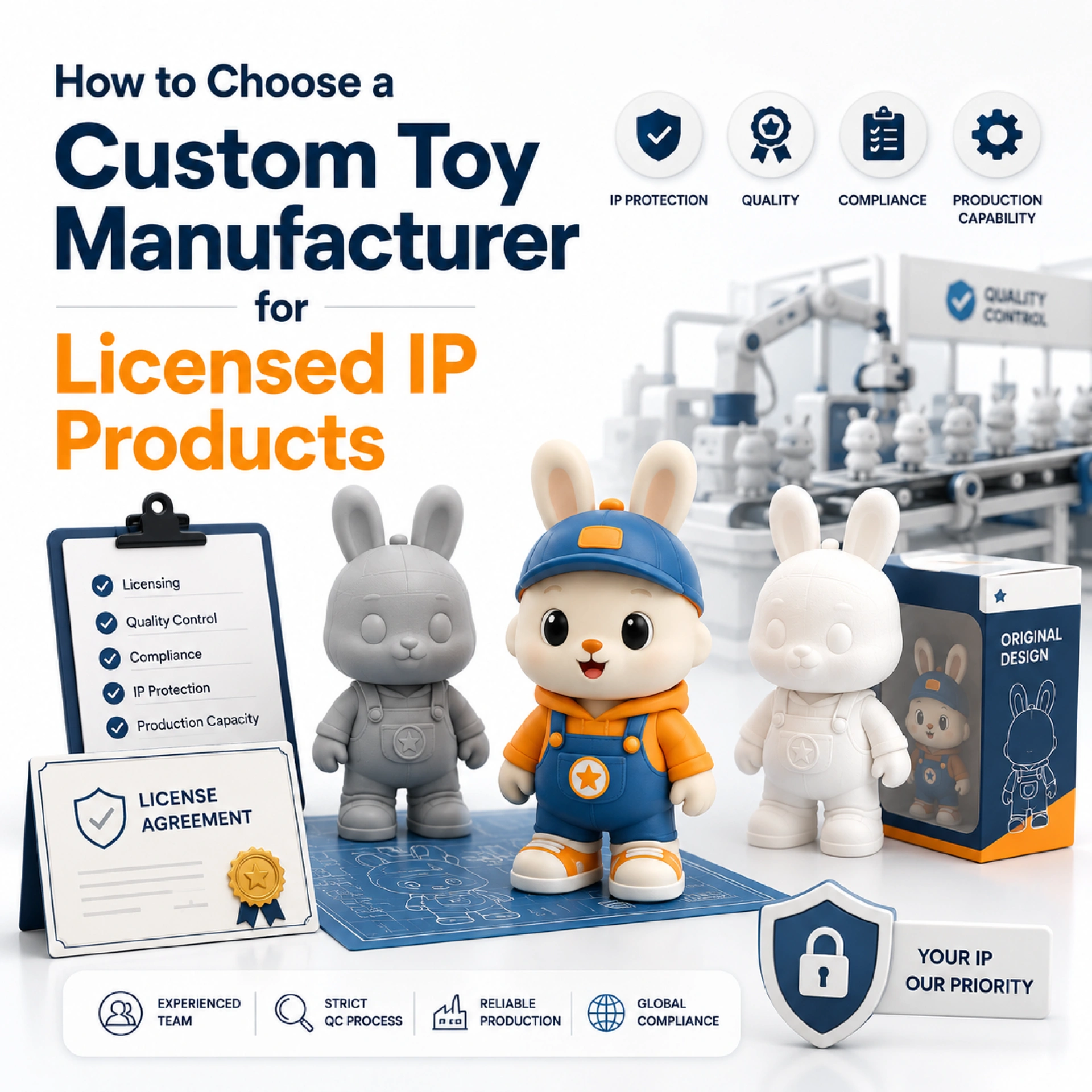
To Choose a Custom Toy Manufacturer for Licensed IP Products, brands should evaluate more than price. The right manufacturer should understand IP confidentiality, licensed character approval, artwork accuracy, 3D modeling, mold making, material selection, painting quality, packaging consistency, safety compliance, and mass production control. For licensed IP products, the factory must not only make toys; it must protect the brand image behind the toy.
Licensed IP products are different from ordinary custom toys. A regular toy project may focus mainly on cost, quantity, and production time. A licensed IP toy project must also follow the original character style guide, protect intellectual property, maintain color accuracy, control packaging presentation, and pass approval from the IP owner or brand team.
This is why brands need a clear process to Choose a Custom Toy Manufacturer for Licensed IP Products. The manufacturer should be able to turn approved artwork into production-ready figures, blind box toys, mascot merchandise, character night lights, electronic gifts, or retail products while keeping the final product consistent with the original IP identity.
For brand owners, animation studios, game companies, licensors, licensees, retailers, distributors, and promotional product buyers, the choice of manufacturer can directly affect product quality, fan response, compliance risk, launch schedule, and long-term brand value.
If your project is still at the early stage, working with an experienced IP licensed product manufacturer can help you review artwork, product structure, manufacturing feasibility, packaging direction, and quality control before mass production.
Why Licensed IP Products Need a Different Manufacturing Standard
Licensed IP products carry brand value. A character, mascot, logo, game figure, animation character, or cartoon design may already have an established fan base. Customers may recognize small differences in the face, color, pose, logo, or packaging. If the final toy does not match the original character, the product may damage trust instead of building brand value.
This is why brands should carefully Choose a Custom Toy Manufacturer for Licensed IP Products. The manufacturer must understand that the goal is not simply to create a similar-looking product. The goal is to reproduce the character identity in a physical product while respecting the approved design, production limits, safety requirements, and retail expectations.
Licensed IP projects may involve:
- Character figures
- Blind box toys
- Mascot figures
- PVC collectibles
- Soft vinyl figures
- Keychain figures
- Character night lights
- Character humidifiers
- Bluetooth speakers
- Aroma diffusers
- Kids electronic gifts
- Promotional merchandise
- Retail packaging sets
Each product type requires different production knowledge. A PVC figure manufacturer may be strong in molding and painting, but a character electronic product also needs PCBA, battery, LED, speaker, assembly, and testing experience. A blind box manufacturer may need series planning, random packing, inner bags, cards, and packaging control.
When brands Choose a Custom Toy Manufacturer for Licensed IP Products, they should match the supplier’s real capabilities with the product type.
Start with IP Protection and Authorization
Before production begins, brands should confirm that they have the right to develop the licensed product. This may involve a license agreement, authorization letter, approved artwork, territory rights, product category rights, and sales channel restrictions.
The World Intellectual Property Organization explains that IP assignment and licensing are ways for IP owners to allow others to use intellectual property rights and generate business value. For licensed toy production, this means the buyer should clarify what can be produced, where it can be sold, and how the IP can be used on products and packaging.
A professional manufacturer should respect IP confidentiality. Before sharing sensitive artwork, 3D files, character guides, or unreleased product designs, buyers may ask the manufacturer to sign an NDA. For licensed IP products, this is especially important because leaked designs can affect marketing plans, product launches, and brand trust.
When you Choose a Custom Toy Manufacturer for Licensed IP Products, ask how the factory manages confidential files. The manufacturer should have a clear process for artwork review, sample approval, internal communication, and file protection.
Check Licensed Product Experience
Experience matters. A manufacturer that has handled licensed character products before will usually understand approval workflows better than a factory that only makes generic plastic toys.
Licensed IP products often require multiple approval stages:
- Artwork approval
- 3D model approval
- Prototype sample approval
- Color sample approval
- Packaging artwork approval
- Pre-production sample approval
- Mass production sample approval
- Final shipment inspection
A manufacturer with licensed product experience will understand why each approval step is important. It will also know that changes cannot be made casually after approval. For example, changing a color, modifying a face shape, adjusting a logo, or simplifying a packaging element may require approval from the IP owner.
When brands Choose a Custom Toy Manufacturer for Licensed IP Products, they should ask whether the supplier has worked with character products, animation IP, game IP, brand mascots, retail merchandise, or promotional licensed products before.
If your brand is developing game-related IP products, our article on custom toys for game companies explains how character art, 3D modeling, sampling, and figure production work together.
Evaluate Character Accuracy
Character accuracy is one of the most important factors in licensed IP manufacturing. A toy can be well made but still fail if the character does not look right.
For example, the eyes may be slightly wrong, the head may be too large, the body proportion may feel off, the expression may not match the original character, or the brand color may be inaccurate. These small details can make a major difference to fans and licensors.
To Choose a Custom Toy Manufacturer for Licensed IP Products, brands should check whether the factory can work from official style guides, 2D artwork, Pantone colors, reference images, 3D files, and packaging guidelines.
A strong manufacturer should be able to help with:
- 2D artwork review
- 3D sculpting
- Character proportion adjustment
- Expression correction
- Accessory modeling
- Color matching
- Painting process planning
- Packaging style matching
- Sample revision
If your brand only has 2D character artwork, you can read our guide on how to turn 2D character art into a custom toy figure to understand how flat artwork becomes a production-ready figure.
Review 3D Modeling and Engineering Capability
Many licensed IP products begin with 2D artwork, but toys are physical products. The manufacturer must translate the design into a 3D model that looks correct and can be produced.
A display render is not enough. A production-ready 3D model must consider mold direction, part separation, wall thickness, balance, assembly, painting areas, accessories, and packaging fit.
When brands Choose a Custom Toy Manufacturer for Licensed IP Products, they should ask whether the supplier can support both creative 3D modeling and engineering review. This is important because licensed characters often include complex shapes, expressive poses, detailed clothing, accessories, or unusual proportions.
For custom PVC figures, engineering review can help prevent problems such as:
- Parts that are too thin
- Sharp points
- Weak accessory connections
- Poor balance
- Difficult painting areas
- Mold undercuts
- Visible assembly gaps
- Packaging mismatch
A good manufacturer will not simply say “yes” to every design. It should explain which details can be preserved, which details need adjustment, and how to keep the character accurate while making the product manufacturable.
Compare Material and Production Capabilities
Different licensed IP products require different materials. A mini blind box figure may use PVC. A larger hollow collectible may use vinyl. A hard structural part may use ABS. A soft night light may use silicone. A character electronic gift may combine plastic, silicone, PCBA, LED, speaker, and battery components.
To Choose a Custom Toy Manufacturer for Licensed IP Products, buyers should review whether the factory has the right production capabilities for the target product.
Common production capabilities may include:
- Mold making
- Injection molding
- PVC figure production
- Silicone molding
- Spray painting
- Pad printing
- Hand painting
- Screen printing
- Heat transfer printing
- PCBA assembly
- LED and battery assembly
- Final assembly
- Packaging
- Quality inspection
If your project involves PVC figures, material choice is important. Our article on PVC vs vinyl vs ABS figures explains how different materials affect appearance, durability, cost, and production method.
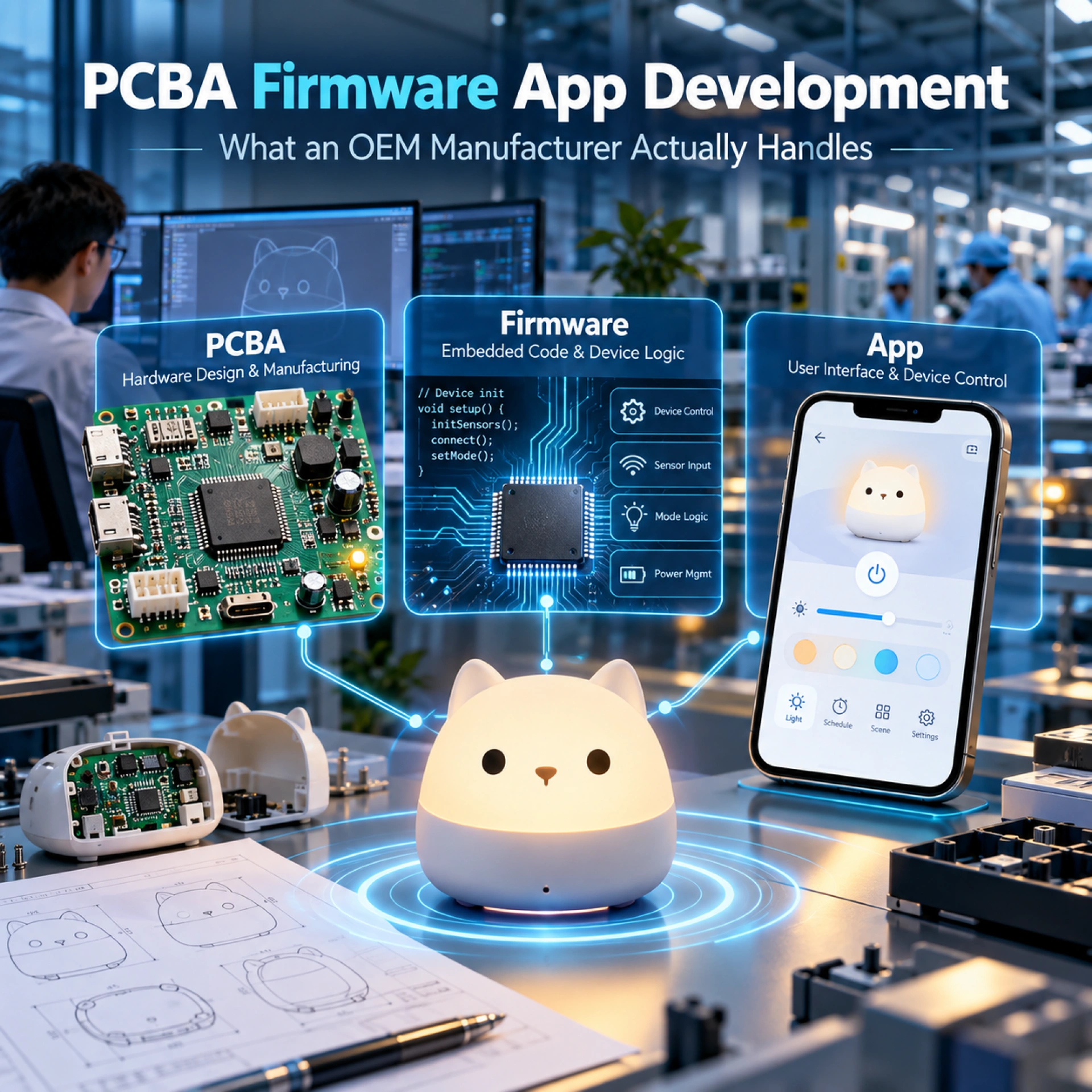
If your licensed IP product is an electronic gift, such as a night light, speaker, humidifier, or sleep training alarm clock, you should also review whether the manufacturer has electronics and assembly experience. A factory that only makes figures may not be enough for multifunctional IP products.
Check Painting and Color Control
Painting is one of the most visible parts of licensed IP product quality. A character product may require exact eye details, facial lines, clothing colors, logo placement, gradients, metallic effects, matte surfaces, or special coatings.
When brands Choose a Custom Toy Manufacturer for Licensed IP Products, they should ask how the factory controls paint quality and color consistency. The factory should be able to work with Pantone references, approved color samples, and production standards.
Important painting checks include:
- Color matching
- Paint position accuracy
- Paint adhesion
- Logo printing clarity
- Facial detail sharpness
- Surface cleanliness
- Overspray control
- Hand-painting consistency
- Batch-to-batch color stability
For licensed products, even small color differences can affect approval. A character’s face, costume, logo, or signature color must be consistent with the IP guidelines.
You can also review our guide on PVC figure painting methods to understand how spray painting, pad printing, hand painting, and other decoration methods affect the final result.
Packaging Must Match the Licensed IP
Packaging is part of the licensed product experience. A character toy with weak packaging may look less valuable, even if the figure itself is good. For licensed IP products, packaging should match the visual identity, brand guidelines, product positioning, and retail channel.
When buyers Choose a Custom Toy Manufacturer for Licensed IP Products, they should check whether the manufacturer can coordinate product and packaging together. This is especially important for blind boxes, retail boxes, gift boxes, window boxes, and character electronic products.
Packaging should consider:
- Official logo placement
- Character artwork
- Product name
- Series name
- Brand colors
- Legal text
- Warning labels
- Barcode
- QR code
- Retail display requirements
- Inner tray protection
- Carton packing
- Language versions
- Importer or distributor information
For licensed IP projects, packaging approval is often as important as product approval. The packaging must not use unapproved artwork, wrong colors, incorrect logos, or inconsistent character style.
If your project includes retail packaging or blind box packaging, our guide on custom toy packaging manufacturer explains what brands should prepare before packaging development.
Confirm Safety and Compliance Awareness
Licensed IP products are often sold through formal retail channels, distributors, e-commerce platforms, museums, events, and brand stores. This means safety and compliance requirements cannot be ignored.
The exact requirements depend on the product type, intended age group, sales market, and function. A display collectible for adults may be different from a children’s toy. A PVC figure may be different from a Bluetooth speaker or rechargeable night light.
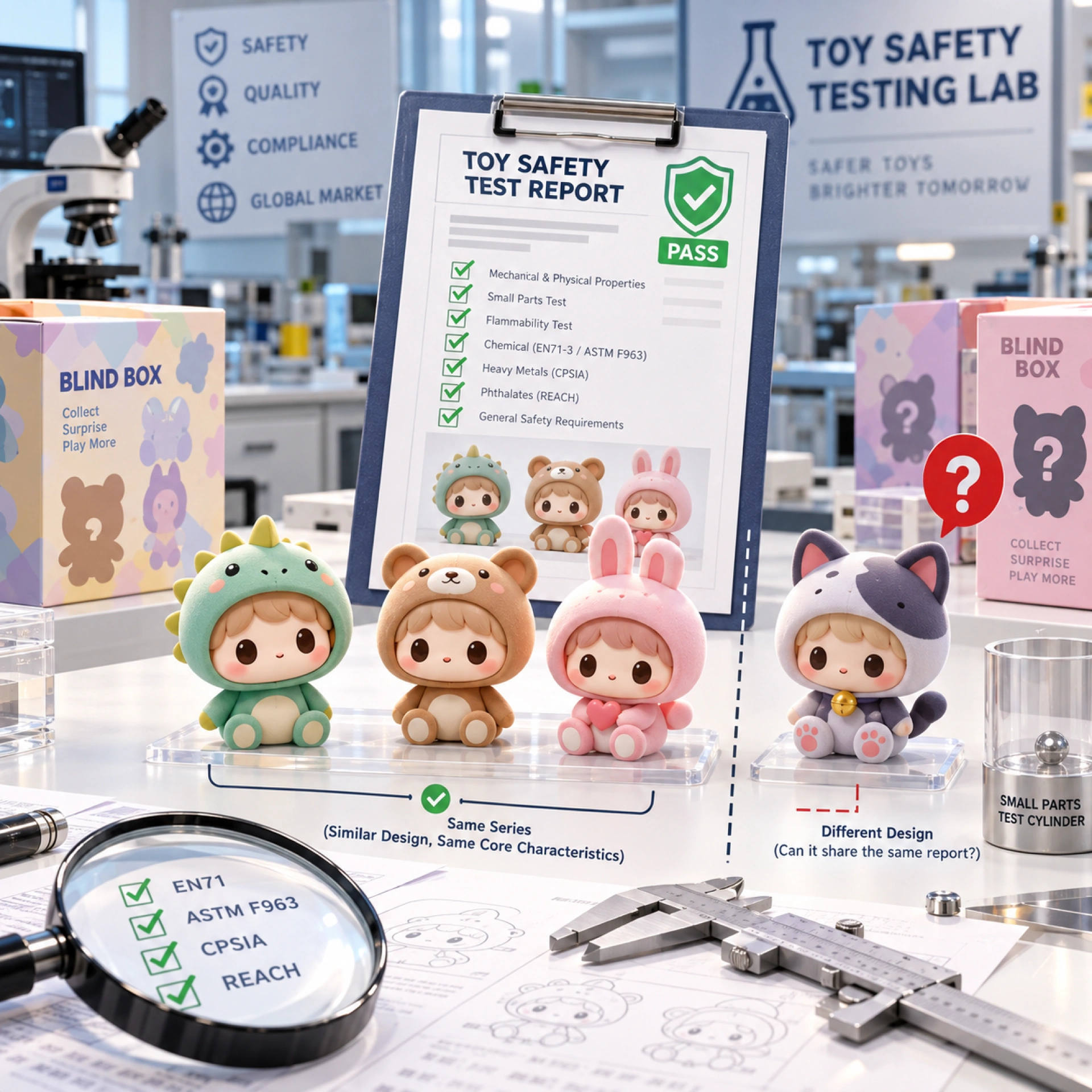
For the U.S. market, the Consumer Product Safety Commission provides official guidance on toy safety. For Europe, buyers may need to consider toy safety, CE marking, EN71, RoHS, and other requirements depending on product type.
If your licensed IP products are intended for the European market, our guide on EN71 custom toys explains what European buyers should prepare before production.
To Choose a Custom Toy Manufacturer for Licensed IP Products, buyers should ask whether the supplier can prepare samples for third-party testing, provide material information, support packaging label review, and maintain consistency between tested samples and mass production.
Ask About Quality Control Process
Quality control is critical for licensed IP products because the product carries a brand image. A defect is not just a production problem. It can become a brand reputation problem.
When brands Choose a Custom Toy Manufacturer for Licensed IP Products, they should ask how QC is managed at each stage.
Important QC points include:
- Raw material inspection
- Mold trial review
- First article inspection
- Injection part inspection
- Surface inspection
- Painting inspection
- Printing inspection
- Assembly inspection
- Function testing for electronic products
- Packaging inspection
- Carton drop or transport simulation
- Final random inspection
- Shipment sample retention
The factory should compare mass production against approved samples. For licensed products, the approved sample is not only a quality reference. It is also an IP approval reference.
A reliable manufacturer should be able to keep production consistent from sample approval to final shipment.
Review Communication and Project Management
Licensed IP projects usually involve more communication than ordinary OEM products. The buyer, licensor, licensee, designer, manufacturer, packaging team, testing lab, and logistics team may all be involved.
This is why project management matters. To Choose a Custom Toy Manufacturer for Licensed IP Products, buyers should evaluate how the supplier communicates during sampling, revisions, approval, production, and shipment.
A good manufacturer should provide:
- Clear quotation breakdown
- Realistic development timeline
- Design feasibility feedback
- Sample revision tracking
- Photo and video updates
- Approval document control
- Production schedule updates
- QC reporting
- Packaging confirmation
- Shipment coordination
Poor communication can cause delays, wrong samples, repeated revisions, and approval problems. For licensed IP products, every delay can affect launch timing and marketing plans.
Compare Factory Capability, Not Only Price
Price is important, but it should not be the only factor. The cheapest supplier may not be the best choice for licensed IP products. A low quotation may hide problems such as weak 3D modeling, poor paint control, no packaging support, limited QC, or unstable production.
When you Choose a Custom Toy Manufacturer for Licensed IP Products, compare the total value of the supplier.
Important questions include:
- Can the factory protect confidential IP files?
- Does it understand licensed character approval?
- Can it support 2D to 3D development?
- Does it have mold making capability?
- Can it produce PVC, ABS, silicone, or electronic products?
- Can it control painting and color matching?
- Can it support packaging development?
- Can it prepare samples for testing?
- Does it have QC throughout production?
- Can it handle communication professionally?
- Does it understand export requirements?
The right manufacturer should help reduce risk, not only reduce unit price.
Licensed IP Product Manufacturer Checklist
Before choosing a supplier, brands can use this checklist:
| Evaluation Item | Why It Matters |
|---|---|
| IP confidentiality | Protects artwork, character files, and launch plans |
| Licensed product experience | Helps manage approval workflow |
| 3D modeling support | Converts artwork into production-ready products |
| Engineering review | Reduces mold and production risks |
| Material capability | Matches product type and quality requirements |
| Painting control | Maintains character accuracy |
| Packaging support | Keeps product and brand presentation consistent |
| Compliance awareness | Supports market entry and testing preparation |
| QC process | Controls batch quality and reduces defects |
| Project communication | Keeps timeline and approvals under control |
| Production capacity | Supports order quantity and delivery planning |
| Export experience | Helps with packaging, shipment, and documents |
This checklist can help brands Choose a Custom Toy Manufacturer for Licensed IP Products with a more professional and risk-controlled process.
Common Mistakes to Avoid
Choosing Based Only on Low Price
Low price may create hidden risks in licensed IP projects. If the final product fails approval or looks different from the character guide, the project may cost more in revisions and delays.
Sharing IP Files Without Protection
Before sharing confidential artwork or unreleased character designs, buyers should consider NDA protection and supplier reliability.
Ignoring 3D Model Approval
If the 3D model is not carefully reviewed, the final toy may have wrong proportions, facial expression, or details.
Treating Packaging as a Separate Step
For licensed products, packaging should match the product and IP identity. It should be developed early, not after mass production begins.
Skipping Pre-Production Samples
A pre-production sample helps confirm that the factory can produce the approved product consistently before full mass production.
Assuming One Factory Can Make Every Product Type
Some factories are strong in PVC figures but weak in electronics. Some are good at simple plastic toys but not licensed character products. Buyers should match the supplier to the product category.
How Jiahong Creative Supports Licensed IP Product Projects
Jiahong Creative supports custom PVC figures, blind box toys, mascot figures, character merchandise, and IP-themed creative household products. Our team can help brands review artwork, create or optimize 3D models, develop prototypes, plan molds, produce plastic or silicone parts, coordinate painting, assemble products, inspect quality, and prepare packaging.
For licensed IP product projects, we focus on character accuracy, production feasibility, packaging consistency, and quality control. We can support brands that want to develop figures, blind boxes, night lights, humidifiers, speakers, alarm clocks, aroma diffusers, and other character-based products.
If you are preparing to Choose a Custom Toy Manufacturer for Licensed IP Products, you can contact us through our custom toy project inquiry page. Please share your character artwork, style guide, target product type, size, quantity, packaging direction, sales market, and approval requirements.
Final Thoughts
Learning how to Choose a Custom Toy Manufacturer for Licensed IP Products is important for any brand that wants to turn characters, mascots, games, animations, or licensed artwork into physical products. The right manufacturer should understand not only production, but also IP confidentiality, character accuracy, approval workflow, packaging consistency, compliance preparation, and quality control.
Licensed IP products carry more responsibility than ordinary toys. They represent the brand behind the character. A poor product can weaken fan trust, while a well-developed product can strengthen brand value, create new revenue opportunities, and support long-term merchandise development.
The best approach is to review the manufacturer’s capabilities before starting production. Check experience, design support, engineering capability, material options, painting quality, packaging support, compliance awareness, QC process, and communication. When these factors are aligned, it becomes much easier to Choose a Custom Toy Manufacturer for Licensed IP Products and develop market-ready merchandise with confidence.
FAQ
1.How do I Choose a Custom Toy Manufacturer for Licensed IP Products?
To Choose a Custom Toy Manufacturer for Licensed IP Products, evaluate the supplier’s IP confidentiality, licensed product experience, 3D modeling capability, mold making, material options, painting quality, packaging support, compliance awareness, QC process, and communication.
2.Why are licensed IP products different from ordinary custom toys?
Licensed IP products must match approved character artwork, brand guidelines, packaging rules, and quality expectations. They also require stronger file protection, approval control, color accuracy, and brand consistency.
3.What should I prepare before contacting a manufacturer for licensed IP toys?
You should prepare character artwork, style guide, authorization information, target product type, product size, quantity, color references, packaging requirements, target market, approval process, and expected timeline.
4.Does the manufacturer need experience with licensed character products?
Yes. It is better to work with a manufacturer that understands licensed product approval, character accuracy, packaging consistency, and production control. This can reduce revision time and approval risk.
5.Can a manufacturer help turn 2D IP artwork into a toy figure?
Yes. A professional manufacturer can help convert 2D artwork into a 3D model, make a prototype sample, adjust structure, open molds, confirm colors, and prepare the product for mass production.
6.How can Jiahong Creative help licensed IP product brands?
Jiahong Creative can support artwork review, 3D modeling, prototyping, mold making, PVC figure production, painting, assembly, packaging, quality inspection, and shipment for licensed IP products, character merchandise, blind boxes, and creative IP household products.