

Introduction
For European buyers, developing custom toys is not only a creative or commercial project. It is also a compliance project. Whether the product is a PVC figure, blind box toy, mascot figure, collectible character product, promotional toy, or IP-related gift, safety requirements must be considered from the beginning of product development.
This is why EN71 custom toys should be planned carefully before sampling and mass production. EN71 is a key group of European toy safety standards used to evaluate whether toys meet essential safety requirements for the EU market. For importers, distributors, brand owners, and retailers, EN71 is not a final step that can be handled only after production. It should influence design, materials, structure, painting, small parts, packaging, warning labels, and documentation.
European buyers often ask whether a custom toy can “pass EN71.” This is an important question, but it should be asked in a more detailed way. A manufacturer and buyer should clarify what type of toy is being developed, which age group it is intended for, which materials are used, whether the toy has small detachable parts, whether it includes electronics, whether it is scented, whether it contains liquid, and which EU market requirements apply.
The European Commission states that toys placed on the EU market must be safe and that only toys bearing CE marking can be placed on the EU market. CE marking indicates compliance with EU safety requirements. This means EN71 custom toys require both product testing and compliance preparation, not just attractive design.
If you are still at the early design stage, working with a custom PVC toy manufacturer can help you review product structure, materials, painting methods, assembly, packaging, and testing risks before tooling begins.
What Does EN71 for Custom Toys Means?
EN71 refers to a series of European standards for toy safety. These standards support the EU Toy Safety Directive and help manufacturers demonstrate conformity with essential safety requirements. The European Commission explains that the Toy Safety Directive sets essential safety requirements, while the technical details are developed by European standardisation organisations such as CEN and CENELEC.
For EN71 custom toys, this means the toy should not be evaluated only by appearance. A cute design, good paint quality, or accurate character shape is not enough. The product must also be reviewed for mechanical safety, physical structure, flammability, chemical migration, labeling, and other relevant risks.
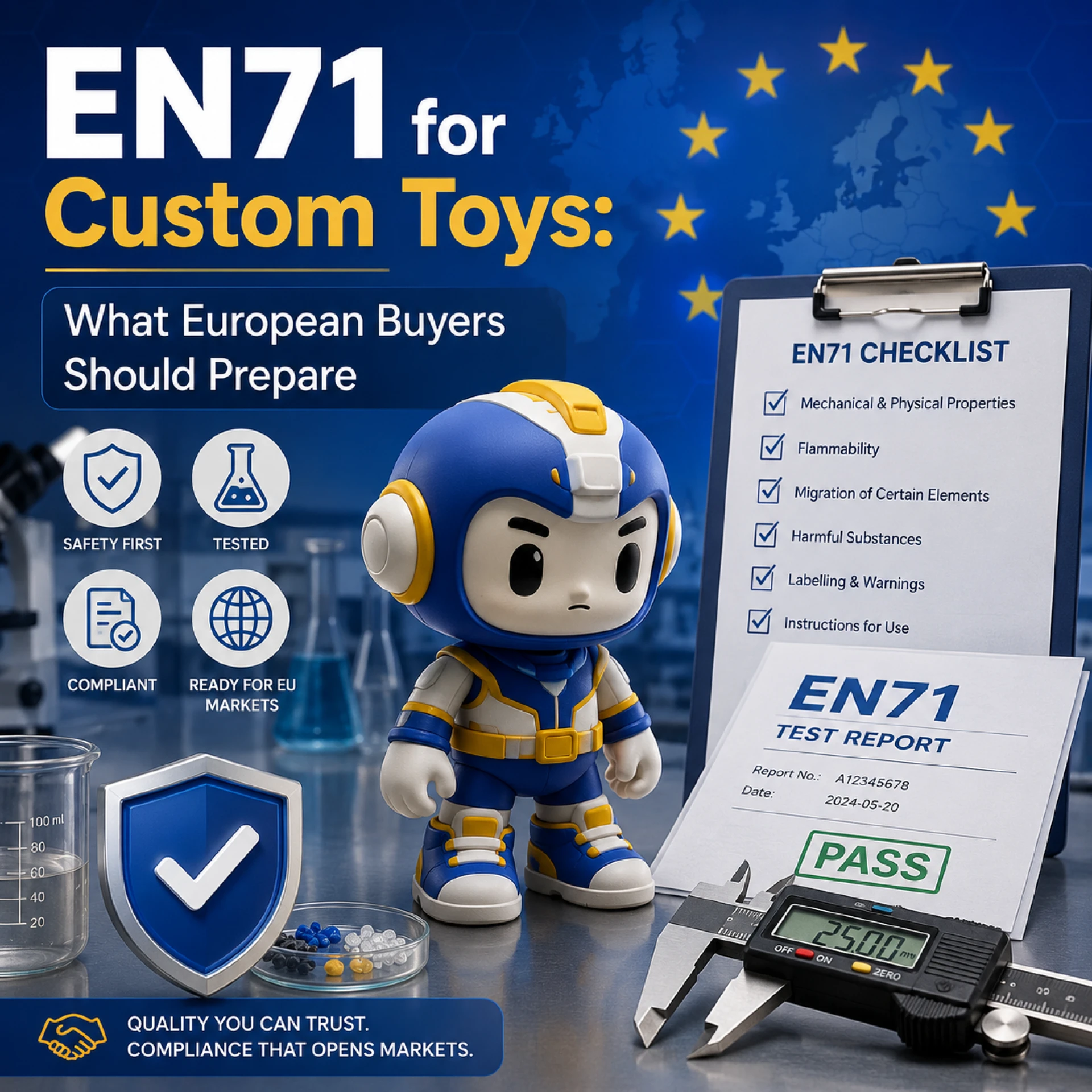
Common EN71-related areas may include:
- Mechanical and physical properties
- Flammability
- Migration of certain elements
- Age grading
- Small parts risk
- Sharp edges or sharp points
- Cords, loops, or accessible parts
- Paint and coating safety
- Warning labels
- Instructions for safe use
Not every EN71 part applies to every toy. A simple PVC figure and an electronic toy with lights, sound, batteries, or liquid functions may require different compliance reviews. This is why European buyers should not treat EN71 as a single checklist. Instead, they should confirm the applicable test scope with a qualified laboratory or compliance consultant based on the exact product design.
For official information on the EU toy framework, buyers can review the EU Toy Safety Directive, which is the main legal reference for toys placed on the EU market.
Why EN71 Should Be Considered Before Tooling
Many toy compliance problems become expensive when they are discovered too late. If a product fails because of small parts, detachable accessories, sharp points, material selection, or paint composition, the buyer may need to redesign the product, modify the mold, remake samples, or delay shipment.
For EN71 custom toys, compliance review should start before tooling. Once the mold is opened, changing product structure becomes more difficult and expensive. For example, if a detachable accessory is too small for the intended age group, the factory may need to enlarge it, connect it permanently, or adjust the product age recommendation. If a part has a sharp tip, the 3D model may need structural modification. If surface paint contains restricted substances, the material or paint supplier may need to be changed.
Early EN71 planning can help avoid:
- Mold modification after testing
- Sample rejection by European buyers
- Delayed retail launch dates
- Packaging and label reprinting
- Customs or market surveillance issues
- Product recall risk
- Brand reputation damage
For this reason, EN71 custom toys should be discussed during RFQ, design review, prototype approval, and pre-production sample confirmation. European buyers should tell the manufacturer from the beginning that the product is intended for the EU market and may require EN71-related testing and CE documentation.
If you are preparing a project quotation, our custom PVC figure quotation guide explains what product details usually affect cost and feasibility before production starts.
What European Buyers Should Prepare
European buyers should provide clear compliance and product information before asking a supplier to produce EN71 custom toys. A vague request such as “Please make it EN71 compliant” is not enough. The supplier needs practical information to evaluate risks correctly.
1. Product Design Files
The buyer should prepare 2D artwork, 3D files, character views, dimensions, color references, accessory details, and product function descriptions. If the product is a PVC figure, the manufacturer should understand the figure pose, base design, detachable parts, surface finish, and paint areas.
For character-based products, product design should also consider whether the figure is intended for display, play, blind box collection, promotional campaigns, or children’s use. The intended use can affect compliance expectations.
2. Intended Age Group
Age grading is one of the most important factors for EN71 custom toys. A product intended for children under 36 months usually faces stricter requirements, especially regarding small parts, detachable components, and accessible materials.
European buyers should clearly confirm whether the product is intended for:
- Children under 36 months
- Children over 36 months
- Older children
- Teenagers
- Adult collectors
- Promotional use
- Display-only collectibles
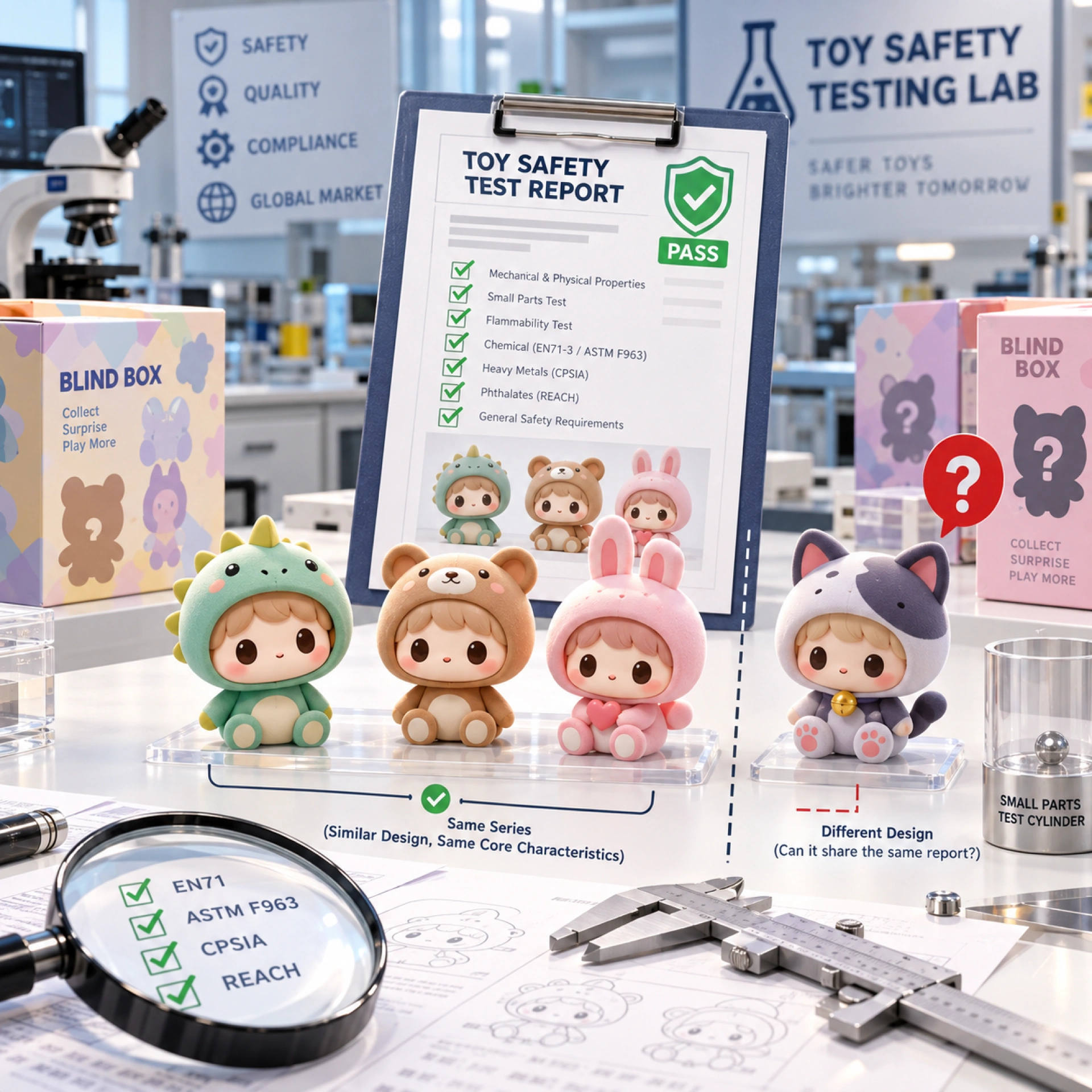
A product described as a “collectible” may still be treated as a toy if it is designed or marketed for children. Therefore, the product description, packaging, warnings, and sales channel should be consistent.
3. Material Information
Material selection matters for EN71 custom toys. Buyers should confirm the main materials, such as PVC, ABS, vinyl, silicone, fabric, metal parts, magnets, electronic components, batteries, coatings, adhesives, and packaging materials.
For PVC figures, material and paint are especially important because EN71 chemical testing may focus on accessible coatings and materials. If the product includes soft parts, scented materials, flocking, or electronic features, the testing scope may become more complex.
If you are comparing figure materials, you can read our guide on PVC vs vinyl vs ABS figures to understand how different materials affect production and product performance.
4. Surface Coating and Paint Requirements
Painting is a major part of custom toy production. For EN71 custom toys, the buyer should confirm whether the product uses spray painting, pad printing, hand painting, heat transfer printing, screen printing, matte coating, gloss coating, metallic effect, glow-in-the-dark effect, or other special finishes.
Painted surfaces are often accessible to users, so they may be relevant to chemical migration testing. The manufacturer should use suitable paint systems and control production consistency.
For more detail on decoration processes, you can review our article about PVC figure painting methods.
5. Packaging and Labeling Requirements
Packaging is not only about presentation. For the EU market, packaging may need CE marking, importer information, warnings, age recommendations, traceability information, product identification, and language requirements.
The European Commission notes that manufacturers must draw up technical documentation, issue the EC Declaration of Conformity, affix CE marking, provide traceability information, and ensure instructions, safety information, and warnings are included where required.
For EN71 custom toys, packaging artwork should be reviewed before printing. Otherwise, a product may pass physical testing but still face issues because of missing warnings, incorrect age labeling, missing importer information, or inconsistent product claims.
If you are planning retail or blind box packaging, our article on custom toy packaging manufacturer explains what brands should prepare before packaging production.
6. Target Countries and Languages
The EU is a single market, but labeling and instructions may still need to be understandable in the language required by the destination country. A toy sold in Germany, France, Spain, Italy, or the Netherlands may require different language planning.
European buyers should confirm the exact sales countries before approving packaging artwork. If the product will be sold across multiple EU member states, multilingual labeling may be needed.
Key EN71 Risk Points for Custom PVC Figures
Custom PVC figures are popular for licensed characters, blind boxes, mascots, and promotional toys. However, EN71 custom toys made from PVC should be reviewed carefully because visual design choices may affect safety testing.
Small Parts
Small detachable accessories can create risk, especially for toys intended for young children. Accessories such as hats, weapons, food items, animal ears, tails, buttons, small bases, or decorative pieces should be checked during design review.
Sharp Points and Edges
Stylized characters may include horns, swords, wings, spikes, hair tips, armor edges, or weapon details. These features may need to be rounded or adjusted to reduce risk.
Stability
A figure with a large head, thin legs, or dynamic pose may need a base or internal support. Poor stability can affect both user experience and product safety.
Paint Adhesion
Paint should be stable during reasonable use. Weak paint adhesion can cause surface quality issues and may affect test results if coating chips or flakes.
Chemical Migration
EN71-3 is commonly associated with migration of certain elements from accessible toy materials. For painted PVC figures, this is one of the areas buyers often discuss with laboratories and suppliers.
Packaging Warnings
If the toy includes small parts or is not suitable for children under 36 months, appropriate warnings may be needed. The warning should match the real product risk and intended age group.
EN71 and CE Marking Are Not the Same Thing
Some buyers use EN71 and CE marking as if they mean the same thing, but they are not identical.
EN71 is a set of toy safety standards. CE marking is a declaration that the toy complies with applicable EU requirements. The European Commission explains that manufacturers can demonstrate toy compliance through self-verification using European harmonised standards or through third-party verification by a notified body.
For EN71 custom toys, a typical compliance preparation process may include:
- Product safety assessment
- Identification of applicable standards
- Sample testing by a qualified laboratory
- Review of test reports
- Preparation of technical documentation
- Preparation of EC Declaration of Conformity
- CE marking and labeling review
- Production control to maintain consistency
Passing EN71 testing can support CE compliance, but buyers should not assume that a test report alone is the complete compliance file. European importers should keep the necessary documentation and confirm their own responsibilities before placing toys on the EU market.
The European Commission also explains that importers must ensure the manufacturer has carried out the appropriate conformity assessment, drawn up technical documentation, kept the EC Declaration of Conformity, and affixed CE marking and required information.
What Test Samples Should Buyers Prepare?
For EN71 custom toys, test samples should be representative of the final product. This means the sample should use the same material, same paint, same assembly method, same accessories, and same surface finish as mass production.
If a buyer tests an early handmade sample but changes materials or paint later, the test report may no longer represent the final product. This is why testing should usually be arranged on final or pre-production samples, not only on rough prototypes.
Buyers should prepare:
- Final product samples
- Packaging samples
- Product artwork
- Material list
- Paint and coating information
- Accessory list
- Age grading proposal
- Intended market
- Instructions and warning label draft
- Factory information
- Importer information, if applicable
A professional supplier should help keep the production process consistent with the tested sample. However, the European buyer or importer should also maintain their own compliance file and confirm requirements with qualified testing bodies.
Why Supplier Capability Matters for EN71 Custom Toys
A good supplier cannot replace a qualified laboratory or legal compliance consultant, but supplier capability still matters greatly. For EN71 custom toys, the manufacturer should understand how design, material, tooling, painting, assembly, and packaging affect compliance risk.
Jiahong Creative’s uploaded company profile shows an integrated production setup covering product development, functional testing, mold opening, production, quality inspection, packaging, warehousing, and logistics, with workshops for tooling, injection molding, silicone processing, spraying/printing, PCBA assembly, final assembly, and packaging. It also mentions ISO 9001 quality management system certification, EU CE certification, testing laboratory equipment, product performance testing, and simulated transportation vibration testing.
For European buyers, this kind of integrated production structure is useful because EN71 custom toys usually require coordination across multiple departments:
- Designers must avoid risky small details.
- Engineers must review structure and assembly.
- Mold teams must support safe part separation.
- Injection teams must control material consistency.
- Spraying teams must control paint and coating quality.
- Assembly teams must prevent loose or detachable parts.
- Packaging teams must include correct warnings and labels.
- QC teams must check production against approved samples.
When these steps are managed by one coordinated manufacturer, communication is usually clearer and production changes are easier to control.
A Practical EN71 Preparation Checklist for European Buyers
Before starting an EN71 custom toys project, European buyers should prepare the following checklist:
| Preparation Item | Why It Matters |
|---|---|
| Product artwork and 3D files | Helps the supplier evaluate structure and risk |
| Intended age group | Affects small parts, warnings, and testing scope |
| Target EU countries | Affects language and labeling requirements |
| Material list | Supports chemical and physical risk review |
| Paint and coating details | Important for accessible surface testing |
| Accessory list | Helps identify small parts or detachable risks |
| Packaging artwork | Must include correct CE, warnings, and traceability |
| Importer information | Required for EU market placement |
| Testing plan | Helps confirm applicable EN71 parts |
| Technical documentation plan | Supports CE compliance and importer responsibility |
| Final sample approval | Ensures tested sample matches mass production |
| Production QC standard | Helps maintain consistency after testing |
This checklist can reduce misunderstanding between buyers, manufacturers, laboratories, and distributors.
Common Mistakes European Buyers Should Avoid
Mistake 1: Treating EN71 as a Last-Minute Test
EN71 should not be discussed only after mass production. If the design has compliance risks, late testing may lead to expensive changes.
Mistake 2: Testing a Sample That Is Not Final
Testing a sample with different paint, material, size, or accessories from mass production can create documentation risk.
Mistake 3: Ignoring Packaging and Labeling
A product may have acceptable physical quality but still face EU market issues if CE marking, warnings, traceability, or importer information is missing.
Mistake 4: Assuming All Collectibles Are Outside Toy Rules
A collectible product may still be considered a toy depending on its design, marketing, age appeal, and sales channel. Buyers should confirm classification carefully.
Mistake 5: Not Confirming Importer Responsibilities
European importers have specific obligations when placing toys on the EU market. They should not rely only on factory statements.
How Jiahong Creative Supports EN71 Custom Toys
Jiahong Creative supports custom PVC toys, blind box figures, mascot products, IP character products, and creative household products. For European buyers preparing EN71 custom toys, our team can assist with early design review, material discussion, prototype development, mold planning, painting process coordination, assembly, packaging review, and pre-shipment quality control.
Our role is to help make the product production-ready and testing-ready. For official EN71 test reports, buyers can arrange testing through qualified third-party laboratories based on the final product and target market. We can coordinate sample preparation and provide necessary production information for the testing process.
If your project involves custom figures, blind boxes, licensed characters, or promotional toys for the European market, you can contact us through our custom toy project inquiry page. Please share your artwork, size, target quantity, intended age group, target EU market, packaging requirements, and testing expectations.
Final Thoughts
EN71 custom toys require more than creative design and mass production capability. For European buyers, EN71 preparation should begin before tooling, continue through sampling, and be confirmed before mass production.
The key is to treat compliance as part of product development. Design, materials, painting, accessories, packaging, labeling, documentation, and production QC all affect the final result. A good manufacturer can help identify production risks early, while a qualified laboratory can confirm the applicable testing requirements.
For European toy buyers, the best approach is to prepare clear product information, confirm the intended age group, review the applicable EN71 scope, plan CE documentation, and ensure that final mass production matches the tested sample.
When handled correctly, EN71 custom toys can be safe, market-ready, and professionally aligned with European buyer expectations.
FAQ
1. What are EN71 custom toys?
EN71 custom toys are custom-made toys developed for the European market with EN71 toy safety requirements in mind. They may include PVC figures, blind box toys, mascot figures, promotional toys, licensed character products, and other toy-related merchandise.
2. Is EN71 required for all custom toys sold in Europe?
Toys placed on the EU market must comply with applicable EU toy safety requirements. EN71 standards are commonly used to help demonstrate conformity with the Toy Safety Directive. The exact test scope depends on the toy type, material, function, age group, and intended use.
3. Is EN71 the same as CE marking?
No. EN71 refers to European toy safety standards, while CE marking is a declaration that the toy complies with applicable EU requirements. EN71 testing can support CE compliance, but CE marking also requires proper documentation, labeling, and conformity assessment.
4. What should European buyers prepare before EN71 testing?
European buyers should prepare final product samples, packaging samples, product artwork, material details, paint information, accessory list, intended age group, target market, warning label draft, and importer information. The tested sample should represent the final mass production product.
5. Can a custom PVC figure pass EN71?
A custom PVC figure can be developed to meet EN71 requirements if the design, materials, paint, accessories, packaging, and labeling are planned correctly. However, the final result should be confirmed through appropriate testing by a qualified laboratory.
6. When should EN71 testing be arranged?
EN71 testing is usually most meaningful when the sample is close to final production quality. However, EN71 risk review should begin much earlier, ideally before mold making, to avoid expensive design changes later.
7. Do adult collectible figures need EN71?
It depends on product classification, marketing, design, and sales channel. Some adult collectibles may not be treated the same as children’s toys, but buyers should confirm classification carefully with compliance professionals, especially if the product may appeal to children.
8. What packaging information is needed for EN71 custom toys?
Packaging may need CE marking, age grading, warnings, importer information, manufacturer information, traceability details, product identification, and instructions in the required language. Packaging artwork should be reviewed before printing.
9. Who is responsible for CE compliance in the EU?
Manufacturers, importers, and distributors each have responsibilities under EU toy safety rules. European importers should ensure that the manufacturer has completed the appropriate conformity assessment, prepared technical documentation, and provided the EC Declaration of Conformity.
10. How can Jiahong Creative help with EN71 custom toys?
Jiahong Creative can support early design review, material discussion, prototype development, mold planning, painting coordination, assembly, packaging review, and QC for EN71 custom toys. For official testing, buyers can arrange third-party laboratory testing based on the final product and EU market requirements.