

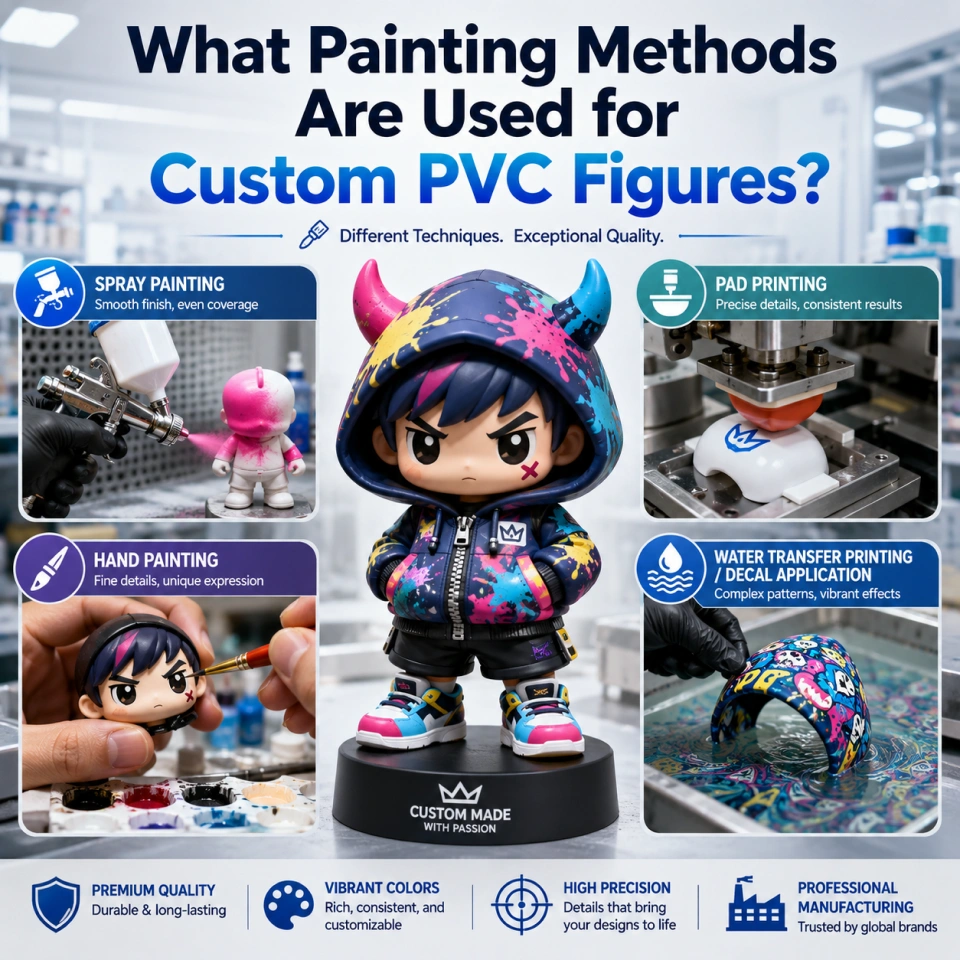
If buyers want a direct answer, the main pvc figure painting methods used in custom production usually include spray painting, pad printing, silk-screen printing, hand painting, heat transfer, and final surface finishing such as matte or gloss coating. These pvc figure painting methods are often used together rather than separately, because one custom PVC figure may need different processes for large color areas, fine logos, facial details, or special visual effects.
In other words, pvc figure painting methods are not just about adding color. They are part of the full manufacturing plan. The right process depends on figure size, part count, color separation, surface shape, consistency requirements, and target price level. A simple figure with two main colors may use a very different finishing plan from a collectible figure with facial details, accessories, logos, and layered decorative effects.
Quick Answer: Main PVC Figure Painting Methods at a Glance
Here is a practical overview of the most common pvc figure painting methods used in custom manufacturing.
| Painting Method | Best Use | Main Advantage | Main Limitation |
|---|---|---|---|
| Spray painting | Large color areas, smooth overall finish | Good coverage and stable visual effect | More masking may be needed for multiple colors |
| Pad printing | Small logos, eyes, fine patterns, text | Good for printing on 3D surfaces | Less suitable for very large painted areas |
| Silk-screen printing | Flat or less curved areas, simple graphics | Clear repeated graphic printing | Less flexible on complex curved surfaces |
| Hand painting | Fine touch-up, small details, premium effects | Good for controlled detail work | More labor-intensive |
| Heat transfer | Decorative surface graphics and repeated patterns | Helpful for certain decorative applications | Needs correct planning and compatible surfaces |
| Matte / gloss coating | Final surface effect and finish control | Improves appearance and perceived quality | Usually used as a finishing layer, not a primary color process |
This is why pvc figure painting methods should be selected as a system, not as isolated techniques.
Why PVC Figure Painting Methods Matter So Much in Custom Production
For custom figures, decoration quality often decides whether the product feels premium or cheap.
A mold can be accurate, the structure can be stable, and the assembly can be correct, but if the painting and printing are weak, the final figure will still look poor. In many projects, buyers notice decoration issues first. They see messy paint lines, inconsistent colors, shifted printing, or weak surface finish before they notice tooling quality.
That is why pvc figure painting methods are one of the most quality-sensitive parts of production.
1. Spray Painting Is One of the Most Common PVC Figure Painting Methods
Spray painting is one of the core pvc figure painting methods for custom figures.
It is commonly used for:
- large body color areas
- base coats
- gradient effects
- shaded surfaces
- smooth visual transitions
- consistent coverage across many units
In practical production, spray painting is often the first major decoration step after molded parts are cleaned and prepared. It is especially useful when the figure has broad color zones such as hair, clothing, skin tone areas, or accessories.
The advantage of spray painting is that it creates a smooth and uniform finish. It is also suitable for scaling to larger production runs. However, when a product has many color separations, spray painting may require extra masking and more production steps, which increases labor and quality-control workload.
This is one reason why pvc figure painting methods are closely linked to product cost. If you want to understand that side better, you can also read What Affects the Unit Price of a Custom PVC Figure?.
2. Pad Printing Is Used for Small Details on 3D Surfaces
Among pvc figure painting methods, pad printing is especially important for small graphics and fine details.
Pad printing is often used in custom PVC figure production for:
- eyes
- eyebrows
- small logos
- costume markings
- text
- repeated tiny patterns
This is one of the most useful pvc figure painting methods when the detail is too small for normal spray control but needs better repeatability than fully manual hand painting.
The main advantage is consistency across repeated units. The limitation is that it works best for relatively small printed areas, not for broad body color coverage.
If you want a simple external reference explaining how it differs from screen printing, you can refer to this overview of pad printing vs. screen printing.
3. Silk-Screen Printing Is Useful for Clear Graphic Areas
Silk-screen printing, also called screen printing, is another important option among pvc figure painting methods.
In custom PVC figures, silk-screen printing is often used for:
- simple logos
- flat graphic marks
- clean repeated patterns
- selected accessory graphics
- certain packaging-matched decorative areas
Compared with pad printing, silk-screen printing is usually better for cleaner graphic areas where the surface is more suitable for the screen process. It is less flexible on highly irregular, deeply curved, or very recessed 3D surfaces.
So when buyers evaluate pvc figure painting methods, silk-screen printing should be seen as a strong method for specific graphic tasks, not a replacement for every other finishing process.
4. Hand Painting Is Still Important for Premium Detail Control
Even with modern production methods, hand painting remains one of the most practical pvc figure painting methods for certain detail work.
Hand painting is often used for:
- sample refinement
- small correction work
- premium detail enhancement
- edges or parts that are difficult to print
- areas that need a more controlled human touch
This method is especially important in prototype review and in high-detail products where a purely automated process may not produce the final cosmetic effect the buyer wants.
The strength of hand painting is flexibility. The weakness is labor cost and consistency pressure if overused in mass production.
That is why buyers should not assume that more hand painting always means better manufacturing. In many cases, the smartest approach is to use hand painting only where it adds real value, and combine it with other pvc figure painting methods for scalable output.
5. Heat Transfer Can Help with Repeated Decorative Graphics
Heat transfer is another one of the pvc figure painting methods commonly used when certain decorative graphics need to be applied efficiently and repeatedly.
In figure-related projects, heat transfer may be useful for:
- repeated decorative patterns
- surface graphics that would be inefficient to hand-paint
- certain accessory decorations
- specific visual effects that need stable repetition
The key point is that heat transfer is not the right answer for every figure. It needs proper surface planning and correct process selection. But in the right situation, it helps reduce manual decoration workload while maintaining a stable pattern result.
6. Matte and Gloss Coating Affect Final Appearance More Than Many Buyers Expect
When discussing pvc figure painting methods, buyers often focus only on color application and forget the final finish.
Matte and gloss coating are important because they influence:
- surface feel
- perceived product grade
- color appearance
- visual contrast
- overall finish consistency
For example, a character face may look better with a softer matte finish, while a certain accessory or premium effect may benefit from a gloss surface. Even if the base colors are correct, the wrong final finish can make the figure look less refined.
That is why matte and gloss coating should be part of the decoration discussion from the beginning, not an afterthought.
PVC Figure Painting Methods Are Usually Combined in One Project
In real manufacturing, one figure rarely uses only one method.
A more realistic decoration plan may look like this:
- spray painting for the main body colors
- pad printing for eyes and small logos
- hand painting for selected touch-up areas
- matte or gloss coating for final surface control
This combined approach is one of the most important things buyers should understand about pvc figure painting methods. The goal is not to choose only one method. The goal is to choose the right combination for appearance, efficiency, and repeatability.
How to Choose the Right PVC Figure Painting Methods for a Project
If buyers want to choose the right pvc figure painting methods, they should ask these questions early.
Does the figure need broad color coverage?
If yes, spray painting is often a core method.
Does the figure need tiny face details, text, or logos?
If yes, pad printing may be necessary.
Does the figure use clean repeated graphics on suitable areas?
If yes, silk-screen printing may be useful.
Are there premium details or irregular areas that need manual correction?
If yes, hand painting may still play a role.
Does the final finish need a specific texture or sheen?
If yes, matte or gloss coating should be planned early.
This is also why decoration should be discussed together with mold structure. Paint lines, masking areas, part split logic, and printing alignment all affect manufacturability. If you also want to understand how structure affects pricing, you can read What Affects the Unit Price of a Custom PVC Figure?.
PVC Figure Painting Methods and Cost Are Directly Connected
Decoration planning is not only a visual decision. It is also a cost decision.
More complex pvc figure painting methods usually mean:
- more labor
- more masking
- more inspection steps
- more touch-up work
- more risk of cosmetic rejection
For example, a figure that uses simple spray painting and limited print areas will usually be easier to scale than a figure that needs many tiny paint separations and repeated correction work.
This is why decoration strategy should be discussed together with budget. If buyers want to protect product quality while controlling cost, they should review paint complexity early. You can connect this topic naturally to How Can Buyers Reduce Custom PVC Figure Cost Without Hurting Quality? and PVC vs Vinyl vs ABS Figures.
A Practical Comparison of PVC Figure Painting Methods
| Method | Best For | Production Efficiency | Detail Precision | Typical Use in Custom Figures |
|---|---|---|---|---|
| Spray painting | Main body colors and smooth coverage | High | Medium | Hair, clothing, skin tone, base coat |
| Pad printing | Fine graphics on curved or uneven parts | Medium to high | High | Eyes, logos, symbols, small patterns |
| Silk-screen printing | Clear repeated graphics on suitable areas | Medium | Medium to high | Flat graphics, simple marks, accessory decoration |
| Hand painting | Fine manual detail and touch-up | Low | High | Prototype detailing, correction, premium accents |
| Heat transfer | Repeated decorative patterns | Medium | Medium | Certain decorative graphics and repeated surface effects |
| Matte / gloss coating | Final surface control | High | N/A | Finish control and premium visual presentation |
This table shows why pvc figure painting methods should be planned based on actual product needs instead of using the same finishing plan for every project.
One Practical Rule Buyers Should Remember
A good-looking custom figure does not come from using the most decoration processes possible. It comes from using the right pvc figure painting methods in the right places.
Too many methods can create:
- higher cost
- slower output
- more cosmetic risk
- more inspection pressure
Too few methods can create:
- weak visual effect
- poor brand presentation
- lower perceived quality
The best result usually comes from balance.
Final Thoughts
The best direct answer to the question “What painting methods are used for custom PVC figures?” is that the most common pvc figure painting methods include spray painting, pad printing, silk-screen printing, hand painting, heat transfer, and final surface finishing such as matte or gloss coating.
In real production, these pvc figure painting methods are usually combined. Spray painting handles broad color coverage. Pad printing supports small graphics on 3D surfaces. Silk-screen printing helps with cleaner repeated graphic areas. Hand painting supports detail and correction work. Heat transfer can help with certain repeated decorative graphics. Matte or gloss coating controls the final surface effect.
That is why buyers should evaluate pvc figure painting methods as part of the full development plan, not as a separate cosmetic decision.
Need Help Selecting the Right PVC Figure Painting Methods?
If you are planning a custom figure, the best time to discuss pvc figure painting methods is before the sample and quotation are finalized.
At Jiahong Creative, finishing is planned together with part structure, color separation, mold logic, and production requirements, so buyers can choose decoration methods that match both visual goals and manufacturability.
You can send your artwork, expected colors, target size, and estimated quantity, and we can help review which pvc figure painting methods are most suitable for your project.
FAQ
Q1:What are the most common pvc figure painting methods?
The most common pvc figure painting methods are spray painting, pad printing, silk-screen printing, hand painting, heat transfer, and matte or gloss surface finishing.
Q2:Which pvc figure painting methods are best for facial details?
Pad printing is often one of the best pvc figure painting methods for facial details such as eyes, eyebrows, and small graphic elements.
Q3:Is spray painting the main method for custom PVC figures?
In many projects, yes. Spray painting is one of the main pvc figure painting methods because it is effective for broad color areas and smooth surface coverage.
Q4:What is the difference between pad printing and silk-screen printing?
Pad printing is better for transferring small images onto irregular 3D surfaces, while silk-screen printing is usually better for clearer graphics on more suitable, less complex surfaces.
Q5:Does hand painting still matter in mass production?
Yes. Hand painting still matters in pvc figure painting methods, especially for touch-up work, selected premium details, and areas that are difficult to decorate with automated processes.
Q6:Do pvc figure painting methods affect cost?
Yes. More complex pvc figure painting methods usually increase labor, masking, inspection, and defect-control requirements, which can raise total production cost.