

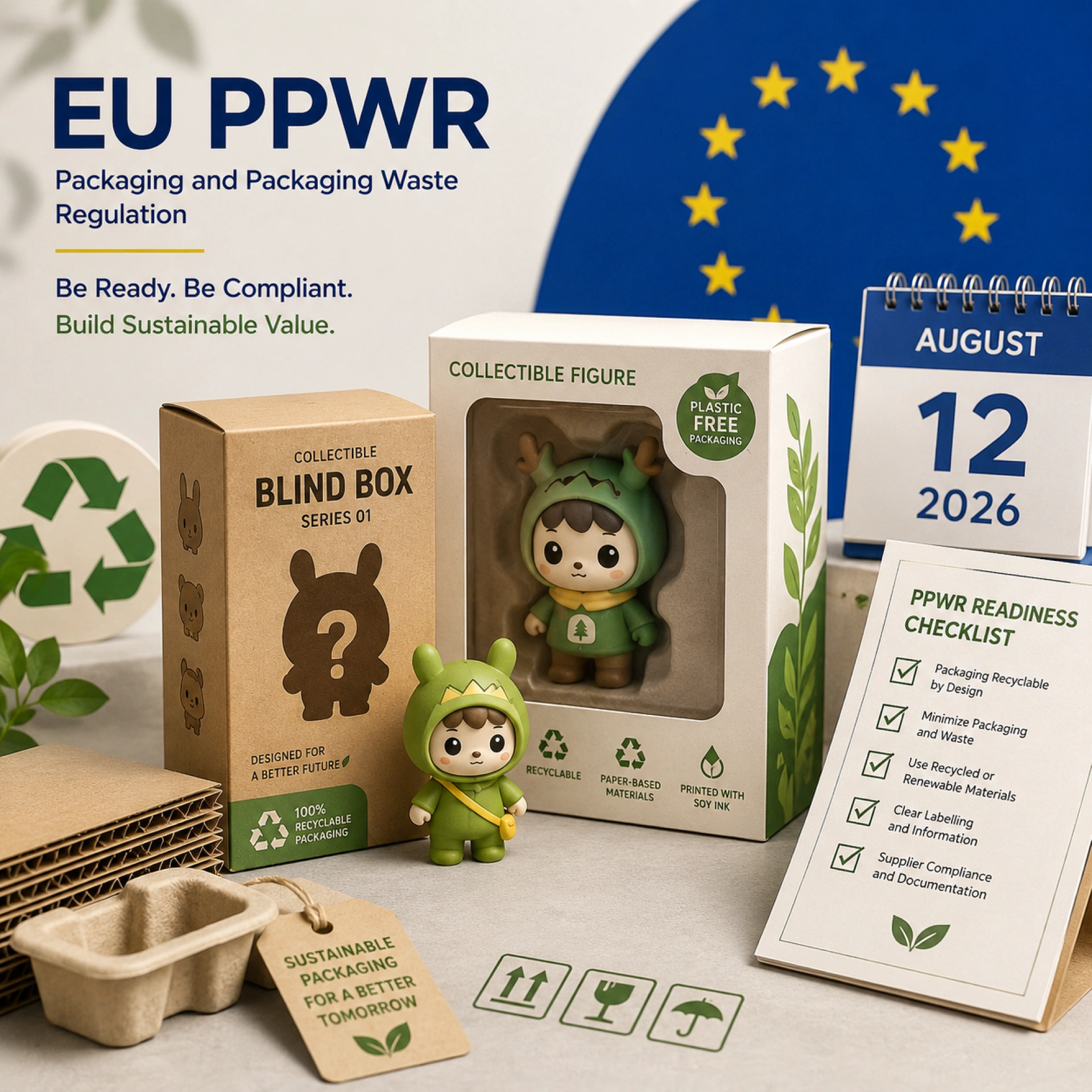
EU PPWR for Custom Toy and Blind Box Packaging means buyers selling toy products, PVC figures, blind box figures, licensed IP merchandise, and collectible gifts into the EU should prepare packaging data, material breakdowns, recyclability information, EPR reporting support, recycled content documentation, packaging labels, and environmental claim evidence before August 12, 2026.
The direct answer is this: buyers should not wait until final shipment to think about PPWR. Before manufacturing starts, buyers should confirm every packaging component, including the blind box, inner tray, foil bag, plastic bag, paper insert, instruction card, barcode label, master carton, and shipping protection. They should know what each component is made of, how much it weighs, whether it is necessary, whether it can be reduced, whether it is recyclable in the target market, and whether any sustainability claim can be proven.
For custom toys and blind boxes, packaging is not just a box. It protects the figure, hides the surprise item, supports retail display, carries safety warnings, shows brand artwork, and affects shipping cost. Under EU PPWR for Custom Toy and Blind Box Packaging, buyers need to treat packaging as part of product development, not as a final decoration step.
If your brand is still planning packaging structure, our guide on working with a custom toy packaging manufacturer explains what brands should prepare before packaging development.
What Is EU PPWR for Custom Toy and Blind Box Packaging?
EU PPWR for Custom Toy and Blind Box Packaging refers to how the EU Packaging and Packaging Waste Regulation affects packaging used for custom PVC toys, blind box figures, collectible figures, licensed IP products, promotional toys, and character merchandise sold into the European Union.
The PPWR is designed to reduce packaging waste, improve recyclability, harmonize packaging requirements, and increase responsibility for packaging placed on the EU market. For toy buyers, this does not mean every blind box must suddenly use one single packaging format. It means buyers should prepare better packaging data, reduce unnecessary material, avoid difficult-to-recycle structures where possible, and support EPR and labeling requirements.
Buyers can review the official EU Packaging and Packaging Waste Regulation page and the full Regulation (EU) 2025/40 text for official background.
For procurement teams, the practical meaning is simple: if your product packaging enters the EU market, you need to know what packaging you are using and why. A vague description like “color box + inner tray + carton” will not be enough for serious EU buyers, retailers, importers, or compliance teams.
Why Toy and Blind Box Buyers Should Prepare Before August 12, 2026
August 12, 2026 is important because the PPWR will generally apply from that date. For buyers, this creates a preparation window. The safest approach is to review packaging during project quotation, not after production.
EU PPWR for Custom Toy and Blind Box Packaging matters because custom toy packaging often uses multiple materials:
- Printed paper box
- PET or PVC inner tray
- Foil bag
- OPP bag
- Paper card
- Plastic window
- Sticker label
- Instruction sheet
- Corrugated carton
- Bubble wrap or protective filling
- Pallet wrap, if used for logistics
A blind box product may look small, but the packaging system can be complex. If the buyer does not organize packaging material data early, it becomes difficult to prepare EPR reporting, packaging claims, recycling labels, packaging specifications, and retailer compliance forms later.
For blind box projects, buyers should also review our blind box figure manufacturing process guide. Packaging decisions should be connected with figure size, assortment planning, secret figure protection, inner bag structure, and carton packing.
Packaging Components Buyers Should List
The first step under EU PPWR for Custom Toy and Blind Box Packaging is to create a complete packaging component list. Buyers should not only record the outer box. Every packaging layer should be listed.
| Packaging Component | Buyer Should Confirm | Why It Matters |
|---|---|---|
| Outer blind box | Paper type, coating, printing, size, weight | Main retail packaging and EPR reporting item |
| Inner tray | PET, paper pulp, folded paper, or other material | Affects plastic use, protection, and recyclability |
| Foil bag | Material structure, purpose, weight | Protects secrecy but may be difficult to recycle |
| Plastic bag | OPP, PE, PP, or other material | May be reduced or replaced depending on function |
| Insert card | Paper weight, coating, printing | Adds brand value but increases packaging material |
| Instruction sheet | Paper type and language needs | Needed for safety or product information |
| Sticker label | Paper or plastic label | May affect recycling and sorting |
| Master carton | Corrugated board size and weight | Needed for logistics and reporting |
| Protective filler | Bubble wrap, paper filler, or molded insert | Affects damage rate and packaging waste |
This table helps buyers turn packaging into measurable data. EU PPWR for Custom Toy and Blind Box Packaging is easier to manage when each component has a material, weight, function, and supplier record.
Packaging Minimization: Avoid Unnecessary Layers
One major buyer task is packaging minimization. This does not mean removing all packaging. It means avoiding packaging that is larger, heavier, or more complex than necessary.
For custom toys and blind boxes, buyers should ask:
- Is the box much larger than the figure?
- Is the inner tray necessary?
- Can the plastic tray be replaced with paper structure?
- Is the foil bag needed for secrecy?
- Can accessory bags be reduced?
- Can the insert card and instruction sheet be combined?
- Is the window film necessary?
- Can carton packing be optimized?
- Does the packaging protect the product without excessive empty space?
EU PPWR for Custom Toy and Blind Box Packaging should push buyers to review packaging efficiency. A premium blind box still needs a good unboxing experience, but unnecessary space, duplicate plastic layers, and decorative packaging that does not protect or inform the customer may create avoidable risk.
If your project already focuses on more responsible packaging, you can also read our article on Sustainable Blind Box Manufacturing, which discusses recycled materials, paper packaging, foil bag alternatives, cost, MOQ, and greenwashing risks.
Recyclability and Material Selection
Recyclability is one of the most important issues in EU PPWR for Custom Toy and Blind Box Packaging. Buyers should understand whether their packaging uses single-material structures, mixed materials, coated paper, plastic windows, laminated films, foil bags, or difficult-to-separate components.
For toy and blind box packaging, the following choices can affect recyclability:
- Paper box with plastic window
- Laminated paper surface
- Metallic foil printing
- Plastic tray inside paper box
- Multi-layer foil bag
- Sticker labels on plastic surfaces
- Mixed material hang tags
- Plastic-coated paper
- Paper pulp tray
- Mono-material plastic bag
A paper box is not automatically easy to recycle if it has heavy lamination, plastic windows, metallic effects, or non-paper attachments. A plastic component is not automatically unacceptable, but buyers should know its material type and whether it has a functional purpose.
For blind box projects, the challenge is balancing recyclability with secrecy and protection. The packaging must hide the figure, prevent scratches, protect painted surfaces, and support retail handling. Buyers should not remove protection in a way that increases product damage or returns.
For packaging planning, buyers can connect this topic with our custom PVC figure quality control checklist, because packaging defects, box damage, wrong labels, and shipping protection should all be checked before release.
Paper Packaging and Plastic Inner Tray Reduction
Many buyers ask whether paper packaging can reduce plastic inner trays. The answer is yes, but it depends on the figure shape, paint finish, accessory structure, and shipping method.
Paper-based alternatives may include:
- Paper pulp tray
- Folded paper insert
- Corrugated insert
- Paper sleeve
- Cardboard divider
- Molded paper protection
- Smaller paper box with better internal fit
For EU PPWR for Custom Toy and Blind Box Packaging, paper inner structures can help reduce plastic use. However, paper inserts must be tested with the actual figure. A matte PVC figure, metallic painted figure, flocked figure, or glow painted figure may be scratched if the paper insert rubs against the surface.
Before replacing a plastic tray, buyers should check:
- Does the paper tray hold the figure securely?
- Does it scratch painted surfaces?
- Does it protect small accessories?
- Does it survive vibration during shipping?
- Does it keep the blind box experience?
- Does it increase packing labor?
- Does it reduce or increase carton size?
- Does it support the brand’s retail presentation?
If the brand wants certified paper sourcing, buyers may review FSC certification, but any FSC claim or logo use should be supported by the correct packaging supply chain and documentation.
Foil Bags and Blind Box Secrecy
Foil bags are common in blind box packaging because they hide the figure and protect the surprise experience. However, foil bags can create PPWR-related questions because they are often multi-layer structures and may not be easy to recycle.
Under EU PPWR for Custom Toy and Blind Box Packaging, buyers should not automatically remove foil bags. Instead, they should decide whether the foil bag has a real function.
Foil bags may provide:
- Figure secrecy
- Scratch protection
- Dust protection
- Accessory separation
- Anti-tamper value
- Retail blind box experience
- Premium unboxing feeling
Possible alternatives include:
- Paper blind bags
- Glassine-style paper bags
- Mono-material plastic bags
- Opaque recyclable plastic bags
- Tissue wrap
- Paper sleeve
- Direct inner tray protection
Each option has trade-offs. Paper bags may reduce plastic but may tear more easily. Clear recyclable plastic bags may be easier to identify but may reveal the figure. No inner bag may reduce packaging but may increase scratches and customer complaints.
For projects involving rare versions, read our guide on Blind Box Special Editions. Secret figure planning and packaging control are closely connected because packaging must protect both the product and the surprise ratio.
Recycled Content and Plastic Packaging
Some buyers ask whether PPWR means all plastic packaging must immediately contain recycled content. The answer is more nuanced. Different PPWR requirements have different timelines, product scopes, and exceptions. Buyers should work with importers, compliance partners, and packaging suppliers to confirm the exact obligations for their packaging format.
For procurement, the practical step is to start collecting recycled content data now.
For EU PPWR for Custom Toy and Blind Box Packaging, buyers should ask packaging suppliers:
- Does this plastic packaging contain recycled content?
- What percentage is claimed?
- Is it post-consumer recycled content or pre-consumer recycled content?
- Is there a supplier declaration?
- Is there third-party certification?
- Can the recycled content be traced by batch?
- Does recycled material affect clarity, strength, odor, or color?
- Is the material suitable for toy packaging?
- Does the claim appear on packaging or only in internal documents?
This is especially relevant for plastic trays, inner bags, hang tabs, windows, and protective films. If the buyer wants to make a recycled content claim, documentation must be clear.
Buyers should avoid vague claims such as “eco plastic” or “green packaging.” It is safer to say exactly what is used and where, such as “paper insert reduces plastic tray use” or “selected packaging component contains recycled plastic, based on supplier documentation.”
EPR Data and Packaging Reporting
EU PPWR for Custom Toy and Blind Box Packaging is also connected with EPR data. EPR means extended producer responsibility. In practice, EU sellers, importers, marketplaces, and distributors may need packaging data for registration, reporting, fees, and market-specific obligations.
Packaging EPR is often handled by the economic operator placing packaging on the market, but the factory should help provide packaging specifications. Buyers should confirm responsibility with importers or local compliance partners.
Useful packaging data may include:
- Packaging material type
- Packaging weight by material
- Number of units shipped
- Packaging dimensions
- Paper weight
- Plastic weight
- Composite material information
- Recycled content claims
- Packaging supplier records
- Country of sale
- SKU-level packaging data
- Carton packing details
For toy buyers, the main risk is not knowing the packaging breakdown. If the buyer only has finished product photos and box artwork, EPR reporting becomes difficult. Packaging weights and material data should be recorded before shipment.
Labeling and Sorting Information
PPWR includes future harmonized packaging labeling requirements, and many detailed requirements depend on implementing acts and timelines. However, buyers should start preparing packaging material information before the label format becomes mandatory.
For EU PPWR for Custom Toy and Blind Box Packaging, buyers should prepare:
- Material composition data
- Packaging component separation
- Recycling or sorting symbols, where applicable
- Language and market requirements
- Consumer sorting instructions
- Correct claims about recyclability
- Importer or responsible operator information
- SKU and batch traceability
- Packaging artwork files
- Version control records
Toy and blind box packaging often has limited space. If the box must include age warnings, CE marking, importer details, barcode, IP legal text, recycling symbols, and future sorting labels, artwork layout must be planned early.
This is especially important for products that also need toy safety information. For EU toy compliance, you can review our EU Toy Safety Regulation 2025/2509 guide and our EN71 for Custom Toys article.
Environmental Claims and Greenwashing Risk
EU PPWR for Custom Toy and Blind Box Packaging also affects marketing language. Buyers may want to say “eco-friendly,” “sustainable,” “recyclable,” “plastic-free,” or “made with recycled materials.” These claims should be specific and supported by evidence.
Avoid broad claims such as:
- 100% eco-friendly
- Fully sustainable
- Green blind box
- Plastic-free, if any plastic remains
- Recyclable, if local recycling reality is unclear
- Made from recycled material, without percentage or documentation
- Zero waste, unless the full claim can be proven
Better claims are more specific:
- Paper insert reduces plastic inner tray use
- Outer box made with certified paper
- Packaging weight reduced compared with previous version
- Selected plastic component contains recycled content
- Foil bag removed for this packaging version
- Mono-material packaging component used for easier sorting
Buyers can review the European Commission’s green claims information and the FTC Green Guides for general guidance on why environmental claims should be truthful, specific, and substantiated.
For custom toys and blind boxes, greenwashing risk is high because packaging has many components. If only one small part uses recycled content, the claim should not suggest the whole product is sustainable.
Packaging Technical File for Buyers
Before August 12, 2026, buyers should create a packaging technical file for each custom toy or blind box project. This does not need to be complicated, but it should be organized.
A practical packaging file may include:
- Packaging specification sheet
- Packaging component list
- Material type for each component
- Weight of each component
- Box dimensions
- Inner tray dimensions
- Carton dimensions
- Artwork files
- Barcode and label information
- Supplier declarations
- Recycled content documents
- Paper certification documents, if used
- Packaging sample photos
- Approved packaging sample
- EPR data summary
- Packaging QC checklist
- Version control record
For EU PPWR for Custom Toy and Blind Box Packaging, this file helps buyers answer retailer, importer, marketplace, and compliance partner questions more quickly.
If your toy packaging also needs sample approval before mass production, our custom PVC figure sample approval checklist can help your team review packaging fit, product protection, labels, artwork, and production feasibility.
Packaging QC Before Shipment
Packaging compliance is not only about documents. The final shipment must match the approved packaging specification. A factory may use the correct sample for approval but accidentally change carton size, plastic bag material, tray thickness, label placement, or printed artwork during production.
Before shipment, buyers should check:
- Outer box material
- Printed artwork
- Barcode
- Warning labels
- Recycling marks
- Material claims
- Inner tray material
- Foil bag structure
- Plastic bag material
- Insert card
- Instruction sheet
- Carton mark
- Carton weight
- Carton quantity
- Packaging damage rate
- SKU mix
- Secret figure packing, if applicable
For EU PPWR for Custom Toy and Blind Box Packaging, packaging QC should also compare the final packaging with the documented packaging data. If the buyer reports one material but ships another, the records may become unreliable.
What Buyers Should Ask the Factory
Before starting production, buyers should ask the manufacturer clear packaging questions.
Ask the factory:
- Can you provide a full packaging component list?
- Can you provide material and weight for each packaging part?
- Can the plastic tray be replaced with paper structure?
- Can the foil bag be reduced or replaced without damaging the blind box experience?
- Can you provide supplier declarations for recycled content?
- Can you provide FSC paper options if needed?
- Can you make packaging samples before mass production?
- Can you record carton dimensions and packaging weight?
- Can you help prepare EPR data?
- Can you check packaging labels before printing?
- Can you confirm final packaging matches approved samples?
A reliable manufacturer should understand that EU PPWR for Custom Toy and Blind Box Packaging is not only the buyer’s problem. The factory should help provide packaging data, samples, supplier information, and QC records.
Jiahong Creative supports custom PVC toys, blind box figures, collectible figures, packaging development, painting, assembly, QC, and shipment preparation. If you are developing a custom figure project, you can also review our custom PVC toy manufacturer page.
Practical Buyer Checklist Before August 12, 2026
| Buyer Task | What to Prepare |
| Map all packaging components | Outer box, tray, foil bag, insert card, instruction sheet, carton |
| Record material type | Paper, PET, PP, PE, foil laminate, corrugated board, label materials |
| Record packaging weight | Weight by component and material category |
| Review packaging necessity | Remove or reduce non-functional packaging where possible |
| Review recyclability | Avoid unnecessary mixed materials and hard-to-separate structures |
| Review plastic reduction | Consider paper tray, paper insert, smaller box, or reduced bags |
| Confirm recycled content | Request supplier declarations and supporting evidence |
| Prepare EPR data | Material weights, quantities, dimensions, country of sale |
| Check labeling space | Sorting labels, warnings, barcode, importer details, IP legal text |
| Control environmental claims | Use specific, documented claims only |
| Approve packaging samples | Confirm protection, fit, artwork, and final appearance |
| Inspect final packaging | Check production matches the approved packaging file |
This checklist turns EU PPWR for Custom Toy and Blind Box Packaging into a practical sourcing workflow.
How Jiahong Creative Supports PPWR Packaging Preparation
Jiahong Creative supports custom toy and blind box packaging development from product size review, packaging structure planning, inner tray discussion, paper box design, sample approval, carton packing, and quality inspection.
For EU PPWR for Custom Toy and Blind Box Packaging, we can help buyers collect packaging component information, review material options, reduce unnecessary packaging layers, compare plastic and paper tray structures, prepare packaging samples, and check final packaging before shipment.
We can also support related product development, including custom PVC figures, blind box figures, collectible figures, mascot toys, licensed IP products, and character merchandise. If you are preparing a project for the EU market, please share your artwork, product size, packaging style, expected quantity, target EU countries, sustainability requirements, and shipment plan.
You can contact us through our custom toy and blind box packaging inquiry page.
Final Thoughts
EU PPWR for Custom Toy and Blind Box Packaging should be treated as a procurement preparation topic, not only a legal update. Buyers should prepare packaging data before August 12, 2026, including component lists, material types, packaging weights, recyclability information, recycled content evidence, EPR data, labeling space, packaging samples, and final QC records.
For blind box products, the challenge is balancing PPWR preparation with the blind box experience. The package still needs to hide the figure, protect painted surfaces, support retail display, and maintain brand value. For custom PVC toys, packaging must also support warnings, labels, product safety information, and carton protection.
The best approach is to design packaging with clear purpose. Keep what protects the product, supports retail, or communicates required information. Reduce what only adds waste, empty space, or hard-to-document material complexity. When packaging design, material data, supplier documentation, artwork, QC, and environmental claims are planned together, EU PPWR for Custom Toy and Blind Box Packaging becomes much easier to manage before shipment and market launch.
FAQ
1.What is EU PPWR for Custom Toy and Blind Box Packaging?
EU PPWR for Custom Toy and Blind Box Packaging refers to how the EU Packaging and Packaging Waste Regulation affects packaging used for custom PVC toys, blind box figures, collectible figures, licensed IP merchandise, and toy gift products sold into the EU market.
2.Why is August 12, 2026 important?
The PPWR generally applies from August 12, 2026. Buyers selling toy and blind box packaging into the EU should prepare packaging material data, recyclability information, EPR support, labeling planning, and packaging documentation before that date.
3.What packaging components should buyers record?
Buyers should record the outer box, inner tray, foil bag, plastic bag, insert card, instruction sheet, label, master carton, protective filler, and any other packaging material used for the product.
4.Does PPWR mean blind boxes cannot use foil bags?
Not necessarily. Foil bags may still have a functional purpose for secrecy and protection. Buyers should review whether the foil bag is necessary, whether alternatives are possible, and whether the material can be documented properly.
5.Can paper trays replace plastic trays?
Paper trays can sometimes replace plastic trays, but they must be tested with the actual figure. Buyers should check protection, scratch risk, accessory fit, shipping strength, carton efficiency, and unboxing experience.