

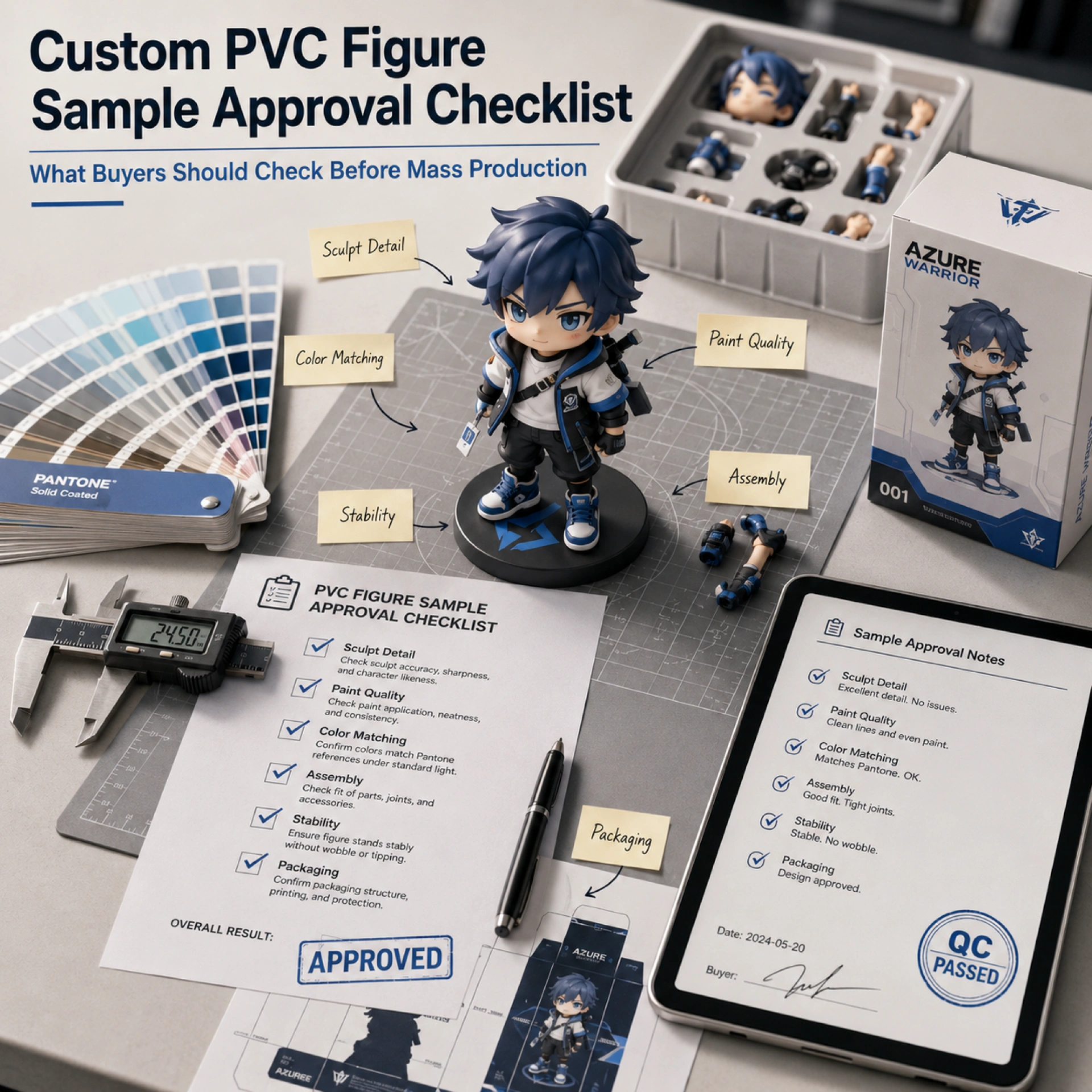
A custom PVC figure sample approval checklist helps buyers confirm whether a prototype or pre-production sample is ready for mass production. Before approving a custom PVC figure sample, buyers should check the character shape, size, 3D details, material, color, painting, printing, surface finish, assembly, balance, packaging, safety risks, and final production standard. The approved sample will usually become the reference for mass production, so any mistake approved at this stage may continue into the final bulk order.
For brands, IP owners, game companies, animation studios, retailers, and gift buyers, sample approval is one of the most important steps in custom PVC figure manufacturing. A 3D model may look correct on screen, but a physical sample can reveal real production issues such as weak details, unstable standing, color mismatch, visible seams, rough painting, poor logo printing, loose accessories, packaging problems, or safety concerns.
The best way to use a custom PVC figure sample approval checklist is to review the sample step by step before saying “approved.” Buyers should compare the sample with the original artwork, approved 3D file, Pantone color references, packaging design, product specification, and target market requirements. If the sample has issues, it is better to revise them before mold making or mass production begins.
If your project is still at the artwork or 3D modeling stage, you may also want to read our guide on how to turn 2D character art into a custom toy figure. A clear 2D-to-3D process makes later sample approval much easier.
Why Sample Approval Matters Before Mass Production
Sample approval is the bridge between product development and mass production. Once the buyer approves the sample, the factory will use it as the production reference. This means the approved sample becomes the standard for shape, size, color, painting, assembly, packaging, and quality control.
A custom PVC figure sample approval checklist is important because custom figures usually involve many details. A character may have a special face, hairstyle, clothes, accessories, logo, base, pose, or brand color. If one detail is wrong, the final product may not match the buyer’s expectation.
For licensed IP products, sample approval is even more critical. The IP owner may need to approve the character face, body proportion, color, packaging artwork, logo placement, legal text, and final presentation. A small color error or incorrect facial detail can delay the project.
For blind box figures, sample approval affects the consistency of the whole collection. All designs in the series should look like they belong to the same product line. Size, finish, painting style, packaging format, and quality level should be consistent across the collection.
A professional custom PVC toy manufacturer should guide buyers through sample review instead of asking for approval too quickly. Careful sample approval helps reduce rework, production delay, extra cost, and quality disputes.
Custom PVC Figure Sample Approval Checklist Overview
Before approving a sample, buyers can use the following custom PVC figure sample approval checklist as a quick overview.
| Approval Item | What to Check | Why It Matters |
|---|---|---|
| Character accuracy | Face, body proportion, pose, accessories, and sculpted details | Ensures the figure matches the original artwork or IP style guide |
| Size and proportion | Height, width, thickness, base size, and part scale | Prevents mismatch with packaging, display, or collection planning |
| Material | PVC, ABS, vinyl, or mixed material parts | Affects cost, surface finish, durability, and production method |
| Color | Pantone reference, skin tone, clothing color, logo color, and finish | Protects brand consistency and IP approval |
| Painting quality | Spray painting, pad printing, hand painting, coating, and edge control | Determines the visual quality of the finished figure |
| Surface finish | Matte, semi-matte, glossy, texture, and coating | Changes how the product looks and feels |
| Assembly | Part fit, visible gaps, glue marks, accessory stability, and base connection | Affects product durability and customer satisfaction |
| Balance and stability | Standing angle, base support, center of gravity, and display performance | Prevents the figure from falling or leaning |
| Packaging fit | Box size, tray, blister, blind box, instruction sheet, and carton packing | Protects the product and supports retail presentation |
| Safety and compliance | Small parts, sharp points, labeling, age grading, and testing needs | Reduces safety and market access risks |
| Final reference sample | Approved physical sample kept for mass production comparison | Helps the factory control bulk production consistency |
This custom PVC figure sample approval checklist should be used before mass production starts. If the buyer wants any changes, those changes should be confirmed clearly in writing and shown on revised samples.
1. Check Character Accuracy
The first step in a custom PVC figure sample approval checklist is checking character accuracy. The buyer should compare the sample with the original artwork, 3D model, reference image, or IP style guide.
Important details include:
- Face shape
- Eye position
- Mouth expression
- Body proportion
- Head-to-body ratio
- Pose
- Hair shape
- Clothing folds
- Shoes
- Accessories
- Logo position
- Character-specific details
For many custom figures, the face is the most important approval area. Even if the body is correct, a small change in the eyes or mouth can make the character feel different. Buyers should review the sample from the front, side, back, top, and bottom.
If the project uses licensed artwork, the approval team should confirm whether the sample follows the official character guide. If the figure is based on a game, animation, comic, or mascot, small details may affect brand approval.
When reviewing character accuracy, do not approve the sample only because it looks “close enough.” The approved sample will guide mass production, so any important difference should be corrected before moving forward.
2. Check Size, Weight, and Proportion
The second part of a custom PVC figure sample approval checklist is size and proportion. Buyers should confirm the actual physical dimensions of the sample, not only the target size written in the quotation.
Check:
- Total height
- Width
- Thickness
- Base size
- Accessory size
- Head proportion
- Body proportion
- Weight
- Packaging fit
Size affects cost, mold structure, packaging, shipping volume, and user experience. A figure that is too large may increase material cost and carton size. A figure that is too small may lose important sculpting or painting details.
For blind box projects, size consistency is especially important. If one figure in the series looks much larger or smaller than the others, the collection may feel unbalanced. Buyers should place all samples together and compare their visual scale.
If your team is still planning the full manufacturing process, our guide on how PVC toys are manufactured explains how design review, 3D modeling, prototype sampling, tooling, injection molding, painting, assembly, QC, and packaging work together.
3. Check Material and Structure
Material and structure are important because the sample should not only look good but also be practical for production. A figure may include PVC parts, ABS parts, metal parts, magnets, transparent parts, or accessories depending on the design.
When using a custom PVC figure sample approval checklist, buyers should confirm:
- Which parts are PVC
- Which parts are ABS or other materials
- Whether accessories are separate or fixed
- Whether the base is strong enough
- Whether thin parts are too fragile
- Whether the figure can stand properly
- Whether the part separation is acceptable
- Whether visible seams are acceptable
PVC is commonly used for character figures because it supports detailed shapes and painting. ABS can be used for bases, stands, supports, or harder structural parts. Vinyl may be used for larger hollow figures or art toy styles.
If you are comparing material choices, read our guide on PVC vs vinyl vs ABS figures. Material selection can influence sample appearance, mold cost, production method, and final quality.
4. Check Color Matching and Pantone References
Color approval is one of the most common reasons for sample revisions. The buyer should compare the sample with Pantone references, brand color guides, artwork, and approved color standards.
A good custom PVC figure sample approval checklist should include:
- Skin tone
- Hair color
- Clothing color
- Accessory color
- Logo color
- Base color
- Matte or glossy finish
- Color consistency between parts
- Color consistency across a series
- Packaging color alignment
Pantone references help buyers and manufacturers communicate color targets. You can learn more about the Pantone Color Systems from Pantone’s official page.
However, buyers should remember that screen colors are not reliable for production approval. PVC, ABS, vinyl, paint, coating, and paper packaging can all make colors appear different. Physical samples are more reliable than digital images.
For a deeper color approval process, read our guide on color matching custom PVC figures. It explains how Pantone references, painted samples, production control, and QC work together.
5. Check Painting, Printing, and Surface Finish
Painting and printing quality strongly affect the final value of a custom PVC figure. Even if the sculpting is accurate, poor painting can make the product look cheap.
When using a custom PVC figure sample approval checklist, review:
- Spray painting coverage
- Paint edge sharpness
- Overspray
- Missing paint
- Uneven color
- Dust or particles
- Scratches
- Pad printing position
- Eye and mouth printing
- Logo printing
- Hand-painted details
- Coating quality
- Matte or glossy finish
Buyers should check the sample under good lighting and from multiple angles. For character products, the face, eyes, mouth, and logo should receive special attention.
The buyer should also decide what level of variation is acceptable. Custom PVC figures are handmade and machine-produced together, especially during painting and assembly. Minor variation may happen, but obvious defects should not be approved as the production standard.
For more detail, read our guide on PVC figure painting methods. It explains spray painting, pad printing, hand painting, and other decoration methods used in custom figure production.
6. Check Assembly, Gaps, and Stability
Assembly quality affects both appearance and durability. A figure may include separate head parts, arms, legs, accessories, base, support rod, or decorative components.
During sample approval, check:
- Whether all parts fit correctly
- Whether gaps are too large
- Whether glue marks are visible
- Whether parts are loose
- Whether accessories fall off easily
- Whether the base is stable
- Whether the figure stands properly
- Whether the product leans forward or backward
- Whether seams affect the appearance
A custom PVC figure sample approval checklist should always include stability review. Some characters have large heads, thin legs, heavy accessories, or action poses. These designs may require a base, hidden support, larger contact area, or internal structure adjustment.
If the figure cannot stand well during sample approval, do not assume mass production will solve the issue automatically. Stability should be corrected before production.
7. Check Packaging Fit and Presentation
Packaging is part of the final product. A good sample should be reviewed together with packaging whenever possible.
Buyers should confirm:
- Box size
- Inner tray fit
- Blister structure
- Blind box size
- Product protection
- Instruction sheet
- Barcode
- Warning label
- Brand logo
- Character artwork
- Legal text
- Carton packing
- Shipping protection
For blind box figures, the buyer should check whether the figure fits well inside the inner tray or bag. If the figure moves too much during transportation, paint damage, scratches, or broken accessories may occur.
For retail products, packaging should show the product value clearly. The box should match the brand style and protect the figure during shipping and storage.
A professional custom toy packaging manufacturer can help buyers plan packaging structure, printed artwork, inner tray, protection method, and carton packing before mass production.
8. Check Safety, Compliance, and Testing Needs
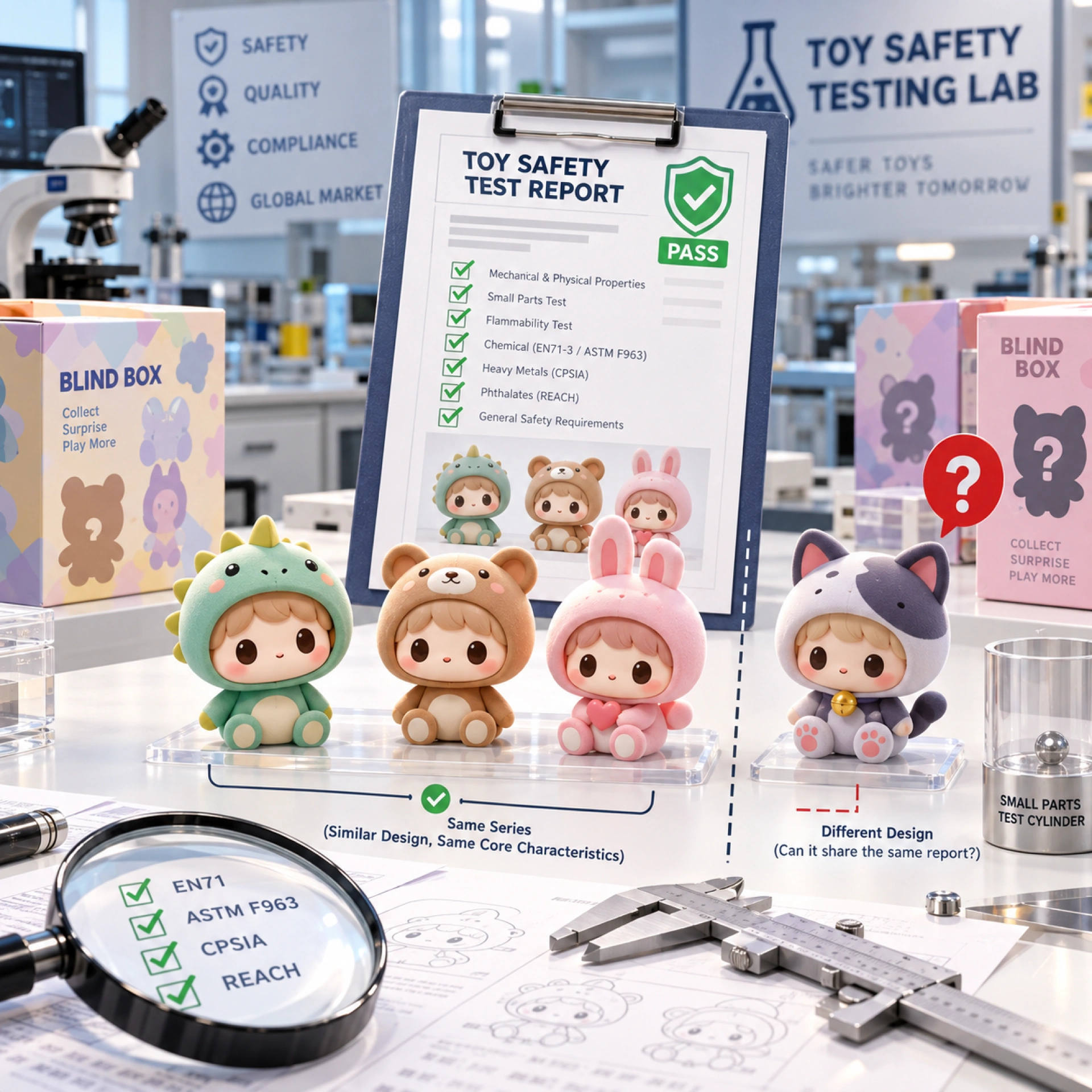
Sample approval should also consider safety and compliance. This is especially important for children’s products, retail toys, licensed IP toys, and products sold in the U.S. or European markets.
Buyers should check:
- Small parts risk
- Sharp points
- Sharp edges
- Material safety
- Paint and coating safety
- Age grading
- Warning labels
- Packaging warnings
- Product category
- Target market
- Testing requirements
For the U.S. market, children’s products may require testing and certification based on applicable rules. The CPSC Children’s Product Certificate page explains CPC requirements for children’s products.
For the European market, buyers should review toy safety and CE requirements. The European Commission provides information on placing toys on the EU market and general CE marking.
A factory can help prepare samples and product information for testing, but buyers should confirm the final testing scope with qualified laboratories or compliance partners.
9. Check Production Feasibility Before Approval
A sample may look good, but buyers should also ask whether it is suitable for mass production. Some samples can be hand-finished to look excellent, but the process may be too slow, too expensive, or too unstable for bulk orders.
Before approving the sample, ask:
- Can this painting standard be repeated in mass production?
- Are small details too difficult to control?
- Will the defect rate be too high?
- Does the mold structure support stable production?
- Are accessories easy to assemble?
- Does the packaging protect the figure during shipping?
- Can the factory maintain color consistency?
- Is the approved sample realistic for the target unit price?
This part of the custom PVC figure sample approval checklist is important because mass production is not the same as making one beautiful sample. The approved sample should represent a quality standard that can be repeated at scale.
If the sample needs many hand-painted details or special effects, the buyer should confirm whether the cost and lead time are acceptable.
10. Confirm the Final Approved Sample
Once all sample issues are corrected, the buyer should confirm the final approved sample clearly. The factory should keep the approved sample as the mass production reference.
A good approval record should include:
- Approved sample photos
- Approved physical sample
- Approved 3D file
- Approved Pantone references
- Approved packaging artwork
- Approved product specification
- Approved change notes
- Approved production quantity
- Approved inspection standard
The buyer should avoid unclear approval messages such as “looks okay” or “almost approved.” Instead, the approval should be specific. For example: “The sample is approved for mass production based on the current color, painting, size, packaging, and assembly standard.”
This reduces confusion and gives the factory a clear production reference.
Common Sample Approval Mistakes
Many custom figure projects face delays because sample approval is not handled carefully. The following mistakes are common.
Approving Only from Photos
Photos can be affected by lighting, camera settings, phone screens, and compression. Photos are useful for communication, but physical samples are better for final approval.
Ignoring Packaging Until the End
The figure and packaging should be reviewed together. Packaging may affect product protection, retail presentation, barcode placement, warnings, and carton size.
Focusing Only on the Front View
A figure should be checked from all angles. Side view, back view, bottom, base, and accessory details may reveal problems that are not visible from the front.
Not Checking Stability
Some figures look good but cannot stand well. Stability should be checked before production.
Approving an Unrealistic Sample
A sample with too many hand-finished details may be hard to repeat in mass production. Buyers should confirm whether the final standard is realistic.
Changing Requirements After Approval
Late changes can affect mold, paint, packaging, cost, and lead time. Buyers should finalize major details before mass production.
Buyer Checklist Before Mass Production
Here is a practical custom PVC figure sample approval checklist that buyers can use before mass production.
| Checklist Question | Approved? |
| Does the sample match the original artwork or IP style guide? | |
| Is the 3D shape accurate from front, side, back, and top views? | |
| Are the size, weight, and proportion correct? | |
| Are all materials confirmed? | |
| Are the Pantone colors or brand colors approved? | |
| Is the painting quality acceptable? | |
| Are the eyes, mouth, logos, and small printed details correct? | |
| Is the surface finish approved as matte, semi-matte, or glossy? | |
| Are all parts assembled correctly? | |
| Are gaps, seams, and glue marks acceptable? | |
| Can the figure stand properly? | |
| Are accessories strong enough? | |
| Does the figure fit the packaging? | |
| Are packaging artwork, labels, and warnings approved? | |
| Are safety and testing requirements confirmed? | |
| Is the sample realistic for mass production? | |
| Has the final approved sample been recorded and stored? |
This custom PVC figure sample approval checklist can be used internally by buyers, product managers, designers, sourcing teams, and brand owners before approving production.
How Jiahong Creative Supports Sample Approval
Jiahong Creative supports custom PVC figure projects from artwork review, 3D modeling, prototype sampling, mold making, injection molding, painting, assembly, packaging, and quality inspection.
During sample approval, we help buyers review character accuracy, size, material, color, surface finish, painting details, assembly, packaging, and production feasibility. For blind box toys, mascot figures, game character merchandise, licensed IP products, and promotional PVC toys, we can help identify potential production risks before mass production begins.
If you are preparing a new project, you can contact us through our custom PVC figure project inquiry page. Please share your artwork, target size, expected quantity, Pantone references, packaging idea, and target market. A clear brief helps us review your sample requirements and recommend a practical production plan.
Final Thoughts
A custom PVC figure sample approval checklist is not just a formality. It is a key tool for controlling product quality before mass production. Buyers should check character accuracy, size, material, color, painting, assembly, stability, packaging, safety, and production feasibility before approving the sample.
The approved sample becomes the standard for mass production, so buyers should not rush this step. A clear approval process can reduce delays, avoid misunderstandings, control quality, and protect the final product’s brand value.
For brands developing custom PVC figures, blind box toys, mascot figures, licensed IP products, or promotional toys, using a custom PVC figure sample approval checklist helps turn sample approval into a controlled production decision instead of a quick visual judgment.
FAQ
1.What is a custom PVC figure sample approval checklist?
A custom PVC figure sample approval checklist is a step-by-step review tool that helps buyers check the physical sample before mass production. It usually covers character accuracy, size, color, painting, material, assembly, packaging, safety, and production feasibility.
2.Why is sample approval important before mass production?
Sample approval is important because the approved sample usually becomes the mass production reference. If the buyer approves incorrect color, poor painting, wrong proportion, or unstable structure, those problems may continue into the bulk order.
3.Should I approve a PVC figure sample from photos?
Photos are useful for communication, but physical samples are better for final approval. Lighting, camera settings, phone screens, and image compression can make the sample look different from the real product.
4.What should buyers check first in a custom PVC figure sample?
Buyers should first check character accuracy, including face, body proportion, pose, accessories, and key design details. After that, they should review size, material, color, painting, assembly, packaging, and safety.
5.How do I check color during PVC figure sample approval?
Check the sample against Pantone references, brand color guides, and approved artwork. Review the physical sample under consistent lighting and confirm whether the finish should be matte, semi-matte, or glossy.
6.How does a sample approval checklist reduce production risk?
A checklist helps buyers and manufacturers review the sample systematically. It reduces the chance of missing important issues such as color mismatch, unstable standing, poor painting, weak accessories, or packaging problems.
7.How can Jiahong Creative help with PVC figure sample approval?
Jiahong Creative can help review artwork, 3D models, prototype samples, Pantone colors, painting quality, assembly, packaging, and production feasibility before mass production. We support custom PVC figures, blind box toys, mascot figures, licensed IP products, and promotional toy projects.