

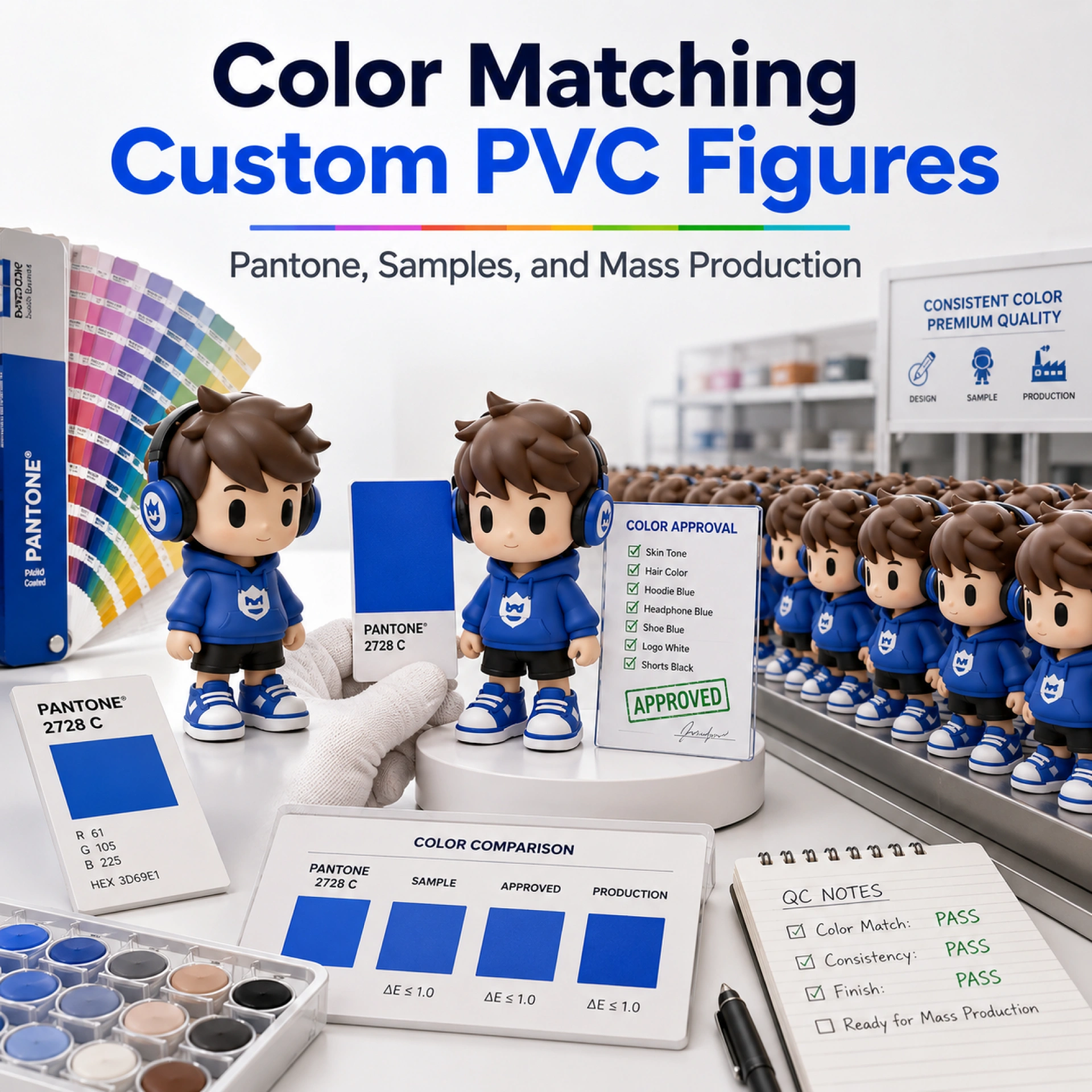
Color matching custom PVC figures means controlling the color of molded PVC parts, spray painting, pad printing, hand painting, coatings, and packaging artwork so the final mass production matches the approved sample as closely as possible. The best way to manage color matching custom PVC figures is to confirm Pantone references, create physical samples, approve color standards under proper lighting, define acceptable tolerance, and use the approved sample as the final production reference.
For brands, color matching custom PVC figures is not only about choosing a nice color on screen. Digital artwork, Pantone codes, printed materials, PVC raw material, spray paint, surface texture, gloss level, and lighting conditions can all affect how the final color looks. This is why professional custom toy manufacturers usually do not rely only on computer files. They need physical samples, color chips, painted parts, and final approval before mass production.
In custom PVC figure production, color accuracy directly affects brand consistency. A mascot figure with the wrong red, a blind box character with an inaccurate skin tone, or a licensed IP product with inconsistent clothing colors may fail approval, delay shipment, or damage the product’s retail value. For this reason, color matching custom PVC figures should be planned before tooling, sampling, painting, packaging, and mass production.
If your brand is still comparing materials before color approval, you can first read our guide on PVC vs vinyl vs ABS figures. Material choice can influence color appearance, surface finish, painting method, and final production consistency.
Why Color Matching Matters for Custom PVC Figures
Color is one of the first things customers notice when they see a custom figure. Even if the sculpture is accurate, the product may still feel wrong if the color is not close to the brand artwork or approved character guide.
Color matching custom PVC figures is especially important for:
- Licensed IP products
- Blind box toy series
- Mascot figures
- Game character figures
- Anime collectible figures
- Promotional PVC toys
- Retail gift products
- Character merchandise
- Limited-edition collectibles
For licensed IP products, color matching is often part of the approval process. The buyer or IP owner may need to approve the character’s face, skin tone, clothes, accessories, logo, packaging artwork, and final decoration details. If the color does not match the approved style guide, the production sample may need to be revised.
For blind box figures, color consistency is also important because all figures in the same series must look like they belong to one collection. A small difference in finish, saturation, or skin tone can make one figure look cheaper than the others.
For promotional toys, color matching custom PVC figures helps protect the brand image. Corporate colors, mascot colors, and logo colors need to be controlled carefully because the product may represent the brand at events, retail stores, campaigns, or customer gifts.
Pantone Is a Reference, Not the Final Product
Pantone is commonly used in color communication because it gives buyers, designers, and manufacturers a shared color reference. Pantone provides color systems such as the Pantone Matching System and other color libraries used across design, printing, fashion, product, and manufacturing fields. You can learn more from the official Pantone Color Systems page.
However, Pantone is not a guarantee that every material will look exactly the same. A Pantone chip is usually viewed on a specific material and surface, while a PVC figure may include molded PVC, painted PVC, ABS parts, silicone parts, printed packaging, or coated surfaces. These different surfaces can make the same color appear slightly different.
For color matching custom PVC figures, Pantone should be used as a starting reference. The final approval should still be based on real physical samples.
For example:
| Color Source | How It Helps | Limitation |
|---|---|---|
| Digital artwork | Shows the design direction and color layout | Screen colors vary by device and are not reliable for production approval |
| Pantone code | Gives the factory a clear color reference | The final look may change on PVC, paint, or textured surfaces |
| Printed artwork | Helps packaging and graphic review | Printed paper color may not match painted PVC parts |
| Painted sample | Shows the real product color | Must be reviewed under proper lighting and compared with the approved standard |
| Approved production sample | Becomes the final reference for mass production | Needs clear documentation and buyer approval |
This is why color matching custom PVC figures should always move from digital reference to physical confirmation.
Color Matching Custom PVC Figures: Full Process Overview
A structured color approval process can reduce delays and prevent disputes during mass production. Below is a practical overview of how color matching custom PVC figures usually works.
| Production Stage | What Happens | Buyer Should Confirm |
| Artwork review | The manufacturer reviews the character design, color layout, and style guide. | Confirm whether colors are based on Pantone codes, brand guidelines, or visual references. |
| Material selection | The factory checks whether the figure uses PVC, ABS, vinyl, silicone, or mixed materials. | Confirm which parts are molded color and which parts require painting or printing. |
| Color planning | The team separates molded colors, spray-painted areas, pad printing, hand painting, and packaging colors. | Confirm which colors are critical for brand approval. |
| Prototype sample | A physical sample is made to check shape, color layout, and finish. | Confirm whether color, gloss, texture, and details match expectations. |
| Painted sample approval | The factory revises colors if needed and submits a final sample for approval. | Approve the physical sample before mass production. |
| Mass production control | The approved sample is used as the production color standard. | Confirm acceptable color tolerance and inspection method. |
| Final QC | Finished products are checked against the approved sample. | Confirm whether color difference, paint defects, and printing details are acceptable. |
A professional custom PVC toy manufacturer should manage color matching custom PVC figures as part of the full production workflow, not as a last-minute painting issue.
Molded Color vs Painted Color
When developing custom PVC figures, buyers should understand the difference between molded color and painted color.
Molded color means the pigment is mixed into the PVC material before molding. The part itself has the color. This can be useful for large color areas, simple bodies, or parts where paint abrasion should be reduced.
Painted color means the molded part is sprayed, printed, coated, or hand-painted after molding. This is common for character faces, clothing details, accessories, shadows, gradients, logos, and small decoration areas.
Both methods are useful, but they behave differently.
| Color Method | Best For | Advantage | Risk |
| Molded PVC color | Large body parts, simple color areas, high-volume parts | Stable base color and fewer painting steps | Less flexible for complex color details |
| Spray painting | Clothing, hair, shoes, accessories, large decoration areas | Good coverage and flexible color control | Masking accuracy and overspray must be controlled |
| Pad printing | Eyes, mouth, logos, small graphics | Good for repeatable small details | Requires accurate positioning |
| Hand painting | Special effects, limited details, complex finishing | Flexible for artistic details | More dependent on worker skill |
| Coating | Matte, glossy, protective surface | Improves final surface style | May slightly change color appearance |
For buyers, the key is not to choose one method for everything. The best color matching custom PVC figures usually combine molded color, spray painting, pad printing, and finishing based on the design.
If you want to understand more about decoration methods, read our guide on PVC figure painting methods. It explains how spray painting, pad printing, hand painting, and other decoration processes are used for custom PVC figures.
How Material Affects Color Matching
Different materials show color differently. PVC, ABS, vinyl, silicone, and packaging paper may all react differently to the same color target.
PVC is commonly used for custom figures because it supports detailed molding and painting. ABS is more rigid and may be used for bases, stands, structural parts, or electronic product shells. Vinyl may be used for larger hollow figures or designer art toys. Silicone may be used for soft-touch products such as tap lights or flexible parts.
For color matching custom PVC figures, material selection affects:
- Surface smoothness
- Paint adhesion
- Gloss level
- Color saturation
- Texture
- Light reflection
- Production consistency
- Long-term durability
A matte surface may make a color look softer. A glossy surface may make the same color look brighter. A textured surface may make a color appear darker or less saturated. This is why buyers should confirm both the color and the surface finish during sample approval.
If your project uses different materials, the same Pantone color may not look identical across all parts. In that case, the goal is not always mathematical sameness. The goal is visual harmony on the finished product.
Lighting Conditions Matter
Color changes under different lighting. A sample may look correct under office lighting but different under daylight, warm light, LED light, or retail shelf lighting.
For color matching custom PVC figures, buyers should avoid approving colors only from photos. Photos can be affected by camera settings, phone screens, filters, lighting, and compression.
The best practice is to approve physical samples. If remote approval is necessary, the factory should provide clear photos and videos under consistent lighting, but the final color standard should still be based on the physical approved sample whenever possible.
Buyers can also define the review condition, such as daylight viewing, neutral light, or a specific lighting environment. This is especially important for licensed IP products and retail collectibles.
What Is Color Tolerance?
Color tolerance means the acceptable range of color difference between the approved sample and mass production parts. In real manufacturing, it is difficult to make every part visually identical. Raw material batches, paint mixing, spray thickness, drying conditions, surface finish, and inspection lighting can all create small differences.
For industrial color control, some companies use instrument-based measurement and color-difference formulas. The CIE provides the CIEDE2000 color-difference formula, and ASTM D2244 is a standard practice related to calculating color tolerances and color differences, including applications in plastics, coatings, inks, packaging, paints, and other industrial areas. You can also review the ASTM D2244 color tolerance standard.
For most custom PVC figure projects, buyers do not always need complex laboratory color measurement. However, the concept is useful: color should not be judged randomly. The buyer and factory should agree on what is acceptable and what is not acceptable.
For color matching custom PVC figures, the practical standard is usually:
- Approved physical sample as the main reference
- Pantone code as the supporting reference
- Visual comparison under consistent lighting
- Defined tolerance for minor variation
- Rejection criteria for obvious color mismatch
- Clear QC process before shipment
This prevents misunderstandings during mass production.
Sample Approval Is the Most Important Step
Sample approval is the most important step in color matching custom PVC figures. Once the buyer approves the sample, the factory uses it as the reference for mass production. If the buyer later wants to change the color after production begins, it may affect schedule, cost, and quality control.
Before approving a sample, buyers should check:
- Does the character color match the artwork?
- Are the Pantone references close enough?
- Are skin tones, hair colors, clothes, and accessories correct?
- Are the eye and mouth details clear?
- Is the logo color accurate?
- Is the finish matte, semi-matte, or glossy as expected?
- Does the color look acceptable under different lighting?
- Are all figures in a series visually consistent?
- Are packaging colors consistent with the product?
- Are any painted areas too thick, too thin, or uneven?
If the sample is not correct, revise it before mold confirmation or mass production. For custom figure projects, fixing color issues during sampling is much cheaper than fixing them after bulk production.
If your project is still in the early design stage, our guide on how to turn 2D character art into a custom toy figure can help you understand how artwork becomes a physical sample before final color approval.
Mass Production Color Control
After the sample is approved, the factory should control color during mass production. This is where color matching custom PVC figures becomes a production management issue, not just a design issue.
Mass production color control may include:
- Keeping the approved sample in the production area
- Comparing first production pieces with the approved sample
- Checking paint mixing before spraying
- Confirming spray masks and fixtures
- Monitoring drying and coating conditions
- Inspecting pad printing position and color
- Checking random samples during production
- Separating defective color batches
- Comparing final packed products with the approved sample
- Recording buyer-approved changes
For blind box figures, production control is even more important because multiple designs may be produced at the same time. Each figure may have different colors, finishes, accessories, and packaging. A clear production standard helps maintain consistency across the whole collection.
If you want to understand the full manufacturing workflow, read our article on how PVC toys are manufactured. Color control should be connected with 3D modeling, tooling, injection molding, painting, assembly, QC, and packaging.
Common Color Matching Problems
Color matching custom PVC figures can fail for several common reasons. Buyers can avoid many problems by understanding these risks early.
1. Only Approving Digital Artwork
Digital artwork is useful, but it is not enough for production approval. Screens vary too much. A color that looks bright on one monitor may look darker on another.
2. Using Pantone Codes Without Physical Samples
Pantone codes help communication, but the final PVC figure may still look different because of material, paint, surface texture, and lighting.
3. Not Confirming Matte or Gloss Finish
Finish changes color perception. A glossy finish may look brighter, while a matte finish may look softer. The same color can look different under different finishes.
4. Ignoring Small Details
Eyes, mouth, logos, shoes, accessories, and clothing lines can affect the overall character accuracy. Small areas often require pad printing, masking, or hand painting.
5. Changing Colors After Sample Approval
Late changes can delay production and increase cost. Buyers should complete color confirmation before mass production.
6. Not Keeping an Approved Sample
The approved sample should be the production reference. Without it, the factory and buyer may judge color differently.
Color Matching Checklist for Buyers
Before approving color matching custom PVC figures, buyers can use this checklist.
| Checklist Item | Why It Matters |
| Provide Pantone codes | Helps the factory understand the target color |
| Send brand style guide | Important for licensed IP and mascot products |
| Confirm material | PVC, ABS, vinyl, and silicone may show colors differently |
| Confirm finish | Matte, semi-matte, and glossy surfaces affect color appearance |
| Review physical sample | More reliable than digital images |
| Check under proper lighting | Reduces disagreement caused by lighting difference |
| Confirm paint method | Spray painting, pad printing, and hand painting have different tolerances |
| Approve final sample | Becomes the reference for mass production |
| Define acceptable variation | Prevents disputes during QC |
| Review packaging color | Product and box should look consistent as a complete brand item |
This checklist makes color matching custom PVC figures easier to manage from quotation to shipment.
Packaging Color Should Also Be Controlled
Many buyers focus only on the figure color and forget packaging color. For retail products, blind boxes, gift boxes, and licensed IP merchandise, packaging is part of the customer experience.
Packaging color may involve CMYK printing, spot color printing, paper material, coating, lamination, and ink absorption. Even if the figure color is correct, packaging can look inconsistent if artwork files, printed proofs, and final boxes are not reviewed.
For color matching custom PVC figures, packaging should be checked together with the product. A complete approval package may include:
- Approved figure sample
- Approved color card or Pantone reference
- Approved packaging artwork
- Printed packaging proof
- Label and barcode confirmation
- Warning text and legal information
- Final carton marking
If your project requires retail packaging, read our guide on working with a custom toy packaging manufacturer. Packaging planning should not be left until the end of production.
How Color Matching Affects Quotation and Lead Time
Color complexity affects cost and production time. A simple figure with one molded color and two paint areas is easier to produce than a complex character with many small painted details, gradients, logos, metallic paint, transparent effects, or hand-painted decorations.
When requesting a quotation, buyers should provide clear color information. This helps the factory estimate painting labor, masking complexity, printing tools, defect risk, and QC time.
For color matching custom PVC figures, quotation may be affected by:
- Number of colors
- Number of painted areas
- Need for Pantone matching
- Spray mask complexity
- Pad printing plates
- Hand-painting requirements
- Matte or glossy coating
- Metallic or special finishes
- Multi-character series consistency
- Packaging color requirements
If you are preparing a new project, our custom PVC figure quotation guide explains what buyers should provide before asking for pricing.
How Jiahong Creative Supports Color Matching Custom PVC Figures
Jiahong Creative supports custom PVC figure development from artwork review, 3D modeling, prototyping, mold making, injection molding, painting, printing, assembly, packaging, and quality inspection.
For color matching custom PVC figures, we help buyers review Pantone references, character artwork, brand color requirements, surface finish, paint areas, printing details, packaging color, and final sample approval. Our team can help evaluate whether the product should use molded PVC color, spray painting, pad printing, hand painting, coating, or a combination of methods.
For brands developing blind box toys, mascot figures, game character merchandise, licensed IP products, or promotional PVC toys, color approval should be planned early. You can contact us through our custom PVC figure project inquiry page and share your artwork, Pantone references, target size, expected quantity, packaging idea, and required delivery timeline.
Final Thoughts
Color matching custom PVC figures is one of the most important parts of custom toy production. It affects character accuracy, brand consistency, licensed IP approval, retail value, and customer satisfaction. A figure with the right shape but the wrong color may still fail the project.
The best approach is to use Pantone references for communication, physical samples for approval, approved samples for mass production, and clear QC standards for shipment. Buyers should confirm material, finish, paint method, packaging color, and acceptable tolerance before production begins.
For brands planning custom PVC figures, blind box toys, mascot figures, or licensed character products, color matching custom PVC figures should be treated as a controlled production process, not a simple design detail. The earlier color requirements are confirmed, the easier it is to reduce delays, avoid rework, and achieve consistent mass production.
FAQ
1.What does color matching custom PVC figures mean?
Color matching custom PVC figures means controlling molded PVC color, spray paint, pad printing, hand painting, coating, and packaging colors so the final mass production matches the approved artwork and physical sample as closely as possible.
2.Is Pantone enough for custom PVC figure color approval?
Pantone is useful as a reference, but it is not enough by itself. For color matching custom PVC figures, buyers should approve physical samples because PVC material, paint, texture, finish, and lighting can all change the final appearance.
3.Why do PVC figure colors look different from digital artwork?
Digital artwork is affected by screen settings, brightness, device differences, and file display. A PVC figure is a physical product with material, paint, texture, and surface finish. This is why physical samples are more reliable than screen colors.
4.What is the best way to approve colors for custom PVC figures?
The best way is to provide Pantone references, review a physical painted sample, check the sample under consistent lighting, confirm matte or glossy finish, and approve the final sample before mass production.
5.Can the same Pantone color look different on PVC and packaging?
Yes. The same color can look different on PVC, ABS, paper packaging, coated surfaces, and printed materials. For color matching custom PVC figures, product color and packaging color should be reviewed separately and then checked together.
6.What is color tolerance in custom PVC figure production?
Color tolerance is the acceptable range of color difference between the approved sample and mass production parts. It helps buyers and manufacturers decide whether a small color variation is acceptable or whether the product needs correction.