

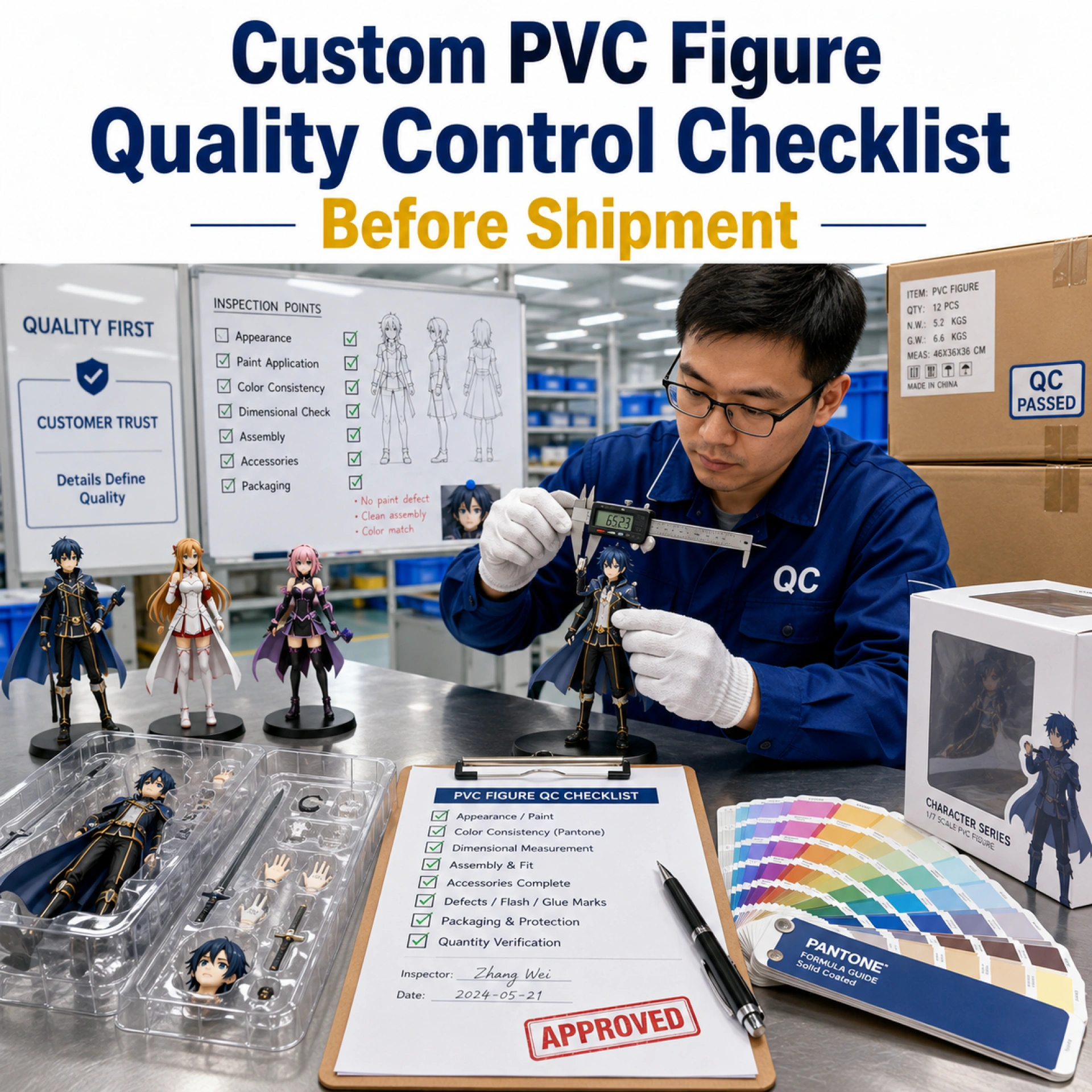
A custom PVC figure quality control checklist helps buyers and manufacturers inspect finished products before shipment. Before a custom PVC figure order leaves the factory, buyers should check appearance, color matching, painting quality, printing accuracy, assembly strength, balance, packaging protection, carton marking, safety labels, and final random inspection results. This step is different from sample approval. Sample approval confirms the production standard before mass production, while final quality control confirms whether the bulk order actually matches that approved standard.
For brands, retailers, IP owners, game companies, animation studios, blind box brands, and promotional product buyers, a custom PVC figure quality control checklist is important because mass production can create issues that do not appear in one approved sample. Common problems include color variation, paint overflow, missing printing, scratches, glue marks, loose accessories, unstable standing, packaging damage, wrong barcode, missing warning labels, or mixed SKUs.
The best way to use a custom PVC figure quality control checklist is to compare final goods against the approved sample, approved artwork, Pantone references, packaging files, and purchase order requirements. If the order is for a licensed IP product or retail toy, the inspection should also include brand consistency, packaging accuracy, and target market safety requirements.
If you are still reviewing the pre-production sample, you can first read our guide on the custom PVC figure sample approval checklist. Once the sample is approved and mass production is finished, this article can help you inspect the final bulk order before shipment.
Why Final Quality Control Matters for Custom PVC Figures
Final quality control is the last major checkpoint before goods are shipped to the buyer, warehouse, retailer, distributor, or fulfillment center. Once the shipment leaves the factory, quality problems become more expensive to fix. Repacking, replacement, rework, air shipment, customer complaints, returns, and brand damage can cost much more than a proper final inspection.
A custom PVC figure quality control checklist is especially important for products with detailed painting, small accessories, multiple SKUs, blind box packaging, or licensed character approval. These products are not simple plastic parts. They are visual products, and customers judge them by small details.
For example, a figure may be rejected by customers if the eyes are printed in the wrong position. A blind box collection may look inconsistent if one character has a different surface finish. A licensed mascot may fail approval if the brand color is wrong. A retail product may face compliance risk if warning labels or tracking information are missing.
A professional custom PVC toy manufacturer should treat quality control as part of the full manufacturing process, not only as a final visual check. Good QC starts from artwork review, 3D modeling, sample approval, mold making, injection molding, painting, assembly, packaging, and final inspection.
Custom PVC Figure Quality Control Checklist Overview
Before shipment, buyers can use the following custom PVC figure quality control checklist as a quick inspection framework.
| QC Item | What to Check | Why It Matters |
|---|---|---|
| Appearance | Shape, surface, scratches, dents, stains, deformation, and visible defects | Confirms the product looks clean and close to the approved sample |
| Color matching | Pantone color, skin tone, clothing color, logo color, and color consistency | Protects brand identity and licensed IP accuracy |
| Painting quality | Spray coverage, overspray, missing paint, paint edge, dust, bubbles, and coating | Determines the visual value of the figure |
| Printing accuracy | Eyes, mouth, logo, small graphics, pad printing position, and sharpness | Small printed details often affect character recognition |
| Assembly | Part fit, gaps, glue marks, loose parts, accessory strength, and base connection | Affects durability and customer satisfaction |
| Stability | Standing balance, leaning, base support, and center of gravity | Prevents the figure from falling during display |
| Packaging | Inner tray, blind box, color box, blister, instruction sheet, and product protection | Prevents damage during shipping and supports retail presentation |
| Carton packing | Carton strength, quantity per carton, carton mark, SKU mix, and shipping label | Reduces warehouse and logistics errors |
| Safety and labeling | Small parts warning, age grading, material safety, tracking information, and market labels | Supports compliance and reduces risk |
| Final reference | Approved sample, approved packaging, and inspection record | Creates a clear standard for acceptance or correction |
This custom PVC figure quality control checklist can be used by sourcing teams, importers, brand owners, product managers, and third-party inspection teams before shipment.
1. Appearance Inspection
Appearance inspection is the first step in a custom PVC figure quality control checklist. Buyers should compare finished goods with the approved physical sample and original artwork.
Check whether the figure has:
- Scratches
- Dust marks
- Stains
- Deformation
- Sink marks
- Rough edges
- Broken parts
- Visible mold lines
- Surface dents
- Uneven texture
- Wrong part shape
- Incorrect character details
The inspector should check the figure from the front, back, left, right, top, and bottom. Many defects are not visible from the front view. For example, a figure may look acceptable from the front but have a rough seam line, glue mark, or paint scratch on the back.
Appearance inspection is especially important for collectible products. Customers who buy custom PVC figures, blind box toys, mascot figures, or IP collectibles usually care about small details. Even minor defects can reduce perceived value if the product is positioned as a collectible or retail gift.
If your team wants to understand how appearance quality is affected by the full production process, read our article on how PVC toys are manufactured.
2. Color Matching Inspection
Color matching should be checked against the approved sample, Pantone references, artwork, and brand style guide. A custom PVC figure quality control checklist should include both molded color and painted color.
Inspectors should check:
- Skin tone
- Hair color
- Clothing color
- Shoe color
- Accessory color
- Base color
- Logo color
- Color consistency between parts
- Color consistency across the production batch
- Color consistency across all characters in a series
Color differences can happen because of PVC material batches, paint mixing, spray thickness, drying conditions, surface finish, lighting, and coating. This is why the approved sample should be kept as the main reference during final inspection.
For licensed IP products, color inspection is very important. The IP owner may have strict requirements for character colors, logo colors, and packaging colors. If the product does not match the approved standard, it may fail approval even if the structure is correct.
For more detail, read our guide on color matching custom PVC figures. It explains how Pantone references, painted samples, and mass production control work together.
3. Painting Quality Inspection
Painting is one of the most common quality risk areas in custom PVC figure production. A product may have a good shape but still look low quality if the painting is rough.
A custom PVC figure quality control checklist should include the following painting checks:
- Missing paint
- Paint overflow
- Uneven spray coverage
- Wrong paint position
- Color contamination
- Paint bubbles
- Dust in paint
- Paint scratches
- Paint peeling
- Masking line problems
- Coating defects
- Matte or glossy finish consistency
For character figures, the face area should receive special attention. Eyes, mouth, eyebrows, cheeks, and small facial details often determine whether the character looks correct. Small misalignment can change the character expression.
Painting defects may also appear around complex areas such as hair edges, shoes, accessories, clothing folds, and small logos. Inspectors should review both large color areas and small decoration details.
If your buyer team wants to understand different decoration methods, our guide on PVC figure painting methods explains spray painting, pad printing, hand painting, screen printing, and other finishing processes.
4. Printing and Logo Inspection
Many custom PVC figures require pad printing, screen printing, heat transfer, or other decoration methods for eyes, mouths, logos, symbols, text, and small graphics. These details must be checked carefully before shipment.
Inspectors should check:
- Printing position
- Printing sharpness
- Missing print
- Double print
- Ink smearing
- Uneven opacity
- Wrong logo color
- Crooked logo
- Eye alignment
- Mouth alignment
- Small graphic accuracy
For brand mascot figures and promotional PVC toys, logo accuracy is especially important. A wrong logo color, unclear text, or crooked print may damage brand presentation.
For blind box toys, all figures in the same series should follow the same printing quality standard. If one character has sharp eye printing and another has blurry printing, the collection may look inconsistent.
The approved sample should define the printing standard. Final goods should not be judged only by whether the print exists. They should be compared with the approved sample for size, position, clarity, and color.
5. Assembly and Structural Inspection
Custom PVC figures often include multiple parts. A figure may have a separate head, body, arms, legs, accessories, base, support rod, or decorative parts. During final QC, all assembled areas should be checked.
A custom PVC figure quality control checklist should include:
- Part fit
- Visible gaps
- Loose parts
- Glue marks
- Weak joints
- Misalignment
- Missing accessories
- Wrong accessories
- Base connection
- Support strength
- Seam visibility
- Assembly direction
Assembly problems can affect both appearance and durability. A loose accessory may fall off during transportation. A weak base may cause the figure to lean. A visible glue mark may make the product look cheap.
For products with detachable parts, buyers should confirm whether the part should be tight, removable, rotatable, or permanently fixed. If the specification is not clear, the factory and buyer may judge the same part differently.
6. Balance and Stability Check
A figure that cannot stand properly can create customer complaints, even if the painting and details are correct. Stability should be part of every custom PVC figure quality control checklist.
Inspectors should check:
- Whether the figure stands on a flat surface
- Whether the figure leans forward or backward
- Whether the base is large enough
- Whether the support point is strong
- Whether heavy accessories affect balance
- Whether the figure falls easily
- Whether multiple samples show the same issue
Stability problems are common in characters with large heads, thin legs, action poses, small feet, or heavy accessories. In some cases, the product may need a base, support rod, wider standing area, or structure adjustment.
If the issue appears only in a few pieces, it may be an assembly defect. If the issue appears in many pieces, it may be a design or mold problem. Final QC should help identify whether the issue is random or systematic.
7. Packaging Inspection
Packaging is not only a box. It protects the product, presents the brand, supports retail display, and reduces transportation damage. A finished figure should be inspected together with its packaging before shipment.
A custom PVC figure quality control checklist should include:
- Color box size
- Blind box structure
- Blister fit
- Inner tray fit
- Plastic bag or protective wrap
- Instruction sheet
- Barcode
- Warning label
- Logo placement
- Product name
- Character artwork
- Legal text
- Importer information
- Carton quantity
- Carton mark
The packaging should match the approved artwork and approved packaging sample. Wrong packaging can be a serious problem, especially for retail products and licensed IP merchandise.
For blind box projects, packaging inspection is even more important because the customer experience depends on the full collection presentation. SKU mixing, secret figure ratio, inner bag sealing, and blind box artwork must be controlled carefully.
If your project needs retail packaging, read our guide on working with a custom toy packaging manufacturer. Packaging should be planned together with product design, not after mass production is finished.
8. Carton Packing and Shipping Inspection
Final QC should also check export cartons and shipping preparation. Even if the figure and retail box are correct, poor carton packing can cause damage, warehouse confusion, or delivery delays.
Inspectors should check:
- Carton strength
- Carton size
- Quantity per carton
- Gross weight
- Net weight
- Carton marking
- SKU information
- Shipping label
- Mixed SKU ratio
- Carton sealing
- Pallet requirement
- Drop or transport risk
For large orders, carton marking must be clear. Warehouses, distributors, and fulfillment centers need accurate carton information to identify the product quickly.
If a buyer has Amazon, retail chain, or distributor packaging requirements, those requirements should be confirmed before shipment. Incorrect carton labels or missing barcodes may create receiving problems.
9. Safety and Compliance Check
Safety and compliance checks depend on the product type, target market, and age grading. A decorative collectible for adults and a toy for children may have different requirements. Buyers should define the product category early.
A custom PVC figure quality control checklist may include:
- Small parts risk
- Sharp points
- Sharp edges
- Material safety
- Paint and coating safety
- Age grading
- Warning labels
- Tracking information
- Packaging warnings
- Testing documents
- Market-specific compliance requirements
For products sold in the United States as children’s products, buyers may need to review the CPSC Children’s Product Certificate. For toys placed on the European market, buyers should review EU toy safety and CE marking requirements.
The factory can help provide samples, material information, and production details, but buyers should confirm final testing requirements with qualified laboratories or compliance partners.
10. Final Random Inspection and AQL
For mass production, it is usually not practical to inspect every single piece in detail before shipment, especially for large orders. Many buyers use random inspection based on an agreed sampling plan.
AQL means Acceptable Quality Limit. It is often used in product inspections to decide how many units to inspect and how many defects are acceptable before a shipment is accepted or rejected. The ANSI/ASQ Z1.4 sampling standard is commonly referenced for sampling procedures in inspection by attributes.
For custom PVC figures, buyers and manufacturers should define defect levels clearly:
| Defect Level | Meaning | Example |
| Critical defect | A defect that may create safety risk or make the product illegal to sell | Sharp edge, choking hazard, missing required warning label |
| Major defect | A defect that affects product function, appearance, or customer acceptance | Wrong color, missing accessory, poor painting on face, unstable standing |
| Minor defect | A small defect that does not seriously affect use or overall appearance | Tiny surface mark, very small paint dot, minor packaging crease |
A custom PVC figure quality control checklist should define which defects are critical, major, and minor. This helps the buyer, factory, and inspector make consistent decisions.
Common Defects in Custom PVC Figures
Before shipment, inspectors should pay close attention to common defects. These defects may appear during molding, painting, printing, assembly, packaging, or transportation.
Common defects include:
- Wrong color
- Color variation
- Missing paint
- Paint overflow
- Scratches
- Dust in coating
- Wrong printing position
- Blurry eyes or logo
- Loose accessories
- Missing accessories
- Visible glue marks
- Large assembly gaps
- Deformation
- Unstable standing
- Wrong packaging
- Damaged box
- Missing barcode
- Missing warning label
- Incorrect carton mark
Some defects are isolated. Others may affect the whole batch. If many samples show the same defect, the factory should check the root cause before shipment. The problem may come from mold, painting fixture, printing plate, assembly method, packaging design, or production handling.
Buyer Checklist Before Approving Shipment
Here is a practical custom PVC figure quality control checklist that buyers can use before shipment approval.
| Checklist Question | Pass / Fail |
| Does the bulk production match the approved sample? | |
| Are the size, shape, and proportion correct? | |
| Are all Pantone colors and brand colors acceptable? | |
| Is the painting quality consistent? | |
| Are eyes, mouth, logos, and small printed details accurate? | |
| Are there scratches, stains, dents, deformation, or rough surfaces? | |
| Are all accessories included and assembled correctly? | |
| Are gaps, seams, and glue marks acceptable? | |
| Can the figure stand properly? | |
| Does the product fit the packaging securely? | |
| Are packaging artwork, barcode, warnings, and labels correct? | |
| Are carton marks and carton quantities correct? | |
| Are safety and compliance documents confirmed? | |
| Has random inspection been completed? | |
| Are defect limits clearly accepted or rejected? | |
| Is the shipment approved for release? |
This custom PVC figure quality control checklist should be used together with the approved sample, purchase order, packaging files, and inspection standard.
How Jiahong Creative Supports Custom PVC Figure Quality Control
Jiahong Creative supports custom PVC figure production from artwork review, 3D modeling, prototype sampling, mold making, injection molding, painting, printing, assembly, packaging, quality inspection, and shipment preparation.
For final shipment inspection, we help buyers check product appearance, color matching, painting quality, printing accuracy, assembly, balance, packaging, carton packing, and production consistency. For blind box toys, mascot figures, licensed IP products, promotional PVC toys, and collectible figures, we can help identify production risks before the shipment leaves the factory.
If you are developing a new figure project, you can contact us through our custom PVC figure project inquiry page. Please share your artwork, target size, quantity, packaging idea, color references, and target market. A clear project brief helps us prepare a more accurate production and quality control plan.
If you are still preparing quotation details, our custom PVC figure quotation guide explains what information buyers should provide before pricing.
Final Thoughts
A custom PVC figure quality control checklist is essential before shipment because it helps buyers confirm whether mass production matches the approved sample. The final inspection should cover appearance, color, painting, printing, assembly, stability, packaging, carton packing, safety, and inspection records.
For custom PVC figures, small details matter. A wrong eye position, color mismatch, unstable base, missing accessory, or damaged blind box can affect customer satisfaction and brand value. The earlier the buyer and factory define the inspection standard, the easier it is to prevent disputes and shipment delays.
For brands developing blind box toys, mascot figures, licensed IP products, game character figures, or promotional collectibles, a custom PVC figure quality control checklist should be part of the normal production workflow. It helps turn final inspection from a quick visual check into a controlled quality decision before shipment.
FAQ
1.What is a custom PVC figure quality control checklist?
A custom PVC figure quality control checklist is a step-by-step inspection tool used before shipment. It helps buyers check appearance, color, painting, printing, assembly, packaging, safety, and final production consistency.
2.Is final QC different from sample approval?
Yes. Sample approval confirms the production standard before mass production. Final QC checks whether the finished bulk order matches that approved sample before shipment.
3.What defects are common in custom PVC figures?
Common defects include color mismatch, missing paint, overspray, scratches, glue marks, loose accessories, unstable standing, wrong packaging, missing barcode, and damaged boxes.
4.How should buyers check painting quality?
Buyers should check paint coverage, edge sharpness, overspray, missing paint, dust, scratches, coating consistency, and small details such as eyes, mouth, clothing lines, and logos.
5.Why is color matching important in PVC figure QC?
Color matching protects character accuracy, brand consistency, and licensed IP approval. Final goods should be compared with the approved sample, Pantone references, and brand color guide.
6.Should packaging be included in final QC?
Yes. Packaging should always be checked before shipment. Buyers should review box structure, inner tray, artwork, barcode, warning labels, instruction sheet, carton packing, and product protection.
7.What is AQL in PVC figure inspection?
AQL means Acceptable Quality Limit. It is used in random inspection to decide how many units should be checked and how many defects are acceptable before accepting or rejecting a shipment.