

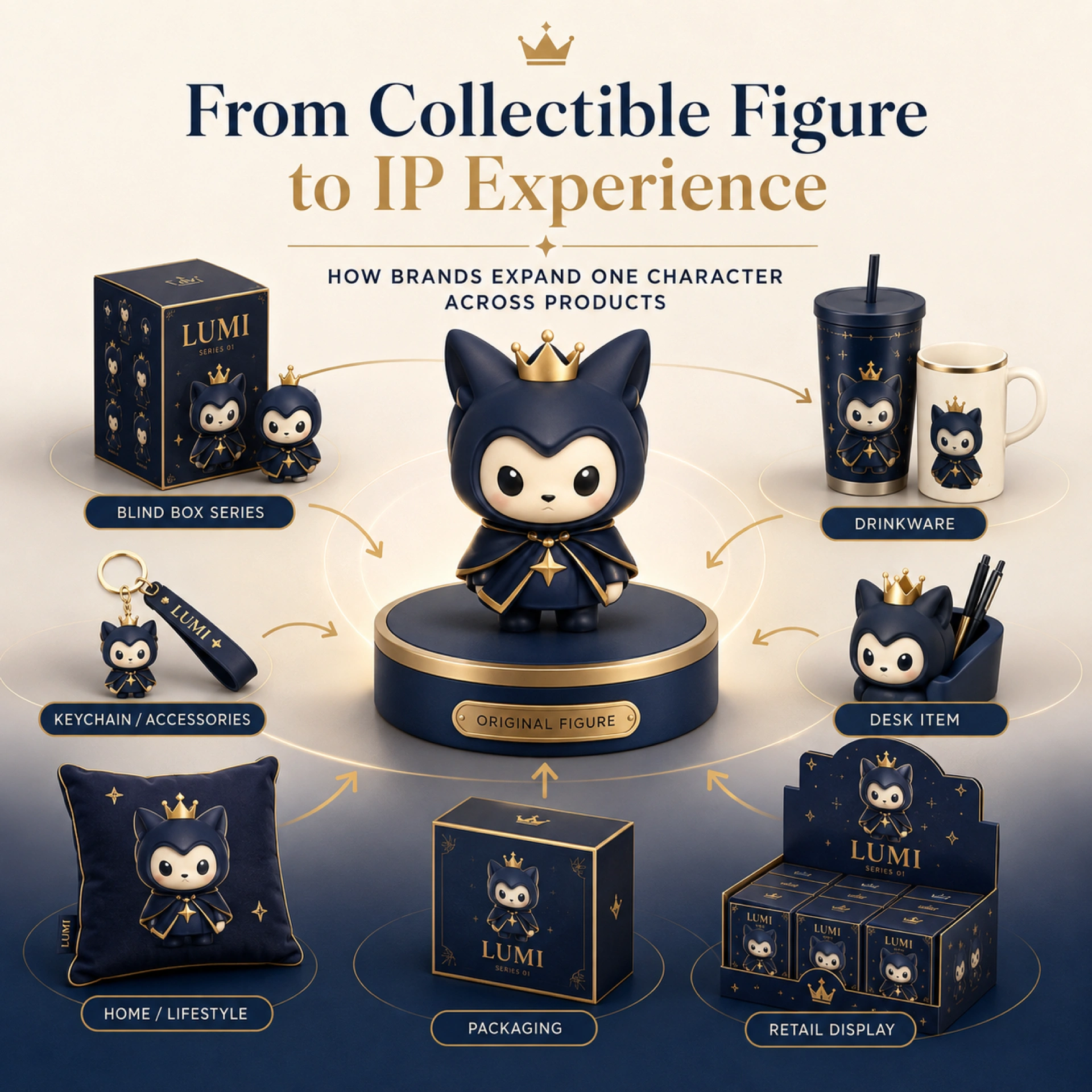
From Collectible Figure to IP Experience means turning one character from a single physical figure into a complete product ecosystem. Instead of selling only one PVC collectible, a brand can expand the same character into blind box series, entry-price accessories, functional home products, seasonal exclusives, retail display materials, packaging systems, and long-term merchandise collections.
The direct answer is this: brands move From Collectible Figure to IP Experience by treating the character as a reusable product asset, not a one-time toy design. A hero collectible can establish the premium look. Blind box series can create repeat purchase. Entry-price accessories can reach more customers. Functional home products can bring the character into daily life. Seasonal and event exclusives can create launch moments. Retail display materials can increase shelf impact. Shared 3D assets and packaging consistency can keep the whole product line recognizable.
For IP owners, game companies, animation studios, licensees, retailers, and brand teams, the biggest opportunity is not only making one figure. The bigger opportunity is building a character world that customers can collect, use, display, gift, and remember. This is why From Collectible Figure to IP Experience has become an important product strategy for modern character merchandise.
If your brand is still choosing a production partner for licensed products, our guide on how to choose a custom toy manufacturer for licensed IP products explains how buyers should evaluate IP confidentiality, character accuracy, approval workflow, packaging control, and mass production quality.
1. Hero Collectible
The first step From Collectible Figure to IP Experience is usually the hero collectible. This is the main figure that defines the character’s physical form, quality level, color standard, facial expression, pose, and collectible value.
A hero collectible may be a PVC figure, vinyl figure, mascot figure, game character figure, anime figure, or licensed IP display product. It is often larger, more detailed, and more premium than other product formats in the same merchandise line.
A strong hero collectible should establish:
- Character proportion
- Face and expression
- Main pose
- Signature colors
- Surface finish
- Painting quality
- Base design
- Packaging style
- Brand positioning
- Retail price level
The hero collectible is important because it becomes the physical reference for later products. If the first figure is inaccurate, every later product extension may inherit the same problem. If the first figure is well-developed, the brand can use it as the foundation for blind boxes, keychains, accessories, electronic gifts, packaging artwork, and retail displays.
For buyers starting from character artwork, our guide on how to turn 2D character art into a custom toy figure explains how flat artwork becomes a production-ready figure through 3D modeling, sampling, mold making, painting, and approval.
2. Blind Box Series
The second step From Collectible Figure to IP Experience is often a blind box series. Blind boxes are powerful because they transform one character into multiple collectible moments. Instead of one product, the brand can create a full lineup with different poses, emotions, outfits, accessories, scenes, colors, and secret figures.
A blind box series may include:
- Standard version
- Happy version
- Sleeping version
- Action pose
- Seasonal outfit
- Rare colorway
- Glow version
- Metallic version
- Secret figure
- Collaboration edition
The purpose of a blind box series is to create repeat purchase and community discussion. Fans may buy more than one box, trade duplicates, search for secret figures, and share unboxing videos. This turns a single collectible into an ongoing IP experience.
However, blind box development must be planned carefully. Each variant may need 3D adjustment, mold planning, paint masks, packaging codes, assortment control, and QC standards. If the buyer wants to move From Collectible Figure to IP Experience efficiently, the blind box lineup should be designed with shared visual identity and realistic production cost.
Our guide on the blind box figure manufacturing process explains how concept planning, lineup design, hidden figure ratio, packaging, and mass production work together.
3. Entry-Price Accessories
Entry-price accessories help brands reach customers who may not buy a premium collectible immediately. This is a practical step From Collectible Figure to IP Experience because it lowers the purchase barrier and increases the number of product touchpoints.
Entry-price products may include:
- PVC keychains
- Bag charms
- Phone charms
- Zipper pulls
- Mini standees
- Badge-style figures
- Desk accessories
- Small scene props
- Magnets
- Mini display bases
- Capsule toys
- Promotional gifts
Accessories should not feel like cheap afterthoughts. They should still carry the character’s core identity. The face, colors, silhouette, and signature elements should remain recognizable even when the product is smaller and simpler.
The main manufacturing challenge is simplification. A detailed hero figure may include thin parts, complex paint areas, and multiple accessories. A keychain or charm needs stronger connection points, fewer fragile details, and more durable surface finishing because it will be handled more often.
Entry-price accessories are useful for events, retail counters, bundle offers, online add-ons, and fan community campaigns. They help the brand move From Collectible Figure to IP Experience by making the character easier to own, carry, and share.
4. Functional Home Products
Functional home products are one of the strongest ways to expand From Collectible Figure to IP Experience because they bring the character into daily life. A figure is displayed. A functional product is used. This difference can create deeper customer attachment.
Character-based functional products may include:
- Night lights
- Bluetooth speakers
- Alarm clocks
- Sleep training clocks
- Aroma diffusers
- Humidifiers
- Soap dispensers
- Desk lamps
- Portable fans
- Sound machines
- Silicone tap lights
- Smart character gadgets
These products require more engineering than static figures. A character Bluetooth speaker needs acoustic structure, speaker outlet, PCBA, battery, buttons, charging port, and plastic shell design. A character night light needs LED placement, light diffusion, material selection, heat review, and user safety. A humidifier needs water tank structure, mist outlet, sealing, and assembly control.
This is why a brand should not simply copy the collectible figure shape into an electronic product. The character must be adapted for function. The product should still look like the character, but it also needs internal space, user controls, stability, safety, and testing.
If your brand wants to expand into electronic gifts, our character electronic gift manufacturer guide explains how OEM development works for character night lights, speakers, humidifiers, aroma diffusers, alarm clocks, and other IP-themed home products.
You can also review our guide on character figure vs character electronic product to compare collectible value, daily-use value, cost, complexity, and buyer risks.
5. Seasonal and Event Exclusives
Seasonal and event exclusives help keep an IP product line fresh. They are a useful step From Collectible Figure to IP Experience because they create limited-time reasons to buy, collect, visit stores, attend events, or engage with campaigns.
Seasonal and event exclusives may include:
- Halloween version
- Christmas version
- Lunar New Year version
- Summer edition
- Anniversary edition
- Game launch edition
- Movie release edition
- Convention exclusive
- Retailer-exclusive colorway
- Online limited edition
- Metallic or glow special edition
These versions can be based on the hero figure, blind box variants, accessories, or functional products. The key is to decide how much should change. A simple repaint may be lower cost. A new accessory may create stronger value. A new pose may require new tooling. A functional seasonal version may require both product and packaging changes.
For brands, seasonal exclusives should not be random. They should support the character story, target audience, retail calendar, and launch sequence. A special edition should feel connected to the IP world.
Our article on Blind Box Special Editions explains how glow effects, flocking, metallic paint, and secret figure planning affect cost, MOQ, packaging, and QC.
6. Retail Display Materials
Retail display materials help convert a product line into a stronger shelf experience. This is often overlooked when brands move From Collectible Figure to IP Experience. A product may look good alone, but weak retail presentation can reduce visibility and sales.
Retail display materials may include:
- Counter display boxes
- PDQ display trays
- Shelf-ready packaging
- Header cards
- Standee displays
- Character display boards
- Window box arrangements
- Blind box display cartons
- Collection posters
- Retail signage
- QR code cards
- Product story cards
Retail display materials should connect the hero collectible, blind box series, accessories, and functional products visually. Customers should understand that all items belong to the same character world.
For example, a retail display can show the hero collectible at the center, blind boxes in the lower section, keychains near checkout, and a character Bluetooth speaker or night light as a premium lifestyle item. This turns scattered products into a coherent IP experience.
Retail displays also need practical planning. Buyers should confirm display size, carton packing, retail shelf dimensions, assembly method, durability, printing, barcode placement, and shipping protection.
7. Shared 3D Assets and Visual Identity
Shared 3D assets are the production foundation when brands move From Collectible Figure to IP Experience. A single 3D master asset can help maintain character consistency across PVC figures, blind boxes, keychains, packaging artwork, product renders, and electronic product adaptations.
A 3D master asset should define:
- Character head shape
- Body proportion
- Signature silhouette
- Facial features
- Core accessories
- Surface details
- Color zones
- Pose logic
- Simplification rules
- Product adaptation rules
However, shared 3D assets do not mean every product should use exactly the same model. A hero figure, blind box, keychain, and night light may each need different proportions and part structures. The shared asset provides identity consistency, while each product format needs production-specific adjustments.
Visual identity should also be shared. This includes Pantone colors, logo placement, expression rules, character naming, packaging typography, background world, icon style, and photography direction.
For color control, buyers can read our guide on color matching custom PVC figures. Color consistency becomes more important when one character appears across many products and packaging formats.
8. Packaging Consistency
Packaging consistency is one of the most important parts of From Collectible Figure to IP Experience. If each product uses unrelated packaging, customers may not recognize the collection as one brand system.
Packaging consistency may include:
- Same logo placement
- Same character artwork style
- Same color palette
- Same typography
- Same legal text system
- Same warning label placement
- Same barcode logic
- Same collection numbering
- Same background story
- Same retail display language
- Same QR code or website placement
Different products can still use different packaging structures. A hero figure may use a window box. A blind box may use sealed mystery packaging. A keychain may use a carded package. A Bluetooth speaker may need a stronger electronic product box. The structure can change, but the brand language should stay consistent.
Packaging also affects cost, shipping, compliance, and retail presentation. A beautiful product line can lose value if the packaging looks inconsistent, weak, or unplanned.
Our guide on working with a custom toy packaging manufacturer explains how buyers should prepare packaging structure, printed artwork, inner tray, warning labels, barcode areas, carton packing, and protection requirements.
9. Product Launch Sequence
A strong launch sequence helps brands expand From Collectible Figure to IP Experience without overwhelming budget, tooling, approval workload, or supply chain capacity. Not every product needs to launch at once.
A practical launch sequence may look like this:
| Launch Stage | Product Type | Purpose |
|---|---|---|
| Stage 1 | Hero collectible | Establish character quality and visual standard |
| Stage 2 | Blind box series | Create repeat purchase and collection behavior |
| Stage 3 | Entry-price accessories | Add lower-price purchase options |
| Stage 4 | Functional home products | Move the character into daily life |
| Stage 5 | Seasonal exclusives | Create campaign moments and limited releases |
| Stage 6 | Retail display materials | Support broader retail rollout |
This sequence can change depending on the brand. A game company may launch accessories first for events. A retailer may launch blind boxes first to test demand. A lifestyle IP brand may launch night lights or speakers earlier because functional products fit the brand positioning.
The important point is to define the role of each product. The hero collectible builds authority. Blind boxes build collection energy. Accessories build reach. Functional products build daily use. Seasonal exclusives build urgency. Retail displays build visibility.
If your brand wants to build a broader licensed merchandise roadmap, our article on how to Turn One Licensed Character Into a Multi-Product Merchandise Line explains how one character can expand through figures, blind boxes, keychains, electronics, packaging, tooling, NDA protection, and launch planning.
10. Supply-Chain Planning
Supply-chain planning is where the full From Collectible Figure to IP Experience strategy becomes realistic. A multi-product line may require different materials, tooling, suppliers, assembly methods, packaging structures, testing plans, and shipment schedules.
A complete supply-chain plan should include:
- 3D modeling schedule
- Sample approval timeline
- Mold development plan
- PVC or ABS material planning
- Painting and printing setup
- Electronics and PCBA planning
- Battery and component sourcing
- Packaging supplier schedule
- Retail display production
- QC inspection plan
- Testing and compliance preparation
- Carton packing and shipment plan
- Reorder strategy
- Inventory risk planning
The buyer should also identify which components can be shared. Shared components may include base parts, accessories, color standards, packaging dielines, printed cards, display materials, or electronics platforms. However, shared tooling is only possible when product size, material, structure, and production method are compatible.
A strong supply-chain plan helps control cost and lead time. Without it, the brand may approve one product at a time, creating repeated 3D work, repeated tooling costs, inconsistent colors, packaging mismatch, and slow launch cycles.
For general manufacturing workflow, our article on how PVC toys are manufactured explains the step-by-step process from design and sampling to mold making, production, painting, assembly, packaging, and QC.
IP Rights, Licensing, and Confidential Development
When moving From Collectible Figure to IP Experience, brands should also confirm license scope and confidentiality. A license may allow PVC figures but not electronic products. It may allow toys but not home appliances. It may allow one country but not another. It may allow retail products but not promotional gifts.
Buyers should confirm:
- Which product categories are covered
- Which territories are covered
- Which sales channels are allowed
- Whether electronics are included
- Whether seasonal exclusives are allowed
- Whether packaging artwork needs approval
- Whether retail display materials need approval
- Whether unreleased character files require NDA protection
- Whether factory sample photos can be used publicly
WIPO explains that IP licensing allows another party to use IP while ownership remains with the IP owner, and merchandising is a specialized form of IP licensing for applying trademarks, designs, or copyright to consumer goods. Buyers can review WIPO’s official page on IP assignment and licensing.
For confidential projects, buyers can also review WIPO’s information on trade secrets and use NDA controls before sharing unreleased artwork, product concepts, 3D files, or packaging designs.
For brand identity, USPTO explains that a trademark can be a word, phrase, symbol, design, or combination that identifies goods or services. This matters because packaging, retail display materials, and product naming should follow the brand’s authorized trademark and licensing rules.
Buyer Checklist: From Collectible Figure to IP Experience
Before starting a multi-product character line, buyers can use this checklist.
| Buyer Question | Why It Matters |
| What is the hero product? | Defines the character’s quality standard and visual reference |
| Can the character become a blind box series? | Creates repeat purchase and collection value |
| What entry-price products make sense? | Expands reach through keychains, charms, and small accessories |
| Which functional home products fit the character? | Brings the IP into daily use |
| Are seasonal exclusives planned? | Creates launch moments and limited-edition demand |
| Are retail display materials needed? | Improves shelf impact and store presentation |
| Is there a shared 3D master asset? | Keeps character identity consistent |
| Is packaging visually consistent? | Makes the whole line feel connected |
| What is the launch sequence? | Controls risk, budget, tooling, and approval workload |
| Is the supply chain ready? | Aligns molds, materials, electronics, packaging, QC, and shipment |
This checklist helps buyers turn From Collectible Figure to IP Experience into a real product development workflow.
How Jiahong Creative Supports IP Product Expansion
Jiahong Creative supports brands that want to move From Collectible Figure to IP Experience through custom PVC figures, blind box series, keychains, accessories, character electronic gifts, packaging, retail display materials, and final assembly.
We can help with artwork review, 3D modeling, prototype sampling, mold making, PVC injection molding, painting, printing, silicone parts, PCBA coordination, electronic product assembly, packaging development, QC, and shipment preparation.
For buyers building one character across multiple products, early planning is important. Please share your character artwork, license scope, target product categories, hero product idea, blind box plan, accessory plan, functional product direction, packaging requirements, launch sequence, target market, and expected quantity.
You can contact us through our custom IP product inquiry page.
Final Thoughts
From Collectible Figure to IP Experience is a powerful strategy for brands that want to build long-term value from one character. A hero collectible creates the premium reference. A blind box series builds collection behavior. Entry-price accessories make the character easier to own. Functional home products bring the character into daily life. Seasonal and event exclusives create urgency. Retail display materials connect the product line in stores.
The key is planning. A brand should not develop each product separately with no shared 3D asset, no packaging system, no launch sequence, and no supply-chain roadmap. The strongest IP merchandise lines are planned as connected product ecosystems.
When buyers organize 3D assets, visual identity, packaging consistency, tooling strategy, product launch sequence, and supply-chain planning early, it becomes much easier to move From Collectible Figure to IP Experience. One character can become more than a figure. It can become a complete product world that customers collect, use, display, and remember.
FAQ
1.What does From Collectible Figure to IP Experience mean?
From Collectible Figure to IP Experience means expanding one character beyond a single figure into a full product ecosystem, including blind boxes, keychains, accessories, home products, seasonal exclusives, retail displays, and packaging systems.
2.Why should a brand start with a hero collectible?
A hero collectible establishes the character’s physical form, quality standard, color reference, packaging style, and collectible value. It becomes the reference point for later product extensions.
3.How can blind boxes help expand one character?
Blind boxes allow one character to appear in multiple poses, emotions, outfits, themes, and secret versions. This creates repeat purchase, trading, collecting, and social sharing.
4.What are entry-price accessories?
Entry-price accessories include keychains, bag charms, phone charms, mini standees, magnets, desk accessories, and small promotional items. They help more customers access the character at a lower price point.
5.What functional home products can use character IP?
Character IP can be adapted into night lights, Bluetooth speakers, alarm clocks, aroma diffusers, humidifiers, soap dispensers, desk lamps, portable fans, and other daily-use products.
6.Why are seasonal and event exclusives useful?
Seasonal and event exclusives create limited-time reasons to buy. They can support holidays, game launches, movie releases, conventions, anniversaries, and retailer campaigns.