

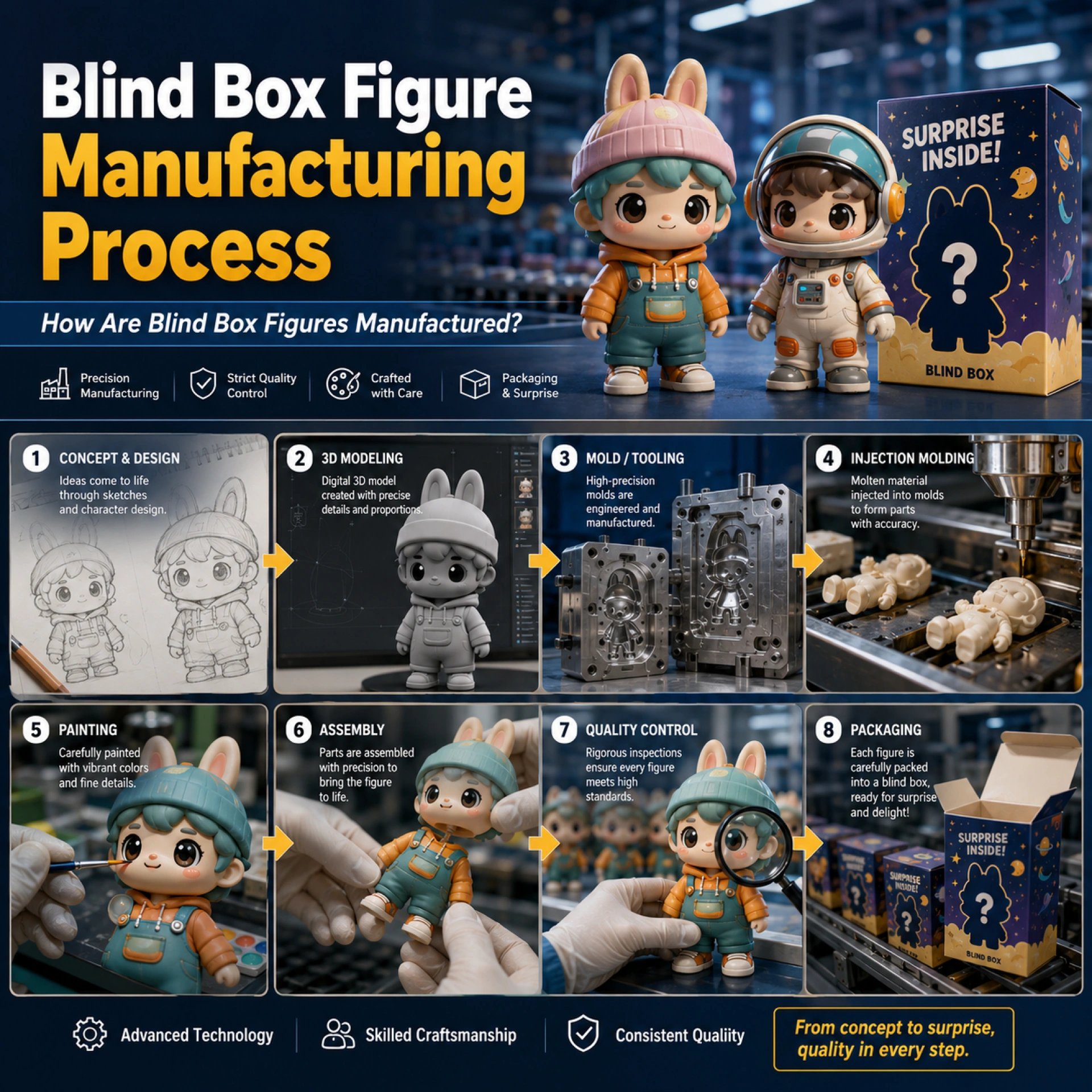
If buyers want a direct answer, the blind box figure manufacturing process usually includes concept development, 2D or 3D design, prototype making, mold development, material selection, painting and decoration, assembly, packaging, quality control, assortment planning, and mass production. However, compared with many standard collectible products, the blind box figure manufacturing process places even more importance on quality consistency and packaging quality.
That is because a blind box figure is not only a toy or collectible. It is also a surprise-based retail product. The customer does not choose the exact figure at the point of purchase, so the product experience depends heavily on consistency, finish quality, sealed packaging, and presentation. If one figure has poor paint, weak assembly, or damaged box quality, the customer experience is affected immediately.
This is why the blind box figure manufacturing process requires careful control from both the product side and the packaging side.
For many blind box projects, the figure itself must be attractive, collectible, and consistent across all designs in the series. At the same time, the packaging must protect the figure, preserve the blind purchase experience, and support the brand image on the shelf or in e-commerce sales. That is why the blind box figure manufacturing process is more than simple toy production. It is a full product-development system.
Quick Answer: Blind box figure manufacturing process at a glance
Here is a simple overview of the blind box figure manufacturing process.
| Stage | What Happens | Why It Matters |
|---|---|---|
| Concept and series planning | Character ideas, lineup, hidden figure ratio, product direction | Builds the commercial foundation of the blind box series |
| Product design | 2D design, 3D development, structural planning | Defines appearance, manufacturability, and collectible value |
| Prototype making | Hand sample or pre-production model | Helps confirm design, pose, paint plan, and structure |
| Mold making | Tooling for figure parts and accessories | Determines production accuracy and repeatability |
| Material selection | Usually PVC, sometimes with ABS or other rigid parts | Affects detail, strength, and production suitability |
| Painting and decoration | Spray painting, pad printing, hand detailing, finishing | Creates the final collectible look |
| Assembly | Fitting parts, gluing, checking stability | Important for consistent product quality |
| Packaging development | Blind box, inner bag, inserts, barcode, assortment system | Critical for protection, secrecy, and retail presentation |
| Quality control | Product inspection and packaging inspection | Essential because blind box buyers expect consistency |
| Mass production and packing | Final manufacturing and sorting by assortment plan | Delivers the full series to market |
This is the basic blind box figure manufacturing process, but each stage needs careful planning if the product is meant for real retail sale.
1. Blind box figure manufacturing process starts with concept planning
A blind box project usually begins with more than one figure design.
Unlike a single collectible toy, a blind box series usually includes:
- a full lineup of normal designs
- one or more hidden or rare designs
- unified packaging direction
- a consistent visual style across the series
- an assortment plan for production and packing
That means the blind box figure manufacturing process starts with series planning, not only with one figure.
This stage usually includes:
- deciding the number of designs
- defining the hidden figure strategy
- setting figure size range
- defining pose style and brand tone
- confirming target market and price level
This early stage matters because blind box figures need strong series identity. A single design may look attractive, but a full blind box collection also needs lineup balance and visual coherence.
2. Product design is one of the most important parts of the blind box figure manufacturing process
After concept planning, the next stage in the blind box figure manufacturing process is product design.
This often includes:
- 2D character development
- pose design
- accessory planning
- 3D modeling
- engineering-friendly structural adjustment
- paint zone planning
- packaging style alignment
For blind box products, design must consider both appearance and production logic. A figure that looks good in artwork may still need modification before it can be produced efficiently and consistently.
This is also where your factory’s design support becomes an important advantage. At Jiahong Creative, you can support customers not only with production, but also with product design and packaging design. That is especially valuable for blind box projects, because the product and the box need to feel like one complete retail concept.
If the customer already has finished development files, the project can move faster. If not, the design stage becomes an important part of the blind box figure manufacturing process.
If you want to understand how design readiness affects timing, you can also read Custom PVC Figure Lead Time: How Long Does It Take to Make a Custom PVC Figure?.
3. Prototype making helps confirm structure, detail, and collectible feel
The next major step in the blind box figure manufacturing process is prototype making.
Before formal tooling begins, a sample or prototype is usually made to confirm:
- figure proportion
- character accuracy
- pose stability
- accessory fit
- part split logic
- basic paint plan
- overall collectible feel
This step is very important for blind box figures because the product is usually small, highly visual, and sold as a surprise item. Small flaws are often easier to notice on this kind of product because the entire value depends on appearance and collectibility.
A good prototype review can prevent later problems in:
- mold structure
- paint workload
- assembly complexity
- packaging fit
That is why the blind box figure manufacturing process should not rush through sample confirmation.
4. Mold making determines whether the series can be produced consistently
After prototype approval, the blind box figure manufacturing process moves into mold making.
Mold development is critical because blind box products are typically sold in series and often in relatively high repeat volume. That means consistency matters more than in many one-off display products.
Tooling affects:
- detail reproduction
- part fit
- repeatable production quality
- assembly accuracy
- defect rate
- overall production stability
This is also why blind box figures with many split parts, layered details, or tiny accessories need extra attention during tooling. The more complicated the product structure, the more important the engineering precision becomes.
5. Material selection shapes the blind box figure manufacturing process
For many series, PVC is one of the most practical materials in the blind box figure manufacturing process because it offers a good balance of:
- collectible-style appearance
- paint adaptability
- detail support
- scalable production
In some projects, ABS may also be used for rigid accessories, bases, or structural parts.
The right material choice matters because blind box products need:
- strong visual consistency
- stable assembly
- acceptable shipping weight
- suitable paint performance
- safe and repeatable mass production
If you want to compare materials more broadly, you can also read What Is the Best Material for Custom Collectible Figures? and PVC vs Vinyl vs ABS Figures.
6. Painting and decoration are core stages in the blind box figure manufacturing process
Painting is one of the most sensitive parts of the blind box figure manufacturing process.
Because blind box figures are usually:
- small in size
- visually driven
- sold in repeated series
- highly dependent on shelf appeal
the painting and printing quality must stay consistent across all units.
This stage may include:
- spray painting
- pad printing
- hand detailing
- touch-up
- matte or gloss finishing
For blind box products, paint quality matters for two reasons.
First, the product is often collected as a set, so differences between units become very obvious.
Second, the customer buys the item in sealed form, so the delivered figure must feel worth the surprise experience.
This is why the blind box figure manufacturing process requires stricter decoration consistency than many buyers first expect.
For more detail on decoration methods, you can also read What Painting Methods Are Used for Custom PVC Figures?.
7. Assembly quality is especially important in blind box production
Assembly is another key part of the blind box figure manufacturing process.
Even if the mold quality and paint quality are good, the product can still fail if:
- parts do not fit well
- glue is messy
- accessories are unstable
- the figure leans or falls
- the standing balance is weak
Blind box products are often small, but that does not make assembly less important. In fact, small products can be even more sensitive because small defects are easier to notice at close range.
That is why the blind box figure manufacturing process needs stable assembly standards, especially when the lineup includes several different designs in one series.
8. Packaging is one of the most important parts of the blind box figure manufacturing process
This is where blind box products are different from many ordinary custom figures.
Packaging is not only for protection. In the blind box figure manufacturing process, packaging also controls:
- the surprise experience
- assortment management
- retail display
- branding
- secrecy of the included figure
- shipping protection
A blind box product usually needs:
- outer blind box packaging
- inner sealed bag or inner pack
- figure protection insert if needed
- barcode or SKU management
- assortment control
- master carton planning
This is why packaging quality matters so much in the blind box figure manufacturing process. If the box quality is poor, the shelf impression is weaker. If the inner packaging is weak, the blind experience may be ruined. If assortment management is poor, the customer may lose confidence in the series.
For blind box products, packaging is not secondary. It is part of the product itself.
This is also where your factory’s design capability becomes a major selling point. Because you have your own design team, you can support customers with both product design and packaging design. That is extremely useful for blind box projects, since the visual style of the figure and the packaging should feel unified from the beginning.
9. Quality control is even more important in the blind box figure manufacturing process
Among all collectible product categories, blind box may be one of the formats where consistency matters most.
Why? Because customers often buy multiple units in the same series. That means they compare:
- paint quality between designs
- assembly consistency
- box printing quality
- inner bag sealing
- overall presentation
This is why the blind box figure manufacturing process needs strong quality control in both product and packaging.
Quality control may include:
- molded part inspection
- paint inspection
- assembly inspection
- drop and packaging checks
- assortment verification
- shipping carton inspection
A blind box project with weak QC can damage the whole series experience, not just one unit.
f you want to understand manufacturing quality systems more generally, you can also refer to ISO 9001 quality management systems, which explains how structured quality processes support consistent products and continuous improvement.
10. Mass production in the blind box figure manufacturing process requires series coordination
Mass production is not only about producing one figure repeatedly. In the blind box figure manufacturing process, the factory usually has to coordinate:
- multiple character designs
- shared packaging systems
- hidden figure ratio
- packing sequence
- carton planning
- inventory logic
That makes blind box production more complex than a single-SKU collectible.
This is why a blind box figure manufacturing process needs strong coordination between:
- design
- engineering
- painting
- assembly
- packaging
- QC
- warehouse packing
A practical blind box figure manufacturing process workflow
Here is a simplified workflow buyers can use.
| Stage | Key Focus |
|---|---|
| Series concept planning | Character lineup, hidden ratio, market positioning |
| Product and packaging design | Figure design, box design, collectible identity |
| Prototype review | Appearance, structure, fit, paint direction |
| Mold making | Precision, repeatability, production stability |
| Decoration planning | Paint consistency, print accuracy, finish quality |
| Assembly setup | Stability, clean fitting, repeatable output |
| Packaging development | Blind experience, protection, branding |
| QC inspection | Product consistency and packaging quality |
| Mass production | Series coordination and assortment control |
This is the real blind box figure manufacturing process buyers should understand before launching a project.
Final thoughts
The best short answer is that the blind box figure manufacturing process includes concept planning, design, prototype making, mold making, material selection, painting, assembly, packaging, quality control, and mass production.
But for blind box products, the two most important priorities are usually product quality and packaging quality.
A blind box figure must not only look good as a collectible. It must also feel consistent across the series, hold up in packaging, and deliver a strong surprise experience to the end customer. That is why the blind box figure manufacturing process needs tighter control than many ordinary toy projects.
At the same time, blind box development also benefits from having a factory that can support both figure design and packaging design. When those two systems are planned together, the final retail product usually feels much stronger.
Need help with your blind box figure manufacturing process?
If you are planning a blind box project, the best starting point is to evaluate the lineup, structure, material, paint complexity, and packaging system together instead of treating them as separate steps.
At Jiahong Creative, the team can support both product design and packaging design, which helps buyers develop a more complete blind box concept from the start. That is especially valuable for brands that want not only a figure, but a stronger blind box retail experience.
You can send your concept, artwork, target size, estimated quantity, and packaging ideas, and we can help review the most suitable blind box figure manufacturing process for your project.
FAQ
Q1:What is the blind box figure manufacturing process?
The blind box figure manufacturing process usually includes concept planning, figure design, prototype making, mold development, material selection, painting, assembly, packaging, quality control, and mass production.
Q2:Why is packaging so important in the blind box figure manufacturing process?
Packaging is important because blind box products depend on both protection and the surprise experience. The box and inner pack help preserve secrecy, improve shelf presentation, and protect the figure during shipping.
Q3:Why does quality control matter more for blind box figures?
Quality control matters more because blind box buyers often compare multiple figures in one series. Inconsistent paint, weak assembly, or poor packaging quality can damage the whole brand experience.
Q4:What material is commonly used in the blind box figure manufacturing process?
PVC is commonly used in the blind box figure manufacturing process because it offers a good balance of detail, paint adaptability, and scalable production. ABS may also be used for rigid accessories or structural parts.
Q5:Can a factory help design both the figure and the packaging?
Yes. A factory with its own design team can often support both product design and packaging design, which is especially useful for blind box projects because the figure and the packaging should feel like one unified retail concept.
Q6:What is the most critical stage in the blind box figure manufacturing process?
There is no single stage for every project, but design, packaging, and quality control are often the most critical because blind box products depend heavily on collectible appeal, consistency, and presentation.