

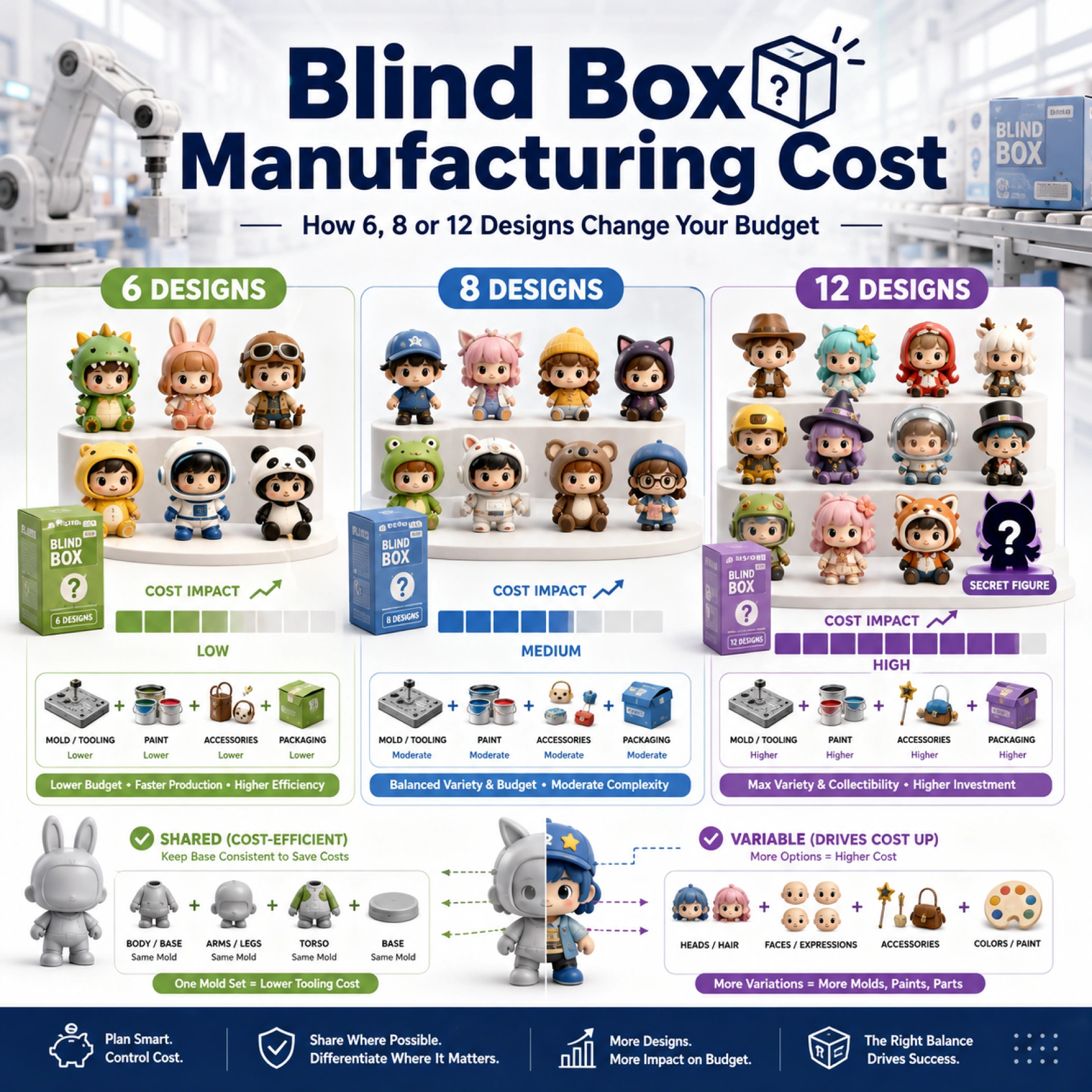
Six blind box designs do not mean one set of molds. This is the first thing buyers should understand when estimating Blind Box Manufacturing Cost. A 6-design blind box series may need one shared body mold plus six different head molds, or it may need six completely different figure molds. An 8-design or 12-design lineup may look like one collection, but the real budget depends on how many parts can be shared, how many accessories are unique, how many paint masks are needed, whether there is a secret figure, how packaging is handled, what testing is required, how strict QC is, and how random packing is controlled.
The direct answer is this: Blind Box Manufacturing Cost is not calculated only by “6 designs,” “8 designs,” or “12 designs.” It is calculated by the real production structure behind the lineup. Shared body, different heads, shared base, different accessories, same mold with different paint, secret figure planning, packaging, testing, QC, and random packing all change the final budget.
For buyers, this matters because two blind box projects with the same number of designs can have very different costs. A 6-design series with six unique poses, six unique heads, six unique accessories, and a secret figure may cost more than an 8-design series that uses one shared body, shared base, and only different paint versions. This is why buyers should discuss the part breakdown before asking for a final quotation.
If you are still learning how blind box products are developed, our guide on the blind box figure manufacturing process explains the full workflow from concept planning to 3D modeling, tooling, painting, packaging, QC, and mass production.
Why Blind Box Manufacturing Cost Is Not Based Only on Design Count
Many buyers start by saying, “We want 6 blind box designs,” or “We want 12 characters in one series.” This is useful information, but it is not enough for accurate pricing. A manufacturer still needs to understand how different those designs are.
Blind Box Manufacturing Cost depends on questions like:
- Do all figures share the same body?
- Are the heads different?
- Is the base shared?
- Are accessories fixed or separate?
- Are the poses different?
- Are the figures the same size?
- Is one design only a repaint?
- Does the secret figure need a new mold?
- Are there special finishes such as glow, flocking, metallic paint, or glitter?
- Is the packaging the same for every design?
- Is random packing required?
- What testing is needed for the target market?
A buyer may think one blind box series equals one product. In manufacturing, each figure design may create new work in 3D modeling, mold making, injection, painting, assembly, packaging, testing, and QC.
This is why a factory should ask for artwork, target size, lineup quantity, expected order quantity, accessories, packaging direction, and target market before quoting. If a supplier gives a very fast price without asking these questions, the quote may be too rough.
For early pricing preparation, our custom PVC figure quotation guide explains what buyers should prepare before requesting a custom figure quotation.
Cost Factor Table: What Changes the Budget?
The table below shows how different design decisions affect Blind Box Manufacturing Cost.
| Cost Factor | Lower-Cost Option | Higher-Cost Option | Why It Changes Budget |
|---|---|---|---|
| Body structure | Shared body | Unique body per design | Unique bodies require more 3D work and more molds |
| Head design | Same head with different paint | Different head for each character | Different heads usually need separate molds |
| Base | Shared base | Different base per design | Unique bases increase tooling and assembly work |
| Accessories | No accessory or shared accessory | Unique accessory per design | Accessories may need extra molds, painting, and packing |
| Paint | Same mold / different paint | Complex multi-color paint masks | Paint complexity increases labor and defect risk |
| Secret figure | Repaint secret | New sculpt secret | New secret figure may need new mold and sample approval |
| Packaging | Same box structure | Different packaging for each design | More packaging versions increase print and packing control |
| Testing | One representative test plan | Separate testing for special designs | Testing scope depends on material, age, and design risk |
| QC | Standard random inspection | Strict sorting by design and finish | More variants need more inspection control |
| Random packing | Simple assortment | Fixed ratio with secret figure | Random packing requires ratio control and carton planning |
This table explains why Blind Box Manufacturing Cost should be discussed by production logic, not only by the number of designs.
6 Designs: When the Budget Is Lower or Higher
A 6-design blind box series is often the first choice for new brands because it feels manageable. However, 6 designs can still create a large cost difference depending on the structure.
A lower-cost 6-design plan may use:
- One shared body
- Six different heads
- One shared base
- Limited accessories
- Same box structure
- Same inner bag
- Same tray
- Similar paint process
- No special finish
- No fully new secret figure
A higher-cost 6-design plan may use:
- Six different body poses
- Six different heads
- Six different bases
- Different accessories for every design
- Different paint masks
- Metallic, glow, or flocking effects
- One secret figure with a new mold
- More complicated random packing
The phrase “6 designs” does not tell the factory whether the project is simple or complex. For Blind Box Manufacturing Cost, the part breakdown matters more than the design count.
For example, six figures with shared body and shared base may only need different head tooling and paint planning. But six figures with different poses may need separate body molds, separate assembly steps, and separate QC standards.
If cost control is important, buyers can review our article on how to reduce custom PVC figure cost, which explains how part count, paint complexity, packaging, and late-stage changes affect pricing.
8 Designs: More Variety, More Planning
An 8-design blind box series gives more collection value than 6 designs, but it also increases planning work. Buyers need to decide whether the extra two designs are truly unique or whether they can share parts with the rest of the lineup.
An 8-design series may work well when:
- The character universe needs more variety
- Retailers expect a fuller lineup
- The brand wants stronger repeat purchase
- Some characters can share body structure
- Accessories can be reused
- Paint variants can create difference without full new molds
For Blind Box Manufacturing Cost, 8 designs are not always much more expensive than 6 designs if the structure is planned well. The extra cost may be controlled when the designs share body parts, bases, accessories, and packaging.
However, 8 designs become expensive when every design requires a unique sculpt, unique mold, unique accessory, and unique paint process. The buyer should review the lineup with the factory and separate designs into groups.
Example grouping:
| Design Group | Production Strategy |
| Designs A / B / C | Shared body, different heads |
| Designs D / E | Same mold, different paint |
| Designs F / G | Shared base, different accessories |
| Design H | Special pose or secret candidate |
This grouping helps the buyer see which figures drive cost and which figures can be optimized.
12 Designs: Strong Collection Value, Higher Execution Risk
A 12-design blind box series can look more professional and collectible, but it requires stronger project management. More designs mean more samples, more molds, more paint approvals, more packaging control, more QC work, and more random packing complexity.
A 12-design lineup may be suitable when:
- The brand already has a clear fan base
- The buyer has enough budget for tooling
- The artwork is complete
- The target order quantity supports the cost
- The launch plan needs a full collection
- The buyer can manage sample approval for many designs
Blind Box Manufacturing Cost usually increases with 12 designs because the factory must manage more production variables. Even if some parts are shared, the project still needs more artwork review, 3D modeling, paint samples, packaging proofing, and production coordination.
The biggest risk is not only tooling cost. The bigger risk is approval time. If every design needs multiple sample revisions, the project timeline can become long. If one design is delayed, the full blind box launch may be affected.
For 12-design blind box projects, buyers should prepare a clear approval table:
| Item | Buyer Should Confirm |
| 2D artwork | Final artwork for all 12 designs |
| 3D model | Approved 3D file for each design |
| Mold plan | Shared molds and unique molds clearly listed |
| Paint plan | Pantone, finish, and paint masks for each design |
| Accessories | Shared or unique accessory list |
| Secret figure | Separate from normal 12 designs or included in the count |
| Packaging | Same blind box structure or different packaging versions |
| Testing | Representative test plan or additional testing |
| Random packing | Ratio and carton assortment method |
| QC | Inspection standard for every design |
This kind of table makes Blind Box Manufacturing Cost easier to understand before production begins.
Shared Body: The Most Important Cost-Saving Decision
Shared body is one of the biggest ways to control Blind Box Manufacturing Cost. If multiple figures can use the same body mold, the buyer may reduce tooling cost and simplify production.
A shared body works best when the lineup has:
- Similar character proportions
- Similar pose style
- Similar clothing structure
- Similar size
- Same standing posture
- Different heads or accessories
- Paint differences for variety
For example, a blind box series may use one common body in a standing pose, then create different heads, hats, hair, clothing colors, and accessories. This can still create a strong lineup while reducing mold complexity.
However, shared body should not damage character identity. If each character needs a very different pose or personality, forcing a shared body may make the collection feel repetitive. The buyer should balance cost and character value.
A strong manufacturer should help buyers decide which parts can be shared and which parts should remain unique. Our custom PVC toy manufacturer page explains how custom figure production connects design review, tooling, painting, assembly, and QC.
Different Heads: More Character Value, More Tooling
Different heads are common in blind box production because the face, hair, ears, horns, hat, or expression often defines the character. Even if the body is shared, different heads may still require separate tooling.
Different heads increase Blind Box Manufacturing Cost because they may require:
- Separate 3D sculpting
- Separate mold cavities
- Separate paint masks
- More facial printing control
- More sample approval
- More QC comparison
However, different heads usually create more visible value than different bodies. Customers recognize character difference from the head and face first. Therefore, if the buyer must control cost, a shared body plus different heads is often more practical than fully unique body poses for every design.
If the buyer’s characters come from 2D artwork, our guide on how to turn 2D character art into a custom toy figure explains how character art becomes a 3D production model.
Shared Base: Small Part, Big Cost Impact
A base may look simple, but it can affect Blind Box Manufacturing Cost. If every figure needs a different base, the project may require more molds, more assembly steps, and more packaging fit checks.
A shared base can reduce cost when:
- All figures stand in a similar way
- The base size works for all figures
- The brand wants a consistent collection look
- The packaging tray can use one cavity style
- The base can include the same logo or shape
A unique base may be needed when:
- The pose is unstable
- The character has a large head or heavy accessory
- The design needs a scene element
- The licensed IP requires a special base
- The secret figure needs a different presentation
For buyers, the base should be discussed early. A figure that cannot stand properly may need a larger base after sample review, which can affect tooling, packaging, carton size, and cost.
Different Accessories: Hidden Budget Drivers
Accessories are one of the most common reasons Blind Box Manufacturing Cost increases. A buyer may think accessories are small and cheap, but every unique accessory can create extra work.
Accessories may require:
- Separate 3D modeling
- Separate mold
- Separate material
- Separate paint
- Separate assembly
- Separate inner bag
- Separate QC
- Small parts review
- Packaging fit adjustment
Examples include hats, bags, weapons, food items, tools, glasses, pets, signs, scene parts, and handheld props.
If the accessory is fixed to the figure, it may become part of the main mold or assembly structure. If it is detachable, it may create small parts and packing control issues. If it is painted separately, it adds painting labor and defect risk.
Buyers should list every accessory before requesting a quote. The factory should not discover accessories after the first quotation, because that can change mold cost and unit price.
Same Mold / Different Paint: A Practical Budget Strategy
Using the same mold with different paint is one of the most practical ways to control Blind Box Manufacturing Cost. This method is common for rare colorways, seasonal versions, secret figures, and low-cost variants.
Same mold / different paint can be used for:
- Color variants
- Costume variants
- Metallic versions
- Glow details
- Holiday editions
- Retailer exclusives
- Secret repaint figures
This strategy reduces mold cost because the shape remains the same. However, it does not make the variant free. Different paint may still require new color approval, new paint masks, more spraying time, additional pad printing, and separate QC.
For example, a normal figure and a metallic repaint may share the same mold, but metallic paint may need special spraying control and more surface inspection. A glow version may need glow pigment or glow paint testing. A secret repaint may require separate packing control.
For special finishes, our article on Blind Box Special Editions explains how glow, flocking, metallic paint, and secret figure planning affect cost, MOQ, packaging, and QC.
Secret Figure: Excitement With Extra Cost
A secret figure can increase the value of a blind box series, but it also affects Blind Box Manufacturing Cost. The cost depends on how different the secret figure is from the standard lineup.
| Secret Figure Type | Budget Impact | Explanation |
| Same mold / different paint | Lower | Uses existing mold but needs separate paint and packing control |
| Same body / different head | Medium | Requires new head tooling and paint approval |
| New accessory | Medium | May need accessory mold and additional packing |
| New pose | High | Requires new 3D model and new body mold |
| Special finish | Medium to high | Glow, flocking, metallic, or glitter increases process risk |
| Fully new figure | Highest | New sculpt, new mold, new painting, new packaging control |
Secret figure production also has a quantity issue. If the secret ratio is low, the secret figure may be produced in a smaller quantity than normal figures. Tooling and sampling costs are then spread across fewer units, increasing the real cost per unit.
For example, a 1:72 secret figure with a fully new mold can be expensive because the mold cost is not supported by a large quantity. If the buyer wants to reduce secret figure production cost, a repaint or accessory-change secret may be more practical.
Packaging: More Than a Box
Packaging is a major part of Blind Box Manufacturing Cost. A blind box product usually includes more packaging layers than a normal figure.
Packaging may include:
- Outer blind box
- Inner bag or foil bag
- Inner tray
- Collection card
- Instruction sheet
- Label
- Retail display box
- Master carton
- Protective filler
Each component has material cost, printing cost, MOQ, supplier lead time, and QC requirements. A premium blind box with foil bag, full-color card, PET tray, and display carton will cost more than a simple box with paper insert.
Packaging also affects random packing. If the secret figure uses different packaging or a different inner bag, the factory must control assortment carefully.
For packaging planning, read our custom toy packaging manufacturer guide. If you need a more detailed packaging execution document, our article on Packaging Bill of Materials for Toys explains how buyers should record box, inner bag, tray, card, label, and master carton information before production.
Testing: Safety Cost Depends on Market and Design Risk
Testing can also affect Blind Box Manufacturing Cost. Buyers should not only ask for the figure unit price. They should also consider testing needs for the U.S., EU, UK, or other target markets.
Testing cost may depend on:
- Product classification
- Intended age
- Material
- Paint and coating
- Small parts
- Accessories
- Special finishes
- Packaging warnings
- Number of variants
- Whether representative testing is accepted
- Whether a secret figure needs review
For the U.S. market, CPSC explains that toys intended or designed primarily for children 12 years of age or younger generally require third-party testing by a CPSC-accepted laboratory and certification in a Children’s Product Certificate. Buyers can review CPSC’s official toy safety and Children’s Product Certificate pages.
For the EU market, buyers can review the official placing toys on the EU market page and our guide on EU Toy Safety Regulation 2025/2509.
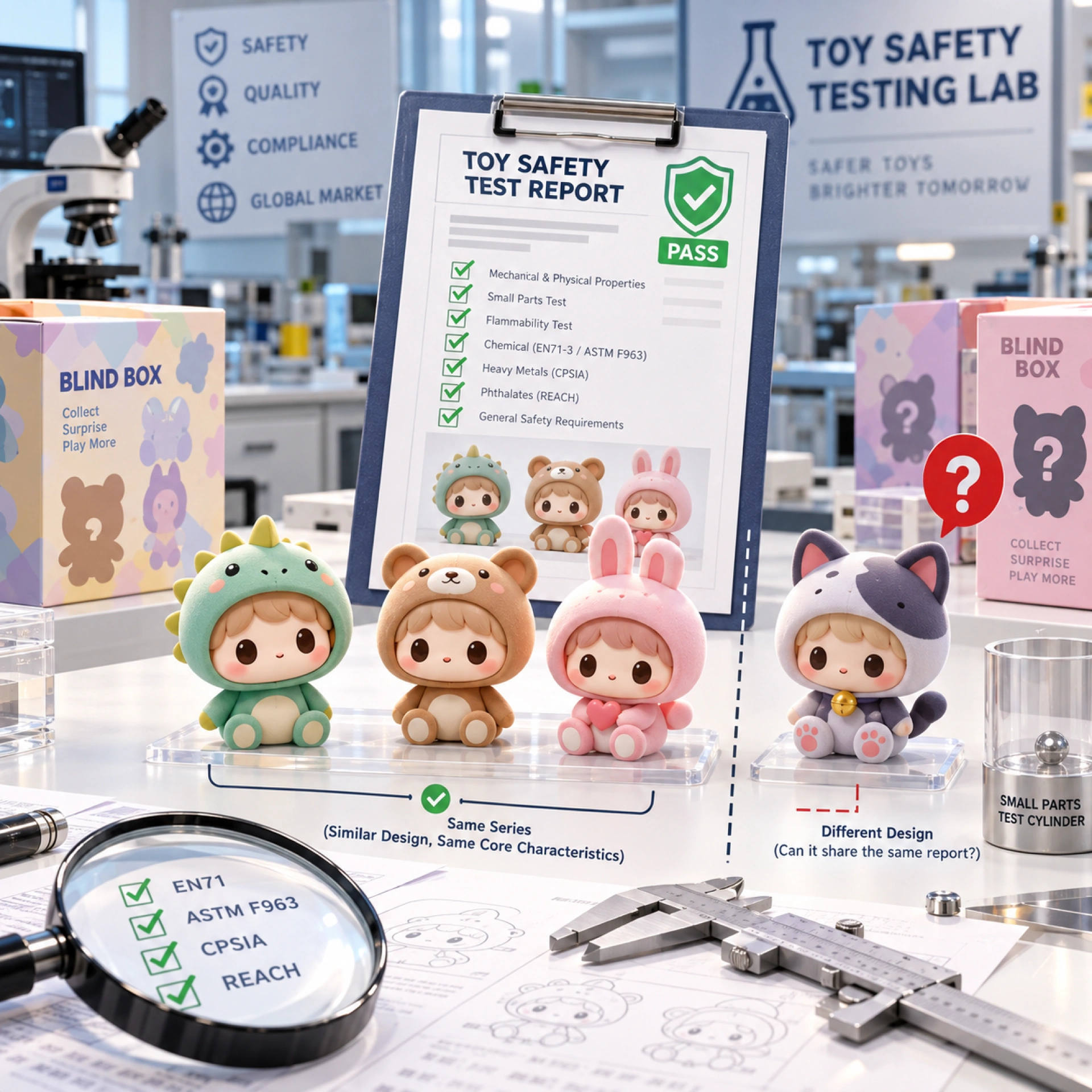
For blind box projects, testing should be planned before production. Our article on Blind Box Toy Safety Testing explains when multiple blind box designs may share one toy safety test and when separate review may be needed.
QC: More Designs Mean More Inspection Work
QC is another cost factor that buyers often underestimate. A blind box series with 6, 8, or 12 designs requires inspection not only for general quality but also for design-specific details.
QC should check:
- Correct character
- Correct paint
- Correct accessory
- Correct base
- Correct card
- Correct inner bag
- Correct box
- Correct random packing ratio
- Surface defects
- Paint defects
- Assembly strength
- Packaging damage
- Barcode and labels
- Carton marks
More designs mean more chances for mistakes. For example, a figure may be packed with the wrong card, a secret figure may be placed in the wrong carton, or two designs may have similar accessories that are mixed during assembly.
Strict QC increases labor, but it reduces customer complaints. For collectible products, small visual defects matter because customers compare figures across the full lineup.
Our custom PVC figure quality control checklist can help buyers inspect appearance, color, painting, assembly, packaging, and final shipment quality before release.
Random Packing: The Cost Buyers Often Forget
Random packing is a special cost in blind box production. It is not the same as packing normal retail products. The factory must control the ratio of each figure while keeping the customer’s mystery experience.
Random packing may involve:
- Sorting each design
- Checking figure and card match
- Sealing inner bags
- Preventing workers from revealing secret figures
- Controlling carton assortment
- Managing secret figure ratio
- Avoiding weight or code differences that reveal the figure
- Recording production quantity by design
- Checking carton mix during QC
If the buyer wants a fixed ratio, such as 1 secret figure in 72 boxes or one complete set per display carton, packing becomes more complex. The factory must plan the packing line carefully.
Random packing affects Blind Box Manufacturing Cost because it adds sorting labor, packing control, QC time, and sometimes packaging design adjustments. Buyers should confirm the packing rule before mass production.
Budget Comparison: 6, 8, and 12 Designs
The table below shows how design count affects cost when other factors change.
| Lineup Size | Budget-Friendly Structure | Higher-Cost Structure | Main Buyer Risk |
| 6 designs | Shared body, different heads, shared base, same packaging | Six unique bodies, six accessories, secret figure | Underestimating tooling cost |
| 8 designs | Shared body groups, some repaint variants, shared tray | Eight unique sculpts, complex paint, different accessories | Longer sample approval time |
| 12 designs | Shared parts, grouped tooling, controlled paint plan | Twelve unique molds, many accessories, special finishes | High tooling, QC, and packing complexity |
A 12-design project is not automatically wrong. It can be very effective for an established IP or retail launch. But buyers should make sure the quantity, budget, approval timeline, and packaging plan support the full lineup.
Buyer Checklist Before Asking for a Quote
Before asking for Blind Box Manufacturing Cost, buyers should prepare the following checklist.
| Buyer Information | Why It Matters |
| Number of designs | Defines lineup size but not final cost alone |
| Artwork for each design | Helps review shape and part differences |
| Target size | Affects material, tooling, packaging, and shipping |
| Shared body plan | Helps reduce mold cost |
| Head differences | Helps estimate tooling and paint work |
| Base plan | Affects stability, tooling, and packaging fit |
| Accessory list | Helps avoid hidden mold and assembly costs |
| Paint requirements | Affects labor, masks, QC, and defect rate |
| Secret figure plan | Affects tooling, ratio, packing, and cost |
| Packaging style | Affects material, MOQ, print cost, and carton data |
| Target market | Affects testing and documentation |
| Random packing rule | Affects labor and QC planning |
| Quantity | Affects unit price and cost distribution |
The more complete the information, the more accurate the quotation will be.
How Jiahong Creative Helps Buyers Control Blind Box Manufacturing Cost
Jiahong Creative supports blind box figure projects from artwork review, 3D modeling, prototype sampling, mold planning, PVC injection molding, painting, printing, assembly, packaging, random packing, QC, and shipment preparation.
For buyers comparing Blind Box Manufacturing Cost, we can help review whether 6, 8, or 12 designs should use shared bodies, different heads, shared bases, different accessories, same mold / different paint, secret figure planning, packaging optimization, testing preparation, QC standards, and random packing rules.
We can also help buyers identify which design choices increase tooling cost and which choices create visible customer value. The goal is not to make every part cheaper. The goal is to spend the budget where it improves the product and reduce cost where it does not hurt the collection.
If you are preparing a blind box project, please share your artwork, number of designs, target size, expected quantity, secret figure plan, packaging idea, target market, and launch timeline. You can contact us through our custom blind box project inquiry page.
Final Thoughts
Blind Box Manufacturing Cost is not only about whether the lineup has 6, 8, or 12 designs. The real cost depends on how those designs are built. Six designs do not equal one set of molds. Shared body, different heads, shared base, different accessories, same mold / different paint, secret figure, packaging, testing, QC, and random packing all change the final budget.
A buyer who plans the product structure early can control cost more effectively. A shared body can reduce tooling. Different heads can create character value. A shared base can simplify packaging. Repaint variants can lower secret figure cost. Packaging BOM control can avoid supplier confusion. Testing planning can reduce late surprises. QC and random packing rules can protect the customer experience.
Before asking for a final quote, buyers should break the blind box series into real production parts. Once the factory understands what is shared, what is unique, what is painted, what is packed randomly, and what must be tested, Blind Box Manufacturing Cost becomes much clearer and easier to control.
FAQ
1.Why do 6 blind box designs not equal one set of molds?
Six blind box designs may use shared parts or completely different parts. If each design has a unique body, head, base, and accessory, it may require multiple molds. If the designs share body and base parts, tooling cost may be lower.
2.What affects Blind Box Manufacturing Cost the most?
Blind Box Manufacturing Cost is mainly affected by part count, shared body structure, head differences, base design, accessories, paint complexity, secret figure planning, packaging, testing, QC, random packing, and order quantity.
3.Is an 8-design blind box series much more expensive than 6 designs?
Not always. An 8-design series can be cost-efficient if some designs share bodies, bases, accessories, or molds. It becomes more expensive when every design needs a unique sculpt, mold, accessory, and paint process.
4.Are 12 blind box designs too expensive for new brands?
A 12-design series can be expensive and complex for new brands, especially if every design is unique. New buyers may start with 6 or 8 designs unless they have strong budget, clear artwork, and enough order quantity.
5.Can the same mold be used with different paint?
Yes. Same mold / different paint is a common way to create variants, secret figures, seasonal editions, or retailer exclusives. It reduces tooling cost but still requires paint approval, production setup, and QC.
6.Does a secret figure increase Blind Box Manufacturing Cost?
Yes. A secret figure can increase cost because it may need new tooling, special paint, separate sample approval, controlled production quantity, random packing management, and stricter QC.
7.Why do accessories increase cost?
Accessories may require separate 3D modeling, molds, painting, assembly, small parts review, inner bags, and packaging fit checks. Even small accessories can increase cost if they are unique for each design.