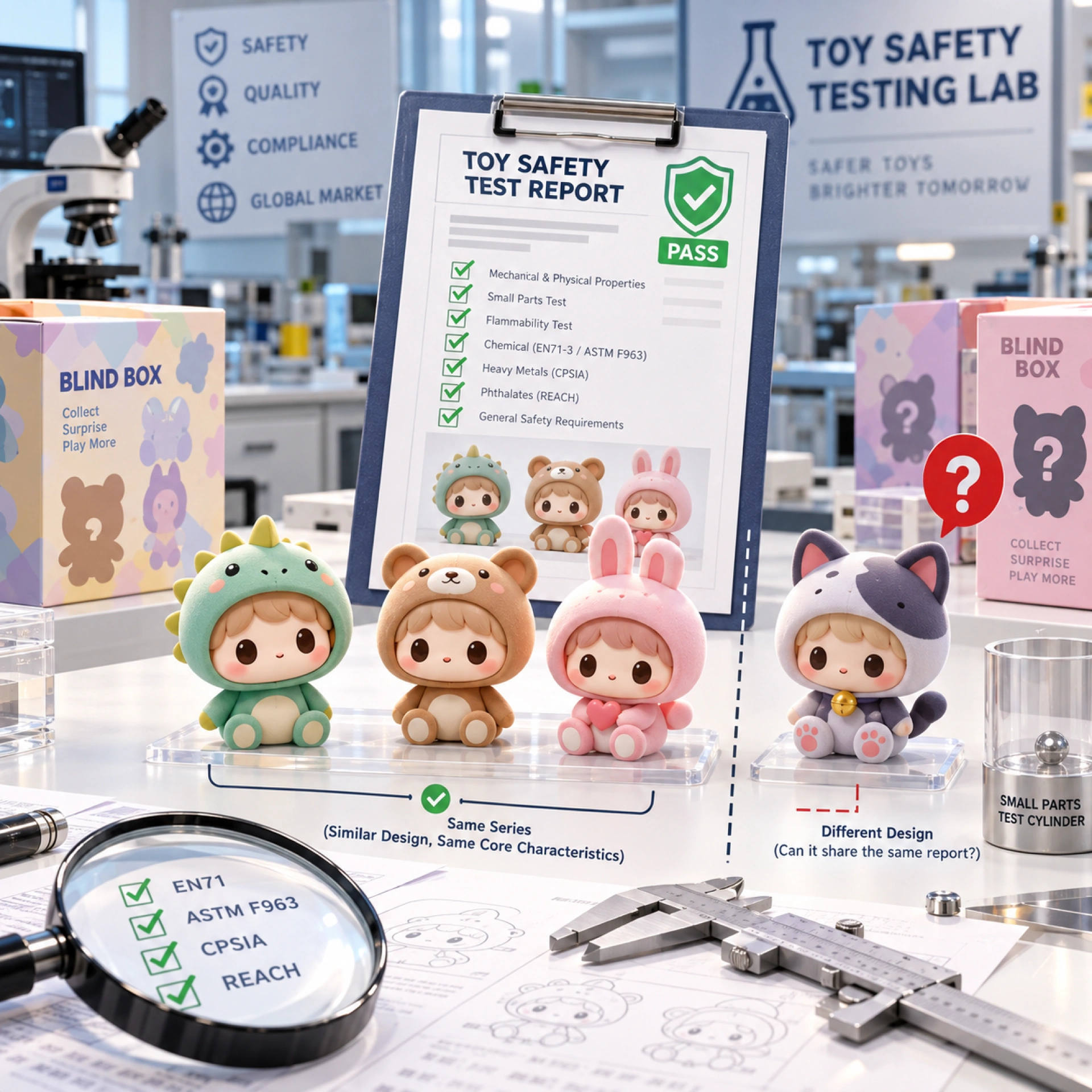


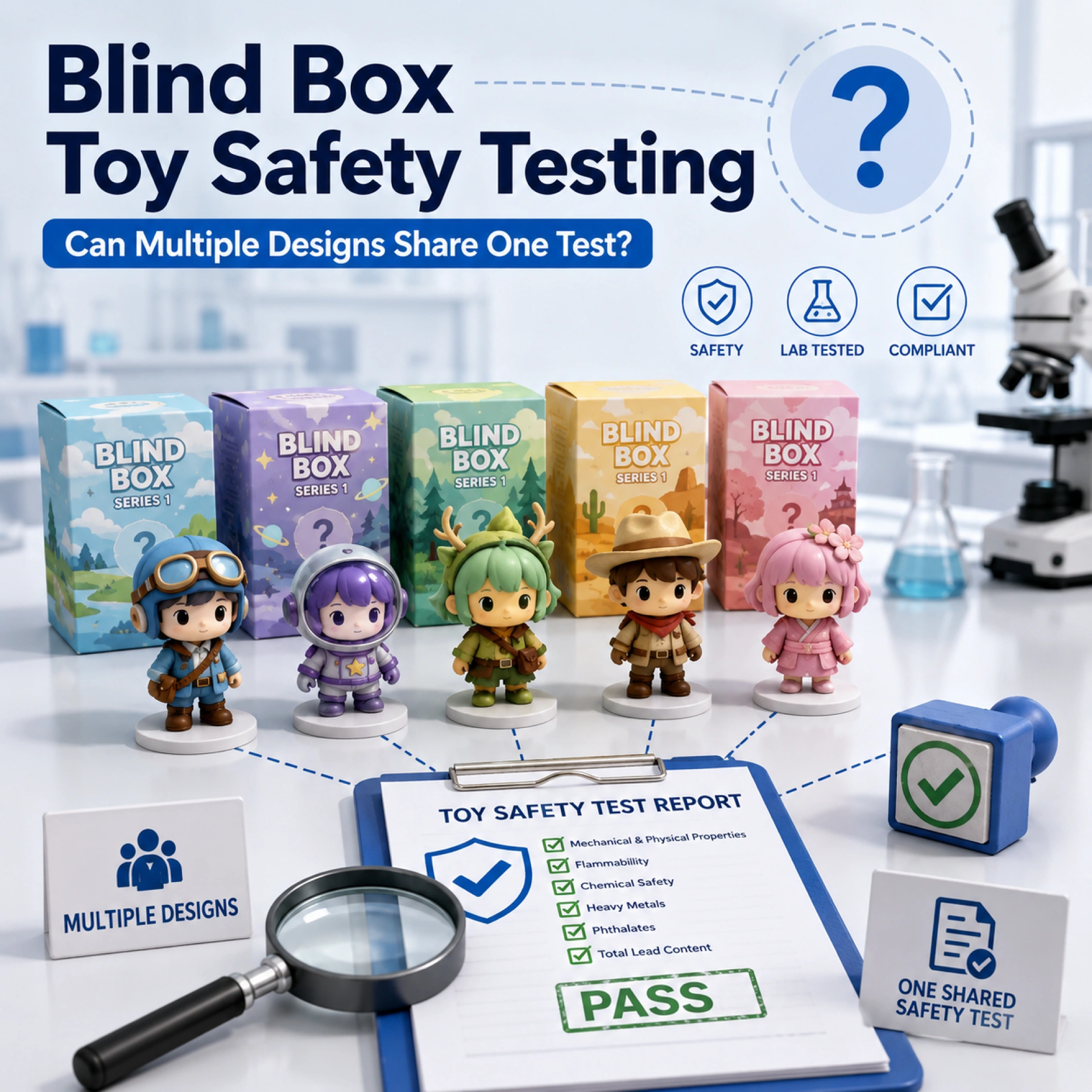
Multiple blind box designs may share one toy safety test only when the designs are treated as the same product family and their differences do not affect the applicable safety requirements. In real Blind Box Toy Safety Testing, buyers should never assume that 6, 8, or 12 blind box figures can automatically share one test report. If the figures use the same material, same paint system, same age grading, similar structure, similar size, and no additional small parts or functions, a laboratory may allow family testing, representative sample testing, or component-based testing. But if one design has a different material, detachable accessory, sharp shape, magnet, battery, coating, flocking, metallic paint, glow pigment, or electronic function, that design may need separate or additional review.
The practical answer is this: Blind Box Toy Safety Testing should be planned by test risk, not only by the number of designs. A blind box lineup may look like one product series from a marketing view, but safety testing depends on materials, components, structure, intended age, packaging, and applicable market rules. Buyers should prepare a design comparison table before asking a laboratory whether multiple blind box designs can share one toy safety test.
For buyers, importers, brand owners, licensees, retailers, and sourcing teams, Blind Box Toy Safety Testing is not only a compliance step. It is a procurement planning issue. If testing is planned too late, the buyer may discover that the secret figure, special paint version, or accessory design needs extra testing after production samples are already made.
If your team is still planning how blind box figures are developed, our guide on the blind box figure manufacturing process explains how concept planning, 3D design, tooling, material selection, painting, packaging, assortment control, and mass production work together.
Why Blind Box Toy Safety Testing Is Different from Testing One Figure
Blind Box Toy Safety Testing is more complex than testing one single PVC figure because a blind box series usually contains multiple designs. A typical lineup may include normal characters, rare versions, secret figures, different poses, different accessories, different colors, and special editions.
A single blind box series may include:
- Six normal figures
- One secret figure
- One metallic version
- One glow in the dark version
- One figure with a small accessory
- One figure with a separate base
- One figure with a different paint finish
- One character card or insert
- One blind bag or foil bag
- One retail outer box
From a consumer perspective, these may feel like one collection. From a testing perspective, each difference may matter.
Blind Box Toy Safety Testing must answer questions such as:
- Are all figures made from the same PVC material?
- Do all figures use the same paint and coating?
- Are all accessories fixed or detachable?
- Is any part small enough to create a choking risk?
- Is any shape sharp, pointed, or fragile?
- Does any figure contain metal, magnets, batteries, lights, or sound?
- Is the intended age the same for the full series?
- Does the secret figure use a different mold or material?
- Does the packaging include correct warnings and labels?
This is why buyers should prepare a testing comparison table before asking for a quotation or test plan.
Quick Decision Table: Can Blind Box Designs Share One Test?
The table below gives a practical starting point. The final decision should always be confirmed with the testing laboratory, importer, or compliance partner.
| Blind Box Design Situation | Can One Test Usually Cover It? | Buyer Action |
|---|---|---|
| Same material, same paint system, similar size, similar structure | Possibly | Ask the lab if representative sample or family testing is acceptable |
| Same PVC body but different colors | Sometimes | Confirm whether all pigments and coatings are covered |
| Same body mold but different printed face details | Sometimes | Check paint, ink, and coating coverage |
| Same character with a new detachable accessory | Not automatically | Review small parts, sharp points, material, and chemical testing |
| Secret figure uses a new mold | Not automatically | Treat as a separate design for risk review |
| One figure has metallic paint | May need additional review | Check coating, paint, migration, rub, and surface durability |
| One figure is glow in the dark | May need additional review | Confirm glow pigment, material, and chemical test coverage |
| One figure is flocked | May need additional review | Check fiber adhesion, coating, shedding, and chemical risk |
| One figure has a magnet | Usually needs additional testing scope | Confirm magnet safety and age group |
| One figure has battery, LED, sound, or Bluetooth | Usually needs separate review | Check electrical, battery, EMC, and toy requirements |
| Different age grading between designs | Usually not suitable for one test only | Separate the product classification and test plan |
| Same figure but different packaging artwork only | Sometimes | Review labeling, warning, barcode, and packaging compliance |
This table shows why Blind Box Toy Safety Testing should not be decided by the number of designs only. The real issue is whether differences affect safety requirements.
Product Classification Comes First
Before asking whether multiple designs can share one toy safety test, buyers should confirm product classification. A blind box product may be a children’s toy, adult collectible, promotional item, designer toy, licensed IP collectible, or electronic character product.
For Blind Box Toy Safety Testing, the buyer should confirm:
- Is the product intended for children?
- What is the target age?
- Is it marketed as a toy?
- Is it sold in toy channels?
- Does the packaging attract children?
- Is it an adult collectible?
- Is it a decorative item?
- Does it include small parts?
- Does it include electronics?
- Which country or market will it enter?
Product classification affects testing. A blind box collectible sold for adults may follow a different compliance path from a toy intended for children. A blind box figure for children under 3 may create different small parts concerns from a product intended for older children.
For EU-focused projects, buyers can review our guide on EU Toy Safety Regulation 2025/2509 and our article on EN71 for Custom Toys. For UK-focused projects, our guide on UK Toy Safety Regulations for Custom PVC Figures explains why product classification, target age, packaging, and technical documentation should be reviewed early.
Target Age and Small Parts Risk
Target age is one of the biggest factors in Blind Box Toy Safety Testing. A blind box figure series may include several designs that look similar, but one small detachable part can change the testing risk.
Buyers should ask:
- Is the product intended for children under 3?
- Is the product intended for children 3+?
- Is the product intended for 6+ or 8+?
- Is the product intended for collectors 14+?
- Does any design include small detachable accessories?
- Can a part break off during use or abuse testing?
- Is the base removable?
- Are props, hats, glasses, tools, food items, or weapons separate parts?
- Does packaging include the correct warning?
If all designs are intended for the same age group and have similar structure, sharing some test coverage may be more realistic. If one design has detachable small parts and another does not, the lab may need to test that higher-risk design separately.
This is why buyers should avoid approving blind box variants only based on appearance. Every pose and accessory should be reviewed for target age and safety.
Material Similarity: PVC, ABS, Paint, and Coating
Material similarity is another key point in Blind Box Toy Safety Testing. Many blind box figures use PVC for the main body and ABS for bases or hard accessories. However, one series may still include multiple material combinations.
Buyers should record:
- PVC body material
- ABS base material
- Paint system
- Pad printing ink
- Coating
- Glue
- Metallic paint
- Glow pigment
- Flocking adhesive
- Plastic tray
- Foil bag
- Accessory material
If multiple designs use the same PVC material but different paints, the paint differences may still matter. If one design uses a metallic finish and another uses standard matte paint, they should not be assumed identical. If one secret figure uses glow pigment or transparent plastic, it may need additional chemical and physical review.
For material comparison, our guide on PVC vs vinyl vs ABS figures explains how different materials affect structure, painting, durability, cost, and production. If the series includes special finishes, our article on Blind Box Special Editions explains how glow, flocking, metallic paint, and secret figure planning affect cost, packaging, and QC.
Representative Sample Testing
In some projects, a laboratory may allow representative sample testing. This means the buyer and laboratory select the sample or samples that represent the highest testing risk in the group.
For Blind Box Toy Safety Testing, representative samples may be selected based on:
- Largest figure
- Smallest detachable part
- Most complex accessory
- Most paint colors
- Highest paint coverage
- Most complex coating
- Weakest structure
- Most fragile pose
- Most unusual material
- Special finish design
- Secret figure with unique parts
Representative sample testing can reduce repeated testing, but it must be used carefully. The representative sample must actually represent the safety risks of the group. If the chosen sample is simple and another design has a detachable accessory, the test may not cover the higher-risk design.
Buyers should prepare a design comparison table and ask the lab to identify which figures must be tested. The manufacturer should provide material information, product photos, sample sets, and part breakdowns for the lab.
Component Testing and Shared Materials
Component testing may also help with Blind Box Toy Safety Testing. For example, if multiple designs use the same PVC material, same paint system, or same ink, the buyer may be able to use component-level test information as part of the certification file, depending on the market and rule.
In the U.S., CPSC provides guidance on component part testing, and importers should exercise due care when relying on supplier test reports or component part certificates. CPSC also provides guidance on third-party testing and the Children’s Product Certificate.
For procurement, the practical point is this: shared materials may support shared documentation, but they do not automatically replace finished product review. Mechanical tests, small parts tests, sharp point tests, tension tests, and use-abuse tests may still depend on the finished design.
For example:
| Test Area | Component-Level Data May Help? | Finished Product Review Still Needed? |
| Lead in paint | Yes, if same paint and documentation are valid | Yes, if paint changes or application differs |
| Substrate material | Yes, if same material is used | Yes, if different components or suppliers are used |
| Phthalates | Yes, for relevant plastic components | Yes, if new soft plastic parts are added |
| Small parts | No, usually design-specific | Yes |
| Sharp points / edges | No, usually design-specific | Yes |
| Tension and torque | Limited | Yes |
| Flammability | Sometimes material data helps | Final product may still need review |
| Battery safety | Component data helps | Final assembly must be reviewed |
| Labeling and warnings | No | Yes |
This table helps buyers understand why Blind Box Toy Safety Testing may combine shared material documentation with design-specific finished product checks.
When Multiple Blind Box Designs Are More Likely to Share One Test Plan
Multiple blind box designs are more likely to share one Blind Box Toy Safety Testing plan when the designs are highly similar.
This may be possible when:
- All designs use the same PVC material
- All designs use the same ABS base material
- Paint and coating systems are the same
- No design has special pigments or finishes
- Size range is similar
- No detachable small accessories are added
- All designs have the same target age
- Structures are similar
- Packaging warnings are the same
- No figure has electronics, magnets, or batteries
- The lab agrees with the representative sample plan
In this case, the buyer may ask the laboratory whether one test plan can cover the product family. The lab may still request multiple samples, but the cost may be lower than testing each figure as a completely separate product.
The important point is that the test plan should be documented. Buyers should keep the lab quotation, sample list, test scope, product photos, material list, and final report with the technical file.
When Separate or Additional Testing Is Safer
Separate or additional testing is usually safer when blind box designs have meaningful differences. For Blind Box Toy Safety Testing, buyers should be cautious when any design includes:
- Different material
- Different supplier
- Different paint or coating
- Metallic paint
- Glow in the dark pigment
- Flocking
- Glitter
- Transparent plastic
- Soft accessory
- Magnet
- Battery
- LED
- Sound module
- Bluetooth or Wi-Fi
- Detachable accessory
- Very small prop
- Sharp shape
- Thin fragile part
- New mold
- Different age grading
- Different packaging warning
A secret figure deserves special attention. Many buyers want to hide the secret figure details, but the testing laboratory and compliance team still need enough information to evaluate risk. If the secret figure uses a new mold or special finish, it should not be ignored in the test plan.
For buyers preparing U.S. imports, our CPSC eFiling for Custom Toys article explains what importers need from the manufacturer, including SKU, model identification, intended age, applicable CPSC rules, third-party testing, CPC information, batch records, test report holder, and shipment coordination.
Design Comparison Table for Buyers
Before asking the laboratory whether multiple designs can share one toy safety test, buyers should prepare a comparison table like this:
| Design / SKU | Material | Paint / Finish | Accessories | Target Age | Special Risk | Suggested Test Decision |
| Figure A | PVC body + ABS base | Standard spray paint | Fixed base | 3+ | Normal structure | Possible representative sample |
| Figure B | PVC body + ABS base | Same paint system | Detachable hat | 3+ | Small part risk | Additional small parts review |
| Figure C | PVC body | Glow paint | No accessory | 3+ | Glow pigment | Additional chemical review |
| Figure D | PVC body + ABS base | Metallic paint | Fixed accessory | 3+ | Coating and scratch risk | Include in finish testing |
| Secret Figure | PVC body | Different paint | New prop | 3+ | New mold and accessory | Separate review recommended |
| Figure F | PVC body | Same paint system | No accessory | 3+ | Similar to Figure A | May be covered if lab agrees |
This table makes Blind Box Toy Safety Testing more efficient because the buyer, manufacturer, lab, and importer can discuss real differences instead of making assumptions.
Packaging and Labeling Must Match the Test Plan
Packaging is often forgotten in Blind Box Toy Safety Testing. Buyers focus on the figure but forget that the box, inner bag, insert card, warning label, and carton information must match the final product.
Buyers should confirm:
- Product name
- SKU or model number
- Target age
- Warning labels
- Small parts warning, if applicable
- CE, UKCA, CPC, or other market-related information where relevant
- Importer or distributor information
- Batch code
- Barcode
- Inner bag material
- Collection card information
- Secret figure claims
- Packaging language
- Instructions, if needed
If the product is a blind box, the packaging must also preserve secrecy. However, secrecy should not prevent correct safety review. The lab and importer may need to know the full lineup, including secret figures.
For packaging planning, our custom toy packaging manufacturer guide explains how buyers should prepare box structure, inner trays, warning labels, barcodes, inserts, and carton packing.
Test Report Coverage: What Buyers Should Check
After Blind Box Toy Safety Testing is completed, buyers should not only ask whether the product passed. They should check what the report actually covers.
Buyers should review:
- Product name on the report
- SKU or model number
- Tested samples
- Photos of tested samples
- Materials included
- Paint colors included
- Accessories included
- Secret figure included or excluded
- Target age
- Test standards
- Test date
- Laboratory name
- Applicant name
- Manufacturer name
- Failures, comments, or limitations
- Whether the report covers all variants
- Whether additional reports are needed
A test report for one standard figure may not automatically cover a special edition. A report for one paint system may not cover a new metallic coating. A report for a figure without accessories may not cover a version with a small detachable prop.
Buyers should ask the lab to clarify report scope in writing whenever the blind box lineup includes multiple designs.
Technical File and Record Keeping
Blind Box Toy Safety Testing should feed into the technical file or compliance file. This is especially important for EU, UK, and U.S. buyers.
A practical file may include:
- Product classification record
- Target age decision
- Lineup list
- SKU and model numbers
- 2D artwork
- 3D files
- Product photos
- Material list
- Paint and coating list
- Accessory list
- Packaging artwork
- Warning labels
- Test plan
- Test reports
- Lab correspondence
- Representative sample justification
- Component test documents
- Approved sample records
- Manufacturing batch information
- QC inspection records
- Shipment records
For EU buyers, the European Commission explains that toys placed on the EU market must carry CE marking and that manufacturers must draw up technical documentation. Buyers can review the official placing toys on the EU market page for background.
For UK buyers, the official GOV.UK page on Toys Safety Regulations 2011 for Great Britain explains importer duties, technical documentation, declarations of conformity, and conformity marking.
Changes That May Require New Review
After a test plan is approved, buyers should control changes. Blind Box Toy Safety Testing may need review if the design, material, supplier, packaging, or target age changes.
Changes that may require review include:
- New PVC supplier
- New ABS supplier
- New paint supplier
- New coating
- New adhesive
- New accessory
- New secret figure
- New metallic paint
- New glow pigment
- New flocking process
- New magnet
- New battery
- New electronic function
- New target age
- New packaging warning
- New product name or SKU
- New factory location
- New production process
In the U.S., CPSC guidance on material change testing explains that material changes may require testing of the product or changed component. For procurement teams, this means every change after initial testing should be reviewed before shipment.
A small change may not always require full retesting, but it should never be ignored. The importer, laboratory, and compliance partner should decide whether the existing test report still supports the final product.
Final QC Should Match the Tested Sample
Final quality control should confirm that mass production matches the tested and approved sample. This is an important but often overlooked part of Blind Box Toy Safety Testing.
Before shipment, buyers should check:
- Same material as tested sample
- Same paint and coating
- Same accessory structure
- Same target age label
- Same warning label
- Same packaging version
- Same SKU or model number
- No unapproved material changes
- No loose small parts
- No sharp edges or points
- No broken accessories
- No missing parts
- Correct assortment packing
- Secret figure correctly controlled
Our custom PVC figure quality control checklist can help buyers inspect appearance, color, painting, assembly, packaging, labels, and final shipment quality before release.
For blind boxes, QC should also check assortment accuracy. If the wrong figure, wrong card, wrong warning label, or wrong packaging version enters the carton, the test report and shipment record may no longer match the actual product.
What Buyers Should Ask the Manufacturer
Before starting Blind Box Toy Safety Testing, buyers should ask the manufacturer practical questions.
Ask the manufacturer:
- Do all designs use the same PVC material?
- Do all designs use the same paint and coating?
- Which parts are ABS, PVC, metal, magnet, or other materials?
- Are any accessories detachable?
- Are any parts small enough to create choking concerns?
- Does any design use glow, flocking, metallic paint, or glitter?
- Does the secret figure use a new mold?
- Are all variants the same target age?
- Can you provide material declarations?
- Can you provide samples for each design?
- Can you identify the highest-risk sample?
- Can you keep the tested sample as the approval standard?
- Can you record production batch information?
- Can you control material changes after testing?
A reliable manufacturer should help buyers organize design differences before sending products for testing. The manufacturer does not replace the laboratory, but it should provide accurate production information.
If you are still choosing a supplier, our Custom PVC Figure Manufacturer page explains how Jiahong Creative supports custom PVC figures, blind boxes, licensed IP products, painting, assembly, packaging, and QC.
Blind Box Toy Safety Testing Procurement Checklist
Buyers can use this checklist before testing.
| Procurement Step | What to Confirm |
| Product classification | Toy, adult collectible, promotional product, or other category |
| Target age | Same age grading for all designs or different age groups |
| Lineup list | Normal figures, secret figures, special editions, accessories |
| Material map | PVC, ABS, paint, coating, ink, adhesive, packaging materials |
| Design comparison | Size, shape, detachable parts, sharp points, and structure |
| Special finishes | Glow, metallic, flocking, glitter, transparent material |
| Packaging review | Inner bag, outer box, warnings, barcode, insert cards |
| Test lab plan | Representative samples, full lineup, or separate testing |
| Report scope | Which designs, materials, and standards are covered |
| Change control | What changes require lab or importer review |
| QC alignment | Final goods must match tested and approved samples |
This checklist keeps Blind Box Toy Safety Testing practical and reduces last-minute testing surprises.
How Jiahong Creative Supports Blind Box Toy Safety Testing Preparation
Jiahong Creative supports blind box figure projects from artwork review, 3D modeling, prototype sampling, mold making, PVC injection molding, painting, printing, assembly, packaging, QC, and shipment preparation.
For Blind Box Toy Safety Testing preparation, we can help buyers organize lineup details, material information, paint and coating differences, accessory lists, secret figure information, packaging versions, approved samples, production batch data, and final QC records. We can also prepare test samples for third-party laboratories according to buyer and importer requirements.
If you are preparing a blind box series for the U.S., EU, UK, or other markets, please share your artwork, lineup quantity, target age, figure size, material plan, special finish requirements, secret figure plan, packaging artwork, target market, and testing requirements. You can contact us through our custom blind box project inquiry page.
Final Thoughts
Blind Box Toy Safety Testing should not be handled as a simple “one collection, one test” decision. Multiple blind box designs may share one toy safety test only when the designs are similar enough and the laboratory, importer, or compliance partner agrees that the selected samples and documents cover the full product family.
For buyers, the safest approach is to compare every design by material, paint, coating, structure, accessory, target age, special finish, packaging, and market requirements. Some shared materials may support component-level documentation. Some similar designs may fit a representative sample plan. But secret figures, new accessories, special finishes, magnets, batteries, or different materials may require separate or additional testing.
The goal of Blind Box Toy Safety Testing is not only to reduce test cost. The real goal is to make sure the final blind box lineup is safe, documented, traceable, and consistent with the approved and tested samples. When buyers prepare the comparison table early, testing becomes easier, cost becomes clearer, and mass production risk is much lower.
FAQ
1.Can multiple blind box designs share one toy safety test?
Multiple blind box designs may share one toy safety test only if the designs are similar enough and the laboratory agrees that the selected samples represent the safety risks of the full series. Buyers should not assume automatic coverage.
2.What makes blind box designs suitable for shared testing?
Shared testing is more likely when all designs use the same materials, same paint system, same target age, similar size, similar structure, no detachable small parts, and no special functions or unusual finishes.
3.When should a blind box design need separate testing?
Separate or additional testing may be needed when a design uses different materials, different paint, detachable accessories, small parts, glow pigment, metallic coating, flocking, magnets, batteries, electronics, or a new mold.
4.Does a secret figure need toy safety testing?
A secret figure should be included in the safety review. If it uses a new mold, new material, new accessory, or special finish, it may need separate or additional testing.
5.Can component testing reduce blind box testing cost?
Component testing may help when multiple designs use the same materials, paint, or coating. However, finished product tests may still be needed for small parts, sharp points, mechanical safety, and final product structure.
6.What should buyers prepare before Blind Box Toy Safety Testing?
Buyers should prepare a lineup list, target age, product classification, material list, paint and coating information, accessory list, packaging artwork, secret figure details, and design comparison table.
7.Should packaging be included in Blind Box Toy Safety Testing planning?
Yes. Packaging may include warnings, age grading, labels, barcode, importer details, inner bags, insert cards, and secret figure claims. Packaging should match the tested and approved product.