

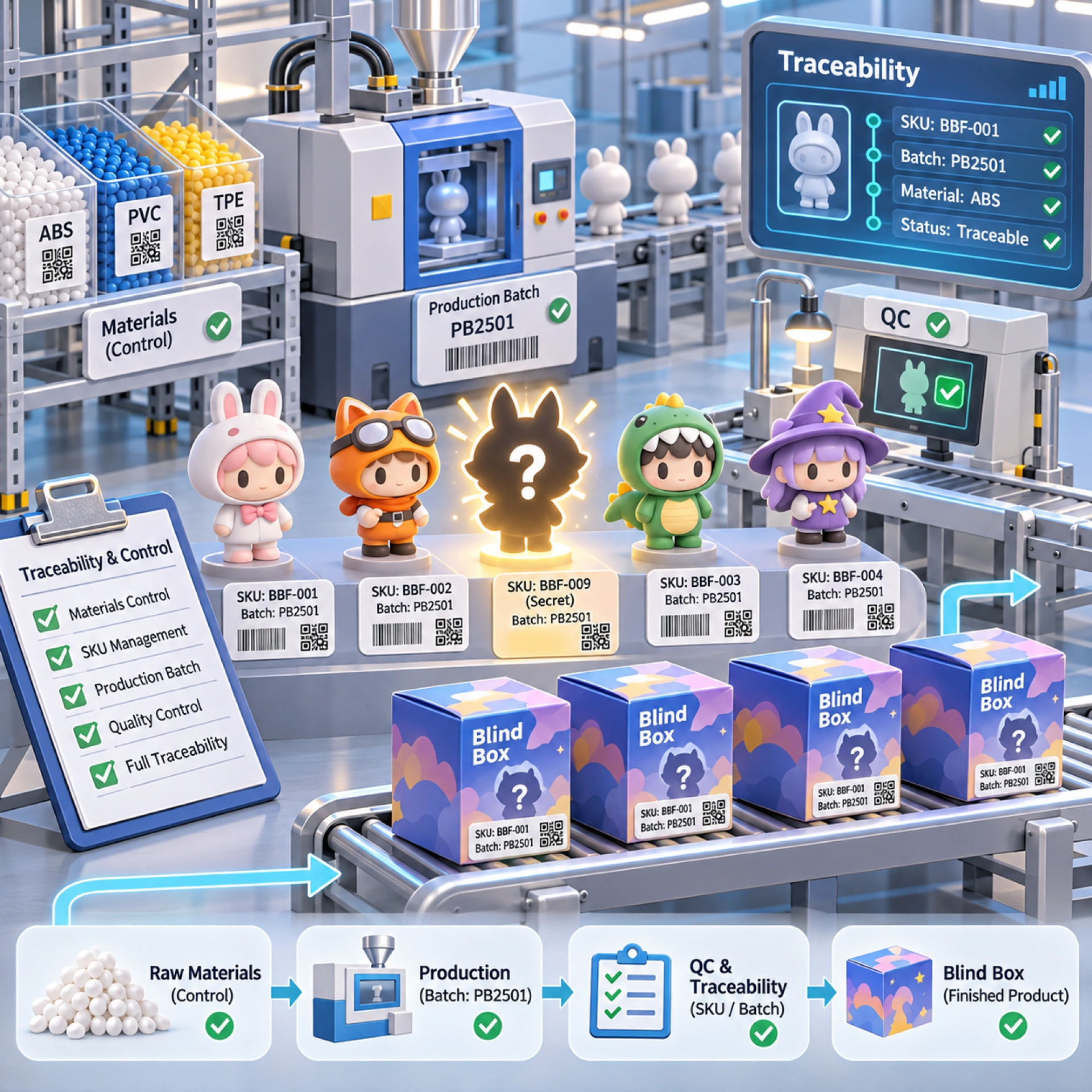
Blind Box SKU Traceability is the process of connecting every blind box figure design to its approved materials, production records, packaging components, packing batches and shipment information. A reliable traceability system allows manufacturers to identify which PVC material lot, paint batch, assembly run and packaging version were used for a particular blind box collection. It also helps control secret figure quantities without revealing the hidden characters to consumers.
For a blind box series containing six regular figures and one secret figure, the factory should assign separate internal identifiers to each design, record material and production batches, control finished inventory by figure type, document secret figure allocation and connect packing records to outgoing cartons.
The most important distinction is that the retail SKU, internal figure SKU and production batch number are not necessarily the same identifier.
A sealed blind box may use one consumer-facing product barcode because customers are purchasing a randomized assortment. Internally, however, the manufacturer needs separate records for every figure design and secret variant.
Without this separation, a brand may struggle to answer basic questions:
- Which production batch contains the defective figure?
- Which PVC or paint lot was used?
- How many secret figures were produced and packed?
- Were the correct character cards included?
- Which cartons contain products from an affected batch?
- Can the manufacturer isolate affected shipments without recalling the entire collection?
For brands, IP owners, importers and retailers, Blind Box SKU Traceability should be established before mass production, not reconstructed after a quality complaint.
This guide explains how manufacturers organize SKUs, control secret figures, maintain material traceability, record production batches and prepare reliable packing and shipment records.
For an overview of the entire production process, see our blind box figure manufacturing process guide.
Blind Box SKU Traceability: What Must Be Tracked?
| Traceability Level | Example Identifier | Information Recorded | Purpose |
|---|---|---|---|
| Collection | BB-2026-01 | Series, brand, artwork version | Identifies the collection |
| Internal Figure SKU | BB01-F01 | Character and variant | Separates individual designs |
| Secret Figure SKU | BB01-S01 | Secret character version | Controls hidden inventory |
| Material Lot | PVC-261101 | Supplier, material, receiving date | Tracks raw materials |
| Paint Batch | PNT-261103 | Paint supplier, color, batch | Tracks surface finishing |
| Production Batch | PRD-261105-A | Production date, line, model | Tracks manufacturing |
| Assembly Batch | ASM-261107-B | Components and assembly record | Tracks completed figures |
| Packaging Version | PKG-V03 | Box, card, tray, artwork | Controls packaging changes |
| Packing Batch | PK-261108-A | Figures allocated and sealed | Links contents to packing |
| Shipment Lot | SHP-261109 | Carton range, PO, destination | Supports shipment traceability |
All identifiers above are illustrative examples rather than actual Jiahong production records.
The purpose of Blind Box SKU Traceability is to connect these records so that the manufacturer can trace products backward to materials and forward to shipments.
1. Retail SKU vs Internal Figure SKU vs Production Batch
The first step in Blind Box SKU Traceability is understanding the different identifiers used in a blind box program.
A manufacturer should not manage the entire collection using only one item number.
Retail SKU: What the Customer Purchases
Consider a blind box series called Fantasy Friends.
It contains:
- Six regular figures
- One secret figure
- Identical outer blind boxes
- Randomized contents
Retailers may sell each sealed mystery box as the same commercial product.
In that arrangement, the individual retail boxes can share the relevant retail product identifier because the consumer is purchasing the same randomized product offering.
The retail identifier does not necessarily reveal the figure inside.
Internal Figure SKU: What the Factory Manufactures
Inside the factory, every character needs a separate identifier.
For example:
| Figure | Internal SKU | Retail Description |
|---|---|---|
| Character A | FF-F01 | Regular figure |
| Character B | FF-F02 | Regular figure |
| Character C | FF-F03 | Regular figure |
| Character D | FF-F04 | Regular figure |
| Character E | FF-F05 | Regular figure |
| Character F | FF-F06 | Regular figure |
| Secret Character | FF-S01 | Secret figure |
These internal SKUs allow the factory to control:
- Production quantities
- Component consumption
- Painting requirements
- Assembly records
- Finished inventory
- Defect rates
- Packaging allocation
This is particularly important because different blind box characters may share molds or materials while requiring different painting and assembly processes.
Production Batch: When and How It Was Made
A production batch identifies a specific manufacturing run or defined quantity produced under recorded conditions.
The same figure SKU may be manufactured in several batches.
For example:
FF-F01
- Batch A: November 2
- Batch B: November 5
- Batch C: November 8
If a painting issue affects only Batch B, traceability records can help identify its material inputs and finished inventory.
What About GS1 Barcodes?
The official GS1 product identification guidance explains how product identifiers connect trade items to their master data and how different product variants are identified.
For blind boxes, buyers should distinguish internal manufacturing variants from the consumer-facing trade item sold as a randomized assortment.
A mystery box sold under one retail product definition may have one retail GTIN, while the factory maintains separate internal SKUs for its possible contents.
If individual characters are also offered as separately selectable retail products, their trade-item identification requirements may differ.
Blind Box SKU Traceability must preserve detailed internal product identification without confusing it with consumer-facing barcode requirements.
2. Create a Master SKU and BOM for Every Figure
The second step is building an approved product record for each figure.
A blind box collection may contain six or twelve designs, but these figures are rarely identical from a manufacturing perspective.
They may share:
- PVC formulations
- ABS bases
- Common body molds
- Adhesives
- Packaging components
But they may differ in:
- Head molds
- Accessories
- Paint colors
- Facial printing
- Assembly instructions
- Special coatings
- Collector cards
For this reason, Blind Box SKU Traceability should start with a controlled Bill of Materials (BOM).
Example: Figure BOM
| Component | Material | Internal Part Code | Shared Across Series? |
|---|---|---|---|
| Character head | PVC | HD-001 | No |
| Main body | PVC | BD-001 | Yes |
| Display base | ABS | BS-001 | Yes |
| Accessory | PVC | AC-003 | No |
| Eye printing ink | Ink | INK-006 | No |
| Main body paint | Paint | PNT-002 | Yes |
| Adhesive | Adhesive | GL-001 | Yes |
Each figure should have a BOM revision linked to the approved physical sample.
This prevents production teams from accidentally using a component approved for a different character or earlier design version.
Shared Components Still Need Traceability
Suppose Characters A, B and C share the same PVC body component.
The factory can use a common part code, but it should still record the actual production batch of that component and which finished figures received it.
If the shared body develops a structural problem, the manufacturer needs to identify every affected figure—not only the first character where the issue was discovered.
Our Blind Box Manufacturing Cost guide explains how shared molds, unique character parts, painting and packaging affect overall production costs.
Shared components may reduce manufacturing investment, but they also make component-level traceability especially valuable.
3. PVC Material and Paint Batch Traceability
One of the most important functions of Blind Box SKU Traceability is connecting finished figures to their material sources.
A custom PVC figure may contain multiple materials and surface treatments.
Common examples include:
- PVC compounds
- ABS plastic
- Pigments
- Spray paint
- Pad printing ink
- Clear coating
- Adhesives
- Metal accessories
- Flocking materials
These materials may arrive from different suppliers and at different times.
Incoming Material Records
A useful receiving record identifies:
| Record | Example |
|---|---|
| Material | PVC compound |
| Supplier | Approved Supplier A |
| Material Specification | PVC-P01 |
| Supplier Lot | LOT-1101 |
| Receiving Date | November 3 |
| Received Quantity | 500 kg |
| Inspection Status | Approved |
| Warehouse Location | WH-A03 |
If the same PVC material arrives in two different supplier lots, the factory should preserve their lot identities rather than treat them as one undifferentiated inventory quantity.
Material Issue Records
When materials are released to production, the factory should record:
- Material part number
- Supplier lot
- Quantity issued
- Production order
- Production line
- Receiving and issue dates
This creates the connection between incoming inventory and actual manufacturing.
Why Paint Batches Matter
Paint variation is a common problem in collectible manufacturing.
Different paint batches can create variation in:
- Skin tone
- Hair color
- Surface gloss
- Coating performance
- Character costume colors
Suppose a batch of blue paint causes a finish problem.
A complete Blind Box SKU Traceability system should help identify:
- The affected paint batch.
- Which figures used that paint.
- Which production runs consumed it.
- Which finished figures may be affected.
- Which packing and shipment lots contain those figures.
Without this information, the manufacturer may need to inspect or quarantine a much larger quantity than necessary.
For buyers managing licensed character colors, our PVC Figure Quality Control article explains common painting, molding and assembly defects.
4. Record Production Batches Through Molding, Painting and Assembly
Blind box manufacturing involves several production stages.
The manufacturing process may include:
Material Receiving → Injection Molding → Painting → Pad Printing → Assembly → Quality Inspection → Packaging
Blind Box SKU Traceability should follow the product through each stage.
Injection Molding Records
A molding production record may contain:
- Production order number
- Internal part code
- Mold identifier
- Machine or line
- Production date
- Material lot
- Produced quantity
- Rejected quantity
For example:
A shared PVC body may be molded in a batch of 10,000 pieces.
Those bodies may later be allocated to multiple character designs.
The factory should maintain records showing how that common component batch was consumed.
Painting Records
Painting creates another layer of traceability.
The factory should record which painting batch was used for each figure SKU.
For example:
| Figure SKU | Painting Batch | Approved Color | Quantity |
|---|---|---|---|
| FF-F01 | PA-1105-A | Blue | 1,200 |
| FF-F02 | PA-1105-B | Pink | 1,200 |
| FF-F03 | PA-1105-C | Green | 1,200 |
| FF-S01 | PA-1106-S | Metallic Gold | 100 |
These are illustrative production values.
The important point is that the painting record connects the figure design to the relevant color and coating materials.
Assembly Records
Assembly may involve heads, bodies, accessories, bases and decorative elements produced in different batches.
The assembly team should record which component batches are used in each finished-figure batch.
This is particularly important when one component is shared across several designs.
A batch code printed only on the final carton cannot provide meaningful material traceability unless the underlying production records establish these connections.
5. Blind Box SKU Traceability for Secret Figures
Secret figures are one of the most sensitive parts of blind box manufacturing.
The brand may specify a secret figure quantity or probability, but the factory must implement that requirement through actual production and packing records.
This is different from ordinary product inventory control.
Secret Figure Planning
Consider an illustrative order of 7,200 sealed blind boxes.
The brand specifies an overall secret figure allocation of 1 in 72 boxes.
For the complete order, the planned quantity would be:
7,200 ÷ 72 = 100 secret figures
The remaining 7,100 boxes would contain regular figures.
This is a planning example, not a universal industry ratio.
Importantly, an overall 1-in-72 allocation does not necessarily mean each carton of 72 boxes contains exactly one secret figure. That depends on the brand’s separate packing rules.
Secret Figure Inventory Must Be Tracked Separately
A factory should distinguish:
- Secret figures produced
- Secret figures passing QC
- Secret figures rejected
- Secret figures retained as samples
- Secret figures released to packing
- Secret figures packed
- Secret figures remaining in inventory
For example:
| Secret Figure Record | Quantity |
|---|---|
| Produced | 104 |
| Packed | 100 |
| QC reference samples | 2 |
| Rejected | 2 |
| Unaccounted balance | 0 |
The numbers must reconcile.
This prevents discrepancies between the approved secret allocation and the actual packed quantity.
Why Blind Box SKU Traceability Matters for Hidden Figures
Without an independent internal secret SKU, a manufacturer may struggle to determine:
- Whether too many secret figures were produced
- Whether secret inventory was transferred correctly
- Whether the correct number was packed
- Whether rejected units were accidentally reused
- Whether a packing batch contains the planned allocation
A well-controlled secret figure workflow should have restricted inventory access, recorded transfers and verified packing counts.
This is not only about inventory accuracy. It also protects the integrity of the brand’s collectible program.
For special variants using metallic painting, flocking or glow effects, see our Blind Box Special Editions guide.
6. How Do Manufacturers Track Secret Figures Without Revealing Them?
A good Blind Box SKU Traceability system should support internal accountability without exposing the identity of the mystery figure on the consumer packaging.
This requires separating internal production information from visible retail information.
Internal Tracking Information
Authorized factory personnel may need access to:
- Figure SKU
- Secret figure designation
- Finished batch
- Packing allocation
- Carton or packing-segment records
- Quantity reconciliation
Consumer-Facing Information
The retail package may display:
- Brand
- Collection name
- Retail barcode
- Required legal information
- Relevant production tracking code
- Warnings and instructions
It should not unnecessarily expose the hidden character identity.
Preventing Secret Figure Identification
Brands should evaluate whether packaging differences allow consumers or retail employees to identify specific figures before opening.
Potential clues include:
- Different printed codes
- Character-specific external labels
- Transparent packaging areas
- Easily distinguishable package shapes
- Detectable weight differences
- Inconsistent sealing
The manufacturer should use consistent packaging where appropriate while preserving the required traceability information.
However, it is not always technically possible to eliminate every physical difference between figures.
A heavy character and a lightweight character may create different package weights even when the outer box is identical.
The objective is to reduce avoidable identification clues without compromising legal labeling or product protection.
Does Every Blind Box Need a Unique Serial Number?
Not necessarily.
Batch-level traceability may be appropriate for many products, while unit-level serialization provides more detailed tracking.
The correct level depends on the product, buyer requirements, risk profile, distribution system and applicable regulations.
If the brand wants to identify the exact character inside one specific sealed retail box without opening it, the system needs an appropriate unit-level or controlled packing-position record.
A batch number alone may identify the production group but not the exact hidden contents of each individual box.
Blind Box SKU Traceability should distinguish batch traceability from individual-unit traceability rather than claiming that they provide the same information.
7. Packaging BOM and Packing Batch Control
A blind box contains more than the figure.
A typical finished retail unit may include:
- PVC figure
- Accessories
- Inner bag
- Inner tray
- Collector card
- Outer blind box
- Labels
- Protective material
Each component may have its own specification and revision.
Why Packaging Version Control Matters
A factory may receive updated packaging artwork after the figures have already been manufactured.
For example, the brand may change:
- Character illustration
- Collection guide
- Product warning
- Barcode
- Importer details
- Language
- Packaging material
If the old and new packaging materials are not controlled, incorrect versions may enter the packing process.
For this reason, Blind Box SKU Traceability should connect the finished figure and packing batch to an approved packaging BOM.
Our Packaging Bill of Materials for Toys guide explains how buyers should document boxes, inserts, trays, inner bags, labels and packaging artwork before production.
Character and Collector Card Matching
A figure can pass visual inspection but still be packed with the wrong collector card.
The packing operation should verify that:
- The correct figure is used
- The correct card is included
- Required accessories are present
- The correct inner protection is used
- The correct packaging version is used
The records should identify the affected figure and packing batch when an error is discovered.
Packing Batch Records
A useful packing record may include:
| Packing Information | Example |
|---|---|
| Packing Batch | PK-1108-A |
| Collection | Fantasy Friends |
| Packaging Version | V03 |
| Production Order | PO-2026-105 |
| Regular Figures Packed | 7,100 |
| Secret Figures Packed | 100 |
| Total Retail Boxes | 7,200 |
| Packing Date | November 8 |
| QC Status | Approved |
These numbers illustrate a single completed order.
Actual factories may divide the order across multiple packing batches, which would need their own allocation and reconciliation records.
8. Carton Traceability and Shipment Records
After individual blind boxes are sealed, the manufacturer must control their movement into display boxes, master cartons and shipments.
A reliable Blind Box SKU Traceability system should connect packing lots to logistics records.
Master Carton Information
Depending on the product and buyer’s requirements, carton records may include:
- Purchase order
- Collection
- Retail product identifier
- Carton number
- Packing batch
- Quantity
- Production lot
- Destination
- Shipment reference
For example:
PO-2026-105 / Carton 001–120 / Packing Batch PK-1108-A
The carton code should allow authorized personnel to retrieve the underlying packing records.
Full Sets vs Randomized Cartons
A full-set packing configuration differs from ordinary random distribution.
For example, a brand may order:
- Single randomized retail boxes
- Display cartons
- Regular figure full sets
- Retail-exclusive assortment cartons
The factory should maintain separate packing specifications for each configuration.
A carton intended to contain a full set should not accidentally be packed according to the single-box randomization rules.
Likewise, a secret figure allocation should follow the brand’s actual approved packing policy.
Why Forward Traceability Matters
Suppose a material issue is discovered after shipment.
The manufacturer may know which finished figure batches used the affected material.
But the next question is:
Where were those products shipped?
That requires a connection between:
Material Lot → Production Batch → Figure SKU → Packing Batch → Carton → Shipment
Without the final shipment link, the traceability system is incomplete.
The international GS1 traceability framework explains how trade-item identifiers, batch or lot information and logistics identifiers can support product movement through supply chains.
9. Quality Control and Traceability Must Work Together
Blind Box SKU Traceability is not a substitute for quality inspection.
It provides the records needed to identify which products were made under particular conditions.
Quality control determines whether those products meet the approved specification.
A useful system connects both functions.
Incoming Quality Control
Check and record:
- PVC material identity
- Paint and ink specifications
- Accessories
- Packaging components
- Supplier lot numbers
- Inspection results
In-Process Quality Control
Record:
- Molding defects
- Painting problems
- Pad printing errors
- Assembly issues
- Rework quantity
- Rejected quantity
- Affected production batch
Finished Product Inspection
Verify:
- Character appearance
- Correct accessories
- Approved color
- Assembly quality
- Stability
- Correct packaging
- Product identification
- Tracking information
Packing and Shipment Inspection
Check:
- Figure quantities
- Secret figure allocation
- Collector card matching
- Packaging versions
- Carton quantities
- Shipment identification
- Inventory reconciliation
Our Custom PVC Figure Quality Control Checklist explains how buyers can prepare final shipment inspection requirements.
For Blind Box SKU Traceability, the additional requirement is connecting each relevant inspection result to the production or packing batch it represents.
10. Can Several Figure Designs Share One Safety Test Report?
Yes, multiple blind box designs may sometimes be covered by one coordinated testing program or report when the supporting evidence adequately covers the relevant models and requirements.
However, this does not mean every figure can be treated as identical.
Different designs may use:
- Different pigments
- Different paints
- Unique accessories
- Different molded structures
- Different coatings
Blind Box SKU Traceability helps maintain the material and design information needed to support testing decisions.
For example, if multiple figures share one tested PVC compound, the factory should retain records showing the relevant material specification and production lots.
If a secret figure uses a different metallic coating, that material should not be hidden from the compliance documentation simply because its identity is confidential to consumers.
A laboratory may need the secret figure’s technical information even when the retail marketing campaign keeps it undisclosed.
Our Blind Box Toy Safety Testing article explains when multiple figures may share testing evidence and when additional tests are needed.
Traceability supports compliance documentation, but it does not replace product testing or certification.
11. Production Changes: When Should a New Batch Be Created?
A manufacturer may need to change materials, suppliers or production conditions during a blind box project.
Not every change requires a new retail SKU.
However, changes that affect the product’s identity, approved specification or relevant traceability records should be reviewed and controlled.
Examples include:
- New PVC supplier
- Different PVC formulation
- New paint batch
- Changed coating
- New accessory
- Revised mold
- Different assembly method
- New packaging artwork
- Changed collector card
- Secret figure redesign
Retail SKU vs Production Revision
A change to production materials may require:
- A new material lot record
- Updated BOM revision
- New production batch
- Additional testing or validation
It does not necessarily require changing the retail barcode.
Conversely, a separately marketed product variant may require a distinct trade-item identifier.
These decisions should be made according to the actual product change and applicable product-identification rules.
Why Change Control Matters
Suppose a factory changes the paint supplier halfway through production.
If the original and replacement paint lots are not recorded separately, the brand may have difficulty determining which finished figures use the new material.
A strong Blind Box SKU Traceability procedure should allow the buyer to identify the affected finished goods and assess whether additional testing or inspection is necessary.
12. Regulatory Traceability: What U.S. Importers Should Know
For certain children’s products sold in the United States, production traceability is not only a good operational practice.
It is also relevant to legal tracking-label requirements.
The U.S. Consumer Product Safety Commission’s official Children’s Product Tracking Label guidance explains that children’s products must carry permanent distinguishing marks on the product and packaging, to the extent practicable.
The required information must allow the relevant manufacturer or importer and ultimate purchaser to ascertain details such as:
- Manufacturer or responsible business
- Production location
- Production date
- Production batch or other identifying information
The exact marking arrangement depends on the product and what is practicable.
Can the Tracking Information Be Coded?
Yes. CPSC permits coded information provided that the required information can be determined appropriately.
This can be useful for blind box products where manufacturers want to preserve compact packaging designs.
However, a code should still connect to reliable manufacturing records.
Can Only the Master Carton Carry the Batch Number?
Buyers should not assume this is sufficient for retail children’s products.
Applicable CPSC rules generally address markings on the product and its packaging, to the extent practicable.
For small products, exceptions based on practicability may be relevant, but they require an appropriate assessment. Retail packaging should not be confused with shipping cartons.
The official CPSC Tracking Label FAQ explains how these requirements apply, including practical considerations for very small products.
Does This Apply to Every Adult Collectible?
Not automatically.
Product classification depends on intended use, age group and applicable regulations.
A collectible marketed primarily to adults may follow a different compliance framework from a children’s toy.
For importers, Blind Box SKU Traceability should therefore be designed around the actual product classification and destination market rather than assuming one labeling rule applies universally.
13. Example: A Paint Defect Discovered After Shipment
Consider a fictional blind box series containing six regular figures and one secret figure.
After shipment, customers report that the blue paint on Character C peels during normal handling.
The brand asks the factory to investigate.
Without Reliable Traceability
The manufacturer may know that Character C was produced but cannot identify:
- Which paint lot was used
- Which production batches used that paint
- Whether other characters used the same coating
- Which cartons contain affected units
The brand may need to inspect or quarantine a large portion of the shipment.
With Blind Box SKU Traceability
The factory can follow the records:
Customer Complaint
→ Figure SKU FF-F03
→ Painting Batch PA-1105-C
→ Paint Material Lot PNT-1103
→ Assembly Batch ASM-1107-B
→ Packing Batch PK-1108-A
→ Shipment SHP-1109
The factory can then investigate whether other figures used the same material lot and whether other production or packing batches may be affected.
Important Limitation
Traceability does not automatically prove that every product in an affected batch is defective.
It identifies which products may have been exposed to the relevant material or process.
The brand and manufacturer must still evaluate the defect, risk and appropriate corrective action.
This distinction matters when determining whether to conduct targeted inspection, sorting, rework or a broader market action.
The value of Blind Box SKU Traceability is that these decisions can be supported by documented production evidence rather than guesses.
14. What Documents Should Buyers Request Before Shipment?
Before approving shipment, buyers should request records appropriate to the complexity and risk of the project.
Recommended Blind Box Traceability Package
| Document | Main Purpose |
|---|---|
| SKU Master List | Identifies regular and secret designs |
| Approved BOM | Defines materials and components |
| BOM Revision History | Tracks specification changes |
| Material Receiving Records | Identifies supplier lots |
| Production Batch Records | Connects manufacturing runs |
| Painting Batch Records | Links colors and coating lots |
| Assembly Records | Connects completed figures and components |
| Finished Inventory Report | Shows accepted and rejected quantities |
| Secret Figure Allocation Record | Confirms hidden figure quantities |
| Packaging BOM | Defines packaging materials and versions |
| Packing Batch Report | Connects contents and sealed boxes |
| Carton Packing List | Identifies packed quantities |
| QC Report | Records inspection results |
| Test Reports | Supports applicable safety and quality requirements |
| Shipment Record | Connects cartons and delivery information |
The exact document package can be adjusted according to the buyer’s requirements.
Not every project needs an advanced ERP system or individual-unit serialization.
However, the factory should maintain enough reliable records to connect relevant materials, finished products and shipments.
A Practical Traceability Test
Before shipment, ask the manufacturer to select one finished carton and answer:
- Which packing batch produced it?
- Which figure SKUs were allocated to that packing batch?
- Which production batches supplied those figures?
- Which PVC and paint lots were used?
- Which packaging version was applied?
- Which QC records cover the products?
- Which shipment contains the carton?
If the manufacturer can retrieve these records accurately, the traceability process is functioning at the agreed level.
If the records cannot be connected, the system needs improvement before shipment approval.
15. Buyer RFQ Checklist for Blind Box SKU Traceability
Buyers should discuss traceability before mass production rather than treating it as an additional documentation request at the end.
| RFQ Question | What Buyers Should Confirm |
|---|---|
| How many figure designs? | Regular and secret lineup |
| Does every figure have an internal SKU? | Individual character identification |
| Are shared components recorded? | BOM and component traceability |
| Are material lots tracked? | PVC, ABS, paint, adhesives and accessories |
| How are production batches defined? | Dates, lines, orders and batch boundaries |
| How are secret figures controlled? | Quantity and inventory reconciliation |
| What is the secret allocation rule? | Series-wide or carton-specific policy |
| Are packing records maintained? | Figure-to-packing batch connection |
| Can packaging versions be identified? | Artwork and packaging BOM control |
| Are cartons linked to packing batches? | Shipment traceability |
| Can affected products be isolated? | Investigation and corrective action |
| Which tracking labels are required? | Destination-market requirements |
| What documents are provided? | Agreed shipment documentation |
| How are changes approved? | Material, design and packaging revision control |
| Who maintains the records? | Factory and buyer responsibilities |
A manufacturer should explain how these requirements will be fulfilled through its actual production and recordkeeping processes.
The required level of traceability should be appropriate to the commercial project, product risk and buyer’s expectations.
16. How Jiahong Creative Supports Blind Box SKU Traceability Planning
Jiahong Creative supports custom PVC figure and blind box manufacturing through character development, prototype sampling, mold making, injection molding, painting, pad printing, assembly, packaging and quality inspection.
For multi-design blind box projects, clear product identification and production documentation are important because the manufacturing process may involve:
- Multiple figure designs
- Shared molded components
- Different paint colors
- Special finish variants
- Secret figures
- Collector cards
- Multiple packaging components
- Several production and packing batches
For Blind Box SKU Traceability requirements, Jiahong Creative can work with buyers to define the required production documentation, identify relevant component differences and coordinate project-specific SKU, material, QC and packing information.
The exact records, coding method, level of batch detail and any serialization requirements should be agreed during project planning.
Supporting Regular and Secret Figures
A typical project may require coordination of:
Regular Figure SKUs + Secret Figure SKUs + Shared Components + Packaging Versions + Production Batches
These records help buyers communicate their expectations for assortment control, component consistency and shipment documentation.
Our Blind Box Toy Manufacturer guide explains how a custom blind box series is developed and manufactured.
For brands seeking packaging that preserves the surprise experience, our Blind Box Unboxing Experience article explains why concealed contents, collector cards, random packing and packaging consistency should be planned together.
Request a Blind Box Manufacturing Evaluation
If your brand is preparing a six-, eight- or twelve-design blind box collection, provide:
- Character artwork or 3D files
- Regular figure count
- Secret figure requirements
- Target product dimensions
- Preferred materials and finishes
- Quantity per design or total order
- Planned secret allocation
- Packaging format
- Target market
- Tracking-label requirements
- Expected QC documentation
- Launch timeline
These details allow the manufacturing team to evaluate development, tooling, production planning and traceability requirements before quotation and mass production.
Contact Jiahong Creative for Blind Box Manufacturing.
Final Thoughts
Blind Box SKU Traceability is more than printing a batch number on a carton.
It is a system that connects individual figure designs with their materials, manufacturing processes, quality records, packaging and shipment information.
A well-planned system should make it possible to:
- Identify every regular and secret figure internally
- Track shared and unique components
- Connect PVC and paint lots to production batches
- Record assembly and finished inventory
- Verify secret figure allocation
- Control packaging revisions
- Link packing batches to outgoing cartons
- Investigate defects and isolate affected products
For blind box manufacturers, the main challenge is balancing accurate internal records with the surprise-based retail experience.
The factory must know which products it manufactured and packed.
The consumer should experience the mystery promised by the brand.
And the buyer should be able to obtain reliable production information if a quality or compliance issue arises.
The central principle of Blind Box SKU Traceability is simple: every product should be identifiable within the manufacturing system, even when its identity remains hidden inside the retail package.
By defining internal SKUs, production batches, material records and packing controls before mass production, brands can improve quality management, protect secret figure allocations and strengthen their ability to investigate problems after shipment.
FAQ
1. What is Blind Box SKU Traceability?
Blind Box SKU Traceability is a manufacturing record system that links individual figure SKUs to materials, production batches, assembly records, packing lots and shipments. It helps brands identify affected products, manage secret figures and investigate quality problems.
2. Does every blind box figure need a separate SKU?
Each distinct figure should generally have a separate internal identifier for manufacturing and inventory control. However, sealed mystery boxes sold as the same randomized retail product may use the same consumer-facing trade-item identifier. Internal SKUs and retail barcodes serve different purposes.
3. How do manufacturers track secret figures without revealing them?
Manufacturers can maintain restricted internal secret figure SKUs, inventory records and packing allocation reports while using appropriate consumer-facing packaging codes that do not unnecessarily disclose the contents. The tracking method should preserve applicable labeling requirements.
4. Can multiple blind box figures share the same PVC material batch?
Yes. Several figures may use the same approved PVC compound or shared molded components. The factory should retain records showing which finished products used the relevant material or component batch so affected figures can be identified if a problem occurs.
5. Is Blind Box SKU Traceability legally required for U.S. children’s toys?
Applicable U.S. children’s products are subject to CPSC tracking-label requirements, including information that allows production source, location, date and batch details to be determined. The exact marking arrangement depends on the product and what is practicable. A detailed internal SKU system is one way to support traceability, but the law does not prescribe one universal ERP or SKU format.
6. How does Blind Box SKU Traceability help with quality complaints?
When a customer reports a defect, traceability records can help identify the relevant figure SKU, material lots, production batches, packaging runs and shipments. This supports targeted investigation and helps determine whether other products may be affected.
7. What should buyers ask a blind box manufacturer before production?
Buyers should confirm internal figure SKUs, material lot tracking, secret figure allocation, production batch identification, packaging revision control, carton traceability, inspection records and shipment documentation. These requirements should be agreed before mass production.