

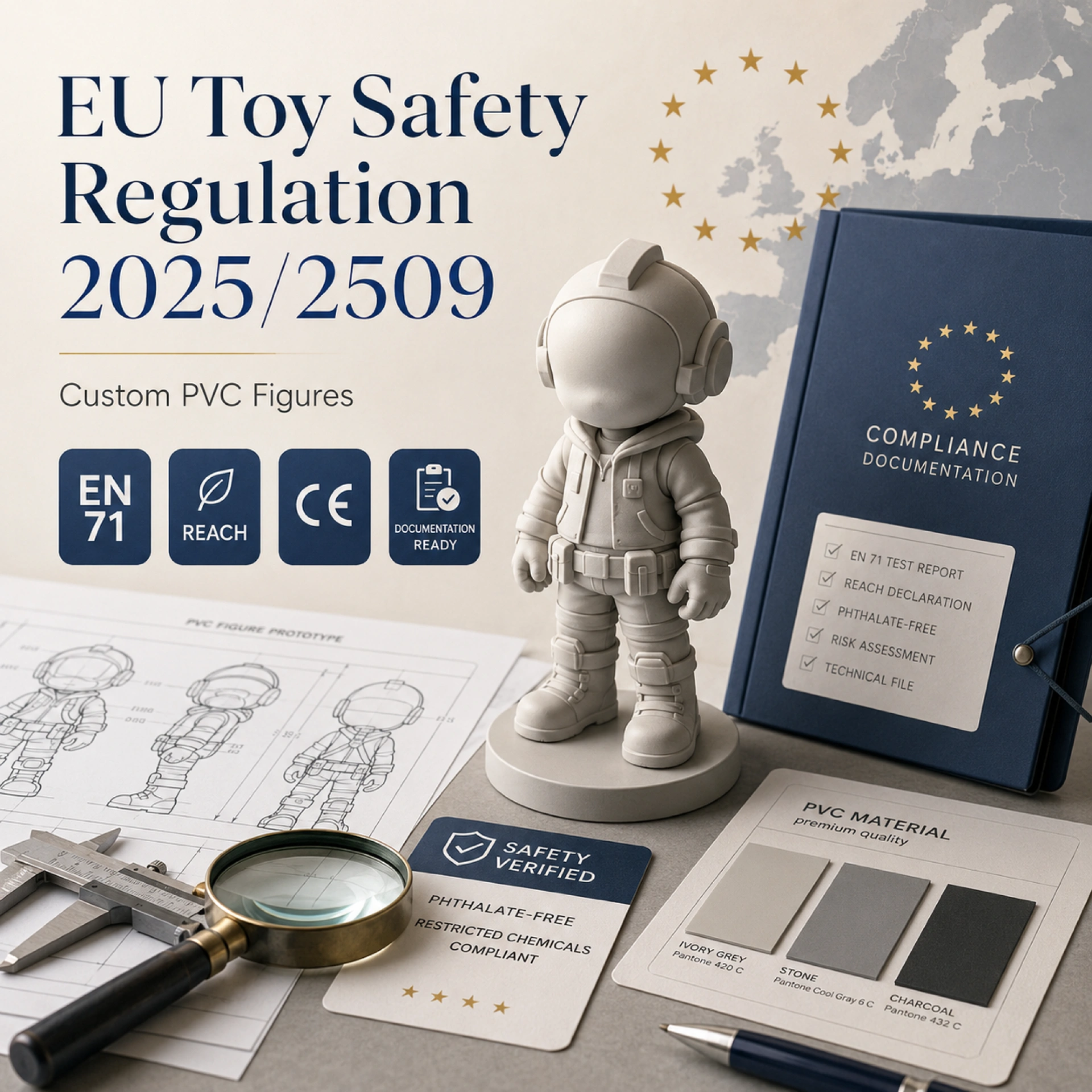
EU Toy Safety Regulation 2025/2509 means custom PVC figure buyers who sell toy products in the European Union should prepare earlier for stricter toy safety documentation, safety assessment, chemical control, CE marking, digital product passport, technical documentation, labeling, warnings, and production traceability. For buyers of custom PVC figures, blind box toys, mascot figures, licensed IP toys, and collectible character products, the main preparation is not only testing the final product. Buyers should build a complete compliance file from the beginning of the project.
The direct answer is this: under EU Toy Safety Regulation 2025/2509, buyers should prepare clear product classification, material information, component lists, paint and coating information, safety assessment records, EN71 test planning, CE marking information, digital product passport data, packaging warnings, traceability details, approved samples, and final quality control records before placing custom PVC figures on the EU market.
For custom PVC figure buyers, EU Toy Safety Regulation 2025/2509 is especially important because PVC figures often involve multiple materials, painted surfaces, small parts, accessories, blind box packaging, IP artwork, and retail presentation. A figure may look simple, but it may still need documentation for material safety, mechanical safety, chemical migration, small parts, age grading, labeling, packaging, and production consistency.
If you are still preparing basic EU toy compliance knowledge, you can first read our guide on EN71 custom toys. EN71 testing will continue to be an important practical reference for many toy safety projects, while EU Toy Safety Regulation 2025/2509 creates a broader regulatory framework that buyers should understand before production.
What Is EU Toy Safety Regulation 2025/2509?
EU Toy Safety Regulation 2025/2509 is the new EU regulation on the safety of toys. It replaces the previous Toy Safety Directive 2009/48/EC and strengthens toy safety requirements across the European Union. Unlike a directive, a regulation is directly applicable in EU Member States, which means buyers, importers, manufacturers, distributors, and other economic operators should treat it as a central compliance framework for toys placed on the EU market.
For custom PVC figure buyers, the most important point is that EU Toy Safety Regulation 2025/2509 is not only about laboratory testing. It also affects product documentation, traceability, digital product passport preparation, chemical safety assessment, warning labels, technical files, and market surveillance.
The regulation is relevant when a custom PVC figure is considered a toy. In general, products designed or intended for use in play by children under 14 can fall within toy safety rules. However, some collectible figures may be positioned as adult collectibles instead of toys. Buyers should clarify the product category, intended age, packaging claims, marketing language, sales channel, and product use before production.
This classification matters. A blind box figure sold as a children’s toy may need different safety review from a limited-edition adult art collectible. A mascot figure used as a promotional gift may also need careful review if it has play value for children. Under EU Toy Safety Regulation 2025/2509, the buyer should not assume that “PVC figure” automatically means one single compliance path.
Why Custom PVC Figure Buyers Should Prepare Early
Custom PVC figures are developed through several production stages: artwork review, 3D modeling, sample making, mold making, PVC injection molding, painting, printing, assembly, packaging, QC, and shipment. Compliance preparation should be connected with these stages from the beginning.
If buyers wait until mass production is finished, it may be too late to correct problems such as small parts, sharp points, restricted substances, wrong warning labels, missing importer information, incomplete technical documentation, or packaging claims that do not match the product category.
A professional custom PVC toy manufacturer can support buyers with production information, material details, samples, packaging review, and QC records. However, EU market compliance usually also involves the importer, brand owner, testing laboratory, and compliance consultant. The buyer should confirm the final legal and testing requirements with qualified professionals.
EU Toy Safety Regulation 2025/2509 makes early preparation more important because technical documentation and digital product passport information depend on accurate product data. If the buyer does not organize product data during development, preparing compliance documents later may become slow and confusing.
Key Preparation Checklist for EU Toy Safety Regulation 2025/2509
Before placing a custom PVC figure on the EU market, buyers should prepare the following items.
| Preparation Item | Why It Matters for EU Toy Safety Regulation 2025/2509 |
|---|---|
| Product classification | Confirms whether the PVC figure is treated as a toy, adult collectible, promotional item, or another product category |
| Intended age group | Affects warning labels, small parts review, safety testing, and packaging claims |
| Artwork and 3D files | Supports product identification, technical documentation, and sample approval |
| Bill of materials | Helps document PVC, ABS, coatings, paints, inks, packaging, and accessories |
| Chemical information | Supports safety assessment and restricted substance review |
| Safety assessment | Identifies hazards and exposure risks before the product is placed on the market |
| EN71 testing plan | Helps buyers check mechanical, physical, flammability, and chemical requirements |
| CE marking plan | Shows that the toy is intended to comply with applicable EU requirements |
| Digital product passport data | Supports traceability, compliance information, and future EU market surveillance |
| Warning labels | Helps communicate user limitations, age warnings, and safe use information |
| Technical documentation | Records how the product complies with applicable safety requirements |
| Packaging review | Confirms labels, warnings, importer details, barcode, and product claims |
| QC records | Shows that mass production matches the approved sample and compliance standard |
This checklist should be prepared before mass production. EU Toy Safety Regulation 2025/2509 rewards organized documentation and punishes rushed projects where materials, labels, product identity, or safety data are unclear.
Product Classification: Toy or Collectible?
The first question for custom PVC figure buyers is whether the product is a toy. Many PVC figures look like toys, but some are sold as adult collectibles, designer art toys, display figures, or promotional display items.
However, classification is not based only on what the buyer wants to call the product. It may also depend on the product’s appearance, function, marketing, packaging, sales channel, price point, age warning, and whether children may reasonably use it for play.
When reviewing EU Toy Safety Regulation 2025/2509, buyers should prepare answers to these questions:
- Is the product designed for play by children?
- Is the product marketed to children under 14?
- Does the packaging use child-oriented language or images?
- Is the figure sold in toy stores, blind box channels, or children’s retail environments?
- Does the product have small detachable parts?
- Does the product include accessories that children may handle?
- Is the product clearly marketed as an adult collectible?
- Does the packaging include appropriate age grading and warnings?
For custom PVC figure buyers, classification should be decided before sample approval. If the product is a toy, safety and labeling requirements must be planned early. If the product is an adult collectible, the buyer should make sure the packaging, description, and sales channel support that positioning.
For broader product positioning, you can also read our article on collectible figure manufacturer China, which explains how brands choose the right factory for collectible figures, blind box toys, and licensed IP products.
Safety Assessment Before Production
Under EU Toy Safety Regulation 2025/2509, safety assessment is a central requirement. For custom PVC figures, the safety assessment should consider hazards that may come from shape, material, chemical content, age group, small parts, paint, coating, packaging, and reasonably foreseeable use.
For a PVC figure project, safety assessment may include:
- Mechanical and physical hazards
- Small parts risk
- Sharp points and sharp edges
- Stability and breakage risk
- Material safety
- Chemical migration
- Paint and coating safety
- Packaging hazards
- Warnings and age grading
- Exposure to substances
- Use by children under 36 months, if relevant
The safety assessment should not be treated as a formality. It should guide product design decisions. For example, if a figure has a small detachable accessory, the buyer may need to adjust the structure, fix the part permanently, increase the accessory size, change age grading, or add appropriate warnings.
If your team is reviewing samples before production, our custom PVC figure sample approval checklist can help you check shape, size, material, color, painting, assembly, packaging, and safety-related details before approving mass production.
Technical Documentation Buyers Should Prepare
EU Toy Safety Regulation 2025/2509 requires technical documentation that shows how the toy complies with applicable safety requirements. For custom PVC figure buyers, this means documentation should be built during development, not after shipment.
A practical technical file for a custom PVC figure may include:
- Product name and model number
- Product photos
- 2D artwork and approved 3D files
- Product dimensions and weight
- Bill of materials
- Component list
- Material specifications
- Paint, ink, coating, and adhesive information
- Safety data sheets where relevant
- Packaging artwork
- Warning labels
- Age grading information
- Safety assessment
- Applicable standards and test reports
- Manufacturing location
- Storage location
- Approved sample records
- QC inspection records
- Production batch information
- Importer or responsible economic operator information
For buyers, the most difficult part is often material and chemical data. A custom PVC figure may include PVC body parts, ABS base parts, metal accessories, magnets, glue, paint, pad printing ink, matte coating, plastic bags, paper boxes, and inner trays. Each material may need to be documented.
If you are not sure how PVC, vinyl, ABS, and other materials affect production and testing, read our guide on PVC vs vinyl vs ABS figures. Material selection can influence testing scope, product safety, durability, and production method.
Digital Product Passport Preparation
One of the biggest changes under EU Toy Safety Regulation 2025/2509 is the digital product passport. The digital product passport is designed to provide compliance and product information digitally. For imported toys, it can also support customs and market surveillance.
For custom PVC figure buyers, this means product information should be organized in a structured way. A digital product passport may require information such as product identifier, manufacturer information, responsible economic operator information, product image, applicable Union law, standards used, CE marking, and communication channel information.
Buyers should prepare digital product passport data early:
| DPP Data Area | What Buyers Should Prepare |
| Product identity | Product name, model number, SKU, unique product identifier, clear product image |
| Manufacturer information | Manufacturer name, address, and contact information |
| Responsible EU operator | Importer, authorised representative, or responsible economic operator information |
| Compliance references | Applicable EU toy safety rules, standards, and test reports |
| CE marking | CE marking status and related conformity information |
| Product description | Custom PVC figure description, age grading, and intended use |
| Warnings | Safety warnings, user limitations, and language requirements |
| Traceability | Batch number, production date, and shipment records |
| Back-up storage | DPP hosting or service provider information, where applicable |
For many buyers, digital product passport preparation will require better communication between the brand owner, factory, importer, compliance team, and data service provider. EU Toy Safety Regulation 2025/2509 makes product data management part of toy compliance.
CE Marking and Conformity
CE marking remains a key part of EU toy compliance. For buyers of custom PVC figures, CE marking should not be treated as only a printed symbol on the box. It represents a conformity responsibility.
Before applying CE marking, buyers should confirm:
- The product category is correctly defined
- Safety assessment has been completed
- Applicable standards have been identified
- Testing has been performed where required
- Technical documentation is complete
- Warnings and instructions are correct
- Packaging information is accurate
- Digital product passport data is prepared
- The responsible economic operator is identified
For more official background, buyers can review the European Commission’s page on CE marking. For toy-specific information, buyers can also review the EU page on toy safety.
A factory can help produce samples and provide production details, but the final CE responsibility usually involves the economic operator placing the toy on the EU market. Buyers should confirm responsibilities before placing an order.
Chemical Safety and PVC Figures
PVC figures often include plastic material, pigments, plasticizers, paints, inks, coatings, adhesives, and packaging materials. Under EU Toy Safety Regulation 2025/2509, chemical safety is a major area of attention.
Buyers should prepare information related to:
- PVC material
- Plasticizers
- Pigments
- Paints
- Printing inks
- Coatings
- Adhesives
- Metal parts
- Fragrances, if any
- Packaging materials
- Supplier material declarations
- Safety data sheets, where relevant
- Chemical test reports
For custom PVC figures, chemical safety is especially important when products are intended for children or placed in toy channels. Buyers should confirm whether the product requires EN71-3 migration testing or other chemical review based on the product type, target age, and market requirements.
If your product uses painted surfaces, you should also review color and coating control early. Our guide on color matching custom PVC figures explains how Pantone references, painted samples, mass production control, and QC work together.
Warning Labels and Packaging Information
EU Toy Safety Regulation 2025/2509 requires warnings to be clear, visible, legible, understandable, and accurate. For custom PVC figure buyers, packaging should be reviewed carefully before printing.
Packaging may need to include:
- Product name
- Age grading
- Warning labels
- CE marking
- Importer or responsible operator information
- Batch or model number
- Barcode
- Instructions, where needed
- Small parts warning, if applicable
- Language required by the Member State
- Digital product passport data carrier, where required
- Brand and IP legal information
- Recycling or packaging marks, where relevant
For blind box figures, packaging review is especially important because small toys often involve inner bags, outer boxes, collection cards, inserts, and retail cartons. Each piece of packaging should be checked for correct information.
A professional custom toy packaging manufacturer can help buyers plan box structure, inner tray, printed artwork, warning placement, barcode area, and carton packing. However, the buyer should still confirm final legal text and language requirements for the EU market.
Quality Control and Production Traceability
EU Toy Safety Regulation 2025/2509 increases the importance of traceability and production consistency. A product may pass testing at the sample stage, but buyers still need to make sure mass production matches the approved sample and documented material standard.
For custom PVC figure production, QC should include:
- Incoming material check
- Molded part inspection
- Painting inspection
- Pad printing inspection
- Assembly check
- Color comparison with approved sample
- Packaging inspection
- Warning label check
- Carton marking check
- Batch record review
- Final random inspection
If the final goods do not match the tested sample or approved technical documentation, compliance risk may increase. For example, changing paint suppliers after testing may require additional review. Changing PVC material, coating, or adhesive may also affect chemical compliance.
Before shipment, buyers can use our custom PVC figure quality control checklist to review appearance, color, painting, assembly, packaging, safety, and final shipment quality.
What Custom PVC Figure Buyers Should Ask the Factory
Before placing an order under EU Toy Safety Regulation 2025/2509, buyers should ask the factory practical questions. This helps prevent incomplete documentation later.
Ask the factory:
- Can you provide material information for PVC, ABS, paint, ink, coating, and packaging?
- Can you support samples for EN71 testing?
- Can you keep the approved sample as the production reference?
- Can you provide batch traceability information?
- Can you confirm whether accessories are fixed or detachable?
- Can you help review small parts risk during sample development?
- Can you support packaging artwork review before printing?
- Can you provide product photos and model information for DPP preparation?
- Can you provide QC records before shipment?
- Can you support corrective action if inspection finds defects?
A reliable manufacturer should not treat EU Toy Safety Regulation 2025/2509 as only the buyer’s problem. The factory should support the buyer with accurate production information and consistent manufacturing control.
If you are comparing suppliers, our article on how to choose a custom toy manufacturer for licensed IP products explains how brands can evaluate confidentiality, approval workflow, IP accuracy, packaging control, and quality management.
Common Mistakes Buyers Should Avoid
1. Waiting Until Production Is Finished
Compliance should not start after goods are packed. Buyers should prepare material data, safety assessment, warnings, and testing plan before mass production.
2. Confusing Adult Collectibles with Toys
Some PVC figures are adult collectibles, but others are toys. Packaging, marketing, age grading, and sales channel can affect classification. Buyers should define positioning clearly.
3. Using the Wrong Sample for Testing
The tested sample should represent the final production product. If materials, paint, coating, accessories, or packaging change later, buyers should review whether new testing is needed.
4. Ignoring Digital Product Passport Data
EU Toy Safety Regulation 2025/2509 makes digital product passport preparation a key issue. Buyers should organize product data early instead of collecting it after shipment.
5. Forgetting Language Requirements
Warnings, instructions, and safety information may need to be provided in language or languages easily understood by consumers in the Member State where the product is sold.
6. Treating CE Marking as a Decoration
CE marking is not only a logo. It reflects conformity responsibility. Buyers should confirm testing, documentation, and responsible operator information before using it.
7. Not Keeping Traceability Records
Custom PVC figures may involve multiple batches, SKUs, and packaging versions. Traceability records help manage recalls, complaints, and market surveillance requests.
Practical Buyer Preparation Table
| Project Stage | Buyer Preparation Under EU Toy Safety Regulation 2025/2509 |
| Concept stage | Define product category, intended age, EU sales channel, and toy or collectible positioning |
| Artwork stage | Prepare artwork, 3D direction, size, accessories, and small parts review |
| Sampling stage | Review sample safety, materials, color, painting, assembly, packaging, and warnings |
| Testing stage | Confirm applicable EN71 and other testing requirements with a qualified lab |
| Documentation stage | Prepare safety assessment, technical file, material list, test reports, and production records |
| Packaging stage | Confirm CE marking, warnings, language, importer information, barcode, and data carrier planning |
| Production stage | Control material suppliers, paint, coating, assembly, QC, and batch traceability |
| Shipment stage | Complete final inspection, packaging check, carton mark review, and document handover |
| EU market stage | Maintain technical documentation, DPP access, and traceability records |
This table can help buyers turn EU Toy Safety Regulation 2025/2509 into a practical project checklist instead of a last-minute compliance problem.
How Jiahong Creative Supports EU Toy Safety Preparation
Jiahong Creative supports custom PVC figure projects from artwork review, 3D modeling, sample making, mold making, PVC injection molding, painting, printing, assembly, packaging, quality inspection, and shipment preparation.
For buyers preparing for EU Toy Safety Regulation 2025/2509, we can help organize production-related information, approved samples, material details, packaging review, quality control records, and sample preparation for testing. We can also support custom PVC figures, blind box toys, mascot figures, licensed IP figures, promotional toys, and collectible character products.
If you are preparing a custom PVC figure for the EU market, you can contact us through our custom PVC figure project inquiry page. Please share your artwork, target size, quantity, intended age group, target market, packaging idea, testing requirements, and launch timeline. Clear information helps us evaluate production feasibility and support compliance preparation more efficiently.
Final Thoughts
EU Toy Safety Regulation 2025/2509 changes how custom PVC figure buyers should prepare for the EU market. The key is not only to test the final product, but to build a complete compliance process from product classification to safety assessment, technical documentation, digital product passport, CE marking, packaging, labeling, production traceability, and final QC.
For custom PVC figures, blind box toys, mascot figures, licensed IP toys, and collectible character products, buyers should confirm whether the product is a toy, define the intended age, organize material data, prepare testing samples, review packaging warnings, and keep production records. The earlier this work starts, the easier it is to avoid delays, rejected shipments, or compliance problems.
EU Toy Safety Regulation 2025/2509 should be treated as a project planning framework. Buyers who prepare early will have a smoother development process, clearer factory communication, better documentation, and stronger control before placing toys on the EU market.
FAQ
1.What is EU Toy Safety Regulation 2025/2509?
EU Toy Safety Regulation 2025/2509 is the new EU toy safety regulation that replaces the previous Toy Safety Directive 2009/48/EC. It strengthens requirements for toy safety, chemical control, digital product passport, CE marking, technical documentation, and market surveillance.
2.Does EU Toy Safety Regulation 2025/2509 apply to custom PVC figures?
It may apply if the custom PVC figure is considered a toy, especially if it is designed or intended for play by children under 14. Buyers should review product positioning, packaging, marketing, age grading, and sales channel before deciding the compliance path.
3.What should custom PVC figure buyers prepare first?
Buyers should first prepare product classification, intended age group, artwork, 3D files, bill of materials, packaging direction, target EU market, and safety testing expectations. These details affect the entire compliance process.
4.What is a digital product passport for toys?
A digital product passport is a digital set of product and compliance information connected to a toy through a data carrier. Under EU Toy Safety Regulation 2025/2509, buyers should prepare structured product identity, manufacturer information, responsible operator information, compliance references, and other required data.
5.Is CE marking still required under EU Toy Safety Regulation 2025/2509?
Yes. CE marking remains important for toys placed on the EU market. Buyers should confirm safety assessment, technical documentation, testing, warnings, and compliance information before applying CE marking.
6.What documents are needed for custom PVC figure compliance?
Documents may include product photos, artwork, 3D files, bill of materials, material information, safety data sheets where relevant, safety assessment, test reports, packaging artwork, warnings, technical documentation, QC records, and traceability records.