

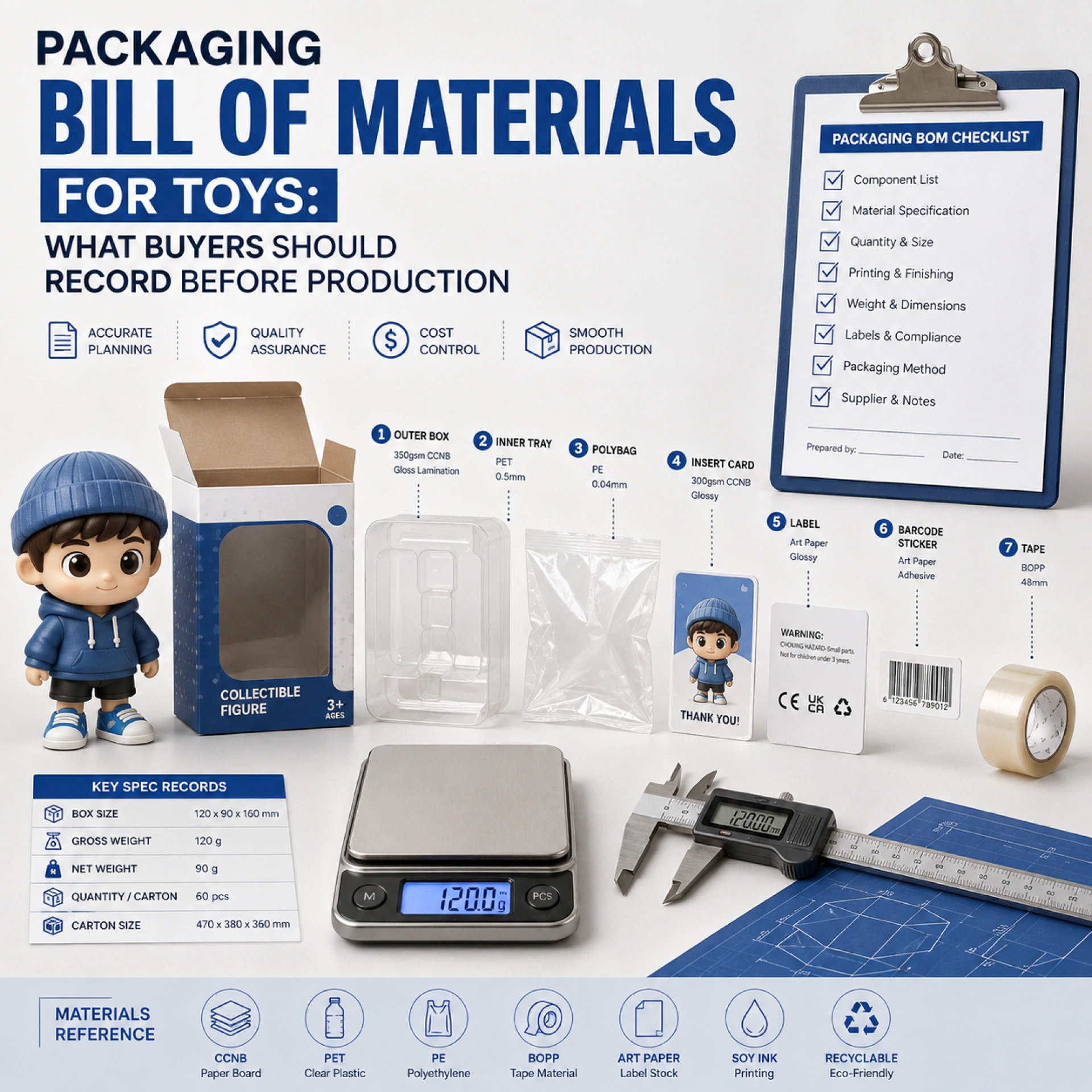
A Packaging Bill of Materials for Toys is a detailed list of every packaging component used for a toy product, including the outer box, inner tray, foil bag, plastic bag, insert card, instruction sheet, sticker label, master carton, and protective materials. For buyers, the purpose of a Packaging Bill of Materials for Toys is not only to record packaging costs. It helps the buyer control material choices, packaging weight, supplier documentation, replacement options, sustainability claims, EPR data, and final production consistency.
The direct answer is this: before production, buyers should prepare a Packaging Bill of Materials for Toys that records each packaging part, material type, dimensions, unit weight, supplier, artwork version, replacement option, approval status, and final lock date. This packaging BOM should be confirmed before mass production packaging is ordered, because packaging changes can affect cost, lead time, carton quantity, product protection, labeling, compliance documents, and retail presentation.
This article is not a broad PPWR legal guide. It is a procurement execution guide. The goal is to help toy buyers, blind box buyers, PVC figure buyers, licensed IP product teams, and retail sourcing teams build a packaging BOM that can actually be used during quotation, sampling, packaging approval, production, inspection, and shipment.
If your team is still planning packaging structure, our guide on working with a custom toy packaging manufacturer explains how buyers should prepare box style, inner tray, artwork, protection, labels, and carton packing before production.
What Is a Packaging Bill of Materials for Toys?
A Packaging Bill of Materials for Toys is a structured packaging list that shows what packaging is used for one toy product or one toy SKU. It should show every packaging layer from the retail box to the export carton.
For a custom toy project, the Packaging Bill of Materials for Toys may include:
- Outer color box
- Window box
- Blind box
- Inner tray
- Foil bag
- OPP bag
- PE bag
- Paper insert
- Instruction sheet
- Collection card
- Sticker label
- Barcode label
- Warning label
- Hang tag
- Protective sleeve
- Master carton
- Inner carton
- Carton divider
- Shipping mark
- Pallet wrap, if used
A packaging BOM is different from packaging artwork. Artwork shows the printed design. The Packaging Bill of Materials for Toys shows the physical materials and packaging structure behind that design.
For example, a blind box package may look like one small paper box to the customer. But in procurement, it may include a printed box, foil bag, paper card, plastic tray, small accessory bag, master carton, and carton sticker. Each part has material, weight, cost, supplier, MOQ, lead time, and approval status.
For blind box projects, our blind box figure manufacturing process guide explains how packaging connects with figure size, assortment planning, secret figure control, and final mass production.
Why Buyers Need a Packaging BOM Before Production
A Packaging Bill of Materials for Toys helps buyers avoid confusion before production starts. Without a packaging BOM, the buyer may approve a sample box but still not know the exact material, tray thickness, bag type, carton size, or packaging weight.
A clear Packaging Bill of Materials for Toys helps buyers answer practical procurement questions:
- What packaging parts are included?
- What material is each part made from?
- How much does each packaging part weigh?
- Which parts are paper, plastic, foil, or mixed material?
- Which parts are necessary for product protection?
- Which parts can be reduced or replaced?
- Which supplier provides each component?
- Which components require artwork approval?
- Which components affect lead time?
- Which version is approved for mass production?
- When should the packaging BOM be locked?
This is especially important for custom PVC figures, blind box toys, licensed IP toys, character gifts, and collectible products because packaging is part of the product experience. It protects the figure, supports retail display, carries warnings, hides blind box contents, and affects shipping cost.
If the product is sold into the EU, buyers may also need packaging data for broader packaging preparation. Our article on EU PPWR for Custom Toy and Blind Box Packaging explains the wider regulatory and market context. This article focuses only on how to execute the packaging BOM.
Packaging Components Buyers Should Record
The first task in a Packaging Bill of Materials for Toys is to list all packaging components. Buyers should not only record the outer box. Every packaging part should be listed separately.
| Packaging Component | Common Use | BOM Record Needed |
|---|---|---|
| Outer color box | Retail display and brand presentation | Paper type, size, printing, coating, weight, artwork version |
| Blind box | Mystery figure packaging | Box material, size, print method, finish, weight, SKU code |
| Window box | Shows the figure inside | Paperboard, window film material, film thickness, glue method |
| Inner tray | Holds the figure in place | PET, PVC, PP, paper pulp, folded paper, thickness, weight |
| Foil bag | Hides blind box contents | Material structure, size, weight, sealing method |
| OPP / PE bag | Protects figure or accessories | Plastic type, size, thickness, weight |
| Insert card | Collection guide or product card | Paper type, size, coating, weight |
| Instruction sheet | Safety or use information | Paper type, folded size, language version |
| Sticker label | Barcode, warning, or SKU label | Label material, size, adhesive type |
| Master carton | Export packing | Corrugated board type, dimensions, weight, carton mark |
| Divider / filler | Product protection in carton | Paper divider, foam, bubble wrap, kraft paper, weight |
A Packaging Bill of Materials for Toys should include both retail packaging and logistics packaging. Many buyers only record the retail box, then forget master cartons, dividers, labels, and protective materials. This creates problems when preparing packaging weights, cost breakdowns, and shipment planning.
What Material Is Used for Each Packaging Part?
After listing the components, buyers should record the material used for each part. This is the core of a Packaging Bill of Materials for Toys.
Common packaging materials include:
- C1S paperboard
- CCNB paperboard
- Kraft paper
- Corrugated board
- Paper pulp
- PET tray
- PVC tray
- PP tray
- PE bag
- OPP bag
- Foil laminate bag
- Paper sticker
- Plastic sticker
- Window film
- Foam
- Bubble wrap
- Paper filler
- Shrink film
For each component, the Packaging Bill of Materials for Toys should record material clearly. Instead of writing “plastic tray,” the BOM should write “PET inner tray” or “PP inner tray.” Instead of writing “paper box,” the BOM should write the paperboard type, thickness or GSM, coating, and print finish where possible.
A useful material record may include:
| BOM Field | Example |
| Component name | Inner tray |
| Material | PET |
| Thickness | 0.35 mm |
| Color | Transparent |
| Size | 145 × 95 × 35 mm |
| Unit weight | 8.2 g |
| Supplier | Packaging supplier A |
| Replacement option | Paper pulp tray |
| Approval status | Sample approved |
| BOM lock status | Locked before packaging order |
This level of detail helps the buyer compare suppliers, review replacement options, and confirm that mass production packaging matches the approved sample.
How to Record Packaging Weight
Packaging weight is one of the most important parts of a Packaging Bill of Materials for Toys. Buyers should record the weight of each packaging component separately, not only the total packed product weight.
A good weight record should include:
- Unit weight of each packaging component
- Total packaging weight per retail unit
- Master carton weight
- Total packaging weight per carton
- Packaging material weight by category
- Paper weight
- Plastic weight
- Foil or mixed material weight
- Protective material weight
For example:
| Component | Material | Unit Weight |
| Outer blind box | Paperboard | 22.5 g |
| Inner tray | PET | 8.2 g |
| Foil bag | Multi-layer film | 2.1 g |
| Collection card | Coated paper | 1.8 g |
| OPP accessory bag | OPP | 0.6 g |
| Master carton allocation per unit | Corrugated board | 5.4 g |
| Total packaging weight per unit | Mixed | 40.6 g |
The weight should be measured from approved samples or supplier-provided specifications. For better accuracy, buyers can weigh multiple samples and calculate an average. If the packaging supplier later changes material thickness, paper GSM, tray thickness, bag size, or carton structure, the Packaging Bill of Materials for Toys should be updated.
Buyers should also record the measurement method:
- Was the weight measured from a physical sample?
- Was it provided by the supplier?
- Was it calculated from material specifications?
- How many samples were measured?
- Which version of packaging was measured?
- Who approved the record?
This helps prevent disputes later. A Packaging Bill of Materials for Toys should be treated as a controlled procurement document, not a rough note.
Which Packaging Parts Can Be Replaced?
A strong Packaging Bill of Materials for Toys should include replacement options. This helps buyers compare cost, plastic reduction, lead time, and protection performance before locking the final packaging.
Common replacement options include:
| Current Component | Possible Replacement | Buyer Should Check |
| PET inner tray | Paper pulp tray | Scratch risk, strength, fit, cost, MOQ |
| PVC tray | PET, PP, or paper tray | Material preference, recyclability, forming performance |
| Foil bag | Paper blind bag or mono-material plastic bag | Secrecy, protection, tear resistance, unboxing experience |
| OPP accessory bag | Paper sleeve or smaller PE bag | Accessory protection and packing efficiency |
| Plastic window | No window or die-cut opening | Retail display effect and protection |
| Foam filler | Paper filler or corrugated insert | Shock protection and product surface safety |
| Large outer box | Smaller box structure | Retail impact and carton efficiency |
| Separate instruction sheet | Printed inside box or combined card | Legal text, language space, user clarity |
Replacement should not be based only on environmental preference. It must also protect the product and support retail use. For example, replacing a PET tray with a paper insert may reduce plastic, but it may scratch a painted PVC figure if the figure moves during shipping. Replacing a foil bag with paper may reduce plastic, but it may weaken the blind box secrecy and increase surface rubbing.
For projects focused on responsible packaging choices, our article on Sustainable Blind Box Manufacturing explains how recycled materials, paper packaging, foil bag alternatives, cost, MOQ, and greenwashing risk should be reviewed before production.
How to Prepare Supplier Documents
A Packaging Bill of Materials for Toys should include supplier document requirements. Buyers should not wait until shipment to request packaging specifications.
Useful supplier documents may include:
- Packaging quotation sheet
- Material specification sheet
- Paperboard specification
- Plastic tray material declaration
- Bag material declaration
- Recycled content declaration, if claimed
- FSC certificate or chain-of-custody document, if claimed
- Packaging artwork proof
- Dieline file
- Color proof
- Sample approval form
- Carton specification
- Supplier contact information
- Supplier production lead time
- MOQ confirmation
- Packaging version control record
For paper packaging, buyers may request FSC-related documents if the project uses certified paper. The official FSC chain of custody certification page explains how FSC-certified materials are tracked through the supply chain.
For environmental claims, buyers should avoid using broad claims without support. The ISO 14021 self-declared environmental claims standard and the FTC environmental claims Green Guides are useful references for understanding why claims should be specific and supported by evidence.
The Packaging Bill of Materials for Toys should not only say “FSC paper” or “recycled plastic.” It should record the supplier document that supports the claim, the certificate number if relevant, and the packaging part connected to that claim.
When Should Buyers Lock the Packaging BOM?
Buyers should lock the Packaging Bill of Materials for Toys before mass production packaging is ordered. Ideally, the packaging BOM should be locked after packaging sample approval and before final packaging print production.
A practical timeline looks like this:
| Project Stage | Packaging BOM Status |
| Quotation stage | Draft packaging BOM |
| Prototype stage | Packaging concept BOM |
| Packaging sample stage | Material and structure confirmation |
| Artwork proof stage | Print and label version confirmation |
| Pre-production sample stage | Final packaging BOM review |
| Before packaging order | Packaging BOM locked |
| During mass production | Change control only |
| Before shipment | Final packaging BOM checked against production |
The packaging BOM should not remain open during mass production. If buyers allow last-minute changes, the project may face cost changes, lead time delays, artwork errors, carton mismatch, packaging weight differences, or wrong supplier documents.
A Packaging Bill of Materials for Toys should be locked when the buyer has confirmed:
- Packaging structure
- Material of each component
- Dimensions
- Unit weight
- Artwork version
- Label information
- Supplier
- MOQ
- Cost
- Sample approval
- Carton packing method
- Replacement decision
- Final production version
After BOM lock, any change should go through a formal review. Even a small change, such as changing tray thickness or replacing a foil bag, may affect product protection, packaging weight, cost, and approval records.
If your product is at the sample stage, our custom PVC figure sample approval checklist can help buyers review packaging fit, visual approval, structure, and production readiness before locking the BOM.
Packaging BOM Template for Toy Buyers
Buyers can use the following template to prepare a Packaging Bill of Materials for Toys.
| Field | What to Record |
| Product name | Toy name or collection name |
| SKU / model | Product ID connected with packaging |
| Packaging component | Box, tray, bag, insert, carton, label, filler |
| Function | Retail display, protection, secrecy, instruction, shipping |
| Material | Paper, PET, PP, PE, OPP, foil laminate, corrugated board |
| Specification | GSM, thickness, size, film type, paper grade |
| Unit weight | Weight of one component |
| Supplier | Packaging supplier name |
| Artwork version | Approved packaging artwork file version |
| Sample status | Pending, approved, rejected, revised |
| Replacement option | Alternative material or structure |
| MOQ | Minimum order quantity for that component |
| Lead time | Supplier production time |
| Document needed | Declaration, certificate, specification, color proof |
| Lock status | Draft, under review, locked |
| Change record | Any approved changes after lock |
This template helps buyers make the Packaging Bill of Materials for Toys practical. It can be used by sourcing teams, packaging suppliers, factories, quality teams, and compliance partners.
Packaging BOM for Blind Box Products
Blind box products need extra attention because packaging is part of the mystery experience. A Packaging Bill of Materials for Toys for a blind box product should record both normal packaging and special blind box controls.
Blind box packaging may include:
- Outer blind box
- Inner foil bag
- Inner tray
- Character card
- Secret figure card
- Accessory bag
- Master carton
- Assortment label
- Anti-tamper sticker
- Retail display carton
For blind boxes, the Packaging Bill of Materials for Toys should also record whether any packaging part can reveal the figure inside. Buyers should check:
- Does the secret figure have a different weight?
- Does the inner bag feel different?
- Does the box code reveal the variant?
- Does the carton assortment label need control?
- Does the collection card reveal the secret too early?
- Does the packaging protect metallic, flocked, or glow finishes?
For special editions, our Blind Box Special Editions article explains how glow, flocking, metallic paint, and secret figure planning can affect packaging structure, packaging protection, and final QC.
Packaging BOM and Quality Control
The Packaging Bill of Materials for Toys should be checked during final quality control. It is not enough to approve the packaging once and then ignore it during mass production.
Before shipment, buyers should compare final packaging against the locked BOM:
- Is the box material correct?
- Is the tray material correct?
- Is the bag material correct?
- Is the carton size correct?
- Is the packaging weight close to the approved record?
- Is the artwork version correct?
- Is the barcode correct?
- Are warnings and labels correct?
- Is the insert card included?
- Is the supplier the approved supplier?
- Are replacement parts approved?
- Does the packaging protect the product?
For custom PVC figures and collectible toys, packaging QC is especially important because painted surfaces can be damaged by poor packaging. A tray that is too tight may scratch the product. A tray that is too loose may allow movement. A weak carton may increase shipping damage.
Our custom PVC figure quality control checklist can help buyers inspect appearance, painting, assembly, packaging, labels, carton packing, and final shipment quality.
Common Packaging BOM Mistakes
1. Recording Only the Outer Box
Many buyers only record the printed retail box. A complete Packaging Bill of Materials for Toys should also include inner trays, bags, inserts, labels, cartons, and protective materials.
2. Using Vague Material Names
Do not write “plastic tray” or “paper card” only. Record PET, PP, PVC, PE, OPP, paperboard type, thickness, GSM, and finish where possible.
3. Not Measuring Weight by Component
Total packed weight is not enough. Buyers should record weight by packaging component and material category.
4. Changing Packaging After Testing or Approval
Packaging changes can affect protection, labeling, carton quantity, and documentation. Changes after BOM lock should be reviewed.
5. Making Environmental Claims Without Documents
Do not claim FSC paper, recycled plastic, recyclable packaging, or plastic reduction unless the supplier documents support the claim.
6. Forgetting Carton and Shipping Materials
Master cartons, dividers, carton labels, and protective fillers are part of the packaging system and should be included in the packaging BOM.
7. Not Connecting BOM to Artwork Version
Packaging material and artwork should be controlled together. A correct box material with wrong artwork is still a production problem.
How Jiahong Creative Supports Packaging BOM Preparation
Jiahong Creative supports custom toy and blind box packaging development from packaging structure planning, sample review, material confirmation, artwork proofing, inner tray discussion, carton packing, and final QC.
For buyers preparing a Packaging Bill of Materials for Toys, we can help record packaging components, material types, unit weights, replacement options, supplier information, packaging sample status, carton packing data, and final packaging approval status. We can also help buyers compare plastic trays, paper inserts, foil bags, paper blind bags, printed boxes, retail displays, and export carton structures.
Jiahong Creative supports custom PVC figures, blind box figures, mascot toys, licensed IP products, collectible figures, character keychains, and character electronic products. If you are preparing a toy packaging project, please share your product size, packaging style, target market, quantity, artwork, sustainability requirements, and shipment plan.
You can contact us through our custom toy packaging inquiry page.
Final Thoughts
A Packaging Bill of Materials for Toys is a practical procurement tool. It helps buyers record every packaging component, confirm material choices, measure packaging weight, compare replacement options, prepare supplier documents, and lock the packaging version before mass production.
For custom toys, blind box figures, PVC collectibles, licensed IP products, and character merchandise, packaging is not only a printed box. It is a complete system that protects the product, supports retail, carries labels, controls blind box secrecy, affects shipment, and supports buyer documentation.
The best time to build a Packaging Bill of Materials for Toys is during quotation and sampling. The best time to lock it is before packaging order and mass production. When buyers control the packaging BOM early, they reduce packaging mistakes, supplier confusion, cost surprises, documentation gaps, and shipment risk.
FAQ
1.What is a Packaging Bill of Materials for Toys?
A Packaging Bill of Materials for Toys is a detailed list of every packaging component used for a toy product, including boxes, trays, bags, labels, inserts, cartons, and protective materials. It records material, size, weight, supplier, artwork version, and approval status.
2.Why do toy buyers need a packaging BOM?
Toy buyers need a packaging BOM to control packaging cost, material selection, supplier documents, replacement options, packaging weight, carton planning, sustainability claims, and production consistency.
3.What packaging components should be included?
A Packaging Bill of Materials for Toys should include outer boxes, blind boxes, window boxes, inner trays, foil bags, plastic bags, instruction sheets, insert cards, stickers, labels, master cartons, dividers, and protective fillers.
4.How should buyers record packaging materials?
Buyers should record the exact material of each component, such as paperboard, corrugated board, PET, PP, PE, OPP, foil laminate, paper pulp, window film, or kraft paper. Avoid vague terms like “plastic” or “paper.”
5.How should packaging weight be recorded?
Packaging weight should be recorded by component. Buyers should weigh approved samples or use supplier specifications, then record unit weight, total packaging weight per product, carton packaging weight, and weight by material category.