

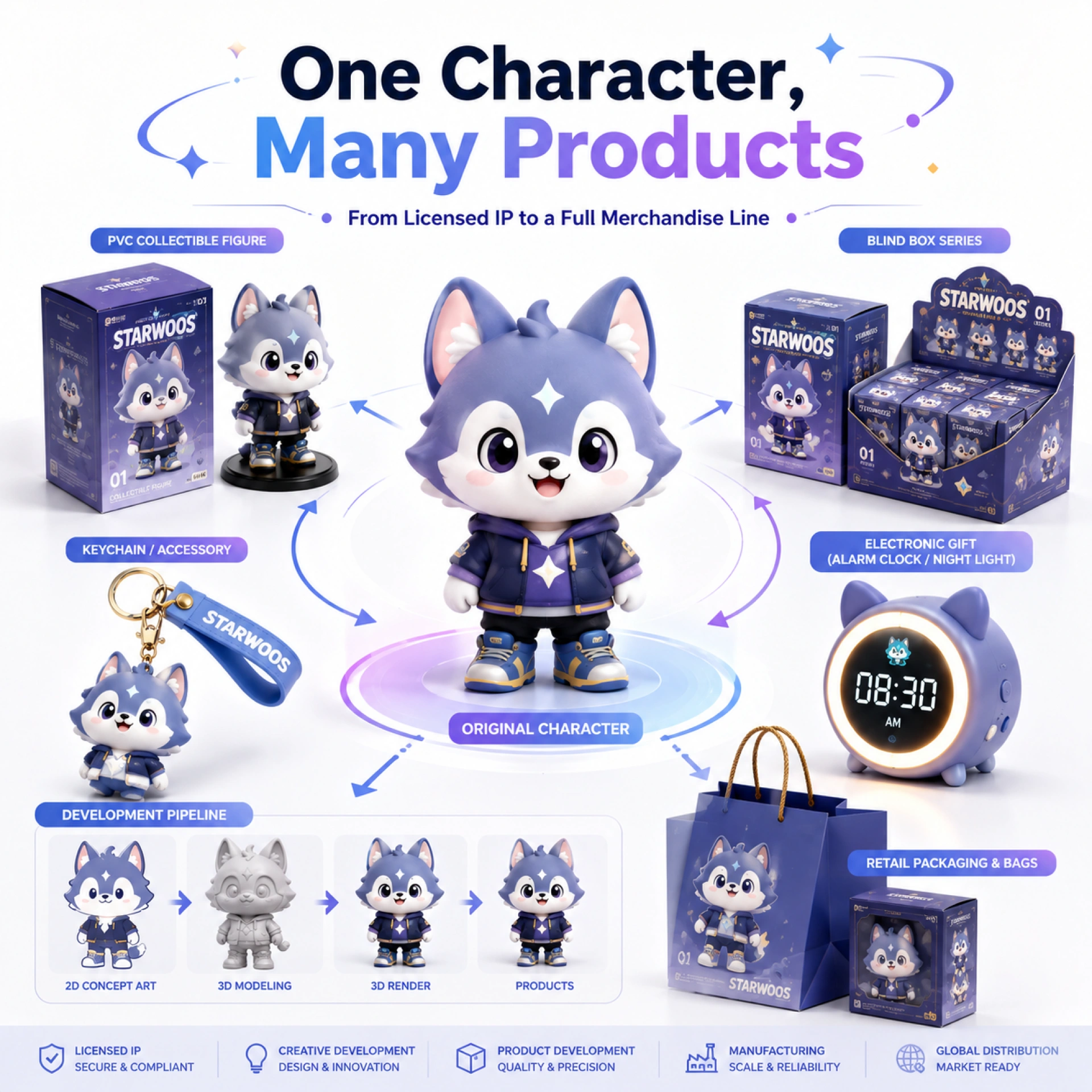
To Turn One Licensed Character Into a Multi-Product Merchandise Line, brands should start with character artwork review, develop one accurate 3D master asset, then adapt that asset into PVC collectible figures, blind box variants, accessories, keychains, and character electronic products. The key is to keep the same character identity across different product formats while controlling tooling cost, packaging consistency, approval workflow, and unreleased IP protection.
For IP owners, licensees, game companies, animation studios, retailers, and brand teams, the goal is not simply to make one product. The goal is to build a product system. One licensed character can become a hero collectible figure, a blind box series, a keychain, a small accessory set, a night light, a Bluetooth speaker, an alarm clock, or another character electronic gift. However, each product must still match the approved style guide, target customer, price point, retail channel, and compliance requirements.
The best way to Turn One Licensed Character Into a Multi-Product Merchandise Line is to plan the full product ladder before mold making. If the first product is designed only as a single figure, later adaptations may require new 3D work, new molds, new packaging, and repeated approvals. If the character is planned as a multi-product merchandise system from the beginning, the factory can identify shared components, consistent colors, reusable packaging assets, and a smarter launch sequence.
If you are still choosing a factory for licensed IP products, our guide on how to choose a custom toy manufacturer for licensed IP products explains how buyers should evaluate confidentiality, artwork accuracy, approval workflow, packaging control, and quality management.
1. Character Artwork Review
The first step to Turn One Licensed Character Into a Multi-Product Merchandise Line is character artwork review. Before creating figures, blind boxes, accessories, or electronic products, the buyer and manufacturer should review the official artwork and identify which visual details must stay consistent across the whole merchandise line.
A licensed character usually has key identity points:
- Face shape
- Eye style
- Mouth expression
- Body proportion
- Signature color
- Clothing details
- Accessories
- Logo or symbol
- Pose language
- Personality cues
- Approved style guide rules
For one product, a small adjustment may be acceptable. For a multi-product line, small inconsistencies can become more obvious. If the PVC figure uses one face proportion, the keychain uses another, and the night light uses a simplified version, the product line may feel disconnected.
During artwork review, buyers should separate the character into three levels:
| Character Element | Decision |
|---|---|
| Must keep | Core face, colors, logo, signature accessories, character identity |
| Can simplify | Fine clothing lines, very small accessories, texture details |
| Can adapt | Pose, product function, base design, packaging scene, accessory layout |
This review helps the factory understand which details are non-negotiable and which details can be adapted for different product formats.
If your project starts only from flat artwork, read our guide on how to turn 2D character art into a custom toy figure. The same 2D-to-3D logic is the foundation when you want to Turn One Licensed Character Into a Multi-Product Merchandise Line.
2. 3D Master Asset Development
The second step is 3D master asset development. A 3D master asset is the main digital model that defines the licensed character’s production-ready shape. It becomes the reference for future PVC figures, blind box variants, keychains, accessories, and electronic product adaptations.
To Turn One Licensed Character Into a Multi-Product Merchandise Line, the 3D master asset should not be treated as a one-time sculpt. It should be built as a reusable product foundation.
A good 3D master asset should define:
- Character front, side, back, and top views
- Head shape and facial expression
- Body proportion
- Part separation logic
- Accessory placement
- Surface details
- Production thickness
- Base contact points
- Simplification rules for smaller products
- Adaptation rules for electronic products
For example, if the character has a complex hairstyle, the 3D master asset should show which hair details are essential and which can be simplified for smaller blind box figures or keychains. If the character has a large head and small feet, the model should consider whether a base is needed for stability.
This stage is critical because every later product depends on it. A weak 3D master asset can create repeated problems: inaccurate figure proportions, unstable blind box variants, oversized keychains, electronic shells with no internal space, and inconsistent packaging artwork.
A professional custom PVC toy manufacturer should review the 3D asset from both artistic and manufacturing perspectives.
3. PVC Collectible Figure
The hero PVC collectible figure is often the best first product when a brand wants to Turn One Licensed Character Into a Multi-Product Merchandise Line. It can establish the character’s physical form, premium quality standard, approved colors, and production reference.
A PVC collectible figure usually focuses on:
- Character accuracy
- Sculpted details
- Paint quality
- Surface finish
- Stable standing
- Packaging presentation
- Brand approval
- Collectible value
The hero figure can be larger than blind box figures and more detailed than keychains. It gives the brand a strong flagship product for launch, retail display, social media, influencer seeding, and fan campaigns.
However, the hero PVC figure should not be designed in isolation. If the brand plans future blind boxes, accessories, or electronic products, the hero figure should define the standard but not make future adaptation impossible. For example, a pose with extreme thin parts may look great as a display figure but may be risky for smaller products.
If your buyer team wants to understand materials before choosing the first product, read our guide on PVC vs vinyl vs ABS figures. Material selection can influence tooling cost, color matching, painting, and mass production quality.
4. Blind Box Variants
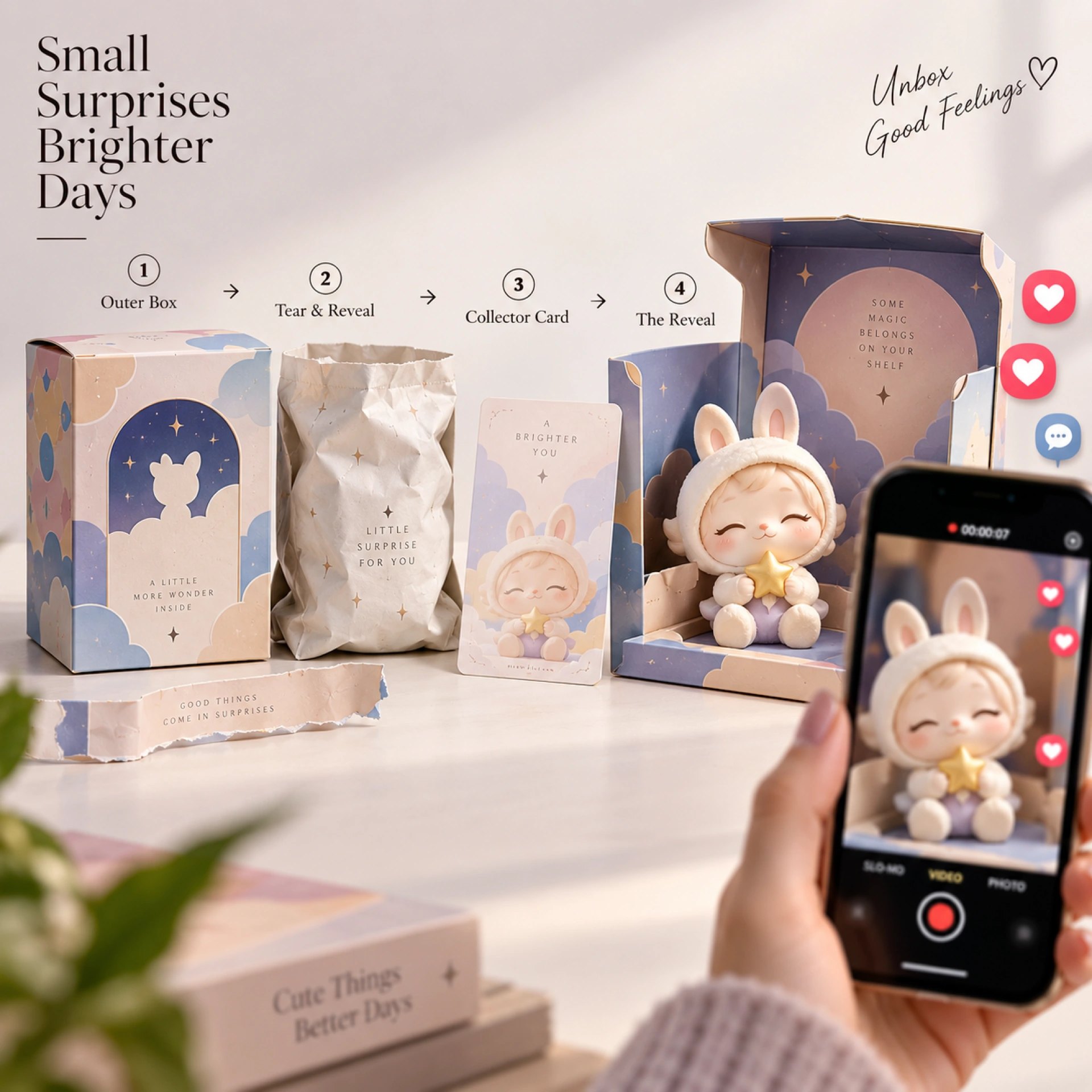
Blind box variants are one of the strongest ways to Turn One Licensed Character Into a Multi-Product Merchandise Line because they allow one character to appear in multiple poses, outfits, emotions, scenes, or themes.
A blind box series can include:
- Standard pose
- Happy expression
- Sleeping version
- Seasonal outfit
- Festival version
- Game scene version
- Secret figure
- Metallic or special color edition
- Mini accessory version
- Partner character version
The key is to keep the character identity consistent while creating enough variation to support collection behavior. A blind box series should not feel like random versions. It should feel like one planned character universe.
For licensed IP, every blind box variant may require approval. Buyers should prepare a clear approval sheet that shows the variant name, pose, color, accessory, packaging artwork, and secret figure logic.
Blind box planning also affects production. Different variants may share some components, but each variant may still require separate molds, painting masks, packaging codes, and SKU control. If the brand wants to Turn One Licensed Character Into a Multi-Product Merchandise Line efficiently, blind box variants should be planned together with tooling and packaging strategy.
Our blind box figure manufacturing process guide explains how concept planning, prototype development, mold making, painting, packaging, assortment planning, and mass production work together.
5. Accessory and Keychain Adaptation
Accessories and keychains are lower-price product extensions that can help a licensed character reach more sales channels. They can be used for retail add-ons, event gifts, fan merchandise, capsule collections, or promotional campaigns.
When brands Turn One Licensed Character Into a Multi-Product Merchandise Line, keychains and accessories should not look like cheap reductions of the main figure. They should be designed as intentional adaptations.
Possible product formats include:
- PVC figure keychains
- Bag charms
- Mini standees
- Desk accessories
- Phone charms
- Zipper pulls
- Badge-style figures
- Small collectible accessories
- Character bases
- Scene props
The most important issue is simplification. A keychain is smaller, handled more often, and exposed to pulling or rubbing. Fine parts may break. Thin accessories may deform. Small painted details may become difficult to control. The factory should adjust thickness, connection points, paint areas, and assembly method.
For example, a detailed PVC figure may have separate arms, a base, and small decorations. The keychain version may need a simpler pose, stronger ring connection, fewer paint masks, and a more durable surface finish.
This adaptation step helps brands increase product variety without always starting from zero.
6. Character Electronic Product Development
Character electronic products can expand a licensed character from collectible merchandise into daily-use lifestyle products. This is one of the most valuable ways to Turn One Licensed Character Into a Multi-Product Merchandise Line because functional products can stay visible in the customer’s bedroom, desk, office, or home.
Possible character electronic products include:
- Night lights
- Silicone tap lights
- Bluetooth speakers
- Alarm clocks
- Sleep training clocks
- Humidifiers
- Aroma diffusers
- Soap dispensers
- Portable fans
- Desk lamps
- Sound machines
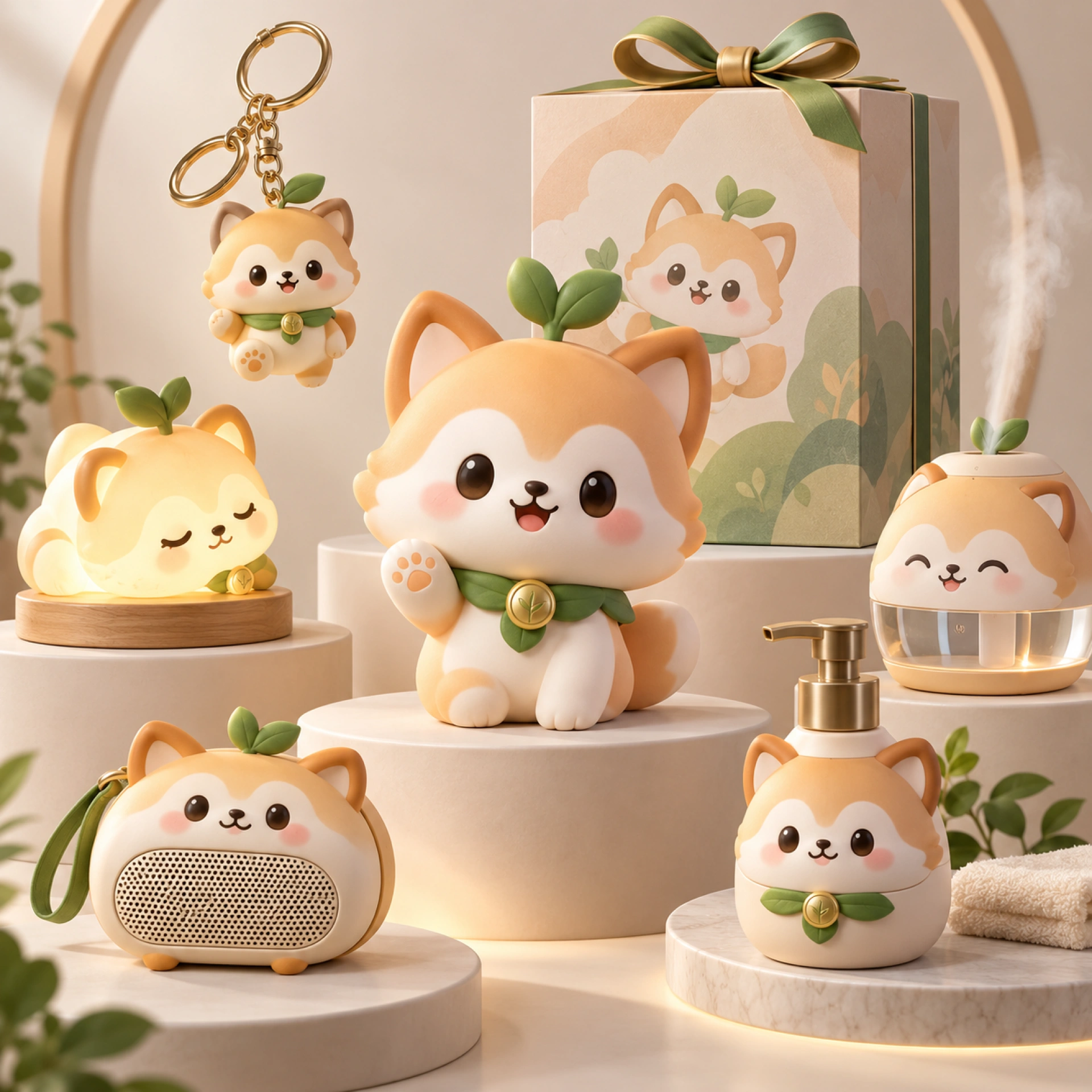
Character electronic products are more complex than static figures. They require structure engineering, internal space, PCBA, battery, LED layout, charging port, speaker position, water tank design, sensors, buttons, and safety review depending on the product type.
A character design that works as a PVC figure may not automatically work as an electronic product. For example, a Bluetooth speaker needs an acoustic outlet and internal chamber. A night light needs light diffusion. A humidifier needs water tank space. An alarm clock needs display position and button access.
If your brand wants to extend IP into functional products, our character electronic gift manufacturer guide explains how OEM product development works for night lights, speakers, aroma diffusers, humidifiers, alarm clocks, and other electronic gifts. You can also review our custom Bluetooth speaker manufacturer guide if your first electronic product is an audio item.
7. Shared Tooling and Component Opportunities
Shared tooling is one of the most important cost-control topics when brands Turn One Licensed Character Into a Multi-Product Merchandise Line. However, buyers should understand that shared tooling does not mean every product can use the same mold.
Tooling can only be shared when the part size, shape, material, structure, and production method are compatible. A 10 cm PVC figure and a 3 cm keychain may not share the same main body mold. A blind box figure and a Bluetooth speaker shell usually cannot share the same mold. But some parts may still be planned together.
Shared opportunities may include:
- Common character head for similar-scale variants
- Shared base design across multiple figures
- Reusable accessory molds
- Shared packaging dieline for the same box size
- Common printed card format
- Reusable logo plate
- Similar internal support parts
- Shared color standards
- Shared paint masks for repeated parts
The best approach is to identify shared components early. If shared parts are planned after the first product is already molded, the opportunity may be lost.
A manufacturer should help the buyer separate product elements into three categories:
| Element Type | Tooling Strategy |
| Core identity parts | Keep accurate; share only if size and pose match |
| Variant parts | Make separate molds when pose, outfit, or accessory changes |
| Support parts | Look for sharing opportunities in bases, stands, inserts, and accessories |
This allows the buyer to control cost without damaging character accuracy.
8. Packaging Consistency
Packaging consistency is essential when brands Turn One Licensed Character Into a Multi-Product Merchandise Line. Even if each product has a different function or price point, the customer should recognize that the products belong to the same licensed character world.
A consistent packaging system may include:
- Same logo placement
- Same character color palette
- Same typography style
- Same legal text system
- Same product naming logic
- Same background world
- Same collection numbering
- Same warning label placement
- Same barcode area
- Same retail display style
However, packaging consistency does not mean every package must look identical. A hero figure may use a window box. A blind box may use sealed surprise packaging. A keychain may use a card or small box. A Bluetooth speaker may need an electronics-style box with function icons. The key is to maintain the same brand language.
For licensed IP, packaging also has approval risk. Wrong logo placement, missing copyright notice, inaccurate character artwork, or inconsistent color may delay approval.
Our guide on working with a custom toy packaging manufacturer explains how packaging should protect the product, support retail presentation, and match the brand identity. Packaging should be planned together with the merchandise line, not added after production.
9. NDA and Unreleased IP Protection
NDA and unreleased IP protection are critical when brands Turn One Licensed Character Into a Multi-Product Merchandise Line. A multi-product line usually involves more files, more suppliers, more samples, more packaging artwork, and more internal discussions than a single product.
If the character is unreleased, confidential, or part of a future campaign, the buyer should control file access carefully.
Protection measures may include:
- Signed NDA before file sharing
- Limited access to character artwork
- Watermarked preview files
- Clear file naming and version control
- Restricted sharing with subcontractors
- No public posting of samples
- No trade show display before launch
- Controlled sample shipment
- Return or destruction of unapproved samples
- Written approval before factory marketing use
WIPO explains the importance of trade secrets and NDA protection for confidential business information. For licensed character projects, buyers should also confirm that the factory understands IP licensing boundaries. WIPO’s information on IP assignment and licensing is a useful reference for understanding why authorization matters.
The manufacturer should never treat licensed artwork as normal sample material. For unreleased IP, confidentiality is part of supplier qualification.
10. Launch Sequence Planning
The final step to Turn One Licensed Character Into a Multi-Product Merchandise Line is launch sequence planning. Not every product should launch at the same time. A good launch sequence helps the brand control risk, test demand, manage cash flow, and build market attention.
A practical launch sequence may look like this:
| Launch Stage | Product Type | Purpose |
| Stage 1 | Hero PVC collectible figure | Establish physical character identity and premium reference |
| Stage 2 | Blind box variants | Expand collectibility and repeat purchase behavior |
| Stage 3 | Keychains and accessories | Add lower-price items and event merchandise |
| Stage 4 | Character electronic products | Expand into daily-use lifestyle products |
| Stage 5 | Seasonal or limited editions | Create campaign moments and repeat launches |
This sequence is only one example. Some brands may start with blind boxes first if the character already has strong fan demand. Others may start with an electronic product if the IP is positioned as lifestyle merchandise.
The important point is to plan the full roadmap before the first tooling investment. If the buyer knows that a character may later become a night light, speaker, keychain, and blind box, the first 3D master asset can be developed more intelligently.
To Turn One Licensed Character Into a Multi-Product Merchandise Line successfully, the buyer should also plan approval timing. Licensed IP products often require approval at multiple stages: concept, 3D model, color sample, packaging artwork, pre-production sample, and final production sample.
Before shipment, buyers can use our custom PVC figure quality control checklist to review appearance, color, painting, assembly, packaging, and final product consistency.
Buyer Checklist: From One Character to Product Line
Before trying to Turn One Licensed Character Into a Multi-Product Merchandise Line, buyers should prepare a clear development checklist.
| Buyer Question | Why It Matters |
| Do we have the right product category license? | A license may allow figures but not electronics or accessories |
| Is the style guide complete? | Helps control character accuracy across all products |
| Can we create one 3D master asset? | Reduces repeated development work |
| Which product should launch first? | Controls cost, approval workload, and market testing |
| Can any components be shared? | Helps reduce tooling and packaging cost |
| Do different products need different compliance review? | Electronics, toys, and collectibles may have different requirements |
| Is packaging consistent across the line? | Builds brand recognition and retail value |
| Is unreleased IP protected by NDA? | Reduces leakage and unauthorized use risk |
| Are color standards fixed? | Supports approval and production consistency |
| Is final QC planned for each product type? | Prevents quality inconsistency across the merchandise line |
This checklist helps buyers treat the licensed character as a long-term product asset, not a one-time manufacturing project.
How Jiahong Creative Supports Licensed Character Merchandise Lines
Jiahong Creative supports licensed character product development from artwork review, 3D master asset planning, PVC figure production, blind box variant development, accessory adaptation, keychain production, character electronic product development, packaging planning, and quality inspection.
We can help brands review whether one character is suitable for PVC collectible figures, blind box series, keychains, accessories, night lights, Bluetooth speakers, aroma diffusers, alarm clocks, humidifiers, and other character-themed products.
For brands that want to Turn One Licensed Character Into a Multi-Product Merchandise Line, early planning is important. Please share your character artwork, license scope, product categories, target size, target quantity, packaging direction, launch timeline, confidentiality requirements, and target market. You can contact us through our custom licensed character product inquiry page.
Final Thoughts
To Turn One Licensed Character Into a Multi-Product Merchandise Line, brands need more than one good figure sample. They need a structured development plan that starts with artwork review and 3D master asset development, then expands into PVC collectible figures, blind box variants, keychains, accessories, character electronic products, shared tooling opportunities, consistent packaging, NDA protection, and launch sequence planning.
The strongest merchandise lines are not random product collections. They are planned systems. The character identity stays consistent, but each product format has a clear role. The hero figure builds collectible value. Blind boxes create repeat purchase. Keychains and accessories support lower-price channels. Electronic products create daily-use value. Packaging connects the whole line visually.
With the right manufacturing partner, one licensed character can become a flexible product platform. When buyers plan structure, tooling, packaging, approvals, confidentiality, and launch timing early, it becomes much easier to Turn One Licensed Character Into a Multi-Product Merchandise Line that is coherent, scalable, and ready for retail.
FAQ
1.What does it mean to Turn One Licensed Character Into a Multi-Product Merchandise Line?
To Turn One Licensed Character Into a Multi-Product Merchandise Line means using one licensed character as the foundation for multiple product formats, such as PVC figures, blind box variants, keychains, accessories, night lights, speakers, alarm clocks, and other character products.
2.What is the first step in developing a licensed character merchandise line?
The first step is character artwork review. Buyers and manufacturers should identify the character’s core visual identity, style guide rules, non-negotiable details, and areas that can be simplified or adapted for different product formats.
3.Why is a 3D master asset important?
A 3D master asset defines the production-ready character shape and becomes the reference for future products. It helps maintain consistency when adapting the character into figures, blind boxes, keychains, and electronic products.
4.Can the same tooling be used for multiple products?
Sometimes, but not always. Tooling can only be shared when size, shape, material, and production method are compatible. Bases, accessories, or similar-scale parts may offer sharing opportunities, but different product formats often need separate molds.
5.Should a brand launch all products at the same time?
Not necessarily. Many brands launch in stages, starting with a hero PVC figure, then blind box variants, then keychains or accessories, and later character electronic products. A staged launch can reduce risk and test market response.
6.Can one licensed character become an electronic product?
Yes. A licensed character can be adapted into night lights, Bluetooth speakers, alarm clocks, humidifiers, aroma diffusers, and other character electronic products. However, the design must allow internal space, electronics, controls, and safety review.
7.How should packaging stay consistent across different products?
Packaging should use consistent logo placement, color palette, typography, legal text, character artwork, and product naming logic. Different product types can use different box structures while still sharing the same brand language.
8.Why is NDA protection important for licensed character projects?
NDA protection is important because licensed or unreleased character files may include confidential artwork, launch plans, product concepts, and packaging designs. Buyers should control file access and sample sharing before public release.
9.What should buyers prepare before asking a factory for a multi-product line quote?
Buyers should prepare character artwork, license scope, product category list, target sizes, quantity estimates, packaging direction, launch sequence, confidentiality requirements, target market, and approval workflow.
10.How can Jiahong Creative help turn one licensed character into multiple products?
Jiahong Creative can support artwork review, 3D master asset planning, PVC figure development, blind box variants, keychains, accessories, character electronic products, packaging consistency, sample approval, QC, and mass production for licensed character merchandise lines.