

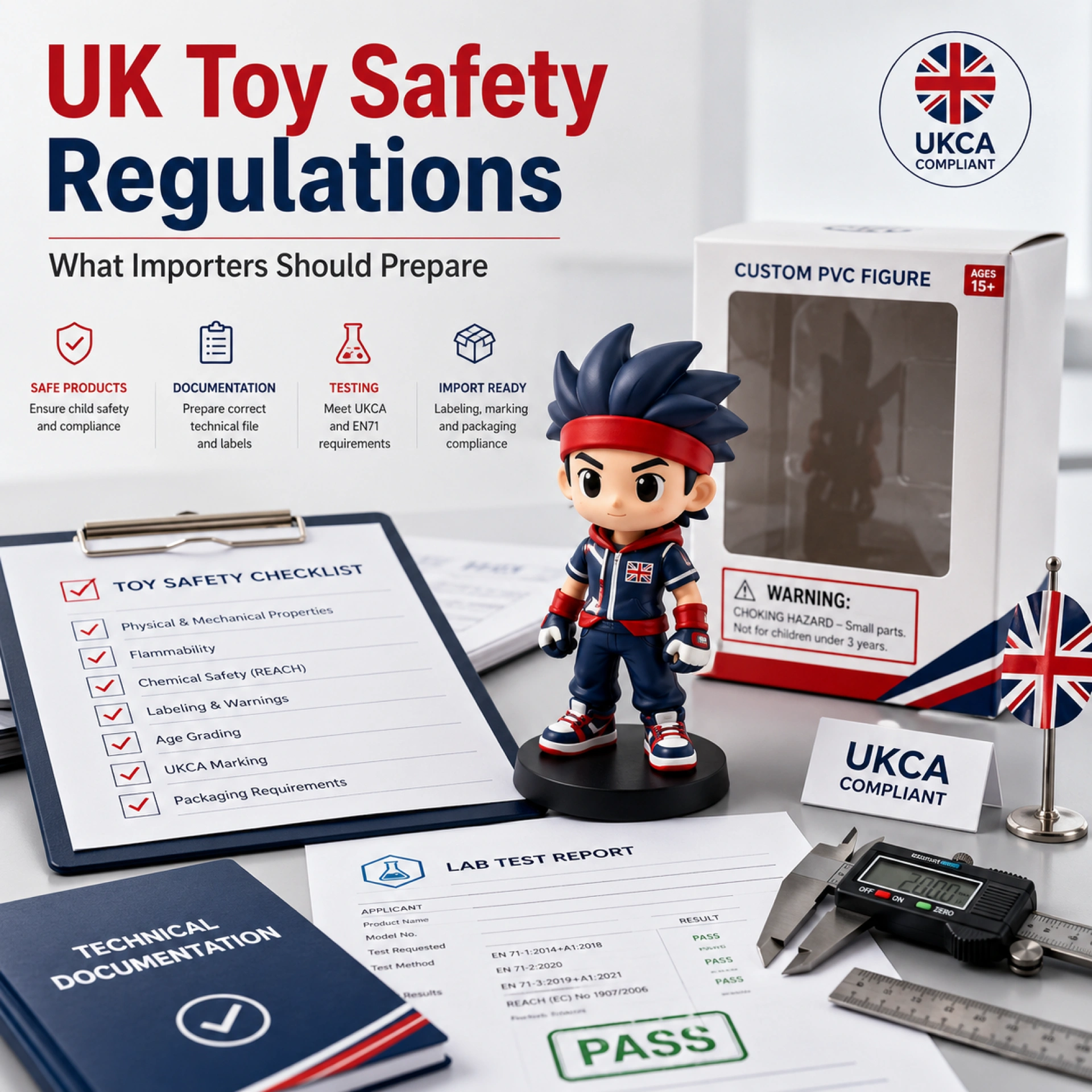
UK Toy Safety Regulations for Custom PVC Figures require importers to prepare product classification, safety assessment, technical documentation, conformity marking, importer details, age grading, warnings, packaging information, test reports, and quality control records before placing toys on the UK market. For custom PVC figures, blind box toys, mascot figures, licensed IP toys, and collectible character products, importers should not wait until shipment to think about compliance. Safety and documentation should be planned from artwork, sampling, packaging, and mass production.
The direct answer is this: under UK Toy Safety Regulations for Custom PVC Figures, importers should confirm whether the product is legally a toy, identify whether it will be sold in Great Britain or Northern Ireland, prepare UKCA or CE marking information, review EN71-related testing needs, check small parts and chemical risks, confirm packaging warnings, keep technical documentation, and make sure the final mass production matches the approved and tested sample.
This is important because a custom PVC figure may look like a simple collectible, but it can still fall under toy safety rules if it is designed or intended for use in play by children under 14. A blind box figure sold through toy retail, children’s gift channels, or family-focused e-commerce may need a different compliance approach from an adult collectible figure. UK importers should define the product category clearly before production begins.
If you also sell into the EU, you should compare this article with our guide on EU Toy Safety Regulation 2025/2509, because UK and EU toy safety requirements are related but not identical.
What Are UK Toy Safety Regulations for Custom PVC Figures?
UK Toy Safety Regulations for Custom PVC Figures refer mainly to the UK rules that apply to toys placed on the UK market. In Great Britain, the key framework is the Toys (Safety) Regulations 2011. For Northern Ireland, the rules can involve EU-related requirements under the Windsor Framework. This means importers must understand where the product will be sold: Great Britain, Northern Ireland, the EU, or multiple markets.
For Great Britain, buyers should review the official UK Toys Safety Regulations 2011 guidance. For general conformity marking, importers can also review the UK guidance on placing UKCA or CE marked products on the market in Great Britain.
For custom PVC figures, the key issue is product classification. If the figure is a toy, the importer should prepare for toy safety obligations. If the figure is an adult collectible, the importer should make sure packaging, marketing language, warnings, sales channel, and product presentation support that positioning.
A custom PVC figure can include PVC body parts, ABS bases, painted surfaces, pad printing, small accessories, blind box packaging, foil bags, paper inserts, and retail boxes. Each component may affect safety, labeling, and compliance.
Toy or Adult Collectible: The First Decision
The first step under UK Toy Safety Regulations for Custom PVC Figures is deciding whether the product is a toy. This decision should be made before quotation, sampling, or packaging design.
Importers should ask:
- Is the product intended for play by children?
- Is it marketed to children under 14?
- Does the packaging use child-focused language or imagery?
- Is it sold in toy stores, blind box retail channels, or children’s gift channels?
- Does the figure include small detachable accessories?
- Does the product have play value?
- Is it clearly positioned as an adult collectible?
- Does the packaging include suitable warnings and age grading?
- Will the product be sold in Great Britain, Northern Ireland, or both?
This classification affects testing, packaging, warnings, importer obligations, and conformity marking. A figure may be called a collectible, but if the overall presentation attracts children and is sold as a toy-like product, importers should be cautious.
If your product is positioned as a collectible figure, you can also review our article on collectible figure manufacturer China. It explains how brands plan PVC figures, blind box toys, licensed IP figures, packaging, and QC before production.
Great Britain vs Northern Ireland
UK importers should not treat the whole UK as one simple market. Great Britain includes England, Scotland, and Wales. Northern Ireland follows a different regulatory route for many goods.
For Great Britain, importers should understand UKCA and CE marking rules. The UK currently allows CE marking recognition for many product categories, including toys, under specified conditions. UKCA may also be used depending on conformity assessment route and market strategy.
For Northern Ireland, CE marking remains central, and UKNI marking may apply when a UK body is involved in conformity assessment. If products are sold in Northern Ireland or across both GB and NI, importers should confirm the marking route before packaging is printed.
For buyers also selling in the EU, the European Commission’s page on placing toys on the EU market is useful for understanding CE marking, safety assessment, technical documentation, and importer obligations in the EU.
For practical sourcing, the buyer should tell the factory clearly whether the custom PVC figure is for GB only, NI, EU, or multiple markets. This affects packaging artwork, labels, importer address, warning text, testing documents, and conformity marking.
Key Preparation Checklist for UK Importers
Before placing an order, importers can use this checklist for UK Toy Safety Regulations for Custom PVC Figures.
| Preparation Item | What Importers Should Prepare |
|---|---|
| Product classification | Confirm whether the PVC figure is a toy, adult collectible, promotional product, or retail gift |
| Target market | Confirm Great Britain, Northern Ireland, EU, or multi-market sales |
| Age grading | Define intended age group and whether small parts warnings are needed |
| Artwork and 3D files | Keep records of the approved design, structure, and product identity |
| Bill of materials | Prepare material list for PVC, ABS, paint, ink, coatings, glue, packaging, and accessories |
| Safety assessment | Review physical, mechanical, chemical, flammability, hygiene, and other relevant risks |
| EN71 test plan | Confirm applicable toy safety tests with a qualified laboratory |
| Conformity marking | Confirm UKCA, CE, or CE + UKNI route depending on market |
| Importer details | Prepare UK importer name, address, and contact information where required |
| Warnings and labels | Confirm warning language, age grading, small parts warning, and safety information |
| Packaging artwork | Check conformity marks, barcode, legal text, and product claims before printing |
| Technical documentation | Keep test reports, declarations, product data, material information, and QC records |
| Final QC | Confirm mass production matches the approved and tested sample |
This table should be used early in the project. UK Toy Safety Regulations for Custom PVC Figures should guide development, not only final shipment inspection.
Safety Assessment for Custom PVC Figures
Safety assessment is one of the most important preparation steps. Importers should work with the manufacturer, testing laboratory, and compliance partner to identify possible hazards before placing the product on the UK market.
For custom PVC figures, safety assessment may include:
- Small parts risk
- Sharp points
- Sharp edges
- Detachable accessories
- Breakage risk
- Stability and falling risk
- Paint and coating safety
- Chemical migration
- Material safety
- Flammability
- Packaging hazards
- Age grading
- Warning labels
- Foreseeable misuse by children
A custom PVC figure may have small accessories such as hats, tools, weapons, food items, glasses, base parts, or small decorative elements. If these parts detach, they may create choking risks for younger children. Importers should review whether parts should be fixed, enlarged, removed, or clearly warned against.
If your team is still reviewing a pre-production sample, use our custom PVC figure sample approval checklist to check structure, color, painting, packaging, stability, and safety before mass production.
EN71 Testing and UK Toy Safety
EN71 standards are commonly used for toy safety testing in Europe and the UK context. For custom PVC figures, EN71 testing may help importers evaluate mechanical and physical properties, flammability, and chemical migration depending on the product type and intended age.
UK Toy Safety Regulations for Custom PVC Figures do not mean every product has the same test plan. A simple PVC figure, a blind box toy with accessories, a figure keychain, and a figure with electronic functions may require different checks.
Importers should discuss testing with a qualified laboratory. Common areas may include:
- EN71-1 mechanical and physical properties
- EN71-2 flammability
- EN71-3 migration of certain elements
- Small parts testing
- Sharp edge and sharp point review
- Packaging and warning label review
- Chemical requirements based on material and target market
Our guide on EN71 for Custom Toys explains what buyers should prepare for EN71-related testing, including material details, product category, age grading, and documentation.
Testing should be done on samples that represent final production. If the factory later changes PVC material, paint supplier, coating, glue, or packaging, the importer should review whether the test result is still valid for the final product.
UKCA, CE Marking, and Packaging
Conformity marking is a major topic under UK Toy Safety Regulations for Custom PVC Figures. Importers should confirm whether the product needs UKCA, CE, or CE + UKNI marking depending on market placement.
For Great Britain, businesses should review the official guidance on UKCA and CE marking in Great Britain. For Northern Ireland, importers should review the official guidance on Toys Safety Regulations in Northern Ireland.
For custom PVC figure packaging, importers should confirm:
- Correct conformity marking
- Product name
- Model number or SKU
- Batch number
- Manufacturer name and address
- UK importer name and address where required
- Age grading
- Warning labels
- Small parts warnings
- Instructions, where needed
- Barcode
- Brand and IP legal text
- Country of origin
- Packaging recycling information, where relevant
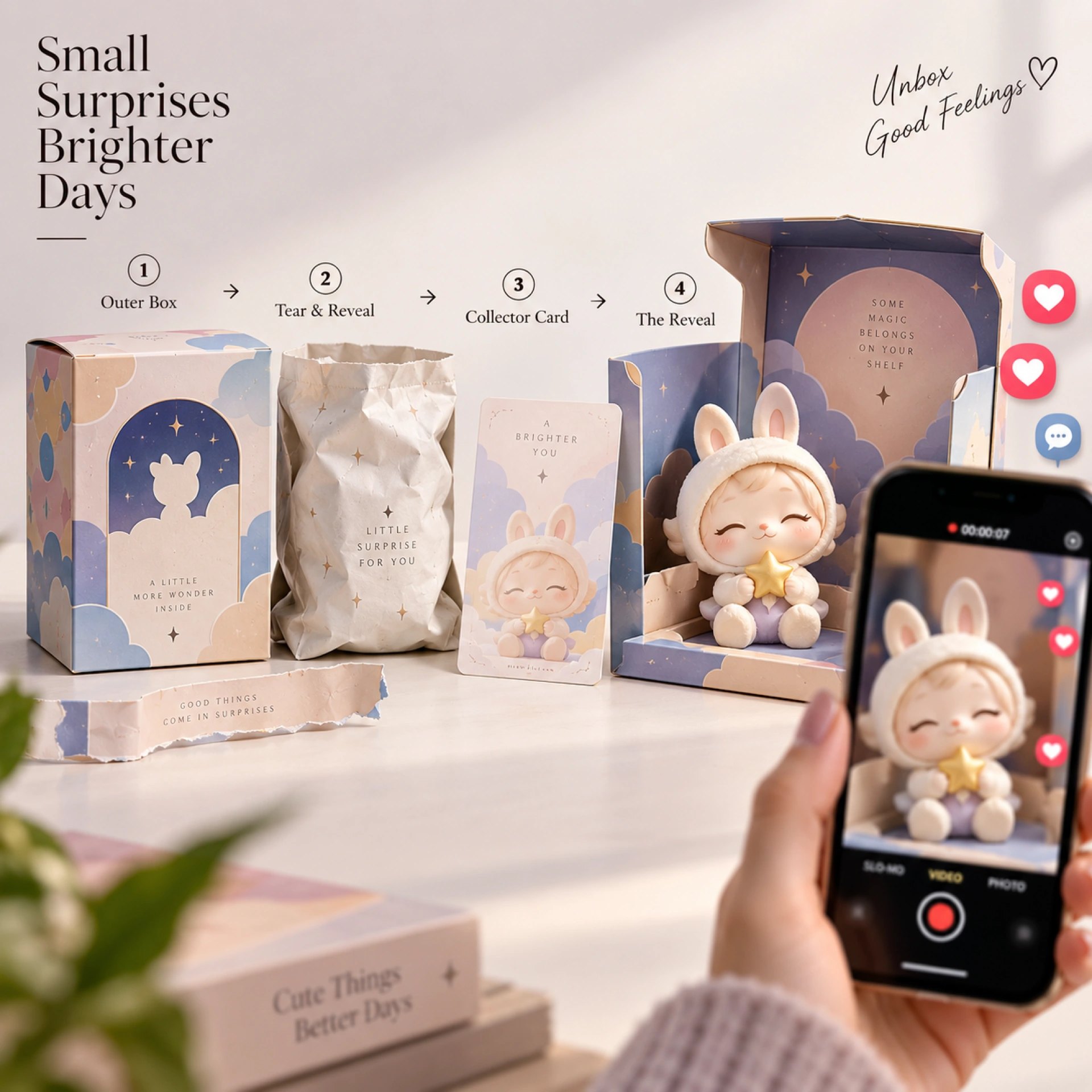
For blind box products, each layer of packaging should be reviewed. The outer box, inner bag, collection card, insert, and carton may all contain information that affects compliance, logistics, and retail acceptance.
If your product needs custom retail packaging, our guide on working with a custom toy packaging manufacturer can help you plan box structure, inner trays, warning placement, barcode area, and carton packing.
Material and Chemical Control
Custom PVC figures often include multiple materials. The figure body may use PVC, the base may use ABS, the surface may use spray paint, the eyes may use pad printing, and the packaging may use paper, ink, plastic bags, or inner trays.
Under UK Toy Safety Regulations for Custom PVC Figures, importers should ask the factory to provide material information early. This can help testing labs and compliance teams decide what needs to be tested.
Material information may include:
- PVC material information
- ABS or other plastic material information
- Pigment information
- Paint and coating details
- Pad printing ink information
- Glue or adhesive information
- Metal accessories, if any
- Packaging materials
- Plastic bag or foil bag materials
- Supplier declarations or safety data sheets where relevant
Material choice also affects production quality. If a buyer chooses recycled material, metallic paint, soft PVC, transparent parts, or special coatings, the importer should review both quality and compliance risks.
For material selection, read our guide on PVC vs vinyl vs ABS figures. It explains how different plastics affect structure, painting, durability, cost, and production method.
Color, Paint, and Coating Risks
Color and surface finishing are not only visual issues. They can also affect chemical testing, durability, and customer complaints. A custom PVC figure may have several painted areas, including face, eyes, clothing, shoes, accessories, logos, and base colors.
Importers should confirm:
- Pantone color references
- Paint supplier information
- Coating type
- Matte, semi-matte, or glossy finish
- Pad printing ink
- Paint adhesion
- Rub resistance
- Chemical test sample preparation
- Approved sample reference
- Mass production consistency
If the product is a licensed IP figure, color accuracy may also affect brand approval. The product may be safe but still fail commercial approval if the character color is wrong.
Our guide on color matching custom PVC figures explains how Pantone references, painted samples, mass production control, and QC work together.
Technical Documentation Importers Should Keep
A good compliance file helps importers respond to retailer, marketplace, customs, or Trading Standards questions. Under UK Toy Safety Regulations for Custom PVC Figures, technical documentation should be prepared before the product is placed on the market.
A practical technical file may include:
- Product name and SKU
- Product photos
- Product dimensions and weight
- Artwork and approved 3D model
- Bill of materials
- Material declarations
- Test reports
- Safety assessment
- Declaration of Conformity
- Conformity marking records
- Packaging artwork
- Warning labels
- Instructions for use, where needed
- Importer details
- Manufacturer details
- Batch or lot information
- Approved sample record
- QC inspection records
- Shipment documents
The importer should keep these documents organized and accessible. If a product safety issue occurs, clear documentation helps identify the product, batch, manufacturer, test basis, and corrective action.
Quality Control Before Shipment
Final QC is essential because the tested or approved sample is only the standard. The bulk order must still match that standard. A factory may produce thousands of custom PVC figures, and defects can appear during molding, painting, printing, assembly, packaging, or carton packing.
Before shipment, importers should check:
- Product appearance
- Color matching
- Painting quality
- Printing accuracy
- Assembly strength
- Accessory attachment
- Small parts risk
- Stability
- Packaging accuracy
- Warning labels
- Conformity marks
- Barcode
- Carton marks
- Batch information
- Random inspection results
If the product has been tested, mass production should use the same material, paint, coating, and structure as the tested sample. If anything changes, the importer should review whether the change affects compliance.
Our custom PVC figure quality control checklist can help importers check appearance, color, painting, packaging, safety, and final shipment quality before release.
What Importers Should Ask the Manufacturer
Before placing an order, importers should ask practical questions. These questions help connect UK Toy Safety Regulations for Custom PVC Figures with actual production.
Ask the manufacturer:
- Can you confirm whether the product is intended as a toy or collectible?
- Can you provide material information for PVC, ABS, paint, ink, coating, and packaging?
- Can you provide samples for EN71 testing?
- Can you keep the tested and approved sample as the production reference?
- Can you control small detachable accessories?
- Can you review packaging warnings before printing?
- Can you provide production batch information?
- Can you support UKCA, CE, or CE + UKNI packaging artwork requirements?
- Can you provide QC records before shipment?
- Can you help correct defects found during inspection?
A reliable manufacturer should not only say “we can make it.” For UK importers, the manufacturer should support product information, sample preparation, packaging review, and production consistency.
Jiahong Creative supports custom PVC figures, blind box toys, mascot figures, licensed IP products, packaging, painting, assembly, and QC. If you need a manufacturing partner, you can review our Custom PVC Figure Manufacturer page.
Common Importer Mistakes to Avoid
1. Treating Collectibles as Automatically Outside Toy Rules
Not every collectible is outside toy safety scope. Product design, marketing, packaging, sales channel, and intended users matter. Importers should decide classification carefully.
2. Printing Packaging Before Compliance Review
Packaging should not be printed until conformity marking, warnings, importer details, age grading, barcode, and legal text are confirmed.
3. Testing a Sample That Does Not Match Mass Production
If the tested sample uses one material and production uses another, the test result may not represent the final goods.
4. Ignoring Northern Ireland Rules
Selling into Northern Ireland can create different marking and responsible operator considerations. Importers should confirm GB and NI routes separately.
5. Missing Importer Address or Batch Information
Toy packaging should support traceability. Missing importer details or batch information may create compliance and recall management problems.
6. Approving Poor Painting or Weak Accessories
Quality defects can become safety risks. A loose accessory may become a small part hazard. Poor coating may affect appearance and chemical review.
Practical UK Importer Preparation Table
| Project Stage | What Importers Should Prepare |
| Concept stage | Decide toy vs adult collectible positioning |
| Artwork stage | Review small parts, sharp points, accessories, and intended age |
| Sampling stage | Check physical sample, material, color, assembly, and packaging |
| Testing stage | Confirm EN71 and other applicable test requirements |
| Packaging stage | Add correct UKCA, CE, UKNI, warnings, importer details, and barcode |
| Production stage | Make sure final production uses approved materials and processes |
| QC stage | Inspect finished goods against approved and tested sample |
| Shipment stage | Keep test reports, technical documentation, declaration, QC records, and batch information |
| Market stage | Maintain documents for retailer, marketplace, or authority requests |
This table helps turn UK Toy Safety Regulations for Custom PVC Figures into an actionable sourcing checklist.
How Jiahong Creative Supports UK Toy Safety Preparation
Jiahong Creative helps brands and importers develop custom PVC figures from artwork review, 3D modeling, sample making, mold making, PVC injection molding, painting, printing, packaging, assembly, and quality control.
For UK importers, we can support production-related preparation such as material information, sample preparation for testing, packaging review, approved sample records, QC inspection, carton packing, and shipment documentation. We can also support blind box figures, mascot figures, licensed IP products, promotional PVC toys, and retail collectible figures.
If you are preparing custom PVC figures for the UK market, contact us through our custom PVC figure project inquiry page. Please share your artwork, target size, expected quantity, intended age group, UK sales route, packaging idea, testing requirements, and launch timeline.
Final Thoughts
UK Toy Safety Regulations for Custom PVC Figures should be treated as a project planning requirement, not a final shipment task. Importers need to confirm whether the product is a toy, which UK market it will enter, what marking route applies, what EN71-related testing may be needed, and what packaging information must be printed.
For custom PVC figures, blind box toys, mascot figures, licensed IP toys, and collectible character products, the key preparation areas are product classification, safety assessment, technical documentation, material information, warnings, conformity marking, packaging, importer details, and final QC.
The best way to reduce risk is to connect compliance with product development. When the importer, manufacturer, testing lab, and packaging supplier work together from the beginning, UK Toy Safety Regulations for Custom PVC Figures become easier to manage before production, shipment, and retail launch.
FAQ
1.What are UK Toy Safety Regulations for Custom PVC Figures?
UK Toy Safety Regulations for Custom PVC Figures refer to the safety, documentation, marking, labeling, and importer requirements that may apply when custom PVC figures are placed on the UK market as toys.
2.Do all custom PVC figures need to follow UK toy safety rules?
Not always. Adult collectibles may be treated differently from toys. However, if the product is designed or intended for use in play by children under 14, UK toy safety rules may apply.
3.What is the main UK toy safety law for Great Britain?
The key framework is the Toys (Safety) Regulations 2011 as they apply in Great Britain. Importers should review official GOV.UK guidance and confirm requirements for their product category.
4.Is UKCA marking required for custom PVC figures?
UKCA may be used for Great Britain, but CE marking is also recognized in many cases under current UK guidance. Importers should confirm the correct route based on product type, conformity assessment, and target market.
5.Can CE marked custom PVC figures be sold in the UK?
CE marking may be accepted for Great Britain under current recognition rules, but importers should confirm the latest requirements and distinguish Great Britain from Northern Ireland.
6.What is different about Northern Ireland?
Northern Ireland has different rules from Great Britain. CE marking remains central, and UKNI marking may apply when a UK body is used for conformity assessment. Products with CE + UKNI cannot be placed on the EEA market.