

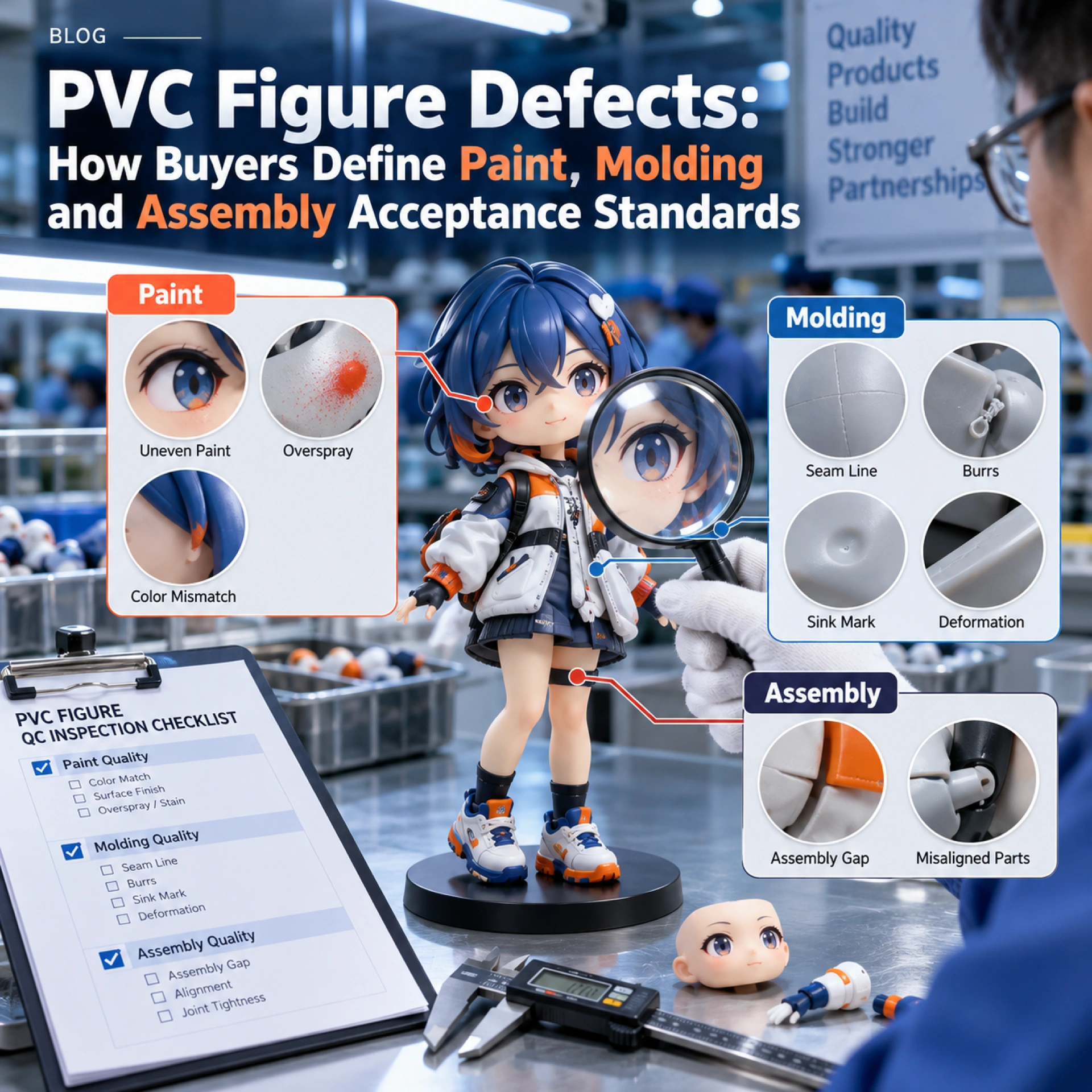
PVC Figure Defects should be evaluated against agreed acceptance standards, not an inspector’s personal opinion. Before mass production, buyers and manufacturers should establish an approved physical sample, identify critical visible areas, define acceptable paint and molding variations, specify assembly requirements, classify defects as critical, major or minor, and agree on an inspection sampling plan.
The most effective way to control PVC Figure Defects is to create a written acceptance specification covering five elements: defect type, defect location, measurable or visual acceptance limit, defect severity and inspection method.
For example, a small paint mark on the bottom of a display base may be acceptable, while the same mark across a character’s eye may be classified as a major defect. A minor seam line on a hidden surface may be unavoidable, but a sharp flash or visibly raised seam across the front of a premium collectible may be unacceptable.
The difference is not simply defect size. It is the impact on character accuracy, appearance, assembly, safety and customer expectations.
For brands, licensed IP owners, collectible companies, retailers and purchasing teams, the goal is to eliminate ambiguity before the first production batch is inspected.
This article explains how to define practical acceptance standards for painting, molding, printing, assembly and packaging, and how to turn them into a repeatable quality control process.
If your team needs a general shipment inspection checklist, read our custom PVC figure quality control checklist. This article goes further by explaining how buyers establish the standards used to accept, rework or reject PVC Figure Defects.
PVC Figure Defects: Quick Acceptance Standards Table
| Defect Category | Common Examples | What Buyers Must Define | Possible Severity |
|---|---|---|---|
| Painting | Overspray, missing paint, dirty coating | Allowable location, size, coverage and appearance | Minor / Major |
| Color | Wrong Pantone, inconsistent skin tone | Approved reference and color tolerance | Minor / Major |
| Pad Printing | Misaligned eyes, blurred logo | Position, registration and clarity | Minor / Major |
| Molding | Flash, parting lines, sink marks | Location, permitted visibility and dimensions | Minor / Major / Critical |
| Surface | Scratches, black spots, dents | Size, location, number and visibility | Minor / Major |
| Assembly | Gaps, loose accessories, glue marks | Fit, alignment, strength and appearance | Minor / Major / Critical |
| Stability | Tilting, rocking, poor base fit | Standing performance and base attachment | Major / Critical depending on risk |
| Packaging | Wrong card, damaged box, missing insert | Approved packaging and product protection | Minor / Major / Critical where safety-related |
| Safety | Sharp points, hazardous detachable parts | Applicable product safety requirements | Critical where noncompliant |
These classifications are examples. Final severity depends on the product’s intended use, age classification, approved specification and applicable safety requirements.
There is no single universal tolerance table for every collectible figure.
A 6 cm blind box character, a 15 cm licensed PVC figure and a premium 25 cm collectible can require different visual and dimensional acceptance criteria.
1. Why Buyers Must Define PVC Figure Defects Before Mass Production
One of the most common problems in custom PVC figure projects occurs after the factory has already produced hundreds or thousands of pieces.
The factory believes the products are acceptable.
The buyer finds visible painting problems and rejects them.
Both sides compare the products with the approved sample but interpret the acceptable variation differently.
The disagreement often comes from an incomplete approval process.
An approved sample establishes the desired product appearance, but it may not define every manufacturing variation that can occur during bulk production.
For example, a sample may show a perfectly painted character face. Does that mean any microscopic paint irregularity on every production unit must result in rejection?
Not necessarily.
The buyer needs to define the actual acceptance requirements.
These may include:
- Which areas require the strictest visual inspection
- Which defects are never acceptable
- Which manufacturing variations are acceptable
- How a defect is measured
- How many defects may appear on one unit
- Which defects require rework
- Which conditions require rejecting the production lot
This is especially important for licensed IP products because facial expressions, character colors, logos and distinctive costume details often have limited flexibility.
A well-prepared defect specification protects both the buyer and the factory.
The buyer receives a defined quality level, while the manufacturer knows the standards it must achieve.
Our custom PVC figure sample approval checklist explains how brands approve shape, color, materials, painting, assembly and packaging before production. Defect acceptance standards should become part of that approval package.
2. Divide the Figure Into Visual Inspection Zones
One of the most effective methods for classifying PVC Figure Defects is to divide the product into inspection zones.
Not every surface has the same visual importance.
A character’s face, logo or front clothing panel normally deserves stricter appearance control than the underside of a base.
Zone A: Critical Appearance Areas
Zone A may include:
- Eyes
- Mouth
- Nose
- Front facial area
- Character logo
- Main display-facing surfaces
- Important licensed IP details
These areas receive the highest visual attention.
For a premium collectible, even a small eye-printing offset may alter the expression.
A paint defect in Zone A may therefore be classified as major even when its physical size is relatively small.
Zone B: Secondary Visible Areas
Zone B may include:
- Back of the head
- Side surfaces
- Rear clothing
- Less prominent accessories
- Secondary decoration areas
Minor variation may be acceptable when it does not affect overall character appearance or exceed agreed limits.
Zone C: Hidden or Low-Visibility Areas
Zone C may include:
- Bottom of a display base
- Internal joining surfaces
- Concealed assembly areas
- Hidden surfaces after final assembly
Buyers may allow greater cosmetic variation in these areas, but structural and safety requirements remain unchanged.
A sharp projection or weak joint does not become acceptable simply because it is hidden.
Example: Location-Based Acceptance Matrix
| Defect | Zone A | Zone B | Zone C |
|---|---|---|---|
| Paint overflow | Strict appearance standard | Limited variation if approved | Cosmetic variation may be allowed |
| Scratch | Usually unacceptable when visible | Evaluate size and visibility | May be acceptable if function is unaffected |
| Mold seam | Highly restricted | Controlled visibility | May be acceptable within agreed limits |
| Glue mark | Usually unacceptable when visible | Limited variation if approved | May be acceptable if bonding is unaffected |
| Color mismatch | Strict character accuracy | Must remain visually consistent | Depends on visibility and specification |
| Sharp flash | Not acceptable where it creates a hazard | Same safety requirement | Same safety requirement |
The final decision should be documented in a project-specific defect standard.
This approach makes PVC Figure Defects easier to evaluate consistently across inspectors, production lines and reorders.
3. Define Paint Acceptance Standards for PVC Figures
Painting is one of the most frequent sources of cosmetic PVC Figure Defects.
A figure may have accurate geometry and well-designed tooling but still be rejected because of painting inconsistencies.
Common painting defects include paint overflow, missing paint, uneven spraying, rough texture, contamination, coating marks, peeling and inconsistent gloss.
For buyers, simply writing “good painting quality required” is not sufficient.
The factory needs clear acceptance criteria.
Paint Overflow
Paint overflow happens when a color extends beyond its intended boundary.
Common areas include:
- Hairline
- Eyes
- Mouth
- Clothing edges
- Shoes
- Gloves
- Accessories
- Logos
Before production, buyers should agree on which boundaries require the highest accuracy and how any permissible variation will be judged.
For example, a small overflow on a hidden clothing fold might receive a different classification from paint crossing an eye outline.
Where practical, the buyer may define an allowable maximum boundary deviation in millimeters. That value must be established from actual product geometry and production trials rather than copied from an unrelated factory standard.
Missing Paint
Missing paint can occur when:
- The spray angle does not reach a recessed area
- Masking covers the wrong region
- The paint application is inconsistent
- A detail is missed during hand painting
- Surface contamination affects coating coverage
The buyer should identify whether full coverage is required in the affected region.
Missing paint on a front display area may be a major defect.
A small uncovered area inside a fully hidden joint may be treated differently, provided the approved specification allows it.
Dust, Black Spots and Surface Contamination
Dust particles, black spots and paint contamination can reduce the appearance quality of collectible figures.
For inspection purposes, the buyer should define:
- Maximum acceptable defect size
- Maximum number of spots per unit
- Permitted locations
- Whether a defect must be visible under normal inspection conditions
- Whether the defect can be reworked without damaging the finish
A useful defect record might identify a black dot by location, measured diameter and severity.
This is more objective than writing “too dirty” in the QC report.
Paint Adhesion and Peeling
A figure can look acceptable immediately after painting but develop peeling or flaking during handling.
The manufacturer should evaluate coating adhesion and durability where relevant.
One recognized reference is ASTM D3359 coating adhesion testing, which describes tape-based methods for evaluating adhesion of coating films.
However, ASTM D3359 was developed primarily for coatings on metallic substrates. It also identifies limitations when applied to non-metallic materials such as plastics.
Buyers should not automatically apply ASTM D3359 to every soft PVC figure without confirming method suitability. The appropriate adhesion or durability test should be agreed with the laboratory or coating specialist based on the actual substrate, surface geometry and finish.
For many custom figures, a suitable project-specific rub, handling or coating durability test may provide useful additional information.
4. Color Variation: How Much Difference Is Acceptable?
Color mismatch is another major category of PVC Figure Defects.
Licensed characters often have precisely defined brand colors.
Examples include:
- Skin tone
- Hair color
- Costume color
- Character accessories
- Logo color
- Special edition finishes
The buyer should distinguish between wrong color and acceptable manufacturing variation.
Pantone Is a Reference, Not the Complete Acceptance Standard
A Pantone reference helps designers and factories communicate the intended color.
The official Pantone Color Systems explain how standardized color references support manufacturing and design communication across materials and finishes.
However, a painted PVC surface can look different from a printed Pantone chip because of:
- Substrate material
- Paint formulation
- Texture
- Surface gloss
- Lighting
- Coating thickness
Therefore, the approved physical production sample should normally be the main visual reference, supported by the agreed color specifications.
Our color matching custom PVC figures guide explains how Pantone references, physical painted samples and mass-production color control work together.
Define the Inspection Method
The buyer and factory should confirm whether color is inspected through:
- Visual comparison under controlled lighting
- Approved painted reference samples
- Instrument-based color measurements where suitable
- Agreed color-difference tolerances
For products requiring instrumental color control, tolerances should be defined for the particular material, finish and measurement setup.
A universal numerical color difference should not be applied blindly across matte paint, metallic coatings, transparent parts and molded plastic.
Example Color Decision
A minor variation in a large clothing color area may be acceptable if it remains within the approved range.
However, a clearly incorrect character skin tone may be a major defect because it affects the recognizable IP identity.
This shows why color acceptance should consider both technical variation and brand-critical appearance.
5. Pad Printing and Facial Detail Acceptance Standards
Facial printing is one of the most sensitive areas in PVC Figure Defects inspection.
Small differences in the position or shape of the eyes can change a character’s expression.
Pad printing defects may include:
- Eye misalignment
- Uneven eye highlights
- Blurred edges
- Double printing
- Broken lines
- Missing details
- Color registration errors
- Crooked logo printing
Why Facial Printing Needs Stricter Control
Consider an anime-style character with two large eyes.
If one eye is printed slightly higher or farther to the side than intended, the figure may look asymmetrical.
The same amount of positional variation on a small rear clothing symbol may be less noticeable.
For this reason, buyers should use location-based standards rather than only a general printing tolerance.
What Should Be Specified?
The approval standard should identify:
| Item | Required Acceptance Information |
|---|---|
| Eye position | Approved alignment and permitted offset |
| Eye size | Approved dimensions and shape |
| Eye highlights | Presence, position and clarity |
| Mouth | Shape, location and complete printing |
| Eyebrows | Symmetry and approved expression |
| Character logo | Correct size, color, clarity and placement |
| Multi-color printing | Registration and overlap limits |
Where measurable tolerances are used, the method of measurement should also be documented.
For particularly detailed licensed collectibles, the factory may need improved fixtures, printing plates or inspection magnification to achieve consistent results.
However, magnification used for process investigation should not automatically become the cosmetic acceptance method unless the buyer and factory have agreed on it.
6. Molding Defects: Flash, Parting Lines, Sink Marks and Deformation
Molding defects originate from tooling, material behavior or molding conditions.
Common PVC Figure Defects in this category include:
- Flash
- Raised parting lines
- Sink marks
- Short shots
- Deformation
- Surface dents
- Poor detail reproduction
- Uneven part dimensions
- Gate vestiges
- Surface texture inconsistency
The factory should identify whether the defect is caused by the mold itself or by production process conditions.
Flash
Flash is excess material formed where mold surfaces meet or where material escapes from the intended cavity.
A small amount may be removable during trimming.
However, sharp or excessive flash may affect:
- Appearance
- Touch
- Assembly
- Product safety
Buyers should define permitted flash or trimming marks according to location and product requirements.
For children’s toys, sharp edges and points should be evaluated against applicable safety requirements. The official CPSC Toy Safety Guidance provides information about U.S. toy safety obligations, which are separate from ordinary cosmetic acceptance criteria.
Mold Parting Lines
Parting lines are often a normal result of the mold design.
The goal is not necessarily to eliminate every visible line. It is to control where the lines appear and how noticeable they are.
For example:
A seam hidden beneath a character’s hair may be acceptable.
A raised line across the face of a premium collectible may be unacceptable.
The buyer should approve the planned parting-line positions during mold engineering whenever appearance is critical.
Sink Marks
Sink marks are local depressions that can occur as plastic cools and shrinks.
They may be more noticeable on:
- Large smooth heads
- Rounded bodies
- Wide clothing panels
- Glossy surfaces
The manufacturer may need to adjust wall thickness, internal structure, tooling or processing conditions.
A painted surface should not be used to hide a significant dimensional problem without evaluating its root cause.
Short Shots and Missing Details
A short shot occurs when a mold cavity is not completely filled.
This may create:
- Missing fingertips
- Incomplete hair details
- Weak accessory connections
- Incomplete molded features
The severity depends on whether the missing material affects appearance, fit or safety.
A missing critical connection feature can require rejecting the part even if the rest of the figure looks acceptable.
For more background on tooling and molding, read our article on how PVC toys are manufactured.
7. Assembly Defects: Gaps, Loose Parts, Glue Marks and Stability
Assembly quality is another important acceptance area.
A PVC figure may consist of multiple molded and painted components, including:
- Head
- Body
- Arms
- Hair parts
- Accessories
- Base
- Decorative features
Even if every individual molded part meets its specification, the final figure may still have assembly problems.
Assembly Gaps
Gaps may occur because of:
- Dimensional variation
- Warped parts
- Poor joint design
- Incorrect assembly
- Excessive paint thickness on mating surfaces
The buyer should define where gaps are visible and what gap width is acceptable.
A gap beneath a hidden hair section may be treated differently from a visible separation across the character’s neck.
For critical joining surfaces, dimensional measurements may be useful.
Loose Accessories
Accessories should remain attached according to the approved design and performance requirements.
Relevant checks may include:
- Correct accessory installation
- Fitting tightness
- Bond integrity
- Rotation or movement
- Pull resistance where applicable
- Resistance to detachment during expected handling
The factory should not use one universal pull-force value for every PVC figure accessory.
A small decorative part, removable collectible accessory and safety-critical attachment may require different testing methods and acceptance criteria.
For products classified as toys, the applicable mechanical safety requirements also need to be evaluated independently of general assembly QC.
Visible Glue Marks
Glue can create cosmetic defects when it spreads beyond the intended joint.
Buyers should define:
- Whether visible glue is permitted
- Which surfaces are affected
- Maximum acceptable visible area, where appropriate
- Whether discoloration or whitening is acceptable
- Whether rework damages the finish
Clear adhesive residue on the underside may have a different severity from white glue marks around the character’s face.
Display Base Stability
A collectible figure should stand or attach to its intended display base as specified.
Inspection may include:
- Standing on the approved reference surface
- Correct foot peg fit
- No unintended rocking
- No significant leaning
- No loose base components
- No visible distortion
A figure that cannot remain in its intended display position may be classified as a major defect.
If instability creates a safety hazard for the intended product, additional safety requirements may apply.
8. Define Critical, Major and Minor PVC Figure Defects
A useful PVC Figure Defects standard should classify defects before final inspection.
Three categories are commonly used.
Critical Defects
Critical defects are conditions that create unacceptable safety or regulatory risks.
Examples may include:
- Prohibited hazardous small parts in applicable children’s toys
- Dangerous sharp edges
- Serious safety-related structural failures
- Other noncompliance with mandatory product requirements
Critical conditions should be addressed through the applicable safety and compliance requirements, not treated as ordinary cosmetic variation.
Major Defects
Major defects can affect the product’s appearance, function or customer acceptance.
Examples include:
- Obviously misprinted eyes
- Incorrect character color
- Large paint overflow on the face
- Missing accessory
- Significant assembly gap
- Unstable display base
- Excessive visible mold seam
- Peeling paint in a prominent area
A major defect does not always create a safety hazard, but it may make the product unacceptable for retail sale.
Minor Defects
Minor defects are limited imperfections that do not significantly affect function or overall appearance and fall within the buyer’s agreed tolerances.
Examples may include:
- Small approved trimming mark on a hidden surface
- Minor cosmetic mark beneath the base
- Limited variation in a secondary painted area
- Slight noncritical surface variation
The severity must be based on agreed project specifications.
Example Defect Severity Matrix
| Defect | Example Location | Possible Classification | Explanation |
|---|---|---|---|
| Eye-printing offset | Face | Major | Changes character expression |
| Small paint dot | Hidden underside | Minor if within specification | Low visual impact |
| Missing arm | Main body | Major; potentially critical if hazardous | Incomplete product |
| Sharp flash | Accessible edge | Critical if it creates a prohibited hazard | Safety concern |
| Visible glue | Front face | Major | Damages character appearance |
| Small approved seam | Back surface | Minor | Controlled manufacturing variation |
| Loose detachable component | Children’s toy | Safety assessment required | May create mechanical or small-parts hazard |
| Unstable base | Display figure | Major | Product cannot display correctly |
The buyer should approve this matrix with the manufacturer before full production.
9. Set Objective Inspection Conditions
Even an accurate defect table can produce inconsistent results if inspectors use different viewing conditions.
One inspector may inspect a figure under bright lighting at close range.
Another may view the same figure from a normal display distance.
They may reach different conclusions.
Therefore, PVC Figure Defects inspection should use a documented method.
Important Inspection Conditions
Buyers should confirm:
- Lighting type
- Illumination level
- Viewing distance
- Viewing angle
- Inspection time
- Whether the figure is removed from packaging
- Which faces of the product are inspected
- When magnification may be used
- Measurement tools for dimensional defects
For example, a buyer and factory could agree to conduct routine visual inspection under controlled neutral lighting at an agreed viewing distance, with additional close-up checks for eyes and other critical details.
These conditions should be established from actual samples and the product’s quality expectations.
They should not be described as universal industry requirements.
Why Inspection Distance Matters
A tiny surface mark may be visible under magnification but invisible during normal product display.
For premium licensed collectibles, the buyer may reasonably request stricter inspection.
For standard promotional products, a different cosmetic acceptance level may be commercially appropriate.
The important point is that the agreed quality level is defined in advance.
Our Premium Collectible Figure Manufacturing article explains why adult collectors place particular importance on facial accuracy, surface finish, mold lines and display presentation.
10. Approved Samples and Defect Limit Samples
An approved physical sample is important, but one ideal sample cannot demonstrate every allowable defect.
A more complete inspection system may use two types of references.
Golden Sample
The golden sample represents the approved product specification.
It shows:
- Final character geometry
- Color
- Painting
- Surface finish
- Facial printing
- Assembly
- Accessories
- Base
- Overall appearance
The buyer and factory should identify the approved version and retain it for comparison.
Defect Limit Samples
Defect limit samples demonstrate the maximum acceptable variation for specific conditions.
For example:
A sample may show an approved minor mold line on a rear surface.
Another may show the largest acceptable cosmetic paint mark in a secondary visible area.
A rejected sample may demonstrate unacceptable eye misalignment.
This creates a practical visual boundary between acceptable and unacceptable production quality.
Example Acceptance Record
| Item | Example Specification Field |
|---|---|
| Product | 100 mm custom PVC character figure |
| Location | Rear clothing panel |
| Defect Type | Paint boundary deviation |
| Acceptance Limit | Buyer-approved physical limit sample and agreed measurable boundary |
| Inspection Method | Visual inspection under agreed conditions |
| Severity | Minor within limit; Major when exceeded |
| Reference | Golden sample version and defect photo |
| Approval | Brand representative and factory QC |
The exact numerical limits, where used, should be filled in only after the project team has reviewed real production samples.
A photographic defect catalog with clear OK and NG examples can make mass-production inspection much more consistent.
11. How AQL Sampling Works With PVC Figure Defects
After defining defect types and severity, the buyer needs a sampling plan for production lot acceptance.
AQL stands for Acceptance Quality Limit.
It is widely used in attribute-based acceptance sampling.
Official references include ASQ acceptance sampling guidance and ISO 2859-1:2026 sampling procedures.
These methods provide rules for selecting samples and determining acceptance or rejection criteria under a specified plan.
However, AQL does not define whether a paint defect is major or minor.
That classification must come from the buyer’s accepted defect standard.
Example: AQL Inspection Plan
A buyer might specify:
| Inspection Item | Illustrative Buyer Selection |
|---|---|
| Standard | ISO 2859-1 or ANSI/ASQ Z1.4, specified edition |
| Inspection | General Inspection Level II |
| Critical Defects | Zero observed in the sample; safety requirements addressed separately |
| Major Defects | AQL 2.5 |
| Minor Defects | AQL 4.0 |
These values illustrate one possible commercial inspection agreement. They are not mandatory universal limits for PVC figures.
The actual sample size and acceptance/rejection numbers must be derived from the selected standard, lot size, inspection level, defect category and applicable inspection rules.
AQL 2.5 does not mean that exactly 2.5% defective products are automatically accepted in any individual shipment.
It is part of a statistical sampling system.
How Should Multiple Defects on One Figure Be Counted?
A buyer should also define the counting rule.
For example, one figure may contain:
- One paint overflow
- One black spot
- One assembly gap
Will that unit be recorded as one defective item based on its highest severity, or will individual defects be counted separately?
The answer depends on the chosen inspection method and agreement.
The counting rule must be consistent with the selected sampling plan.
Without this clarification, different inspectors may produce different defect totals from the same production batch.
12. When Should a Defect Be Accepted, Reworked or Rejected?
A practical PVC Figure Defects specification should define what happens after inspection.
Not every defect requires scrapping a finished figure.
Some may be corrected through approved rework.
Others require replacing a part or rejecting the product.
Accept
A product may be accepted when:
- It matches the approved specification
- Any cosmetic variations remain within agreed limits
- Assembly and function meet requirements
- There is no applicable safety noncompliance
Rework
Rework may be appropriate when an approved process can correct a defect without damaging the product or compromising compliance.
Examples may include:
- Correcting certain paint defects
- Cleaning surface contamination
- Replacing an incorrectly installed accessory
- Correcting certain packaging errors
Rework should be validated before full-batch application.
Repeated paint touch-ups may create uneven gloss, coating buildup or visible repair marks.
Reject or Replace
A part or figure may require rejection or replacement when:
- The character geometry is incorrect
- A major structural defect cannot be repaired reliably
- Painting cannot be restored to the approved finish
- Assembly strength remains inadequate
- A safety-related defect is present
- The product cannot meet the agreed specification
Lot Acceptance vs Individual Product Acceptance
These decisions should be separated.
An individual defective figure may need rework.
An entire production lot may require additional sorting, corrective action or rejection if the agreed sampling plan fails.
The buyer and factory should identify both types of decision in the quality agreement.
13. Root Cause Analysis: Why the Same PVC Figure Defect Keeps Appearing
Correcting one visibly defective figure does not necessarily correct the production process.
If the same issue appears repeatedly, the manufacturer should investigate the cause.
Example: Repeated Eye Misalignment
Possible causes include:
- Incorrect printing fixture
- Unstable positioning
- Printing plate error
- Part dimensional variation
- Setup drift
- Inadequate in-process inspection
The corrective action may involve revising the fixture or printing process rather than simply reworking the finished figures.
Example: Recurring Paint Overflow
Potential causes include:
- Incorrect masking
- Worn fixtures
- Inconsistent spray positioning
- Inappropriate painting sequence
- Paint viscosity variation
Example: Large Assembly Gaps
Potential causes include:
- Molding deformation
- Incorrect part dimensions
- Excess paint on joining surfaces
- Improper assembly force
- Joint design problems
The quality team should record the defect, isolate affected production where necessary, identify the cause and verify whether the corrective action works.
This is especially important for repeat orders.
A recurring defect that is ignored during the first production run may become a much larger problem when the brand reorders the product.
14. Packaging Can Create New Defects After Production
Some PVC Figure Defects do not originate during molding or painting.
They appear after the finished figure is packed.
For example, a painted accessory may rub against the inner tray during shipment.
A loose metal component may scratch the figure.
An oversized product may be forced into packaging that applies pressure to fragile parts.
Therefore, packaging design should be reviewed together with finished-product quality.
Buyers should confirm:
- Tray fit
- Accessory separation
- Product orientation
- Surface contact points
- Movement during transport
- Protection of raised painted details
- Correct labels and inserts
A packaging system can meet its visual design requirements while still providing insufficient protection.
For packaging component specifications, review our Packaging Bill of Materials for Toys article.
For blind box collections, the manufacturer also needs to control character/card matching, secret versions and assortment accuracy.
Our blind box figure manufacturing process guide explains how packaging and final production control interact.
15. Buyer Checklist: What to Agree With the Factory Before Mass Production
A complete PVC Figure Defects agreement should include the following items.
| Buyer Requirement | What Must Be Confirmed |
|---|---|
| Approved Golden Sample | Correct physical sample and revision |
| Visual Zones | Zone A, B and C locations |
| Paint Acceptance | Overflow, missing paint, marks and coating finish |
| Color Acceptance | Physical reference and allowable variation |
| Facial Printing | Alignment, clarity and expression |
| Mold Quality | Flash, parting lines, sink marks and deformation |
| Surface Defects | Scratches, dust, dents and contamination |
| Assembly | Gap limits, fitting and attachment requirements |
| Base Stability | Standing and base assembly requirements |
| Accessories | Presence, position and strength |
| Inspection Conditions | Lighting, distance, angle and measurement method |
| Defect Classification | Critical, major and minor definitions |
| Defect Limit Samples | Approved acceptable/unacceptable examples |
| AQL | Standard, edition, level and acceptance criteria |
| Counting Method | Defects versus defective units |
| Rework | Approved methods and reinspection |
| Packaging | Tray protection, artwork, labels and contents |
| Safety | Applicable testing and compliance requirements |
| Change Control | Approval needed for materials or process changes |
| QC Reporting | Photos, quantities, defect codes and disposition |
This checklist should be completed before the factory begins full production.
A written agreement is especially valuable when manufacturing licensed IP collectibles because the same project may involve a brand owner, licensee, sourcing agent, factory and third-party inspection company.
All parties need to work from the same acceptance standard.
16. How Jiahong Creative Helps Buyers Control PVC Figure Defects
Jiahong Creative supports custom PVC figure and collectible production through artwork review, 3D modeling, mold development, injection molding, painting, pad printing, assembly, packaging and quality inspection.
For PVC Figure Defects control, our manufacturing workflow can support buyers in establishing clear production requirements for:
- Character appearance
- Physical samples
- Paint boundaries
- Color consistency
- Facial printing
- Mold seams
- Surface finish
- Assembly quality
- Accessory attachment
- Display base stability
- Packaging protection
Before mass production, buyers can discuss approved samples, defect categories, inspection requirements and product-specific acceptance criteria with our team.
For example, a premium licensed collectible may require particularly strict facial and visible-surface standards, while a simpler promotional figure may use a different agreed cosmetic acceptance level.
The important point is to establish those expectations before bulk production—not after shipment inspection.
Our collectible figure manufacturer China guide explains how artwork, tooling, painting, assembly and quality management fit together in custom figure sourcing.
Request a Custom PVC Figure Manufacturing Evaluation
If your brand is developing a new PVC character figure, blind box series, game character collectible or mascot product, you can share:
- Character artwork or 3D files
- Target dimensions
- Materials
- Number of designs
- Color references
- Surface finish requirements
- Target quantity
- Packaging concept
- Intended market
- Expected quality level
- Desired inspection method
These details help the engineering and production teams evaluate manufacturability, sample requirements and quality expectations.
Contact Jiahong Creative for Custom PVC Figure Manufacturing.
Final Thoughts
PVC Figure Defects cannot be controlled effectively when buyers and factories rely only on subjective descriptions such as “good quality,” “clean painting” or “acceptable appearance.”
A reliable acceptance system should clearly define:
Where the defect appears, what type of defect it is, how much variation is permitted, how it will be inspected and what happens if it exceeds the limit.
Paint overflow on a hidden surface should not automatically receive the same classification as a paint defect across the character’s eye.
A normal mold parting line should not automatically be treated as a manufacturing failure.
A dangerous sharp projection should never be accepted simply because it is difficult to see.
A small assembly gap may be acceptable within the approved structure, while a loose accessory or unstable base may require corrective action.
For buyers, the best approach combines a golden sample, inspection zones, documented acceptance limits, defect classification, suitable sampling procedures and clear rework rules.
When these requirements are agreed before production, PVC Figure Defects become easier to identify, measure, report and resolve.
The goal is not to promise that every manufactured figure will be visually identical under magnification. The goal is to produce consistent, safe and commercially acceptable figures against a clearly agreed standard.
FAQ
1. What are the most common PVC Figure Defects?
Common PVC Figure Defects include paint overflow, missing paint, color mismatch, misaligned eye printing, mold flash, visible parting lines, sink marks, scratches, glue marks, assembly gaps, loose accessories and unstable display bases.
2. How should buyers define PVC Figure Defects acceptance standards?
Buyers should define defect types, inspection zones, acceptable limits, inspection methods and severity classifications. An approved physical sample and photographic defect examples should support the written standard.
3. Are there universal paint defect tolerances for PVC figures?
No. There is no single paint overflow or defect-size tolerance suitable for every custom PVC figure. Buyers should agree on project-specific limits based on product dimensions, character details, inspection locations and quality expectations.
4. Are mold lines considered defects in PVC figures?
Mold parting lines can be a normal result of injection molding. They become unacceptable when their location, height, visibility or finish exceeds the approved standard or when they create a mechanical or safety problem.
5. Why are facial printing defects often classified as major?
Facial details determine the character’s expression and identity. Even a relatively small printing offset on the eyes or mouth can noticeably change the appearance, especially for licensed IP collectibles.
6. What is the difference between major and minor PVC Figure Defects?
Major defects significantly affect appearance, function or customer acceptance. Minor defects are limited variations that remain within the agreed tolerance and do not significantly affect product quality or use.