

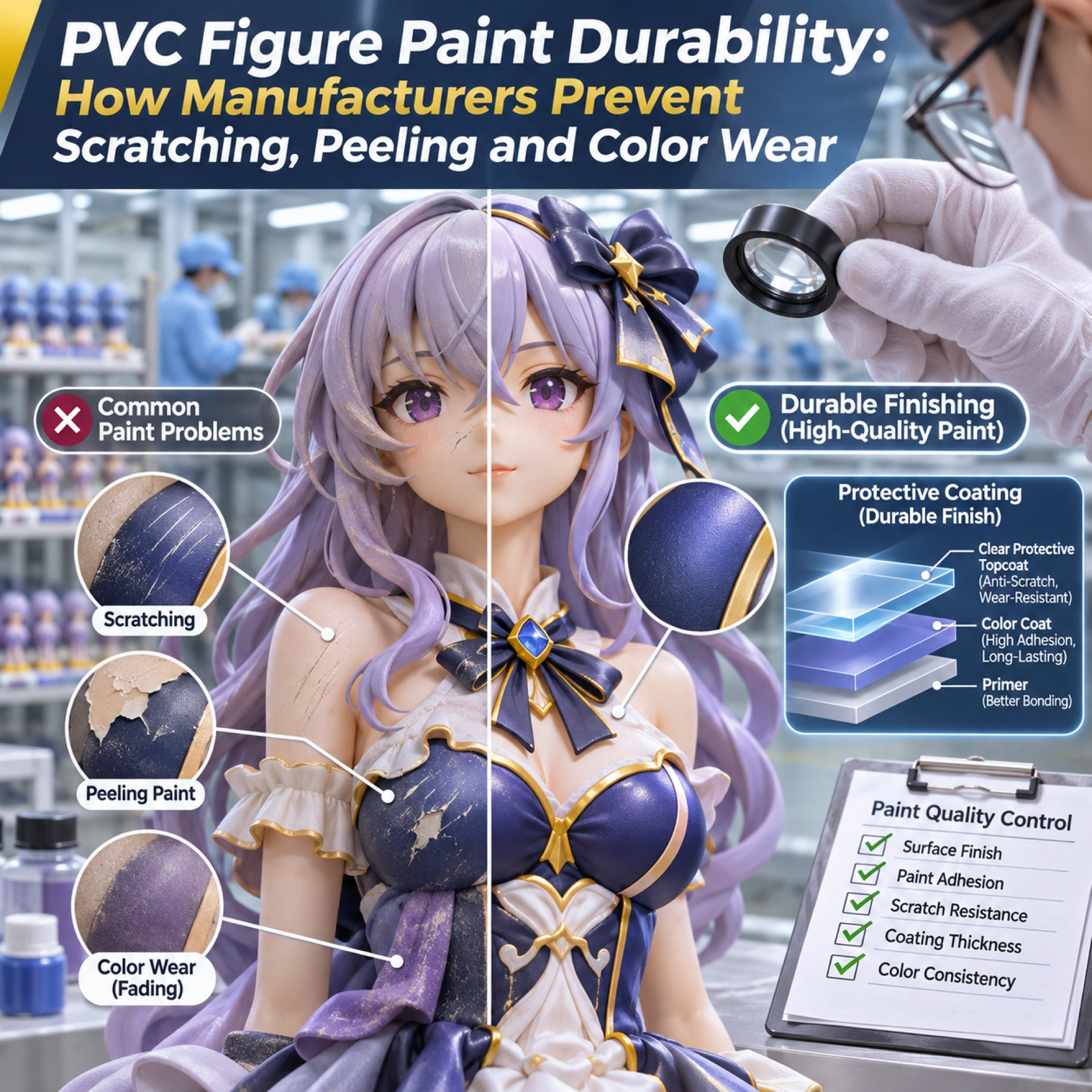
PVC Figure Paint Durability depends on five key factors: proper surface preparation, compatible paint formulations, controlled application and curing, appropriate durability testing, and protective packaging. To prevent scratching, peeling and color wear, manufacturers must evaluate the relationship between the PVC substrate and its coating rather than relying only on the finished figure’s appearance.
A painted PVC figure can look excellent during sample approval but develop scratches, peeling, sticky surfaces or faded details after handling, assembly or transportation. These problems may result from surface contamination, incompatible paint systems, inadequate curing, mechanical friction or poorly designed packaging.
For OEM buyers, licensed IP owners and collectible brands, the most effective way to improve PVC Figure Paint Durability is to define durability requirements before mass production. The manufacturer should confirm the PVC material, paint supplier, coating system, application process, curing conditions and testing methods during prototype development.
Good paint adhesion does not automatically mean good abrasion resistance, and a scratch-resistant coating does not necessarily have strong adhesion to PVC. Both properties must be evaluated separately.
This distinction is especially important for custom PVC figures, blind box toys, character keychains and collectible bag charms, where surface decoration directly affects product appearance and customer satisfaction.
This guide explains how manufacturers control PVC Figure Paint Durability through material selection, spray painting, pad printing, hand painting, coating verification, rub tests, production quality control and packaging engineering.
For an overview of the decoration processes themselves, read our PVC figure painting methods guide, which compares spray painting, pad printing, screen printing, hand painting and different finishing techniques.
PVC Figure Paint Durability: Common Problems and Manufacturing Solutions
| Paint Problem | Possible Cause | Manufacturing Control |
|---|---|---|
| Paint peeling | Poor adhesion or incompatible coating | Surface preparation and paint compatibility evaluation |
| Paint scratching | Contact with hard objects or packaging | Abrasion testing and protective packaging |
| Color rubbing off | Weak coating or insufficient cure | Rub testing and curing control |
| Sticky painted surface | Material interaction or incomplete curing | PVC formulation and coating compatibility review |
| Paint cracking | Coating cannot tolerate substrate deformation | Flexible coating selection and deformation testing |
| Faded color | Pigment or coating instability | Color durability evaluation |
| Paint transfer | Coating rubbing against other materials | Contact testing with representative materials |
| Metallic finish wear | High friction or unsuitable finish system | Coating evaluation and protection of contact areas |
| Shipping scratches | Tray movement or accessory contact | Packaging fit and transport simulation |
These failure modes require different corrective actions.
Applying an additional clear coat may improve certain surface properties, but it will not automatically solve poor adhesion, substrate contamination or plasticizer migration.
A reliable PVC Figure Paint Durability program begins by identifying the actual cause of the problem.
1. Why Is PVC Figure Paint Durability Important for Collectible Manufacturing?
Painting is one of the most visible indicators of collectible figure quality.
A custom PVC figure may have accurate sculpting, well-designed tooling and properly assembled components, but its commercial value can still be affected by damaged paint.
Common customer complaints include:
- Paint peeling from hair or clothing
- Scratches on the face or body
- Eye printing wearing away
- Paint transfer onto packaging
- Metallic coatings losing their finish
- Sticky or softened painted surfaces
- Paint damage around moving or contacting parts
These issues can occur at different stages of the product’s life.
During Production
Paint may be damaged by handling, fixtures, insufficient curing or assembly contact.
During Packaging
The painted surface may rub against a plastic tray, inner bag or another component.
During Transportation
Repeated vibration can cause the figure to move inside the package, creating scratches.
During Consumer Use
Handling, cleaning and contact with other objects can gradually wear the coating.
For PVC Figure Paint Durability, manufacturers must consider the product’s complete lifecycle rather than evaluating only the freshly painted sample.
Different Products Need Different Durability Standards
A premium 15 cm display figure and a 5 cm PVC bag charm should not automatically use the same durability acceptance criteria.
A display collectible may remain on a shelf with relatively limited contact.
A bag charm may experience repeated rubbing against fabric, metal hardware and other accessories.
Therefore, the expected use determines how much mechanical resistance the coating requires.
Our Collectible Bag Charm Manufacturer guide explains why portable character accessories need additional consideration for attachment strength, weight, metal hardware and surface abrasion.
2. Surface Preparation: The Foundation of PVC Figure Paint Durability
Surface preparation is one of the most important steps in achieving reliable paint adhesion.
Before painting, molded PVC components should be evaluated for contamination and surface conditions that could interfere with the coating.
Possible contaminants include:
- Mold-release residues
- Dust
- Oil
- Fingerprints
- Processing residues
- Surface contaminants from handling
- Migrated ingredients from certain PVC formulations
If the coating is applied over a contaminated surface, it may initially appear normal but later separate from the plastic.
Mold-Release Residues
Some molding processes use release agents to help remove parts from molds.
Residues remaining on the surface can interfere with coating adhesion.
Manufacturers should evaluate whether the selected molding process and release-agent system are compatible with subsequent painting.
Where cleaning is necessary, the method must be suitable for the PVC formulation.
Cleaning Before Painting
A controlled cleaning process may involve:
- Removing visible dust
- Using approved cleaning agents
- Avoiding oil contamination
- Allowing surfaces to dry
- Handling parts with suitable gloves or fixtures
- Keeping prepared components in clean storage conditions
However, cleaning chemicals should not be selected casually.
An unsuitable solvent may soften PVC, damage the surface or create new coating problems.
The manufacturer should validate the cleaning method with the actual PVC material and coating system.
Surface Treatment and Adhesion Promoters
Some PVC formulations or finishes may require additional surface preparation or an adhesion-promoting layer.
Possible technical approaches include selected primers or surface treatments, where appropriate.
The choice should be based on supplier recommendations and prototype testing.
Not every PVC figure needs the same preparation process.
For PVC Figure Paint Durability, the important requirement is a stable and repeatable surface condition before painting begins.
3. PVC Material and Paint Compatibility: Why Some Figures Peel After Production
A major cause of coating problems is poor compatibility between the PVC material and paint system.
PVC is not one identical material used in every figure.
Different formulations can vary in:
- Flexibility
- Hardness
- Additives
- Plasticizer content
- Surface behavior
- Processing conditions
These differences can affect how a coating bonds to the substrate and performs over time.
Soft PVC vs Rigid Components
A coating applied to a relatively rigid plastic component may behave differently when applied to a flexible PVC part.
When soft PVC bends or deforms, the coating may experience additional strain.
If the coating is too brittle for the substrate, it may crack or separate.
If the paint formulation is incompatible with the substrate, the surface may become sticky, discolored or poorly bonded.
This is why PVC Figure Paint Durability should be evaluated using the actual production material rather than a visually similar substitute.
Plasticizer Migration
Certain flexible PVC formulations contain plasticizers.
Over time, plasticizers can migrate within the material and potentially interact with adjacent coatings or contacting surfaces.
Depending on the formulation and conditions, this may contribute to:
- Reduced coating adhesion
- Surface tackiness
- Softened coating
- Discoloration
- Changes in surface appearance
Research into plasticizer migration from PVC materials discusses the relationship between plasticizer movement and coating performance.
The practical lesson is that a coating that performs well immediately after application may still need additional evaluation after storage, heat exposure or contact with other materials.
Paint Compatibility Checklist
Before approving a paint system, buyers should ask:
- Is the coating designed for the selected PVC formulation?
- Does the PVC contain ingredients that could affect adhesion?
- Is a primer or other surface treatment required?
- Does the coating tolerate expected component flexibility?
- Is the curing process compatible with the substrate?
- Will the surface remain stable during storage?
- Can the same coating system be repeated in mass production?
A manufacturer should verify these factors through actual samples.
PVC Figure Paint Durability begins with material compatibility, not with adding more paint.
4. Spray Painting: How Application Conditions Affect Durability
Spray painting is widely used for custom PVC figures because it can produce uniform coverage, gradients, shading and multiple color effects.
However, coating durability depends on the application process as well as the paint formulation.
Important production variables include:
- Paint viscosity
- Application method
- Spray distance
- Spray angle
- Coating thickness
- Number of layers
- Flash-off time between layers
- Drying and curing conditions
- Environmental conditions
Why Paint Thickness Matters
A coating that is too thin may provide inadequate coverage or wear resistance.
A coating that is excessively thick may create:
- Poor detail reproduction
- Runs and sagging
- Uneven appearance
- Longer curing requirements
- Increased stress in the coating
- Problems around assembly joints
More paint does not automatically mean greater durability.
The appropriate film build depends on the paint supplier’s specifications and the product’s requirements.
Multiple Color Layers
Character figures often require several coating steps.
For example:
PVC Substrate → Base Color → Masked Color Areas → Decorative Details → Optional Clear Finish
Each layer introduces another interface.
If one layer does not bond properly to the layer beneath it, peeling may occur within the coating system rather than directly at the PVC surface.
This is why manufacturers should evaluate the complete paint system instead of testing only the final clear coat.
Spray Painting Quality Control
During production, relevant controls may include:
- Approved paint batch
- Approved paint preparation
- Spray equipment settings
- Coating appearance
- Color matching
- Drying or curing conditions
- In-process inspections
These controls support PVC Figure Paint Durability by helping production batches remain consistent with the approved sample.
5. Pad Printing and Hand Painting: Preventing Wear on Small Character Details
Many collectible figures combine spray painting with pad printing and hand painting.
These methods serve different purposes.
Pad Printing
Pad printing is commonly used for:
- Eyes
- Eyebrows
- Mouths
- Small logos
- Costume symbols
- Fine decorative patterns
Facial printing requires particularly careful durability control because even a small area of missing ink can change the character’s expression.
For example, a figure may have excellent spray-painted hair and clothing but develop worn eye details after handling.
In this case, the problem may involve printing ink compatibility, surface preparation, curing or contact with another component.
Hand Painting
Hand painting may be used for:
- Small decorative details
- Premium effects
- Complex edges
- Sample refinement
- Selected touch-up work
Hand-painted features can require additional consistency control because application thickness and coverage may vary.
A manual touch-up should not automatically be treated as equivalent to the original production coating.
The repaired area must still meet the approved appearance and durability requirements.
How to Improve Printing and Detail Durability
Manufacturers should review:
| Process | Durability Risk | Recommended Control |
|---|---|---|
| Spray painting | Weak adhesion or uneven film | Compatible paint and controlled application |
| Pad printing | Ink wear or detachment | Suitable ink and curing conditions |
| Hand painting | Inconsistent film thickness | Standardized work instructions |
| Metallic finishing | Surface wear | Compatible coating and abrasion evaluation |
| Clear coating | Peeling or color change | Full coating-system validation |
The process must also consider where customers are most likely to touch the figure.
For example, a raised painted accessory may receive more friction than a recessed facial detail.
A good PVC Figure Paint Durability plan identifies these high-contact areas before sample approval.
6. Paint Curing: Why Dry-to-Touch Does Not Mean Fully Cured
One of the most common manufacturing misunderstandings is treating a coating as fully ready for handling as soon as it feels dry.
Depending on the paint chemistry, a surface may become dry to the touch before it has developed its intended final properties.
Insufficient curing may contribute to:
- Weak abrasion resistance
- Surface tackiness
- Poor coating durability
- Paint transfer
- Fingerprints or handling marks
- Adhesion problems
What Should Manufacturers Control?
The coating supplier’s technical requirements may specify:
- Drying temperature
- Drying time
- Required flash-off
- Curing conditions
- Recoating interval
- Minimum time before assembly
- Time before final durability testing
The exact conditions depend on the coating system.
PVC components may also deform or change properties when exposed to unsuitable heat.
Therefore, manufacturers must ensure that curing conditions are compatible with both the coating and the plastic substrate.
Why Early Packaging Can Cause Problems
If a freshly coated figure is placed directly into a tight plastic tray or bag before the finish has sufficiently developed, contact pressure may create marks or sticking.
The surface may appear acceptable before packing but become damaged during storage.
For PVC Figure Paint Durability, production planning should include an appropriate interval between coating, inspection, assembly and final packaging.
That interval should be determined through validation rather than based on a universal curing-time assumption.
7. Paint Adhesion Testing: How to Check Whether Coatings Will Peel
Paint adhesion is the ability of the coating system to remain attached to its substrate or underlying layer.
Poor adhesion can result in:
- Peeling
- Flaking
- Separation around edges
- Coating removal during handling
- Localized coating failure
A simple tape test is sometimes used as a preliminary method for evaluating coating adhesion.
However, buyers should understand its limitations.
ASTM D3359: Tape Adhesion Testing
The official ASTM D3359 coating adhesion test methods describe procedures for evaluating coating adhesion using pressure-sensitive tape.
However, the standard was developed primarily for metallic substrates.
ASTM notes that its methods have been used on non-metallic surfaces such as plastics, but the supporting precision and bias data are limited.
This matters for soft or curved PVC figures.
A small, flexible character head may not behave like a flat metal test panel.
ISO 2409: Cross-Cut Testing
The ISO 2409 cross-cut test provides another method for assessing the resistance of coatings to separation from a substrate.
However, the suitability of a cross-cut test depends on factors such as coating thickness, substrate behavior and specimen geometry.
For a small curved or flexible PVC component, performing consistent cuts and interpreting the results may be difficult.
What Should OEM Buyers Do?
Instead of requesting a generic “100-grid test” without specifying the method, buyers should agree on:
- Relevant test standard, if applicable
- Coating and substrate
- Test specimen geometry
- Tape specification
- Surface preparation
- Conditioning
- Test procedure
- Acceptance criteria
- Documentation
For complex PVC figures, testing may be performed on representative coated test pieces where technically appropriate, supplemented by evaluation of the finished components.
The buyer should confirm that the test specimen represents the actual production material, coating system and curing conditions.
An adhesion test result does not automatically demonstrate resistance to scratching or repeated rubbing.
That is why PVC Figure Paint Durability needs more than one type of evaluation.
8. Abrasion and Rub Testing: Measuring Resistance to Color Wear
Abrasion testing evaluates how a coating responds to repeated mechanical contact.
For collectible figures, relevant contact may come from:
- Fingers
- Fabric
- Packaging trays
- Metal accessories
- Other painted components
- Decorative parts
- Cleaning cloths
A coating can show good initial adhesion but still wear away under repeated rubbing.
Rub Testing
A practical rub test may involve repeated contact between a coated surface and a defined material.
Possible contact materials include:
- Dry cotton fabric
- Approved synthetic fabric
- Representative packaging film
- A defined rubbing material
The manufacturer should establish:
- Contact material
- Applied force
- Number of cycles
- Rubbing distance
- Test speed
- Test location
- Surface condition
- Acceptance criteria
These values must be defined for the product.
There is no universal rubbing force or cycle count suitable for every PVC figure.
ASTM D5264 and Printed Surface Abrasion
The ASTM D5264 rub resistance practice provides a reference for evaluating the abrasion or scuff resistance of printed materials.
However, it is not automatically a directly applicable acceptance test for an irregularly shaped PVC collectible.
It can be useful as a technical reference when developing suitable tests on representative printed or coated specimens.
ASTM D4060 and Taber Abrasion
The official ASTM D4060 Taber abrasion test addresses abrasion resistance of organic coatings applied to plane, rigid surfaces.
This creates an important limitation for PVC figures with curved, flexible or irregular surfaces.
For some projects, a representative rigid coated test panel may be useful for comparing coating systems, but the final figure still requires evaluation under relevant product conditions.
Recommended Durability Test Matrix
| Test | Main Purpose | Important Limitation |
|---|---|---|
| Adhesion evaluation | Check coating separation | Does not directly measure abrasion life |
| Dry rub test | Evaluate repeated surface contact | Must define contact material and conditions |
| Color transfer test | Detect pigment or coating transfer | Requires suitable receiving material |
| Scratch evaluation | Assess visible damage from defined contact | Depends on contact geometry and force |
| Flexibility evaluation | Check coating behavior during deformation | Relevant primarily to deformable components |
| Environmental conditioning | Evaluate stability after heat or humidity exposure | Conditions must match project requirements |
| Packaging transport test | Assess damage during distribution | Tests product-packaging system, not coating alone |
A useful PVC Figure Paint Durability program combines the tests that reflect the actual product’s risks.
It should not depend on one pass/fail result from a single test method.
9. Why a Figure Can Pass a Rub Test but Still Scratch During Shipping
This is one of the most important questions for collectible brands.
A figure can pass a laboratory rub test yet arrive with scratches because shipping involves different types of contact.
For example, a rub test may use soft cotton fabric under controlled pressure.
During transportation, the figure may contact:
- A rigid plastic tray edge
- A sharp accessory
- Another painted component
- A metal keychain
- A hard decorative base
These contacts can produce different damage mechanisms.
Three Types of Shipping Damage
Surface Friction
Repeated movement against packaging gradually wears the coating.
Localized Scratching
A hard edge or accessory creates a concentrated contact point.
Pressure Marks
A tight insert continuously presses against a coated surface, potentially causing marks, sticking or deformation under some storage conditions.
These problems should be addressed through packaging engineering as well as coating selection.
Why a Stronger Clear Coat Is Not Always the Best Solution
If the main problem is that a metal accessory continuously scratches the figure during transportation, changing the coating alone may not be sufficient.
A better solution may be to:
- Separate the metal accessory
- Add a protective sleeve
- Change the tray contact points
- Increase internal clearance
- Immobilize the product
- Change the product orientation
This can reduce damage at its source.
10. Packaging Design: Preventing Scratches Before Shipment
Packaging is an essential part of PVC Figure Paint Durability.
A well-painted figure can still be damaged by unsuitable retail or export packaging.
The packaging should prevent unnecessary movement and contact while protecting fragile details.
Inner Tray Design
The tray should support the figure without placing excessive pressure on important painted surfaces.
High-risk areas include:
- Face
- Hair tips
- Raised accessories
- Metallic details
- Glossy surfaces
- Protruding costume parts
Where possible, tray contact points should be located on structurally suitable areas with lower cosmetic sensitivity.
Inner Bags and Protective Materials
Inner bags may help protect surfaces from dust and contact.
However, buyers should verify that the bag material does not create unwanted interaction with the coating during storage.
For example, the manufacturer may need to evaluate:
- Plastic film compatibility
- Surface sticking
- Color transfer
- Long-term contact marks
- Abrasion caused by movement
Transport Simulation
The International Safe Transit Association (ISTA) test procedures provide methods for evaluating packaged products under simulated transportation conditions.
Depending on the actual distribution route, testing may include vibration, impact, compression or other relevant environmental conditions.
A package that protects the figure during a short factory handling test may not necessarily provide sufficient protection throughout international transportation.
What Should Buyers Check After Transport Testing?
After the package has been subjected to the agreed transport simulation, inspect:
- Paint scratches
- Surface rub marks
- Color transfer
- Broken accessories
- Coating damage
- Tray deformation
- Loose components
- Product movement
Our Packaging Bill of Materials for Toys guide explains how packaging materials, trays, bags, protective inserts and carton specifications should be recorded before production.
For PVC Figure Paint Durability, the packaging specification should include appropriate surface-protection requirements rather than only dimensions and appearance.
11. How to Define PVC Figure Paint Durability Acceptance Standards
One frequent source of disputes between brands and factories is the lack of written acceptance criteria.
The buyer expects the painted product to resist scratching.
The factory believes the coating is acceptable because the visual sample passed inspection.
Without an agreed durability specification, both interpretations can exist.
A practical acceptance system should define the required performance before production.
Example Buyer Acceptance Matrix
| Quality Item | Inspection Method | Acceptance Requirement |
|---|---|---|
| Paint adhesion | Agreed suitable method | No unacceptable coating separation |
| Dry rub resistance | Defined contact and rubbing conditions | Meets approved wear limit |
| Color transfer | Contact with agreed receiving material | No unacceptable visible transfer |
| Surface scratches | Visual inspection under agreed conditions | Within approved defect limits |
| Paint cracking | Relevant handling or deformation test | No unacceptable cracking |
| Coating tackiness | Defined conditioning and contact assessment | No unacceptable sticking |
| Paint consistency | Approved color and surface references | Matches agreed sample |
| Shipping protection | Agreed transport simulation | No unacceptable coating damage |
| Assembly wear | Contact and fitting inspection | No unacceptable surface damage |
The exact test conditions and acceptance limits should be defined through engineering evaluation and sample approval.
Critical Appearance Areas
Not every surface has the same cosmetic importance.
A figure’s face, eyes and main display-facing areas usually require stricter control than hidden joining surfaces.
The buyer can classify surfaces into inspection zones.
For example:
- Zone A: Face, eyes, logo and primary display surfaces
- Zone B: Secondary visible surfaces
- Zone C: Hidden or low-visibility surfaces
A small scratch on the underside of a base may receive a different classification from a similar scratch across the character’s eye.
Our PVC Figure Defects acceptance standards guide explains how buyers classify paint, molding and assembly defects as critical, major or minor.
PVC Figure Paint Durability specifications should complement those appearance standards with defined performance testing.
12. Production Quality Control: Maintaining Paint Durability Across Thousands of Figures
Passing prototype testing does not guarantee that every mass-production batch will have identical durability.
Manufacturers must control the production conditions that influence the coating.
Incoming Material Inspection
Confirm:
- Approved PVC formulation
- Approved paint supplier
- Paint batch identity
- Coating material specifications
- Appropriate storage and handling conditions
Painting Process Control
Monitor:
- Surface preparation
- Paint preparation
- Application conditions
- Coating appearance
- Drying and curing conditions
- Handling between stages
In-Process Quality Inspection
Evaluate representative samples for:
- Surface contamination
- Paint consistency
- Coating appearance
- Printing quality
- Unexpected peeling
- Abnormal rub resistance
Final Product Inspection
Check finished figures against the approved golden sample and agreed durability requirements.
For products with higher handling risks, additional evaluation of assembled products may be appropriate.
Batch Traceability
If a coating problem appears after shipment, the manufacturer should be able to identify relevant production records.
These may include:
- PVC material lot
- Paint batch
- Production date
- Painting process
- Inspection results
- Assembly batch
- Packaging batch
For multi-design blind box collections, our Blind Box SKU Traceability guide explains how manufacturers connect material lots, individual figure SKUs, production batches and shipment records.
Traceability does not prevent peeling by itself, but it helps identify which products may be affected and supports root-cause investigation.
13. Root Cause Analysis: What Should Manufacturers Do When Paint Peels?
When a customer reports coating failure, immediately adding a thicker clear coat is not always the correct response.
The manufacturer should first determine the failure mechanism.
Problem A: Paint Peels Easily From the PVC Surface
Possible causes:
- Inadequate surface preparation
- Mold-release contamination
- Incompatible paint
- Poor adhesion
- Substrate-related material interaction
Recommended investigation:
Review the PVC material, surface treatment, paint formulation and adhesion test results.
Problem B: Paint Rubs Off During Handling
Possible causes:
- Insufficient cure
- Low abrasion resistance
- Unsuitable coating system
- Unexpected contact conditions
Recommended investigation:
Review the curing process and perform relevant rubbing evaluations.
Problem C: Paint Becomes Sticky After Storage
Possible causes:
- Incomplete curing
- Retained solvents
- Material compatibility issues
- Plasticizer-related interaction
Recommended investigation:
Compare newly painted samples with conditioned samples and review the material specifications.
Problem D: Scratches Appear Only After Transportation
Possible causes:
- Insufficient packaging restraint
- Hard tray contact points
- Unprotected accessories
- Repeated vibration
- Excessive contact pressure
Recommended investigation:
Inspect the packed product, reproduce relevant transport conditions and identify the actual contact points.
Problem E: Metallic Paint Wears Faster Than Other Colors
Possible causes:
- Different coating formulation
- Surface texture
- Incompatible finishing layer
- Higher friction at the decorated location
Recommended investigation:
Evaluate the metallic coating system separately rather than assuming it has the same durability as standard colors.
This root-cause approach makes PVC Figure Paint Durability improvements more targeted and commercially practical.
14. Prototype Validation: What Buyers Should Approve Before Mass Production
For custom OEM figures, paint durability should be verified during sample development.
A visual prototype may confirm color and character appearance without establishing coating performance.
Therefore, buyers should request production-intent painted samples before final approval.
Recommended Prototype Approval Checklist
| Approval Item | Buyer Should Confirm |
|---|---|
| PVC Material | Same approved formulation as planned production |
| Surface Preparation | Defined cleaning and preparation process |
| Paint System | Approved base coats, printing inks and finishing coats |
| Paint Supplier | Approved materials and specifications |
| Application Process | Spray painting, pad printing and hand painting requirements |
| Curing | Validated process and conditions |
| Adhesion | Appropriate test method and results |
| Abrasion | Relevant rubbing and wear results |
| Color | Approved visual and instrumental references if applicable |
| Packaging | Actual inner tray, bag and protective materials |
| Transport | Representative packaged-product validation |
| Final Sample | Approved production reference |
| Change Control | Requirements for material or process substitution |
Why Production-Intent Samples Matter
If a prototype is painted using a different PVC formulation or coating system from mass production, its durability results may not represent the final product.
The manufacturer should identify any differences between the prototype and production process.
Changes to the PVC supplier, paint formulation, clear coat, curing process or packaging material may require further evaluation.
For more information about sample approval, read our Custom PVC Figure Sample Approval Checklist.
15. Buyer RFQ Checklist for PVC Figure Paint Durability
When requesting a quotation from a PVC figure manufacturer, buyers should include durability expectations alongside dimensions, materials and painting requirements.
| RFQ Information | What Buyers Should Provide |
|---|---|
| Product Type | Display figure, blind box, bag charm or other collectible |
| Character Artwork | Approved 2D or 3D files |
| Figure Dimensions | Height, width and relevant details |
| PVC Material | Soft or rigid requirements and available specifications |
| Surface Finish | Matte, gloss, metallic, soft-touch or other |
| Painting Process | Spray painting, pad printing, hand painting |
| Usage | Display, frequent handling or portable accessory |
| High-Contact Areas | Parts likely to rub against other surfaces |
| Durability Expectations | Adhesion, rub, scratch and wear requirements |
| Testing Method | Agreed procedure and acceptance criteria |
| Packaging | Box, tray, inner bag and protective materials |
| Target Market | Destination countries |
| Order Quantity | Expected volume per design |
| Quality Standard | Approved defect limits and inspection method |
| Change Control | Approval required for paint or material substitutions |
A professional manufacturer should explain which durability risks come from the coating system and which come from the product or packaging design.
This is more useful than a general promise that the paint will never scratch.
16. How Jiahong Creative Supports PVC Figure Paint Durability
Jiahong Creative supports custom PVC figure and collectible manufacturing through product development, mold making, injection molding, spraying, printing, assembly, packaging and quality inspection.
Our manufacturing capabilities include:
- 3D character development
- Mold design and manufacturing
- PVC and plastic molding
- Large-area spray painting
- Fine-detail spray painting
- Pad printing
- Screen printing
- Hand painting
- Surface finishing
- Final assembly
- Product quality inspection
- Packaging and shipment preparation
These processes allow our team to coordinate material selection, molded-part quality, surface decoration and assembly requirements within the overall product development process.
For PVC Figure Paint Durability projects, we can work with buyers to review:
- PVC material compatibility
- Painting process requirements
- Surface preparation
- Color and finish specifications
- Critical painted areas
- Handling and assembly risks
- Prototype approval standards
- Packaging protection
- Appropriate durability testing requirements
Specific adhesion, abrasion or environmental tests can be evaluated and coordinated according to the project and applicable test methods. Buyers should confirm the agreed test scope and acceptance criteria before production.
Why Integrated Manufacturing Matters
Paint durability can be affected by decisions made before the painting stage.
For example:
- Mold-release residues may affect coating adhesion.
- Molded-part geometry can create difficult spray areas.
- Assembly joints may scratch painted surfaces.
- Packaging trays may damage raised details.
When molding, painting, assembly and packaging are reviewed together, these problems can be identified earlier.
For collectible brands, game companies, licensed IP owners and merchandise buyers, this coordination helps establish clearer manufacturing requirements before mass production.
Request a Custom PVC Figure Painting and Durability Evaluation
If you are developing a custom PVC figure, blind box series or character accessory, please share:
- Character artwork or 3D files
- Target dimensions
- Preferred PVC material
- Painting colors and finishes
- Intended product use
- Expected durability requirements
- Packaging concept
- Target quantity
- Destination market
- Expected delivery schedule
Our team can review the product requirements and discuss suitable manufacturing, painting, sample development and quality control arrangements.
Contact Jiahong Creative for Custom PVC Figure Manufacturing.
Final Thoughts
PVC Figure Paint Durability should be designed into the manufacturing process rather than judged only after painting is complete.
A durable finish requires coordination between the PVC substrate, surface preparation, paint formulation, application process, curing conditions, product structure and packaging.
Scratching, peeling and color wear do not always have the same root cause.
Poor adhesion may require better surface preparation or a compatible coating.
Abrasion may require a different finish or improved product design.
Color transfer may indicate a coating or curing problem.
Shipping scratches may require changes to the inner tray, accessory placement or packaging materials.
For OEM buyers, the best approach is to approve both appearance and durability requirements during prototype development.
A complete PVC Figure Paint Durability specification should identify the intended use, critical surfaces, coating system, relevant test methods, acceptance criteria and production control requirements.
The most effective way to prevent paint damage is to match the right coating to the right PVC material, validate the finished product under realistic conditions and protect the surface throughout assembly and transportation.
That is how manufacturers turn an attractive painted sample into a consistent, durable mass-produced collectible.
FAQ: PVC Figure Paint Durability
1. What affects PVC Figure Paint Durability?
PVC Figure Paint Durability depends on PVC formulation, surface cleanliness, paint compatibility, application quality, curing conditions, handling, abrasion exposure and packaging. All these factors should be evaluated during prototype and production development.
2. Why does paint peel off PVC figures?
Paint may peel because of surface contamination, mold-release residues, incompatible coatings, insufficient curing or interactions between the PVC formulation and paint system. The manufacturer should identify the failure cause before changing the coating.
3. How can manufacturers improve paint adhesion on PVC figures?
Manufacturers can improve adhesion by using compatible paint formulations, controlling surface preparation, selecting appropriate primers or surface treatments where needed, and validating the complete coating system with suitable adhesion tests.
4. What tests are used to evaluate PVC Figure Paint Durability?
Relevant methods may include coating adhesion evaluation, dry rub testing, scratch assessment, color transfer testing, environmental conditioning and packaged-product transport testing. ASTM D3359, ISO 2409 and ASTM D4060 are technical references, but their applicability to curved or flexible PVC figures must be assessed.
5. Does applying a clear coat prevent PVC figure scratches?
A compatible clear coat may improve certain surface properties, but it does not guarantee scratch resistance or solve poor underlying adhesion. The coating system should be tested on the actual PVC material and under relevant contact conditions.
6. Why do PVC figures get scratched during shipping?
Scratches may result from movement inside the packaging, hard tray contact points, loose accessories, metal components or repeated vibration. Improving packaging fit and separating high-risk components can help prevent damage.
7. What should buyers confirm before approving PVC figure mass production?
Buyers should confirm the approved PVC material, paint system, surface preparation, curing process, adhesion and abrasion requirements, critical appearance areas, packaging protection and final inspection standards. These requirements should be validated with production-intent samples before mass production.