

PVC figure quality control is the process of checking whether custom PVC figures meet the approved sample, artwork, material standard, painting requirement, packaging specification, and shipment quality standard before delivery. For buyers, pvc figure quality control should not only mean “checking if the figure looks okay.” It should include defect classification, inspection criteria, sample comparison, paint inspection, assembly check, packaging review, safety-related review, and final random inspection.
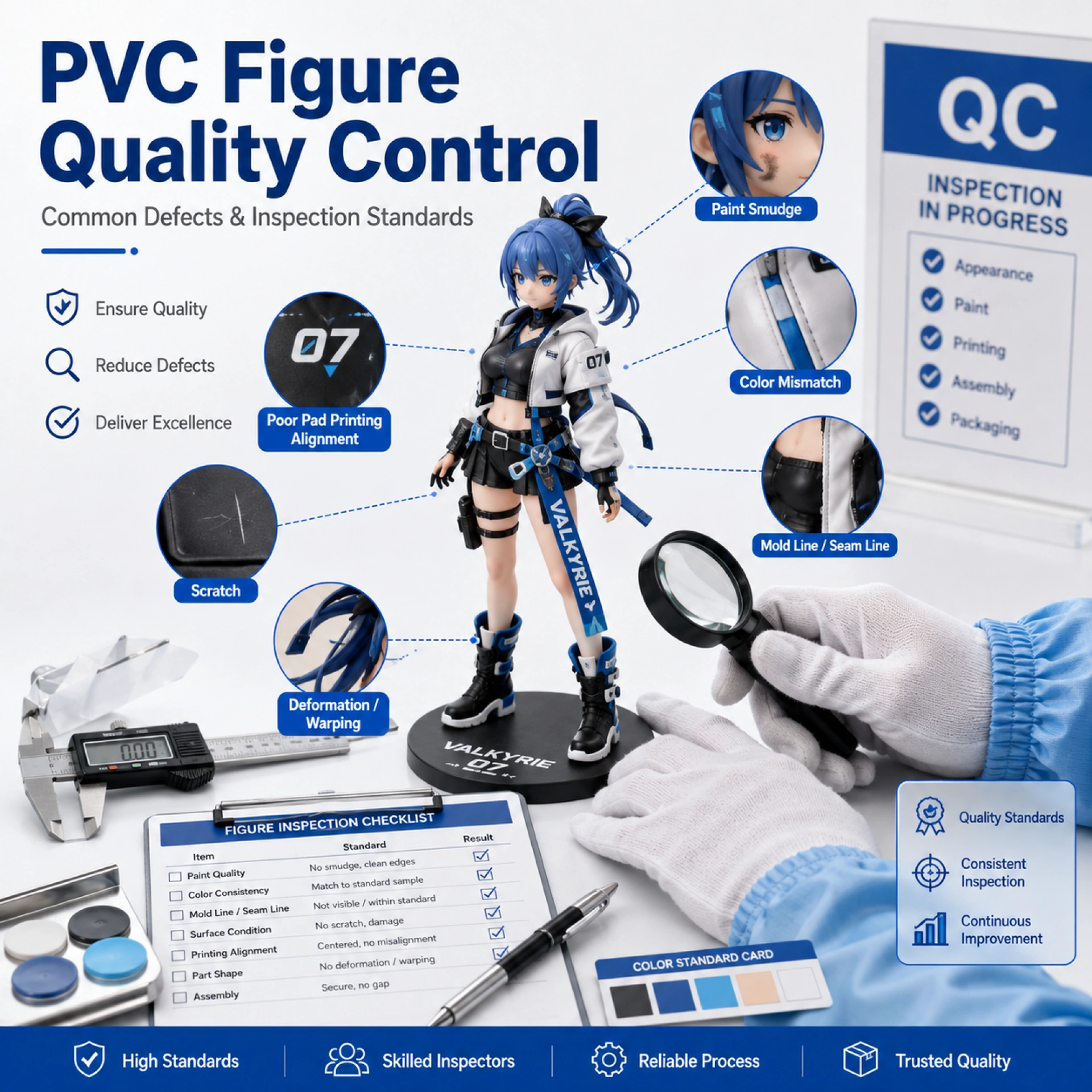
The direct answer is this: a good pvc figure quality control system should identify common defects such as color mismatch, paint overflow, dirty surface, visible mold lines, poor pad printing, loose accessories, unstable bases, glue marks, deformation, scratches, packaging damage, wrong labels, and carton packing errors. Buyers should define which defects are critical, major, and minor before mass production begins.
This article focuses on common defects and practical inspection standards for custom PVC figures, collectible figures, blind box toys, mascot figures, licensed IP figures, and promotional character products. It is designed for buyers, importers, sourcing teams, brand owners, and product managers who need to understand what should be inspected before shipment.
If your team needs a shipment checklist, you can also review our custom PVC figure quality control checklist. That article focuses on final pre-shipment review, while this article explains common defects and inspection standards in more detail.
Why PVC Figure Quality Control Matters
PVC figures are visual products. Buyers, collectors, retailers, and end customers judge them by surface quality, color accuracy, facial details, pose stability, packaging condition, and consistency across the batch. A small defect can make the product feel cheap, even if the figure structure is correct.
PVC figure quality control matters because custom figure production includes many steps:
- 3D modeling
- Prototype approval
- Mold making
- PVC injection molding
- Surface treatment
- Spray painting
- Pad printing
- Hand painting
- Assembly
- Packaging
- Carton packing
- Shipment
A defect can appear at any stage. For example, mold lines may come from tooling. Color mismatch may come from paint mixing. Eye misalignment may come from pad printing. Loose accessories may come from assembly. Scratched surfaces may come from packaging friction.
For a full overview of the production process, read our guide on how PVC toys are manufactured. Understanding the production flow makes pvc figure quality control much easier.
PVC Figure Quality Control Inspection Table
The table below shows the main inspection areas buyers should include in pvc figure quality control.
| Inspection Area | What to Check | Common Defects |
|---|---|---|
| Appearance | Overall shape, surface, size, proportion | Deformation, dirt, scratches, dents |
| Color | Pantone, approved sample, color zones | Color mismatch, uneven color, wrong color |
| Painting | Spray areas, edges, finish, coating | Paint overflow, missing paint, rough surface |
| Pad Printing | Eyes, mouth, logo, small graphics | Misalignment, blurry print, broken lines |
| Mold Quality | Parting lines, flashing, shrinkage | Visible seam line, flash, sink mark |
| Assembly | Accessories, limbs, base, glue | Loose parts, gaps, glue marks |
| Stability | Standing balance and base fit | Tilting, weak foot peg, unstable base |
| Packaging | Box, tray, bag, card, label | Damaged box, wrong card, loose tray |
| Safety Review | Small parts, sharp points, labels | Detachable small parts, incorrect warning |
| Carton Packing | Quantity, marks, barcode, assortment | Wrong carton mark, missing SKU, wrong mix |
A strong pvc figure quality control process should compare final goods against the approved sample, not only against a written description.
Common Defect 1: Color Mismatch
Color mismatch is one of the most common PVC figure defects. It can appear on skin tones, clothing, hair, accessories, bases, or printed details.
Color mismatch may happen because of:
- Wrong Pantone reference
- Paint mixing variation
- Different material base color
- Different surface finish
- Batch-to-batch paint difference
- Lighting difference during approval
- Matte or gloss coating effect
- Human error during spraying
For licensed IP figures, color mismatch is especially serious because character colors are part of brand identity. A wrong skin tone, hair color, logo color, or outfit color may fail IP approval.
PVC figure quality control should include color comparison under consistent lighting. Buyers should approve physical color samples, not only digital renders. For color communication, the Pantone Color Systems can be used as a reference during sample development and production approval.
You can also read our guide on color matching custom PVC figures to understand how Pantone references, painted samples, and production control work together.
Common Defect 2: Paint Overflow and Missing Paint
Painting defects are a major part of pvc figure quality control. A figure may have the correct sculpt, but poor painting can make it look low-end.
Common painting defects include:
- Paint overflow
- Missing paint
- Uneven coating
- Dust in paint
- Paint bubbles
- Rough surface
- Color bleeding
- Wrong finish
- Paint peeling
- Inconsistent gloss level
Paint overflow usually happens when color crosses the intended boundary. Missing paint means part of the intended color area is not fully covered. Both problems are easy to notice on faces, hairlines, shoes, clothing edges, accessories, and logos.
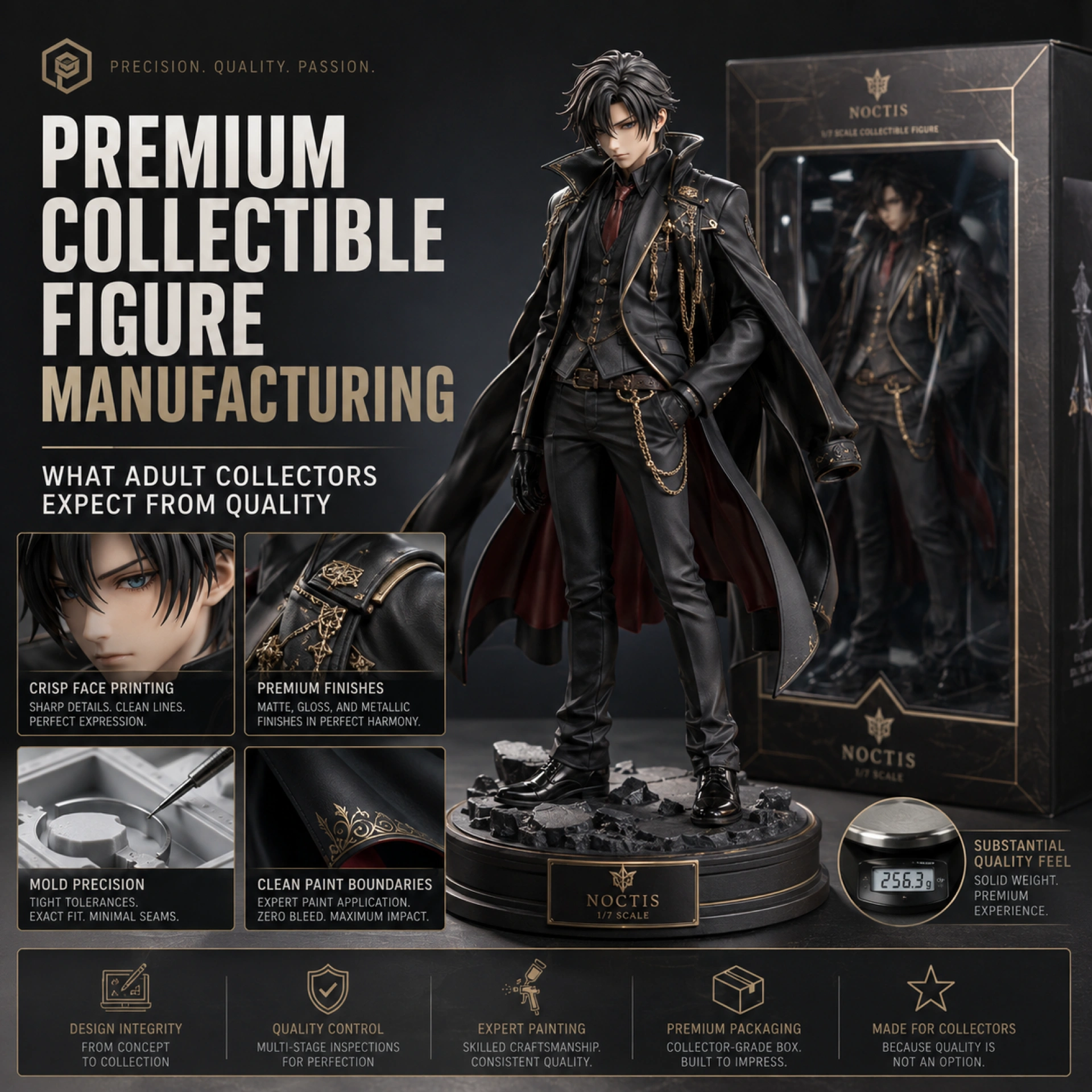
For premium collectible figures, paint boundaries must be cleaner than promotional toys. A small defect on the eyes or mouth may be unacceptable even if the same defect on a hidden area is minor.
Our guide on PVC figure painting methods explains spray painting, pad printing, hand painting, and finishing methods used in custom PVC figure production.
Common Defect 3: Poor Eye Printing and Facial Details
Facial details are one of the most sensitive parts of pvc figure quality control. Customers usually look at the face first. If the eyes are misaligned, the figure may feel wrong even if the body is perfect.
Common facial defects include:
- Eye misalignment
- Blurry eye printing
- Uneven eye highlights
- Wrong mouth position
- Broken printed lines
- Ink overflow
- Asymmetrical expression
- Color shift on facial details
Fine pad printing requires stable jigs, correct ink viscosity, proper pressure, and clean surfaces. Registration tolerance is important when multiple colors are printed on the same face.
Inspection should compare the face with:
- Approved sample
- Approved artwork
- Approved 3D render
- Color sample
- Production standard sheet
For anime-style figures, chibi figures, mascot figures, and blind box figures, facial detail inspection should be stricter than hidden body areas.
Common Defect 4: Visible Mold Lines and Flash
Mold lines are common in plastic figure production, but adult collectors and premium buyers usually have lower tolerance for visible seam lines.
Common mold-related defects include:
- Visible parting line
- Flash
- Sink mark
- Mold scratch
- Uneven surface
- Part mismatch
- Poor fitting
- Injection mark
A mold line is not always avoidable, but its position and visibility should be controlled. A seam on the back of a hidden area may be acceptable. A seam across the face, hair front, chest logo, or main display surface may be a major defect.
PVC figure quality control should classify mold line defects by location and severity.
| Mold Defect Location | Typical Severity |
| Face, eyes, front hair, logo area | Major or critical |
| Main clothing surface | Major |
| Back side or bottom area | Minor to major depending on visibility |
| Base bottom | Usually minor if it does not affect stability |
| Joint area hidden after assembly | Minor if structure is safe |
Good mold design, mold polishing, injection parameter control, and proper trimming can reduce visible defects.
Common Defect 5: Scratches, Dirt, and Surface Contamination
Surface defects can appear during molding, painting, assembly, packaging, or transport. They are common but should not be ignored.
Typical surface defects include:
- Scratches
- Black dots
- Dust particles
- Fingerprints
- Oil stains
- Glue residue
- Paint dust
- Surface dents
- Rubbing marks
PVC figure quality control should check surfaces under proper lighting. Some defects are only visible from certain angles, especially on gloss, metallic, transparent, or soft-touch surfaces.
Special finishes need extra care:
- Matte finish shows scratches easily
- Gloss finish shows fingerprints and dust
- Metallic paint shows uneven reflection
- Transparent parts show bubbles and cloudiness
- Flocking attracts dust and fiber shedding
For adult collectible figures, surface cleanliness is one of the strongest signs of quality.
Common Defect 6: Loose Accessories and Assembly Gaps
Assembly defects can affect both appearance and product safety. A custom PVC figure may include separate head parts, hands, accessories, bases, weapons, props, magnets, or decorative components.
Common assembly defects include:
- Loose accessories
- Large gaps between parts
- Misaligned assembly
- Weak glue
- Visible glue marks
- Wrong accessory
- Missing accessory
- Base not fitting
- Foot peg too loose or too tight
PVC figure quality control should include physical handling checks. Inspectors should not only look at the product. They should gently check whether accessories are properly fixed and whether the figure stands correctly.
For products intended for children, loose detachable parts may also create safety concerns. Buyers should confirm intended age and small parts risks before production. For U.S. toy products, the CPSC Toy Safety Guidance is a useful official resource for understanding toy safety considerations.
Common Defect 7: Unstable Display Base
A display base is not only a decorative part. It affects product stability, perceived quality, and customer satisfaction.
Common base defects include:
- Figure cannot stand
- Base is warped
- Foot peg is too loose
- Foot peg is too tight
- Figure tilts forward or backward
- Base surface is scratched
- Logo printing is misaligned
- Acrylic plate is damaged
- Diorama base does not fit packaging
PVC figure quality control should include a standing test. Each figure should stand on a flat surface according to the approved sample. If the figure has a large head, thin legs, dynamic pose, or heavy accessory, the base should be checked more carefully.
For premium products, the base should also match the visual quality of the figure. A high-quality figure with a weak base will feel incomplete.
Common Defect 8: Packaging Damage and Wrong Inserts
Packaging defects can damage the customer experience even when the figure itself is acceptable. For collectible figures and blind box toys, packaging is part of the product value.
Common packaging defects include:
- Crushed box
- Wrong box artwork
- Wrong barcode
- Missing collector card
- Wrong instruction sheet
- Wrong inner tray
- Loose figure inside tray
- Scratches caused by tray
- Wrong label
- Poor carton mark
- Wrong assortment
- Missing warning label
PVC figure quality control should include retail packaging and export carton inspection. Buyers should check both appearance and accuracy.
For packaging execution, read our guide on Packaging Bill of Materials for Toys. It explains how buyers should record box, inner bag, tray, card, label, and master carton specifications before production. You can also review our custom toy packaging manufacturer guide for packaging structure and supplier preparation.
Inspection Standards: Critical, Major, and Minor Defects
A practical pvc figure quality control system should classify defects into critical, major, and minor categories.
| Defect Level | Meaning | PVC Figure Examples |
| Critical Defect | Safety, legal, or serious functional risk | Sharp point, choking hazard, toxic material concern, wrong safety warning |
| Major Defect | Affects appearance, function, saleability, or customer acceptance | Eye misprint, large paint defect, loose part, wrong color, unstable base |
| Minor Defect | Small defect that does not strongly affect saleability | Tiny mark on hidden area, slight color variation within approved tolerance |
This classification helps buyers and factories avoid subjective arguments. A small scratch on the bottom of a base should not be treated the same as a misprinted eye. A loose small accessory should not be treated as a minor issue if it creates safety or functional risk.
Inspection standards should be confirmed before mass production. The approved sample should become the reference for final inspection.
AQL and Random Inspection for PVC Figures
For mass production, buyers often use random inspection instead of checking every unit. AQL inspection is commonly used in consumer product quality control to decide sample size and acceptance criteria.
For reference, ANSI/ASQ Z1.4 sampling standards are widely used for inspection by attributes and acceptance sampling. Buyers should work with quality professionals or third-party inspection agencies to choose the correct inspection level and AQL limits.
A practical pvc figure quality control plan may include:
- Sample size based on order quantity
- Critical defect acceptance level
- Major defect acceptance level
- Minor defect acceptance level
- Inspection checklist
- Approved sample comparison
- Defect photo record
- Rework decision
- Final release approval
Example inspection logic:
| Defect Type | Suggested Handling |
| Critical defect | Usually zero tolerance |
| Major defect | Controlled by agreed AQL |
| Minor defect | Controlled by agreed AQL |
| Repeated same defect | Escalate to production review |
| Defect on face or front display area | Usually stricter than hidden area |
AQL does not replace process control. It is a final inspection tool. The factory should still control quality during molding, painting, assembly, and packaging.
Paint Adhesion and Coating Inspection
Paint adhesion is important for PVC figure quality control because painted surfaces may rub during handling, packaging, shipping, or customer use.
Inspection may include:
- Visual inspection
- Rub test
- Tape test
- Scratch check
- Coating consistency review
- Handling test
- Packaging friction test
For coating adhesion, buyers can refer to standardized methods such as ASTM D3359 paint adhesion testing standards, especially when figures use painted surfaces, coatings, metallic finishes, or special surface treatments.
For normal decorative figures, the exact test method should be confirmed with the buyer, laboratory, or inspection agency. The important point is that painted surfaces should not peel, scratch, or transfer easily under expected handling and packaging conditions.
Inspection Timing: When Quality Should Be Checked
PVC figure quality control should not happen only at the end of production. Quality should be controlled at multiple stages.
| Production Stage | Inspection Focus |
| Sample approval | Shape, color, painting, assembly, packaging, stability |
| Mold trial | Mold lines, flash, fit, deformation, surface quality |
| Pre-production sample | Final material, paint, packaging, and structure approval |
| In-line inspection | Molding, painting, pad printing, assembly consistency |
| Final random inspection | Finished goods, packaging, labels, cartons, quantity |
| Shipment release | QC report, defect record, packing list, carton marks |
The earlier a defect is found, the easier it is to fix. A paint defect found during production may be corrected. The same defect found after packaging may require unpacking, sorting, rework, and shipment delay.
Our custom PVC figure sample approval checklist can help buyers check important details before mass production starts.
Buyer Inspection Checklist
Before shipment, buyers should confirm these pvc figure quality control points:
| Area | Buyer Should Confirm |
| Approved sample | Factory and buyer use the same approved sample |
| Color standard | Pantone, painted sample, or physical color chip confirmed |
| Paint standard | Acceptable boundaries and defect tolerance defined |
| Face inspection | Eye, mouth, eyebrow, and expression checked carefully |
| Mold line standard | Visible seam line tolerance confirmed by location |
| Assembly standard | Accessories, base, glue, and part fitting checked |
| Stability | Figure stands correctly on approved base |
| Packaging | Box, tray, card, label, and carton match approved version |
| Safety | Small parts, sharp points, warnings, and target age reviewed |
| Random inspection | AQL or agreed sampling plan used |
| Defect photos | Defects recorded with clear images |
| Rework plan | Factory response agreed before shipment release |
This checklist helps buyers keep pvc figure quality control practical and repeatable.
Common Buyer Mistakes
1. Approving Samples Without Defect Limits
Buyers often approve a beautiful sample but do not define what defects are acceptable in mass production. This creates arguments later.
2. Ignoring Hidden but Important Areas
The bottom of the base may be hidden, but if the foot peg is weak or the base is warped, the figure may fail.
3. Treating All Defects Equally
A tiny mark on the back is not the same as an eye misprint. Defects should be classified by severity and location.
4. Checking Packaging Too Late
Packaging can cause scratches, wrong assortment, or crushed boxes. It should be inspected before shipment.
5. Not Reviewing Material or Paint Changes
If the factory changes PVC material, paint supplier, coating, or packaging tray after approval, the buyer should review whether quality or safety is affected.
6. Using Only Photos for Final Approval
Photos are useful, but some defects require physical handling, standing tests, surface checks, and packaging review.
How Jiahong Creative Supports PVC Figure Quality Control
Jiahong Creative supports custom PVC figure projects from artwork review, 3D modeling, prototype sampling, mold making, PVC injection molding, painting, pad printing, assembly, packaging, and final quality inspection.
For pvc figure quality control, we help buyers check appearance, color matching, painting, facial details, mold lines, assembly, accessories, display bases, packaging, labels, cartons, and shipment quality. We can also help organize approved samples, defect photos, production batch records, packaging versions, and QC reports before delivery.
Jiahong Creative supports custom PVC figures, blind box figures, mascot figures, licensed IP products, collectible figures, character keychains, and character electronic products. If you are preparing a custom PVC figure project, please share your artwork, target size, quantity, packaging idea, quality expectations, testing requirements, and target market.
You can contact us through our custom PVC figure project inquiry page.
Final Thoughts
PVC figure quality control is not a single final inspection step. It is a complete system that connects sample approval, mold quality, color matching, painting, facial printing, assembly, packaging, safety review, random inspection, and shipment release.
For buyers, the most important thing is to define standards before mass production. Common defects such as paint overflow, color mismatch, visible mold lines, poor eye printing, loose accessories, unstable bases, scratches, glue marks, damaged packaging, and wrong labels should be classified clearly as critical, major, or minor defects.
When the buyer and manufacturer agree on inspection standards early, pvc figure quality control becomes much easier. The factory knows what to produce. The buyer knows what to inspect. The final shipment is more likely to match the approved sample and customer expectations.
FAQ
1. What is pvc figure quality control?
PVC figure quality control is the inspection process used to confirm that custom PVC figures match the approved sample, artwork, color standard, painting requirement, assembly standard, packaging specification, and shipment quality requirement.
2. What are common PVC figure defects?
Common defects include color mismatch, paint overflow, missing paint, eye misalignment, visible mold lines, flash, scratches, dirt, glue marks, loose accessories, unstable bases, packaging damage, and wrong labels.
3. Why are facial details important in pvc figure quality control?
Facial details are important because customers notice the face first. Eye misalignment, blurry printing, wrong expression, or poor mouth placement can make the figure look incorrect even when the body is acceptable.
4. How should buyers inspect painting quality?
Buyers should compare mass production with the approved painted sample, check color accuracy, paint boundaries, surface smoothness, missing paint, overflow, dust, coating consistency, and special finish quality.
5. Are visible mold lines acceptable?
Some mold lines may be unavoidable, but their visibility and location matter. Mold lines on the face, front hair, logo area, or main display surface are usually more serious than mold lines on hidden areas.