

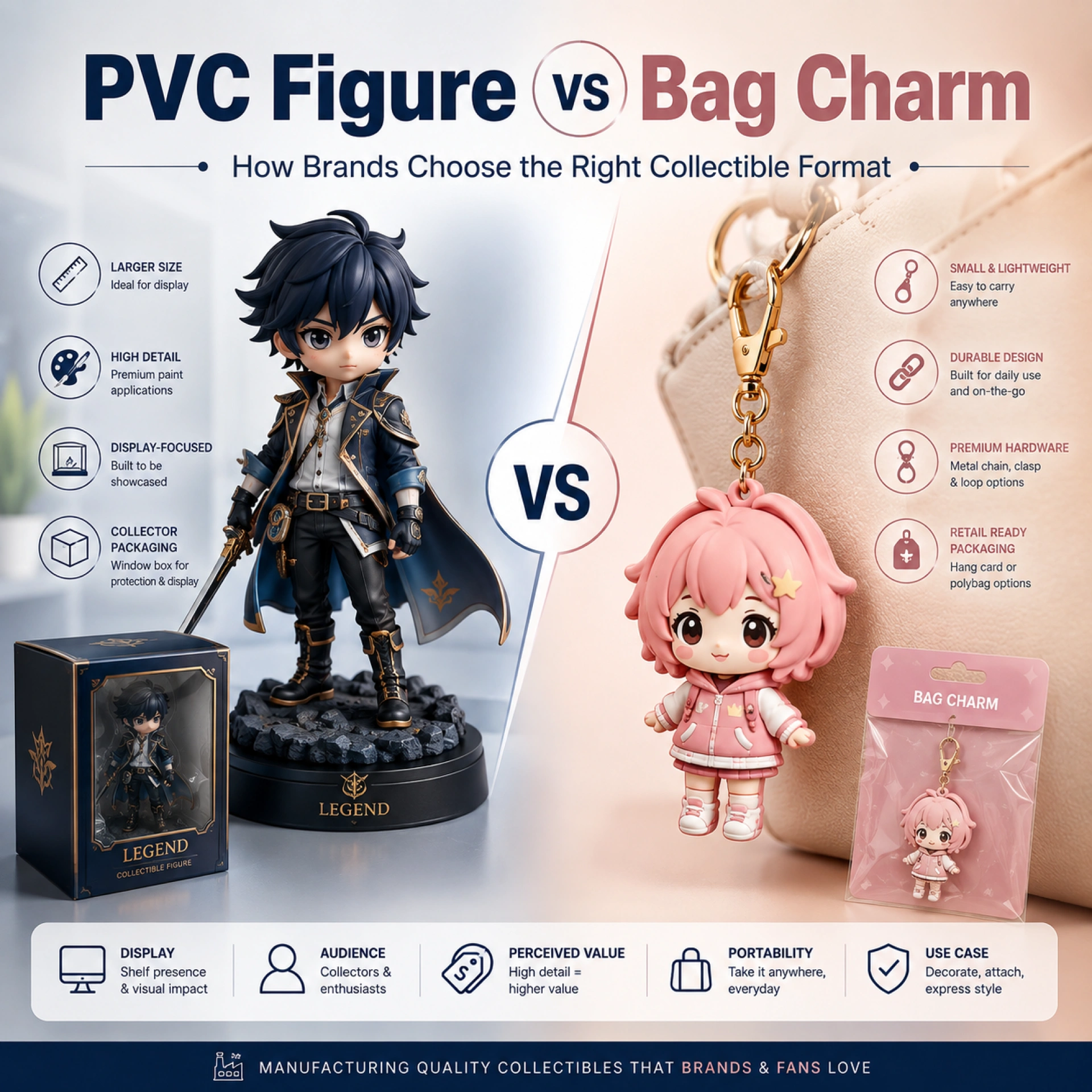
How Brands Choose the Right Collectible Format depends on how the product will actually be used. A PVC display figure is designed mainly for visual detail, standing stability, collectible presentation, and display value. A bag charm is a portable collectible that must survive pulling, swinging, rubbing, dropping, and repeated contact with bags, keys, clothing, and other objects. Because of this, the same character artwork should not simply be scaled down and fitted with a metal chain.
The direct answer is this: choose a PVC figure when character detail, premium painting, pose, display base, and collector presentation are the priorities. Choose a bag charm when portability, lower product size, everyday visibility, and entry-price merchandise are more important. But bag charm manufacturing requires more attention to pull strength, metal attachment, PVC tearing, paint abrasion, small parts, chain plating, and drop resistance.
For brands, IP owners, game companies, animation studios, retailers, and merchandise teams, How Brands Choose the Right Collectible Format should therefore be decided before 3D modeling and tooling. The format affects not only unit cost but also structural engineering, material thickness, paint specification, metal hardware, packaging, QC, and testing requirements.
A 15 cm collectible figure and a 6 cm character bag charm may use the same IP, colors, and character identity, but they are not the same manufacturing product.
PVC Figure vs Bag Charm at a Glance
| Project | Display Figure | Bag Charm |
|---|---|---|
| Size | Usually larger | Usually smaller |
| Weight | Can be relatively heavy | Weight must be controlled |
| Structure | Display-focused | Pull/load-focused |
| Hardware | Optional | Metal loop / chain usually required |
| Paint | High-detail finish | Higher abrasion exposure |
| Safety | Depends on classification and use | Portable-use risks need review |
| Packaging | Window box / blind box | Blind box / card / pouch |
| Main Engineering Risk | Balance, seams, appearance | Attachment strength, tearing, abrasion |
| QC Focus | Paint, face, mold line, stability | Pull strength, chain, attachment, coating |
| Typical Buyer Goal | Premium display and collection | Portable merchandise and entry-price collectible |
This comparison is the starting point for understanding How Brands Choose the Right Collectible Format. The correct choice should be based on customer use and manufacturing structure, not only character appearance.
If your team is still choosing materials, our guide on PVC vs vinyl vs ABS figures explains why PVC is commonly used for detailed character surfaces while ABS is often better suited to rigid or structural components.
1. Size: Display Detail vs Portable Scale
Size changes more than material consumption.
A display figure may be:
- 10 cm
- 15 cm
- 20 cm
- 25 cm or larger
At this size, manufacturers can reproduce more:
- Hair detail
- Facial features
- Clothing texture
- Accessories
- Paint boundaries
- Character poses
A bag charm is usually much smaller because it must remain practical when attached to a handbag, backpack, zipper, or key ring.
Reducing size creates several manufacturing challenges:
- Thin arms become fragile.
- Small accessories may become too weak.
- Facial printing becomes harder.
- Paint boundaries become narrower.
- Connection points need reinforcement.
- Character proportions may need simplification.
This is why How Brands Choose the Right Collectible Format starts with use scenario. If the customer mainly displays the character on a desk or shelf, the larger PVC figure gives the design more room. If the customer carries it every day, the bag charm needs a simpler and stronger structure.
A factory should not simply reduce a 15 cm 3D figure to 5 cm. The smaller model usually needs a separate engineering review.
For projects beginning with 2D artwork, our guide on how to turn 2D character art into a custom toy figure explains how artwork is converted into production-ready geometry.
2. Weight: Why Bag Charms Need More Control
Weight is another major difference.
A display figure can feel more premium when it has:
- A heavier base
- Solid components
- Balanced weight distribution
- Stable structure
Collectors may associate more weight with perceived quality.
A bag charm has the opposite engineering problem.
If the charm is too heavy:
- It can pull on the bag material.
- It may swing excessively.
- The metal loop experiences higher load.
- The PVC connection point receives more stress.
- The charm may become uncomfortable to carry.
- Drop impact becomes stronger.
Therefore, How Brands Choose the Right Collectible Format should consider whether perceived weight is an advantage or a liability.
For bag charms, manufacturers may reduce weight by:
- Decreasing overall dimensions
- Simplifying thick sections
- Adjusting internal structure
- Reducing oversized accessories
- Using suitable part separation
However, weight reduction should not make the PVC connection area too thin.
The critical point is balance: the bag charm must be light enough for portable use but strong enough to survive repeated loading.
3. Structure: Display-Focused vs Pull/Load-Focused
This is probably the most important engineering difference.
A display figure primarily experiences static load. Once placed on a shelf, it may remain in the same position for months.
A bag charm experiences dynamic load.
It may be:
- Pulled
- Twisted
- Shaken
- Dropped
- Compressed inside a bag
- Rubbed against other objects
- Caught on clothing
- Pulled by the chain
This means the attachment structure must be designed as a load-bearing feature.
A bag charm should have a clear load path:
Metal hardware → connection point → PVC structure
The engineering team should evaluate:
- Thickness around the attachment point
- Distance from the edge
- Shape around the eyelet
- PVC flexibility
- Tear propagation risk
- Metal insert design
- Connection orientation
- Expected pulling direction
A decorative loop positioned only for appearance may fail after repeated use.
This is a key reason How Brands Choose the Right Collectible Format cannot be based only on the artwork.
4. Hardware: Metal Loop, Chain, Ring, or Attachment
A display PVC figure may not require metal hardware at all. A bag charm usually does.
Typical hardware includes:
- Metal eyelet
- Jump ring
- Ball chain
- Key ring
- Lobster clasp
- Carabiner-style clip
- Short decorative chain
Each hardware choice changes both cost and performance.
Buyers should confirm:
| Hardware Item | Buyer Should Check |
|---|---|
| Eyelet / loop | Pull strength and insertion depth |
| Jump ring | Wire thickness and opening resistance |
| Chain | Length, strength, plating |
| Key ring | Spring strength and diameter |
| Clasp | Opening cycles and load |
| Plating | Color, wear resistance, corrosion appearance |
The attachment should be tested as a complete system. A strong chain does not help if the PVC tears around the eyelet. A strong PVC connection does not help if the jump ring opens.
For products that may fall within toy or children’s product requirements, the metal hardware should also be included in the material and testing review. CPSC publishes test methods for children’s product materials, including methods covering metal components and surface coatings.
5. Paint: Premium Detail vs High Abrasion
Display figures and bag charms can use similar painting methods, but their wear environments are very different.
A display figure may use:
- Matte finish
- Gloss finish
- Metallic paint
- Fine pad printing
- Gradients
- Hand painting
- Detailed facial decoration
Because the product remains mostly stationary, the surface receives limited abrasion after purchase.
A bag charm is frequently rubbed against:
- Bag fabric
- Metal zippers
- Keys
- Clothing
- Tables
- Other accessories
This makes paint abrasion one of the biggest bag charm manufacturing risks.
High-risk areas include:
- Raised nose
- Hair tips
- Shoes
- Hands
- Character ears
- Edge details
- Printed logos
- Metal-contact areas
The manufacturing team may need to simplify delicate painted details or add a suitable protective finish.
Buyers should check:
- Paint adhesion
- Rub resistance
- Color transfer
- Surface scratches
- Printed detail durability
- Metal-to-PVC contact areas
For a deeper explanation of decoration processes, read our guide on PVC figure painting methods.
If your project requires particularly high visual quality, our guide to Premium Collectible Figure Manufacturing explains matte, gloss, metallic, flocking, facial printing, mold lines, and premium surface expectations.
6. Safety: Product Use Changes the Risk Review
Safety should be determined by actual product classification, intended age, target market, and foreseeable use rather than by the words “figure” or “bag charm” alone.
For a display collectible, buyers should consider:
- Target age
- Small detachable components
- Sharp points
- Material requirements
- Product positioning
- Packaging warnings
For a portable bag charm, additional physical-use questions become important:
- Can the metal attachment detach?
- Can the PVC tear and create a small component?
- Can the jump ring open?
- Are sharp metal edges exposed?
- Can small accessories detach after pulling or dropping?
- Does the product remain intact after expected use?
For U.S. children’s products, CPSC explains that a small part can include an entire article, a separate part, or a component that breaks off during use-and-abuse testing. The official CPSC small parts guidance is useful when evaluating portable character products.
ASTM’s F963 Toy Safety Standard also includes test methods for impact, torque, tension, compression, and normal-use or abuse testing where applicable.
The exact test program should be confirmed with a qualified laboratory based on target age, market, and product classification.
Bag Charm Manufacturing Risks
Bag charms look simpler than larger collectible figures, but their structural risks can actually be higher because they are portable and repeatedly handled.
1. Pull Strength
Pull strength is one of the first items buyers should define.
The inspection should evaluate the complete connection:
PVC body + insert + ring + chain
Possible failures include:
- Eyelet pulling out
- PVC tearing
- Jump ring opening
- Chain breaking
- Insert rotating loose
A manufacturer should not evaluate only whether the hardware can support the static product weight. Real use can generate much higher momentary loads.
For products subject to toy testing, ASTM F963 includes tension tests for removal of components as part of its testing framework. This makes ASTM toy safety testing a useful external reference when buyers discuss structural test planning with laboratories.
2. Metal Attachment
The metal attachment point is often the highest-stress region of a bag charm.
Possible structures include:
- Screw eye
- Embedded metal loop
- Molded hole with ring
- Internal metal insert
The factory should review:
- Insert depth
- Surrounding PVC thickness
- Pull direction
- Rotation
- Position relative to the center of gravity
If the attachment point is placed too close to a thin edge, repeated pulling may gradually tear the material.
One of the most important decisions in How Brands Choose the Right Collectible Format is therefore whether the character geometry has a natural location strong enough for a portable attachment.
3. PVC Tearing
PVC offers flexibility, which is useful for character products, but thin sections can still tear.
Risk areas include:
- Thin ears
- Hair tips
- Arms
- Character antennae
- Narrow loops
- Bag attachment areas
The engineering team may need to:
- Increase wall thickness
- Round sharp transitions
- Move the hardware position
- Add internal reinforcement
- Integrate the connection into a stronger body area
A display figure may preserve extremely thin artistic details because they are rarely touched. A bag charm often needs those details thickened.
That is manufacturing optimization, not simply visual simplification.
4. Paint Abrasion
Bag charm paint receives much more physical contact than display figure paint.
During development, buyers should consider practical abrasion simulation:
- Repeated rubbing
- Contact with fabric
- Metal hardware contact
- Bag movement
- Pocket or pouch friction
For high-contact products, the buyer may prefer:
- Molded base colors for large areas
- Fewer fragile painted edges
- More durable coating
- Protected facial zones
- Reduced paint on connection areas
For mass production, our PVC figure quality control guide explains how paint overflow, abrasion, scratches, printing accuracy, assembly defects, and inspection standards should be managed.
5. Small Parts
A bag charm can contain several potential small parts:
- Jump ring
- Chain connector
- Clasp
- Mini accessory
- Decorative PVC part
- Separate charm
If the product is aimed at children, these components should be reviewed carefully.
The concern is not only whether a part is small before use. A component that separates during use or abuse may also become relevant to small-parts assessment.
CPSC’s small parts and choking hazard guidance explains that use-and-abuse testing can include impact, flexure, torque, tension, and compression to determine what components may become detached.
For buyers, the practical lesson is simple: attachment strength and small parts review should be planned together.
6. Chain Plating
Chain plating is often overlooked during quotation.
Common finishes include:
- Nickel color
- Black
- Gold
- Rose gold
- Antique finishes
- Colored coatings
Buyers should confirm:
- Plating color
- Surface consistency
- Scratch resistance
- Corrosion appearance
- Material specification
- Applicable chemical requirements
A premium-looking PVC charm can lose value quickly if the chain changes color or the plating becomes visibly worn.
The metal hardware BOM should therefore be controlled separately from the PVC figure BOM.
For licensed IP projects, this also matters visually. Chain color may be part of the approved product design.
7. Drop Test
A display figure and a bag charm behave differently during a drop.
A display figure may fall occasionally. A bag charm is much more likely to be dropped during daily use.
Drop evaluation should check:
- PVC cracking
- Accessory breakage
- Eyelet release
- Chain failure
- Paint chipping
- Part separation
- Sharp edges created after impact
The relevant test conditions depend on product classification and target age. ASTM F963 includes impact tests as part of its toy safety test methods, while CPSC use-and-abuse guidance also incorporates impact testing for relevant children’s products.
Even when a bag charm is not classified as a toy, brands may still choose internal drop-performance standards to reduce customer complaints and returns.
Display Figure Manufacturing Priorities
While bag charms are designed around portable durability, display figures have a different priority list.
Manufacturers should focus on:
- Character accuracy
- Fine sculpting
- Facial printing
- Paint boundaries
- Seam lines
- Surface finish
- Weight perception
- Standing stability
- Display base
- Packaging presentation
This is why a display figure can justify more delicate structures that would be unsuitable for a bag charm.
For example, a 15 cm premium figure may have:
- Thin hair strands
- Extended weapons
- Complex layered clothing
- Transparent effect parts
- Large diorama base
Those details increase visual value when the product is displayed. The same features would create unnecessary breakage risk if attached to a handbag.
Packaging: Window Box vs Card, Pouch, or Blind Box
Packaging is another area that affects How Brands Choose the Right Collectible Format.
Display Figure Packaging
Common options include:
- Window box
- Blind box
- Color box
- Blister
- Premium gift box
- Collector card
- Inner tray
Display figures often require more protection because the figure may have:
- Fragile accessories
- Large bases
- Premium painted surfaces
- Transparent parts
Bag Charm Packaging
Typical options include:
- Blind box
- Printed card
- Pouch
- Small color box
- Display card
- Retail hanger
Bag charm packaging should protect both the PVC character and the metal hardware. If the chain moves freely inside the package, it may scratch the painted figure during shipping.
A practical packaging solution may separate the chain from the figure or secure the hardware so it cannot repeatedly hit the PVC surface.
For packaging development, our custom toy packaging manufacturer guide explains box structure, inner protection, artwork, labels, and carton packing.
Cost Differences: PVC Figure vs Bag Charm
Bag charms are smaller, but that does not mean their cost is simply proportional to size.
A display figure cost may be driven by:
- Larger molds
- More PVC material
- Detailed painting
- Display base
- Premium packaging
Bag charm cost may be driven by:
- Metal hardware
- Structural reinforcement
- More durable coating
- Pull testing
- Assembly
- Plating
- Smaller-scale fine printing
A useful cost comparison looks like this:
| Cost Area | Display Figure | Bag Charm |
|---|---|---|
| Material volume | Higher | Lower |
| Mold size | Larger | Smaller |
| Painting detail | Often higher | May be simpler but needs abrasion resistance |
| Hardware | Usually low | Required |
| Assembly | Figure/base assembly | PVC + metal hardware assembly |
| Structural testing | Stability-focused | Pull/load/drop-focused |
| Packaging | Larger | Smaller |
| Freight volume | Higher | Lower |
Therefore, How Brands Choose the Right Collectible Format should compare the complete cost structure, not only grams of PVC.
When Should a Brand Choose a PVC Display Figure?
Choose a display figure when:
- Character accuracy is the main priority.
- The product is meant for shelves or desks.
- Fine painting is important.
- The brand wants premium collectible positioning.
- A display base improves the product.
- Larger packaging is acceptable.
- Collectors are willing to pay for detail.
Display figures work particularly well for:
- Anime characters
- Game characters
- Mascots
- Licensed IP collections
- Premium gifts
- Adult collectibles
When Should a Brand Choose a Bag Charm?
Choose a bag charm when:
- Portability matters.
- Customers should carry the character every day.
- The brand needs an entry-price collectible.
- Smaller packaging is preferred.
- Fashion or bag accessories fit the IP.
- The product can be simplified structurally.
- Hardware durability can be engineered properly.
Bag charms are particularly useful for:
- Character merchandise collections
- Fashion IP collaborations
- Game merchandise
- Event products
- Retail add-ons
- Blind box accessory series
Can One Character Become Both?
Yes. In many cases, the best answer to How Brands Choose the Right Collectible Format is not “figure or bag charm.” A brand can develop both, but each format should have its own production engineering.
For example:
Hero collectible
→ 15 cm PVC display figure
Entry-price product
→ 5–7 cm PVC bag charm
The two products can share:
- Character identity
- Pantone references
- Facial style
- Packaging visual system
- Approved 3D master asset
But they should not automatically share:
- Part thickness
- Hardware structure
- Paint specification
- QC standard
- Packaging structure
If you are planning multiple product formats from the same IP, our article on how to Turn One Licensed Character Into a Multi-Product Merchandise Line explains how shared 3D assets, accessories, packaging, and launch planning can support a broader merchandise strategy.
Buyer Development Checklist
Before choosing between a PVC figure and bag charm, buyers should confirm:
| Buyer Question | Display Figure | Bag Charm |
|---|---|---|
| Target size | Larger | Smaller |
| Target weight | Flexible | Must be controlled |
| Main use | Display | Carry / attach |
| Fine details | Can be extensive | Simplification often needed |
| Structural load | Low static load | Repeated pull and dynamic load |
| Metal hardware | Optional | Usually required |
| Painting | Premium appearance | Abrasion resistance important |
| Base | Often required | Usually not required |
| Pull strength | Low priority | High priority |
| Drop risk | Moderate | Higher |
| Small parts | Design-dependent | Hardware must also be reviewed |
| Packaging | Window / blind box | Card / pouch / blind box |
This table can help buyers understand How Brands Choose the Right Collectible Format before the factory begins 3D development.
How Jiahong Creative Supports PVC Figures and Bag Charms
Jiahong Creative supports character merchandise projects from artwork review, 3D modeling, prototype development, mold making, PVC production, painting, printing, assembly, packaging, and final QC.
For display figures, we can help buyers review:
- Figure size
- Character details
- Material
- Painting
- Surface finish
- Display base
- Packaging
For bag charms, additional manufacturing review should cover:
- Product weight
- Hardware position
- Pull strength
- Metal attachment
- PVC thickness
- Paint abrasion
- Chain structure
- Plating
- Drop performance
- Small-part risk
- Packaging protection
If you are deciding How Brands Choose the Right Collectible Format for a new character project, share your artwork, target product size, quantity, intended use, target age, packaging direction, hardware preference, and target market.
You can contact us through our custom character product inquiry page.
Final Thoughts
How Brands Choose the Right Collectible Format should begin with product use, not only character artwork. A PVC display figure is optimized for visual quality, facial detail, painting, mold precision, display stability, and collector presentation. A bag charm is optimized for portability, controlled weight, structural strength, metal attachment, abrasion resistance, and repeated handling.
The manufacturing difference is significant.
A display figure asks:
“Does this character look correct and display well?”
A bag charm must also ask:
“What happens when the customer pulls it, swings it, drops it, rubs it against a bag, or repeatedly loads the metal attachment?”
That is why bag charm development should include pull strength, metal attachment design, PVC tearing review, paint abrasion checks, small-part review, chain plating control, and drop testing.
When brands understand these engineering differences before tooling, How Brands Choose the Right Collectible Format becomes much easier. The result is not only a better-looking product but a collectible format designed for the way customers will actually use it.
FAQ
1. How Brands Choose the Right Collectible Format between a PVC figure and a bag charm?
How Brands Choose the Right Collectible Format depends mainly on use. Choose a PVC figure for display, premium detail, painting, and collector presentation. Choose a bag charm for portability, everyday use, and entry-price merchandise, while planning for pull strength and abrasion.
2. Is a bag charm just a smaller PVC figure?
No. A bag charm should be redesigned for portable use. It needs controlled weight, reinforced attachment points, suitable metal hardware, stronger abrasion resistance, and drop and pull-performance review.
3. Why is pull strength important for bag charms?
The charm experiences repeated pulling and swinging. The PVC body, eyelet, jump ring, and chain must work together as one load-bearing system.
4. Can PVC tear around a bag charm attachment?
Yes. Thin PVC around an eyelet or connection point can tear under repeated loading. The factory may need to increase thickness, change the connection position, or use a different insert structure.
5. Does bag charm paint need to be more durable?
Usually yes. Bag charms experience more rubbing against fabric, zippers, keys, and other surfaces than display figures. Paint adhesion and abrasion should therefore receive more attention.
6. What metal hardware is commonly used for character bag charms?
Common options include jump rings, ball chains, key rings, lobster clasps, eyelets, and small carabiner-style clips. Hardware should be selected based on weight, appearance, strength, and use.