

Connected Character Products are character-based products that combine mascot design, licensed IP, toy-like appearance, or collectible styling with electronic functions such as Bluetooth, Wi-Fi, microphones, voice interaction, apps, cloud services, rechargeable batteries, sensors, or data transmission. For UK and EU buyers, the key question is not only whether the product looks attractive. The real question is what must be confirmed before manufacturing begins so the product can be designed, tested, documented, packaged, and supported properly.
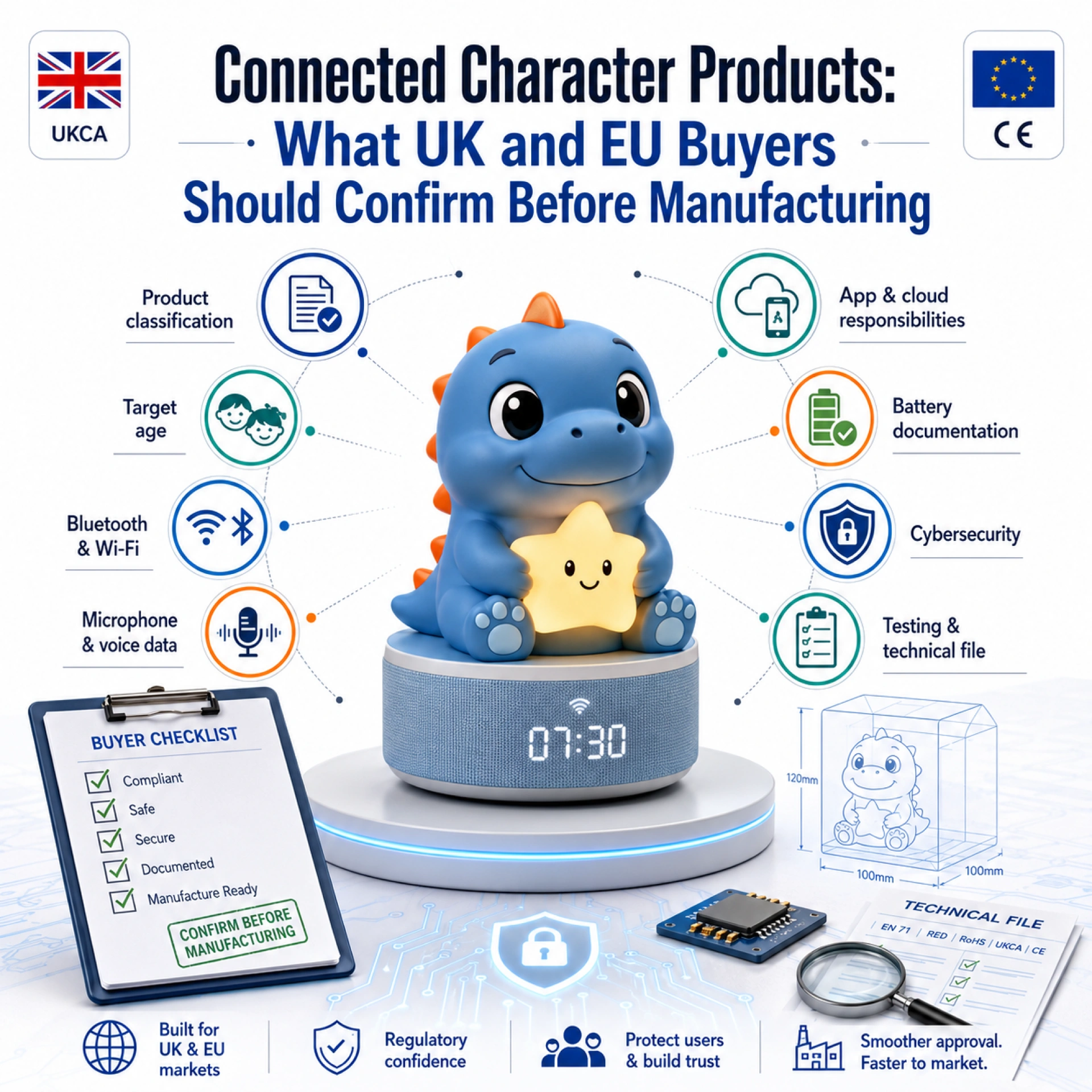
The direct answer is this: before manufacturing Connected Character Products, UK and EU buyers should confirm product classification, target age, toy or non-toy positioning, Bluetooth and Wi-Fi functions, microphone and voice data use, app and cloud responsibilities, battery documentation, cybersecurity responsibilities, testing scope, technical file preparation, packaging information, and final quality control. These decisions should be made before sample approval, not after mass production.
Connected Character Products can include character Bluetooth speakers, smart alarm clocks, app-connected night lights, voice-interactive toys, Wi-Fi-enabled mascots, character learning devices, cloud-based sound machines, smart desk companions, or electronic gifts with wireless functions. Because these products combine physical character design with digital or connected functions, buyers must review both product manufacturing and connected product responsibilities.
If your brand is still deciding between a static figure and an electronic product, our guide on character figure vs character electronic product can help you compare display value, daily-use function, cost, complexity, and buyer risk.
Why Connected Character Products Need a Procurement Checklist
Connected Character Products are more complex than ordinary PVC figures, blind box toys, or basic electronic gifts. A normal PVC figure mainly requires design accuracy, material selection, molding, painting, packaging, and QC. A connected character product may also require wireless modules, firmware, app functions, cloud services, cybersecurity review, data processing decisions, battery documentation, and technical file preparation.
This means buyers cannot treat Connected Character Products as simple “cute electronics.” A character Bluetooth speaker with only local Bluetooth playback is different from a Wi-Fi toy that records a child’s voice and sends data to cloud servers. A rechargeable character night light is different from an app-controlled sleep trainer that stores user profiles. A microphone-enabled mascot is different from a basic sound machine with fixed offline audio.
Before asking a manufacturer for a quotation, buyers should confirm the product scope. The more connected the product is, the more responsibility may shift from basic factory production to product owner decisions, app developer responsibilities, cloud service management, data protection planning, cybersecurity updates, and post-sale support.
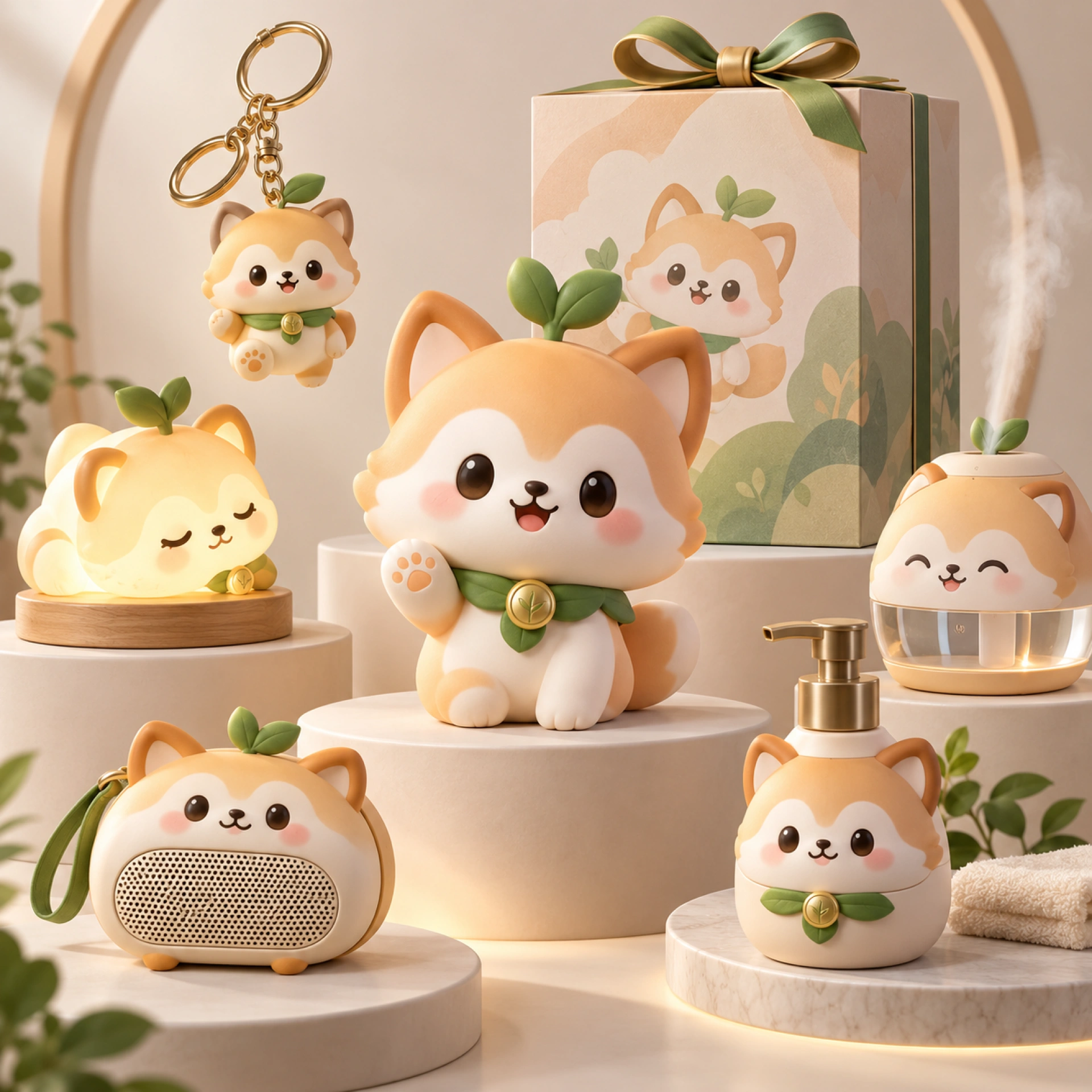
For early product planning, our character electronic gift manufacturer guide explains how character night lights, speakers, humidifiers, aroma diffusers, alarm clocks, and other electronic gifts are developed through OEM manufacturing.
1. Product Classification
The first step for Connected Character Products is product classification. Buyers should decide what the product is before manufacturing begins.
A connected character product may be classified as:
- A toy
- A children’s electronic product
- An adult collectible with electronic function
- A Bluetooth speaker
- A smart home device
- A sleep training product
- A promotional electronic gift
- A licensed IP merchandise product
- An app-connected device
- A voice-interactive product
This classification affects testing, labeling, documentation, packaging, user instructions, and responsibility allocation. For example, a character Bluetooth speaker sold as lifestyle merchandise may follow a different review path from a talking toy designed for children. A connected mascot with a microphone may require more data and privacy review than a simple rechargeable night light.
For UK and EU buyers, classification should be discussed with compliance partners, laboratories, importers, and product teams early. The manufacturer can help provide production details, but the buyer must define the product’s intended use, target market, and sales channel.
If the product may be treated as a toy, buyers should review our guide on UK Toy Safety Regulations for Custom PVC Figures and our article on EU Toy Safety Regulation 2025/2509. Even though those articles focus on PVC figures, the same early classification logic is useful for connected character toys.
2. Target Age
Target age is one of the most important decisions for Connected Character Products. A product intended for adults, teenagers, children over 6, children over 3, or younger users may need different safety review, warning labels, packaging language, data protection review, and design controls.
Buyers should confirm:
- Is the product intended for children?
- What age group is the product designed for?
- Is it likely to be accessed by children even if not marketed as a toy?
- Does the product have small detachable parts?
- Does it use a microphone?
- Does it require an app account?
- Does it collect voice, usage, location, or profile information?
- Can parents control settings?
- Are privacy details available before purchase?
- Does packaging clearly match the intended age group?
Connected Character Products for children need especially careful planning. A cute character shape, cartoon packaging, playful sounds, and child-friendly colors can all influence how the product is perceived. Buyers should not rely only on internal intention. They should review how the product appears to users, retailers, parents, and regulators.
If your project includes toy-like elements, our guide on EN71 for Custom Toys can help buyers understand why age grading, small parts, materials, packaging, and safety testing should be planned early.
3. Bluetooth and Wi-Fi Functions
Bluetooth and Wi-Fi functions are a major dividing line in Connected Character Products. A product with Bluetooth playback may have different risks from a product that connects to Wi-Fi, cloud servers, apps, or user accounts.
Before manufacturing, buyers should confirm:
- Does the product use Bluetooth?
- Does it use Wi-Fi?
- Does it connect directly to the internet?
- Does it connect through a mobile app?
- Does it receive firmware updates?
- Does it transmit user data?
- Does it use a certified wireless module?
- Does it need antenna layout review?
- Does the enclosure affect signal performance?
- Does the product require RED, UK radio, EMC, or other wireless testing?
For example, a character Bluetooth speaker must balance acoustic layout, antenna position, plastic shell design, battery placement, and user controls. If the character shape blocks the antenna or speaker outlet, the product may look good but perform poorly.
Our custom Bluetooth speaker manufacturer guide explains how Bluetooth speakers require planning for Bluetooth module selection, acoustic structure, PCBA, battery, plastic molding, painting, assembly, packaging, and quality control.
For Connected Character Products, buyers should also decide whether the wireless function is essential or only a marketing feature. More connectivity often means more testing, more documentation, more cybersecurity responsibility, and more after-sales support.
4. Microphone and Voice Data
Microphones create a different level of responsibility. A character product with a microphone can feel interactive and engaging, but it also raises important questions about voice data, consent, storage, user control, and child privacy.
Before adding a microphone to Connected Character Products, buyers should confirm:
- Does the microphone record voice?
- Does the product process voice locally or in the cloud?
- Is voice data stored?
- Is voice data linked to an account?
- Can users delete recordings?
- Can parents control microphone access?
- Is the microphone always listening or button-activated?
- Is there a visible microphone indicator?
- Is privacy information available before purchase?
- Who is responsible for the voice processing system?
A simple offline sound toy with a button-triggered prerecorded response is different from a cloud-connected character that records and processes user speech. Buyers should define this clearly before manufacturing.
If the product is likely to be accessed by children, UK buyers should review the official ICO connected toys and devices guidance. It highlights that providers of connected toys and devices should be clear about who processes personal data and what responsibilities apply.
For procurement, the key point is simple: do not add a microphone until the buyer has confirmed data flow, privacy responsibilities, app design, cloud supplier role, and technical file requirements.
5. App and Cloud Responsibilities
Many Connected Character Products use apps or cloud services. The physical factory may produce the product shell, PCBA, battery, speaker, lighting system, and packaging, but the app and cloud system may be managed by another supplier or by the buyer’s own software team.
Before manufacturing, buyers should confirm:
- Who develops the app?
- Who owns the app account system?
- Who hosts the cloud service?
- Who processes user data?
- Who maintains the server?
- Who handles security updates?
- Who responds to vulnerabilities?
- Who manages app store updates?
- Who provides customer support?
- What happens if the cloud service stops?
This is a common risk in Connected Character Products. The buyer may assume the factory is responsible for the full connected ecosystem, while the factory may only be responsible for the physical device. If responsibilities are not written clearly, problems can appear after launch.
Buyers should create a responsibility matrix before starting the project.
| Area | Buyer Should Confirm |
|---|---|
| Device hardware | Factory, electronics supplier, or buyer engineering team |
| Firmware | Module supplier, PCBA supplier, app developer, or buyer |
| App | Buyer, app agency, ODM platform, or third-party developer |
| Cloud service | Buyer, platform provider, or software partner |
| Data processing | Buyer, app owner, cloud provider, or joint arrangement |
| Cybersecurity updates | Firmware owner, app owner, cloud owner, or buyer |
| Customer support | Brand, retailer, distributor, or platform provider |
| Technical file | Buyer, importer, manufacturer, lab, and compliance partner |
Connected Character Products should not enter sampling until this responsibility structure is clear.
6. Battery Documentation
Many Connected Character Products use rechargeable batteries. Battery design affects product size, charging time, working time, safety, packaging, transport, certification, and user experience.
Before manufacturing, buyers should confirm:
- Battery type
- Battery capacity
- Battery supplier
- Protection circuit
- Charging port
- Charging cable
- Working time
- Charging time
- Battery location
- Heat management
- Battery test reports
- Transport documents
- Battery warning labels
- Replacement or repair policy
- End-of-life information
For EU buyers, battery documentation is becoming increasingly important. The EU Batteries Regulation includes requirements related to batteries placed on the EU market, including conformity assessment, CE marking, and documentation depending on battery category and timeline.
For procurement, buyers should not only ask, “How many hours can the product work?” They should also ask whether the battery supplier is stable, whether battery documents are available, whether the charging design is safe, and whether the packaging includes required information.
If the connected product is a character night light or kids room device, our custom night light manufacturer article can help buyers understand how lighting, battery, silicone or plastic structure, safety, and packaging work together.
7. Cybersecurity Responsibilities
Cybersecurity is now a central issue for Connected Character Products. If a product connects to the internet, uses radio communication, receives updates, links to an app, or processes personal data, buyers should ask cybersecurity questions before manufacturing.
Buyers should confirm:
- Are default passwords avoided?
- How does the product authenticate users?
- Is data encrypted in transit?
- Can firmware be updated securely?
- How are vulnerabilities reported?
- Who handles security patches?
- Is there a support period?
- Are unnecessary ports or services disabled?
- What happens if the app or cloud service is discontinued?
- Is there a statement of compliance or technical record for the target market?
For the UK market, the official consumer connectable product security regulations explain that the PSTI regime applies to consumer connectable products and includes obligations for manufacturers, importers, and distributors.
For the EU market, the Cyber Resilience Act is an important framework for products with digital elements. Buyers should review its scope and timeline with compliance professionals if their Connected Character Products include software, connected hardware, cloud functions, or digital update mechanisms.
The factory can support hardware design and production records, but cybersecurity responsibility often extends beyond the factory. Buyers should involve software developers, app owners, cloud partners, compliance consultants, and importers before launch.
8. Testing and Technical File Preparation
Connected Character Products may require multiple types of testing and documentation. The exact scope depends on product classification, target age, target market, wireless function, battery type, microphone, app, cloud service, and packaging claims.
A technical file may include:
- Product description
- Product classification
- Target age statement
- Product photos
- Artwork and 3D files
- Bill of materials
- PCBA information
- Wireless module information
- Firmware version
- App description
- Cloud data flow summary
- Battery documents
- Charger and cable information
- Safety assessment
- Test reports
- User manual
- Packaging artwork
- Warning labels
- Conformity marking records
- Quality inspection records
- Supplier declarations
- Change control records
Buyers should discuss testing with qualified laboratories. Testing may include toy safety, EMC, radio equipment, electrical safety, battery safety, chemical testing, packaging review, cybersecurity review, and product-specific tests.
For UK and EU toy-related requirements, buyers can connect this planning with EU Toy Safety Regulation 2025/2509, UK Toy Safety Regulations for Custom PVC Figures, and EN71 for Custom Toys.
Connected Character Products Buyer Checklist
Before manufacturing Connected Character Products, UK and EU buyers can use this checklist.
| Checklist Item | Buyer Should Confirm |
| Product classification | Toy, adult collectible, electronic gift, smart device, or connected product |
| Target age | Children, teenagers, adults, or mixed household use |
| Wireless function | Bluetooth only, Wi-Fi, app connection, cloud connection, or offline mode |
| Microphone | No microphone, local voice only, cloud voice processing, or stored recordings |
| App responsibility | App owner, developer, maintenance plan, app store account, and updates |
| Cloud responsibility | Hosting provider, data controller, support period, server location, and shutdown plan |
| Battery documentation | Battery supplier, capacity, safety documents, charging design, transport documents |
| Cybersecurity | Passwords, updates, vulnerability handling, data protection, and support period |
| Testing scope | Toy safety, RED, EMC, PSTI, battery, chemical, packaging, and cybersecurity review |
| Technical file | Product data, materials, software version, test reports, warnings, and QC records |
| Packaging | Age label, warnings, conformity marks, app notices, battery info, and privacy link |
| QC | Function testing, wireless pairing, charging, audio, lights, app connection, and final inspection |
This procurement checklist helps buyers treat Connected Character Products as complete hardware-software products, not only molded character shells.
Common Mistakes Buyers Should Avoid
1. Adding Wi-Fi Without Confirming Responsibilities
Wi-Fi can increase product value, but it also increases technical, cybersecurity, app, and cloud responsibilities. Buyers should only add Wi-Fi when the function truly supports the product experience.
2. Treating a Microphone as a Simple Feature
A microphone may create voice data and privacy responsibilities. Buyers should define whether voice is processed locally or transmitted to a server.
3. Assuming the Factory Owns the App
Many factories can manufacture hardware, but app and cloud services may belong to another supplier. The buyer should clearly define responsibility.
4. Ignoring Target Age
A product that looks like a toy and is used by children may require different testing, labeling, and privacy review from an adult collectible.
5. Forgetting Firmware and App Updates
Connected products may need post-sale updates. Buyers should confirm who maintains firmware, app compatibility, cloud services, and security patches.
6. Treating Testing as the Last Step
Testing should be planned before sample approval. Late testing can reveal design problems that are expensive to fix after mold making.
Packaging Information for Connected Character Products
Packaging for Connected Character Products should explain both the character value and the connected function. It may need more information than a normal PVC figure package.
Packaging may include:
- Product name
- Target age
- App requirement
- Bluetooth or Wi-Fi function
- Microphone notice
- Battery information
- Charging information
- Privacy link or QR code
- User manual reference
- Safety warnings
- Conformity marking
- Importer or responsible operator information
- Barcode
- Model number
- Batch number
- Customer support contact
For packaging planning, buyers can review our custom toy packaging manufacturer guide. Packaging should support retail presentation, compliance information, product protection, and user understanding.
How Jiahong Creative Supports Connected Character Products
Jiahong Creative supports character product development from artwork review, 3D modeling, structural engineering, mold making, plastic production, silicone processing, PCBA coordination, assembly, painting, printing, packaging, and quality inspection.
For Connected Character Products, we can help buyers review character appearance, product structure, internal space, battery placement, speaker outlet, LED layout, button design, plastic shells, packaging structure, and production QC. We can also coordinate hardware manufacturing for products such as character Bluetooth speakers, night lights, alarm clocks, humidifiers, aroma diffusers, and other character electronic gifts.
Because Connected Character Products may involve apps, cloud services, data processing, cybersecurity, and market-specific compliance responsibilities, buyers should also work with qualified software developers, testing laboratories, importers, and compliance partners. Manufacturing should be planned together with the full connected product system.
If you are preparing a connected character product, you can contact us through our custom product inquiry page. Please share your artwork, target product type, Bluetooth or Wi-Fi requirements, app or cloud plan, battery requirements, packaging direction, target market, and expected quantity.
Final Thoughts
Connected Character Products can create strong value for UK and EU buyers because they combine licensed IP, mascot design, daily-use function, and digital interaction. However, they also require more preparation than ordinary PVC figures or simple electronic gifts.
Before manufacturing Connected Character Products, buyers should confirm product classification, target age, Bluetooth and Wi-Fi functions, microphone and voice data use, app and cloud responsibilities, battery documentation, cybersecurity responsibilities, testing scope, technical file preparation, packaging information, and final QC requirements.
The safest approach is to treat Connected Character Products as a complete product system. The character design, hardware, firmware, app, cloud, packaging, testing, documentation, and post-sale support should be planned together. When these decisions are made early, buyers can reduce development risk, avoid unclear responsibilities, and build connected character products that are easier to manufacture, document, and launch in UK and EU markets.
FAQ
1.What are Connected Character Products?
Connected Character Products are character-based products that include connected or digital functions such as Bluetooth, Wi-Fi, microphones, apps, cloud services, firmware updates, sensors, or data transmission. Examples include character Bluetooth speakers, smart alarm clocks, app-connected night lights, and voice-interactive toys.
2.What should buyers confirm before manufacturing Connected Character Products?
Buyers should confirm product classification, target age, wireless functions, microphone use, app and cloud responsibilities, battery documentation, cybersecurity responsibilities, testing scope, technical file needs, packaging information, and quality control requirements.
3.Are Connected Character Products always toys?
No. Connected Character Products may be toys, adult collectibles, electronic gifts, smart devices, or licensed IP merchandise. Classification depends on intended use, target age, marketing, packaging, sales channel, and product features.
4.Why is target age important?
Target age affects toy safety review, small parts assessment, warning labels, packaging language, privacy planning, app design, and microphone or voice data responsibilities. Products likely to be accessed by children need extra care.
5.Is Bluetooth less complicated than Wi-Fi?
Usually, Bluetooth-only products may be simpler than Wi-Fi and cloud-connected products, but they still require wireless, EMC, battery, and user experience review. Wi-Fi often adds app, cloud, cybersecurity, and data responsibility.
6.What should buyers check if the product has a microphone?
Buyers should confirm whether the microphone records voice, whether voice is processed locally or in the cloud, whether data is stored, who controls the data, how users can manage it, and whether privacy information is available before purchase.