

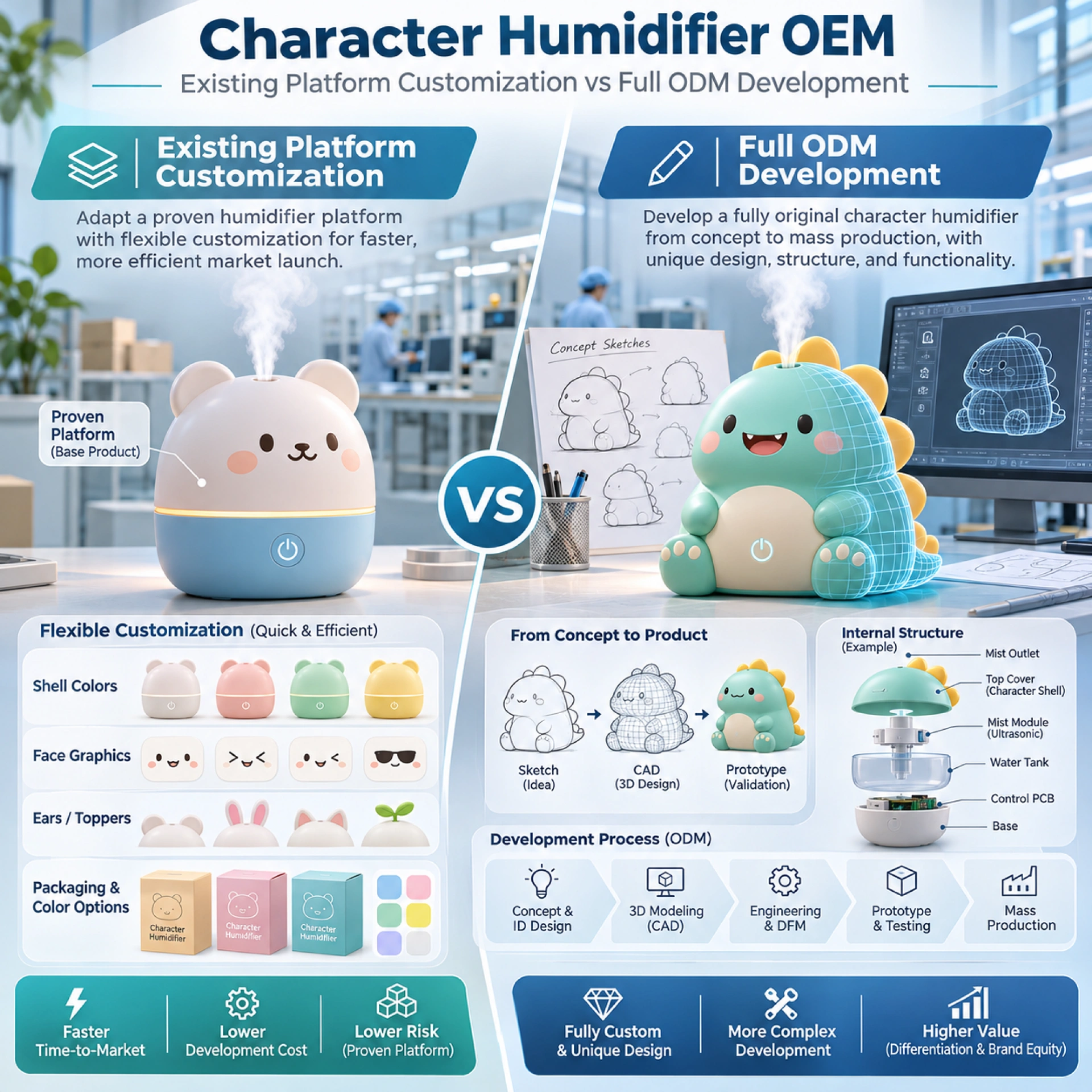
For most Character Humidifier OEM projects, the best development method depends on how much of the existing humidifier’s functional structure can be reused. If a brand mainly needs a custom character appearance, colors, logo or packaging, customizing an existing humidifier platform is often faster, less expensive and technically less risky. If the character requires a completely new water tank, mist outlet, internal structure, PCBA, control system or unique electronic functions, full custom ODM development may be necessary.
The critical decision is not simply whether the product looks different. It is whether the desired character design changes the humidifier’s internal operating system.
An existing platform may already contain a working ultrasonic atomizer, water tank, power circuit, mist channel, buttons and protective functions. A brand can sometimes develop a new character-themed housing around these components while retaining much of the proven functional architecture.
However, a character with mist coming from its mouth, ears, hat or a decorative accessory may require a different mist channel, internal layout or tank geometry. In this case, modifying an existing product may be more difficult than developing a new structure.
For brands, licensed IP owners, gift companies and consumer electronics buyers, Character Humidifier OEM development should therefore begin with a technical feasibility assessment.
The most practical rule is: reuse the existing functional platform where possible, but choose full custom development when the character’s structure or required functions cannot be accommodated safely and reliably.
This guide compares both approaches and explains what buyers should confirm regarding tooling, tank design, ultrasonic atomization, PCBA, mist output, product safety, cost, ownership and mass production.
For a broader overview of character-based electronics, our Character Electronic Gift Manufacturer guide explains how brands develop night lights, humidifiers, Bluetooth speakers, alarm clocks and other functional IP merchandise.
Character Humidifier OEM: Existing Platform vs Full ODM Comparison
| Development Area | Existing Platform Customization | Full Custom ODM Development |
|---|---|---|
| Product Concept | Adapt an existing functional humidifier | Create a new humidifier architecture |
| Character Appearance | Customized housing, colors or decorations | Greater freedom over shape and structure |
| Water Tank | Usually retained or lightly modified | May be redesigned |
| Atomizer | Existing module may be reused | Can be selected for the new design |
| Mist Outlet | Must fit the existing mist path | Can be positioned around the character |
| PCBA | Existing PCBA often retained | New or substantially modified PCBA possible |
| Firmware | Limited function changes | More extensive customization possible |
| Tooling | Depends on the parts changed | Usually requires new production tooling |
| Prototype Development | Typically simpler if the platform fits | More extensive engineering validation |
| Initial Investment | Often lower | Usually higher |
| Development Risk | Generally lower for unchanged systems | Higher because more systems are newly developed |
| Product Differentiation | Limited by the original platform | Greater potential for functional exclusivity |
| Testing | Changes must still be assessed | Broader validation of the new design |
| Best For | Fast product launches and controlled budgets | Unique IP products and proprietary designs |
The actual cost and timeline must be quoted against the specific design. An existing platform with major structural modifications can sometimes approach the cost and complexity of full development.
1. What Does Existing Platform Customization Mean?
Existing platform customization means using an established humidifier’s functional system as the starting point for a branded character product.
The manufacturer may already have a working combination of:
- Ultrasonic atomization module
- Water tank
- Mist outlet
- PCBA
- USB power interface
- Button control
- LED indicator
- Water-level protection
- Internal mounting structure
Instead of designing every component from zero, the manufacturer evaluates which parts can remain unchanged.
Three Levels of Platform Customization
Not all Character Humidifier OEM customization projects are equally simple.
Level A: Cosmetic Customization
The existing product remains structurally unchanged.
Typical changes include:
- Custom colors
- Logo printing
- Character artwork
- Decorative printing
- Packaging
- Instruction manual
This option typically requires the least engineering work.
However, it may offer limited product exclusivity because other brands can potentially use the same functional platform.
Level B: Custom Character Housing
The internal humidifier platform remains substantially unchanged, while the external housing is redesigned.
The brand may request:
- Character-shaped outer shell
- Custom head or body
- Decorative ABS or PVC components
- Modified visual appearance
- Exclusive painted details
- New packaging
This is often an attractive option for licensed IP projects.
The product can look significantly different while retaining much of the existing humidifier system.
However, the manufacturer must still evaluate whether the new housing affects ventilation, moisture movement, electrical safety, stability or access to the water tank.
New molds may be required even when the internal PCBA is unchanged.
Level C: Functional Platform Modification
The buyer retains part of the existing humidifier architecture but requests additional changes.
For example:
- Different LED effects
- Modified button functions
- New mist outlet position
- Different tank capacity
- Revised power interface
- New internal supports
- Updated firmware
This option sits between simple platform customization and full custom development.
It may offer more flexibility, but each change can reduce the time and cost advantages of the original platform.
For Character Humidifier OEM sourcing, buyers should ask the manufacturer to identify exactly which components will remain unchanged.
A product described as “using an existing platform” is not necessarily made entirely from existing components.
2. When Is Full Custom ODM Development Necessary?
Full custom ODM development becomes more appropriate when the brand requires a humidifier with a unique structure, new functionality or architecture that cannot be accommodated by the available platform.
In this context, full custom ODM refers to a manufacturer-led development project in which a new product architecture is created to meet the buyer’s requirements. Commercial use of the terms OEM and ODM varies, so the agreement should describe the actual development and ownership scope rather than relying on the label alone.
Examples of Full Custom Development
A brand may require:
- A uniquely shaped water tank
- A custom mist outlet integrated into the character
- New ultrasonic atomization architecture
- Unusual product proportions
- A completely new PCBA
- Custom lighting sequences
- Sensors or additional electronic functions
- Rechargeable battery integration
- Special control methods
- Bluetooth or Wi-Fi connectivity
These requirements can create changes across the entire product.
Example: A Character That Releases Mist From Its Mouth
Imagine a brand wants a small dragon-shaped humidifier.
The mist must emerge from the dragon’s mouth while the main water tank is located inside its body.
A normal tabletop humidifier platform may have a vertical mist outlet directly above the atomization chamber.
Redirecting mist through the dragon’s neck and mouth may create problems such as:
- Condensation inside the channel
- Water collecting in low points
- Reduced mist output
- Leakage around internal joints
- Difficult cleaning
- Increased assembly complexity
The project may need a redesigned mist pathway and new internal structure.
At that point, the buyer should compare the cost of modifying the existing platform with the cost of developing a new humidifier architecture.
A visually distinctive product is not automatically a full ODM project. But a distinctive function or internal structure often requires deeper engineering.
3. Water Tank Design: The First Major Engineering Decision
Water tank design is one of the most important differences between existing platform customization and full Character Humidifier OEM development.
The tank affects:
- Overall product dimensions
- Usable water capacity
- Product stability
- Filling method
- Cleaning access
- Sealing
- Internal electronics placement
- Mist channel configuration
A character figure can use almost all its internal space for structural supports or decoration.
A humidifier cannot.
It must contain a functional water system.
Existing Platform Water Tank
If the manufacturer already has a suitable tank, retaining it can reduce engineering work.
The character housing can be designed around the existing tank dimensions.
However, the external character must still allow users to:
- Fill the tank
- Remove the tank or access its opening
- Empty remaining water
- Clean internal surfaces
- Reassemble the product correctly
A character-shaped cover should not make normal cleaning unnecessarily difficult.
Fully Customized Water Tank
A new tank may be required when the character’s shape does not accommodate the existing one.
For example, a character with a very narrow body and oversized head may have insufficient usable volume in the torso.
The designer might consider placing water in the head instead, but this changes the center of gravity and potentially complicates sealing and filling.
The engineering team should evaluate the new tank geometry before the external character dimensions are finalized.
Tank Capacity Is Not the Same as Runtime
Buyers sometimes specify a tank capacity and assume it guarantees a particular operating time.
However, runtime depends on the actual mist output, usable water volume, control mode and relevant system behavior.
A useful engineering estimate is:
Approximate runtime = usable water volume ÷ average water consumption rate
For example, a hypothetical 200 mL usable tank with an average consumption rate of 40 mL per hour would have an estimated five-hour runtime under those assumptions.
Real product performance must be measured, and the calculation should not be treated as a guaranteed specification.
4. Mist Outlet and Atomization: Can the Character Design Support the Function?
The atomization system creates the mist. The mist pathway determines how it exits the product.
These systems must be considered together.
For small character humidifiers, ultrasonic atomization is a common technical approach.
An ultrasonic humidifier uses a vibrating element to produce fine droplets from water.
However, a Character Humidifier OEM project must integrate this system into a decorative enclosure without compromising performance.
Key Engineering Questions
Before choosing an existing platform, ask:
- Where is the atomizer located?
- How does mist travel to the outlet?
- Is a fan or another airflow arrangement involved?
- Can the mist exit without collecting inside the housing?
- Will condensation reach electronic components?
- Can the mist outlet be cleaned?
- Does the character design obstruct the mist?
- What happens if the product is tilted?
- Does the system stop appropriately when the water level is insufficient?
Why Mist Outlet Position Matters
A character may look more appealing when mist comes from its mouth, nose, ears, hat or accessory.
But a longer or more complex mist channel can increase condensation and create additional maintenance needs.
For example, a mist outlet positioned inside a decorative hat may look attractive, but the manufacturer must confirm that water does not collect inside the hat and drip onto the housing.
The appropriate internal channel should be developed and validated through functional prototypes.
Why Existing Mist Modules Still Need Validation
Even if the atomizer and PCBA have previously been used in a standard humidifier, the completed character product may perform differently.
Changing the enclosure can affect:
- Airflow
- Mist direction
- Condensation
- Surface wetting
- Noise
- Stability
- Maintenance access
Therefore, existing-platform customization does not eliminate the need for finished-product testing.
5. PCBA and Electronic Functions: What Can Be Reused?
The PCBA is another major difference between platform customization and full development.
For a basic character humidifier, the electronic system may include:
- Main control circuit
- Ultrasonic atomizer driver
- Power management
- USB-C input
- Push button or touch control
- LED indicator
- Water-level sensing or protection
- Timer functions
An existing PCBA may be adequate if the brand does not require major functional changes.
When Can the Existing PCBA Be Retained?
Reusing the PCBA may be practical when:
- The original atomization module is retained
- Operating voltage remains unchanged
- Button functions are suitable
- LED requirements are compatible
- Physical board dimensions fit the new housing
- Relevant protection functions remain appropriate
The manufacturer should still test the assembled product with the final character enclosure.
When Is a New PCBA Needed?
A new or modified PCBA may be required when the brand requests:
- Additional LED channels
- More complex lighting animations
- New sensors
- Rechargeable battery integration
- Different power requirements
- Bluetooth control
- Wi-Fi connectivity
- Advanced timer functions
- Different atomization hardware
These changes introduce additional engineering, component selection, firmware development and testing.
Firmware vs Mobile App
A Character Humidifier OEM project may need embedded firmware to control mist output, lighting, buttons, sensors and automatic shutdown functions.
However, firmware is not the same as a mobile app.
A basic humidifier with local controls does not need a custom iOS or Android application.
If a buyer wants Bluetooth or Wi-Fi control, app requirements should be quoted separately.
Our PCBA Firmware App Development guide explains the differences between electronic hardware, embedded firmware and mobile app development.
For complex connected products, Jiahong Creative can support relevant hardware and embedded firmware development while coordinating full mobile app or cloud development with external software partners where required.
6. Existing Platform vs Full ODM: Tooling, Cost and MOQ
The main commercial advantage of an existing platform is the potential to reuse previously developed functional components.
However, buyers should understand exactly which costs can be reduced.
Existing Platform Cost Structure
A platform-based Character Humidifier OEM project may require:
- Artwork review
- New character housing design
- Structural adjustment
- Prototype
- New housing molds, if needed
- Decoration or painting
- Existing functional components
- Assembly
- Packaging
- Testing or reassessment
The internal atomizer, PCBA and tank may be reused, depending on the customization scope.
Full Custom ODM Cost Structure
A full custom project may additionally require:
- Complete industrial design
- New internal mechanical engineering
- Custom water tank
- New atomization layout
- New PCBA design
- Firmware development
- Multiple functional prototypes
- More extensive tooling
- Additional engineering validation
This usually increases non-recurring engineering costs and the number of technical milestones.
Cost Comparison
| Cost Item | Existing Platform | Full Custom ODM |
|---|---|---|
| Industrial Design | Limited or partial redesign | Full development |
| Functional Engineering | Mostly existing | New architecture |
| PCBA Development | Often reusable | May require new design |
| Firmware | Existing or modified | Custom development possible |
| Water Tank Tooling | May be reused | Often new |
| Character Housing Tooling | May be new | Usually new |
| Prototyping | Adaptation and verification | More extensive validation |
| Testing | Change-based assessment and finished-product validation | Full assessment of the new design |
| Unit Cost | Depends on components and volume | Depends on custom architecture |
| Development Investment | Often lower | Usually higher |
Is MOQ Lower With an Existing Platform?
Not necessarily.
MOQ depends on more than engineering complexity.
Factors include:
- New mold requirements
- Material ordering quantities
- Custom color production
- Packaging
- Component purchasing
- Production-line setup
- Assembly requirements
- Supplier commercial terms
A project using an existing PCBA but requiring an exclusive injection-molded character housing may still have a substantial MOQ.
Buyers should request a product-specific quotation rather than assuming platform customization automatically allows a very small order.
7. Development Timeline: Which Method Is Faster?
Existing platform customization is often faster because the main functional architecture has already been developed.
However, the schedule depends on how much modification is required.
Existing Platform Development Flow
Choose Platform → Character Design → Structural Fit Review → Prototype → Tooling if Needed → Functional Validation → Production
Full Custom ODM Development Flow
Product Specification → Industrial Design → Water System Engineering → Electronic Architecture → Functional Prototype → Design Revision → Tooling → Validation → Production
The full custom process contains more technical dependencies.
For example, the external mold should not be released before the water tank, PCBA, mist outlet and internal supports have been sufficiently defined.
What Can Delay Either Project?
Common causes of delays include:
- Frequent character design revisions
- Changes to tank capacity
- Moving the mist outlet
- Adding new electronic functions
- Changing power requirements
- Product classification changes
- Failed leakage tests
- Condensation problems
- Packaging revisions
A realistic Character Humidifier OEM schedule should include time for engineering review, samples, revisions, applicable testing and approval.
Manufacturers should not promise a fixed lead time before the development scope is clear.
8. Product Safety, Hygiene and Cleaning Requirements
A character humidifier is a functional appliance that handles water.
It should not be evaluated only as a decorative electronic gift.
The design must account for normal use, cleaning, water quality, electrical construction and applicable product safety requirements.
Water Quality and Cleaning
The U.S. Environmental Protection Agency explains in its official Use and Care of Home Humidifiers guidance that ultrasonic and impeller humidifiers can disperse minerals and microorganisms from water tanks into indoor air.
EPA recommends measures such as using low-mineral water, changing water regularly and cleaning portable humidifiers frequently.
For Character Humidifier OEM development, this creates practical design questions:
- Can users empty the tank completely?
- Are interior surfaces accessible for cleaning?
- Are there narrow areas that trap stagnant water?
- Can the tank dry properly?
- Are cleaning instructions understandable?
- Is the product easy to disassemble and reassemble where appropriate?
A decorative character shell should not obstruct cleaning access.
Avoid Unsupported Health Claims
A buyer should not describe an ordinary ultrasonic humidifier as sterilizing, disinfecting or producing medically beneficial mist unless those claims are supported and the applicable legal requirements are addressed.
The actual function, intended use and available evidence should determine the product’s marketing claims.
Appliance Safety
The international standard IEC 60335-2-98:2023 covers particular safety requirements for household and similar electrical humidifiers.
Notably, the 2023 edition includes additional provisions addressing humidifiers shaped or decorated like toys.
This is particularly relevant to character-themed designs.
A manufacturer may have previous test reports for a standard humidifier platform, but changes to the outer enclosure, accessible parts, stability or electrical construction may affect the finished product’s compliance.
Target-Market Requirements
For EU-market electronic humidifiers, buyers should review applicable legislation, potentially including:
- Product-specific electrical safety requirements
- Electromagnetic compatibility
- RoHS material restrictions
- Radio equipment requirements if wireless features are present
- Product labeling and instructions
The European Commission’s EMC Directive guidance explains requirements concerning electromagnetic disturbance and immunity.
The EU RoHS Directive addresses restrictions on certain hazardous substances in electrical and electronic equipment.
The exact conformity assessment path must be determined from the finished product’s electrical ratings, functions, classification and target market.
An existing platform’s test report is useful supporting information, but it does not automatically establish compliance for every newly customized character humidifier.
9. Prototype Validation: What Must Be Tested Before Tooling?
One of the biggest mistakes in Character Humidifier OEM development is approving a cosmetic 3D sample without validating the internal water and electronic systems.
A visual prototype can show character proportions and painting quality.
It cannot demonstrate reliable mist output, leakage resistance or electronic function.
Prototype Validation Checklist
| Test Area | What Buyers Should Confirm |
|---|---|
| Mist Output | Meets the agreed operating specification |
| Mist Direction | Exits the character at the intended position |
| Condensation | Does not cause unacceptable internal water accumulation |
| Water Tank | Fills, empties and closes correctly |
| Leakage | Meets the agreed test conditions |
| Dry-Run Protection | Responds appropriately to low or empty water level |
| Power Input | Correct operation under specified power conditions |
| PCBA | Stable functional performance |
| LED Functions | Correct lighting and control |
| Noise | Meets the approved product specification |
| Cleaning | Tank and water-contact parts are accessible |
| Stability | Product remains stable during expected use |
| Assembly | No unacceptable gaps, wiring problems or interference |
| Surface Finish | Character colors and painting match approval |
| Packaging | Protects the finished product during shipment |
The engineering team should define the test methods and acceptance criteria based on the actual product.
Why Mist Outlet Testing Matters
Consider a character whose mist emerges through a long decorative channel.
A prototype may initially produce visible mist.
However, during extended operation, condensation may form inside the channel.
Over time, water may collect or flow into an unintended area.
This is why a short demonstration video is not enough to approve the final engineering design.
The buyer should request functional testing under agreed operating conditions.
Production-Intent Samples
Before mass production, the buyer should approve samples that represent:
- Final tank material
- Actual atomization module
- Production PCBA
- Final or representative internal structure
- Intended seals and joints
- Production assembly method
- Approved character exterior
Major substitutions after testing should be reviewed because they may affect performance and compliance.
10. Example: Developing a Licensed Character Humidifier
Consider a fictional licensed character called Cloud Bear.
The brand wants a desktop humidifier with a rounded body, soft facial appearance, LED lighting and mist emerging from a cloud-shaped accessory above the head.
The project can be evaluated through two different development approaches.
Option A: Existing Platform Customization
The manufacturer has a compact humidifier platform with:
- Suitable water capacity
- Established atomization system
- Existing PCBA
- USB-C input
- Basic LED function
- Suitable mist outlet configuration
The new Cloud Bear shell is developed around this platform.
The project may retain the tank, atomization module and PCBA while requiring new exterior molds and decoration.
Advantages may include lower development investment and reduced technical risk.
However, the brand must accept some limitations imposed by the existing platform’s dimensions and mist pathway.
Option B: Full Custom ODM Development
The brand requires mist to exit through a decorative cloud above the character, with a completely different tank position and special lighting effects.
The engineering team may need to develop:
- New water tank
- Custom mist channel
- New housing structure
- Modified atomization layout
- Revised PCBA
- New firmware
- Custom internal assembly
- Additional tooling
This provides greater creative freedom but increases engineering and validation requirements.
Which Option Is Better?
If the available platform can accommodate the character’s functional requirements, Option A may provide a more efficient first launch.
If the unique mist location and product silhouette are essential to the brand’s positioning, Option B may be justified.
The decision should be based on engineering feasibility and the total project budget, not only the visual rendering.
This is the central sourcing decision in Character Humidifier OEM development.
11. Buyer RFQ Checklist: What to Ask Before Requesting a Quote
Before contacting a Character Humidifier OEM manufacturer, buyers should prepare information about both the character design and the humidifier function.
| RFQ Item | Buyer Should Provide or Confirm |
|---|---|
| Character Artwork | Approved 2D artwork or 3D files |
| IP Authorization | Product-category and territory rights |
| Development Method | Existing platform or full custom |
| Product Size | Target height, width and depth |
| Water Capacity | Target usable tank volume |
| Mist Output | Required performance or operating modes |
| Mist Outlet | Preferred position |
| Power Supply | USB-C, adapter or battery |
| LED Functions | Indicator, decorative light, RGB or timer |
| Control | Buttons, touch, sensors or app |
| Materials | ABS, silicone, decorative PVC or other |
| Cleaning | Tank access and maintenance requirements |
| Target Age | Intended user and product positioning |
| Target Market | USA, EU, UK, Japan or other |
| Testing | Applicable safety and technical evaluation |
| Packaging | Color box, protective tray and accessories |
| Quantity | Expected units per design |
| Tooling | Mold ownership and exclusivity requirements |
| Software | Firmware and optional app responsibilities |
| Timeline | Target sample and launch schedule |
Questions to Ask an Existing Platform Supplier
Buyers should request clear answers to the following:
- Which functional components are already developed?
- Can the water tank be reused without modification?
- Can the character housing be redesigned independently?
- Can the mist outlet position be changed?
- Which PCBA functions can be modified?
- Which molds are existing and which must be developed?
- What existing technical reports are available?
- Which product changes require additional evaluation?
- Who owns the platform design and new character tooling?
- What are the MOQ, development costs and mass-production prices?
Questions to Ask for Full ODM Development
A full custom project should additionally clarify:
- Who develops the internal functional architecture?
- Who selects the atomization system?
- Who designs the PCBA?
- Who owns the electronic design files?
- Who develops and maintains the firmware?
- Which sample stages are included?
- How many design revisions are covered?
- What testing must be completed before tooling?
- Who owns the new molds?
- What happens if engineering changes are needed?
- What support is provided after shipment?
These questions help prevent disputes about costs, ownership and development responsibilities.
12. How Jiahong Creative Supports Character Humidifier OEM Development
Jiahong Creative supports OEM/ODM character electronic product development by combining industrial design, structural engineering, mold making, injection molding, PCBA, assembly, surface finishing and quality control.
Our manufacturing capabilities can support suitable projects involving:
- Character artwork and product concept review
- 3D modeling
- Functional feasibility evaluation
- Structural engineering
- Prototype development
- Mold design and manufacturing
- Plastic injection molding
- Silicone product manufacturing
- PCBA integration
- LED and embedded function development
- Product painting and decoration
- Final assembly
- Functional testing
- Packaging and QC
For Character Humidifier OEM projects, we can evaluate whether an existing functional platform is suitable for the requested design or whether deeper custom engineering is needed.
The development scope may involve adapting an existing product architecture, designing a new character exterior or coordinating more extensive structural and electronic development.
The appropriate solution depends on the artwork, functional requirements, project quantity, development budget and target market.
Character Design and Functional Engineering
For licensed IP and mascot products, maintaining character accuracy is important.
However, a humidifier must also function as a reliable water-handling electronic product.
The project therefore needs to coordinate:
Character Appearance + Water Tank + Mist System + PCBA + Internal Structure + Assembly
Our Character Figure to Lifestyle Product guide explains how licensed characters can expand from PVC collectibles into functional products, including humidifiers, night lights, speakers and daily-use electronic merchandise.
For brands comparing decorative collectibles with functional electronic products, the Character Figure vs Character Electronic Product article also explains how product engineering requirements change when electronics are introduced.
Request a Character Humidifier OEM Quotation
If your brand is developing a custom character humidifier, please share:
- Character artwork or 3D model
- Target dimensions
- Preferred development approach
- Required tank capacity
- Mist outlet concept
- Lighting and control functions
- Target market
- Estimated order quantity
- Packaging requirements
- Target launch timeline
With these details, our team can review whether the product is better suited to platform customization or a more extensive custom development project.
Contact Jiahong Creative for Character Humidifier OEM Development.
Final Thoughts
Choosing between existing platform customization and full ODM development is one of the most important decisions in a Character Humidifier OEM project.
An existing platform can reduce development time, tooling requirements and technical risk when its water tank, atomization system, PCBA and internal structure already match the brand’s functional needs.
Full custom ODM development may be necessary when the character design requires a new water tank, unique mist pathway, different internal architecture or new electronic features.
Neither approach is automatically better.
The most efficient manufacturing solution is the one that provides the required character identity and product functionality without creating unnecessary engineering complexity.
For buyers, the most important decisions should be made before tooling:
- Can the existing water tank be reused?
- Can the mist outlet support the character design?
- Is the existing PCBA suitable?
- Which components require new molds?
- Can the product be cleaned properly?
- Will the completed enclosure affect safety or performance?
- What testing and documentation are needed?
- Who owns the customized tooling and product design?
Reuse mature functions when they fit. Develop a new architecture when they do not.
That is the foundation of a practical Character Humidifier OEM manufacturing strategy.
FAQ
1. What is Character Humidifier OEM?
Character Humidifier OEM refers to the development and manufacturing of customized humidifiers featuring licensed characters, mascots, cartoons or original brand IP. Projects may involve customizing an existing humidifier platform or developing a new product with unique structure and electronic functions.
2. What is the difference between existing platform customization and full ODM development?
Existing platform customization reuses an established functional humidifier system while changing selected external or internal features. Full custom ODM development creates a new or substantially redesigned product architecture to meet unique functional and structural requirements.
3. Which option is cheaper for a custom character humidifier?
Existing platform customization is often less expensive when most functional components can be reused. Full custom development generally requires more engineering, tooling and validation. The actual difference depends on the design and the components that must change.
4. Can a manufacturer put a custom character shell over an existing humidifier?
Sometimes. The existing platform must fit inside the new housing without compromising mist flow, cleaning access, structural stability, electrical safety or assembly. A new shell may still require separate molds and finished-product testing.
5. Can the mist come from a character’s mouth or hat?
Yes, such designs may be technically possible. However, the mist outlet must be engineered to control condensation, water accumulation, leakage and performance. Complex outlet positions may require a custom mist channel or new internal structure.
6. Can an existing humidifier PCBA be reused?
Yes, when its electrical and functional specifications match the new product. Changes to the atomizer, LEDs, sensors, power supply or controls may require PCBA modification or redevelopment.
7. Does a Character Humidifier OEM project need firmware development?
Basic humidifiers may use existing embedded control logic. Customized lighting effects, sensor functions, timers or advanced controls may require firmware changes. Complete mobile app development is a separate scope.