

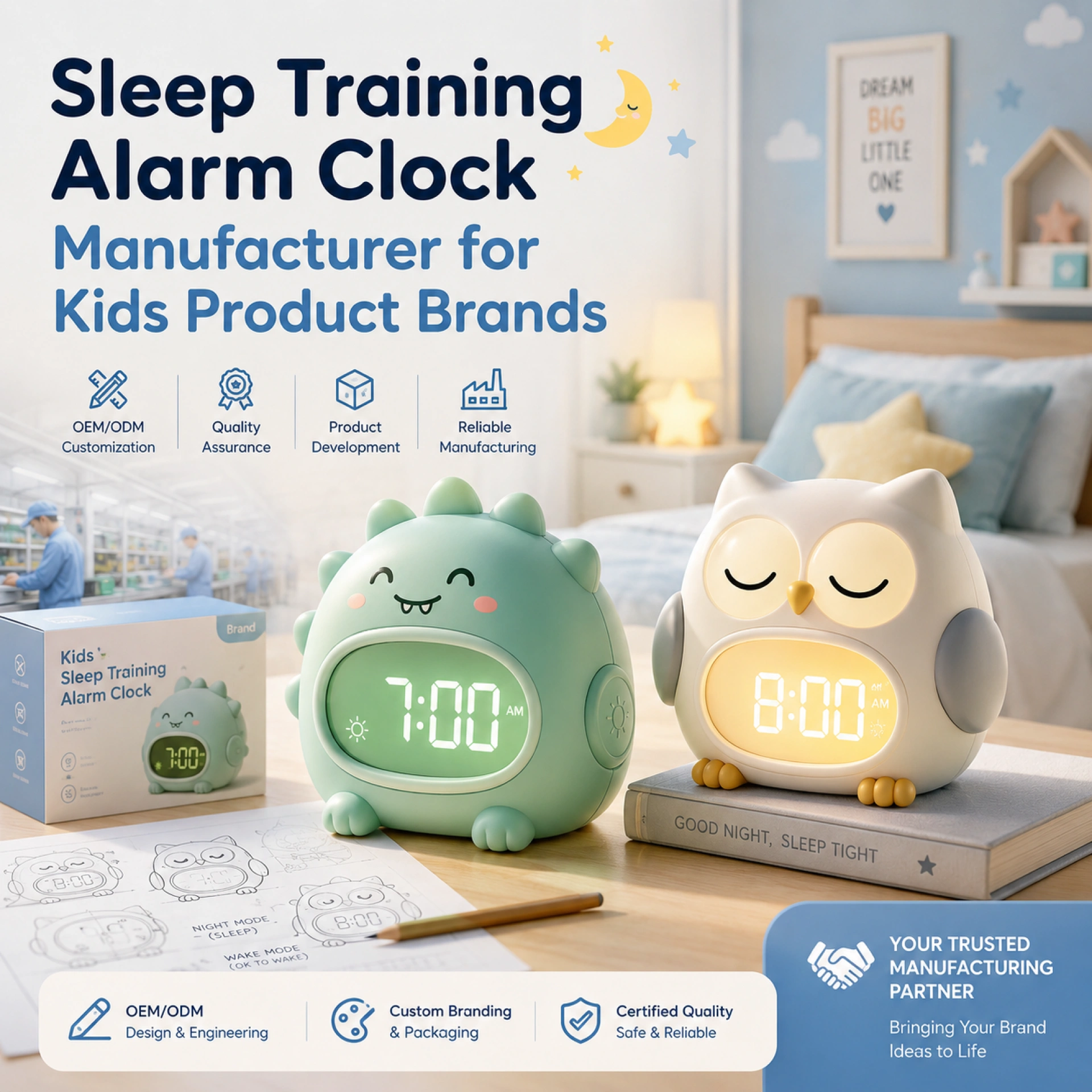
For kids product brands, working with a reliable sleep training alarm clock manufacturer can help turn a simple electronic product into a valuable daily-use item for families. A sleep training alarm clock is not only an alarm clock. It can combine visual sleep guidance, wake-up routines, LED night light, sound machine functions, music playback, child-friendly design, and brand customization into one product.
Parents often look for tools that help children understand bedtime and wake-up time more easily. Young children may not fully understand a traditional clock, but they can understand colors, icons, lights, sounds, and simple visual cues. This is why sleep training alarm clocks have become popular in the children’s product market. They help brands create products that are practical, emotional, and suitable for family routines.
For brands, retailers, distributors, IP owners, and gift companies, choosing the right sleep training alarm clock manufacturer is important. The product involves industrial design, plastic molding, electronics, LED lighting, speaker performance, battery safety, user interface, packaging, testing, and mass production. If these details are not planned carefully, the final product may look attractive but fail to deliver a stable user experience.
This guide explains what kids product brands should prepare before developing a sleep training alarm clock, how OEM and ODM development works, what functions matter, and how to choose a suitable sleep training alarm clock manufacturer for long-term cooperation.
If you are looking for a ready product reference, you can review our kids sleep training alarm clock to understand how a children’s alarm clock can combine sleep guidance, lighting, sound, and brand-friendly design.
What Is a Sleep Training Alarm Clock?
A sleep training alarm clock is a child-friendly clock designed to help children understand when it is time to sleep, stay in bed, or wake up. Instead of relying only on numbers, it often uses colors, facial expressions, icons, light changes, music, or sound cues to communicate time in a way that children can understand.
A sleep training alarm clock manufacturer may develop products with functions such as:
- Digital clock display
- Wake-up alarm
- Sleep trainer light
- LED night light
- Adjustable brightness
- Sound machine
- White noise or lullaby sounds
- Bluetooth music playback
- Timer settings
- Nap mode
- Child lock
- USB or Type-C charging
- Rechargeable battery
- Cute character appearance
- Custom brand logo
- Custom packaging
For kids product brands, the most important value is not only the clock function. The real value is helping families build a more structured bedtime and wake-up routine. A well-designed sleep training alarm clock can become part of a child’s room, bedtime ritual, and morning habit.
Why Kids Product Brands Need This Category
Sleep training alarm clocks are attractive for kids product brands because they combine function, design, and emotional value. Unlike a simple toy, the product has practical use. Unlike a standard digital clock, it can be designed with a cute appearance, soft light, sound features, and parent-friendly settings.
A sleep training alarm clock can be suitable for:
- Children’s product brands
- Baby and toddler product brands
- Educational product brands
- Lifestyle retailers
- Gift product companies
- Licensed IP owners
- E-commerce brands
- Supermarket and retail chains
- Promotional product buyers
- Private label brands
For many brands, this product category is also a good bridge between toys and small electronic home products. It can look cute and playful, but it still needs reliable electronic design and quality control. This makes supplier capability especially important.
A professional sleep training alarm clock manufacturer should understand both the children’s product market and electronic product manufacturing. The manufacturer should know how to balance appearance, safety, usability, cost, packaging, and mass production stability.
If your brand is also developing other kids room products, you can read our article on working with a custom night light manufacturer to understand how lighting products are developed for brands.
Why Bedtime Routine Matters in Product Positioning
A sleep training alarm clock should not be promoted as a medical product. It should be positioned as a helpful routine-building product for families. The American Academy of Pediatrics’ parent resource HealthyChildren.org suggests setting up a quiet bedtime routine to help children understand that it will soon be time to sleep. This kind of guidance shows why routine-based products can be meaningful for families.
When developing product content, packaging, and sales pages, brands should focus on practical language such as:
- Helps children understand bedtime and wake-up time
- Supports a more consistent bedtime routine
- Uses light and sound cues for easier time recognition
- Designed for kids’ bedrooms and family routines
- Combines alarm clock, night light, and sound machine functions
A sleep training alarm clock manufacturer can help brands develop the product structure and functions, but brands should also prepare clear product positioning. The product should be easy for parents to understand and simple for children to use.
OEM Sleep Training Alarm Clock Manufacturing
OEM manufacturing is suitable for brands that already have a clear product design or unique concept. The buyer may provide industrial design drawings, 3D files, functional specifications, UI requirements, color references, packaging artwork, and market requirements.
In an OEM project, the sleep training alarm clock manufacturer helps turn the buyer’s design into a production-ready product. This may include structural engineering, mold design, PCBA development, LED layout, speaker selection, display design, button design, battery placement, firmware coordination, assembly process planning, and packaging production.
For OEM sleep training alarm clock projects, buyers should prepare:
- Product concept or design drawings
- Target product size
- Display requirements
- Light color and brightness requirements
- Sound or white noise requirements
- Alarm setting logic
- Button or touch control design
- Battery capacity expectation
- Charging method
- Logo and brand color references
- Packaging style
- Target market
- Quantity estimate
- Testing and certification requirements
OEM is suitable when the brand wants a unique product with stronger differentiation. However, it usually requires more development time, more engineering discussion, and more tooling investment.
ODM Sleep Training Alarm Clock Manufacturing
ODM manufacturing is suitable for brands that want to launch a product faster by using an existing product structure, proven design direction, or mature development experience from the manufacturer.
In an ODM project, a buyer may choose an existing sleep training alarm clock product and customize the color, logo, packaging, sound content, UI interface, outer decoration, brand story, or character elements. This can reduce early development risk and shorten the timeline.
A sleep training alarm clock manufacturer with ODM capability can help buyers choose from existing solutions and explain which parts can be customized. For example, the buyer may be able to customize:
- Product shell color
- Button color
- Logo printing
- Packaging artwork
- User manual
- Sound options
- Light color settings
- Character decoration
- Retail bundle
- Brand sticker or label
- Display language
- Gift box style
ODM is useful for private label brands, retailers, e-commerce sellers, and gift companies that want to test the market before investing in a fully customized product.
However, buyers should still confirm quality standards, testing needs, packaging details, and market compliance. ODM does not mean the product can skip professional review.
Key Functions Buyers Should Consider
A sleep training alarm clock manufacturer should help buyers define the right functions based on target users, price range, and sales channel. Too many functions can increase cost and make operation complicated. Too few functions may reduce product value.
Sleep Trainer Light
The sleep trainer light is one of the most important functions. It can use different colors to show sleep time and wake-up time. For young children, color cues are easier to understand than numbers.
For example, a soft warm color may indicate bedtime, while another color may indicate wake-up time. The exact color logic should be simple and easy for parents to explain.
Digital Clock Display
A clear clock display is important for parents and older children. Buyers should confirm display size, brightness, viewing angle, time format, and whether the display should dim at night.
A bright display may look good in photos, but it should not be too strong for bedroom use. Adjustable brightness is usually a useful feature.
LED Night Light
A built-in night light can make the product more useful. It can help children feel more comfortable in the dark and support bedtime routines. The night light should be soft, stable, and adjustable.
For kids products, warm and gentle lighting is usually more suitable than harsh white light.
Sound Machine Function
Some sleep training alarm clocks include sound machine features, such as white noise, lullabies, nature sounds, or soft music. These sounds can support a calm bedtime environment.
If the product includes built-in sounds, buyers should confirm sound quality, volume control, speaker position, sound loop, and whether the sound content is licensed or original.
Bluetooth Music Playback
Bluetooth can add value if the product is positioned as a multifunctional kids room product. However, Bluetooth also affects electronics, app or pairing logic, testing requirements, and market certification.
For products with wireless functions, buyers should discuss applicable market requirements with qualified testing laboratories.
Alarm and Timer Settings
The alarm logic should be simple. Parents should be able to set wake-up time, nap time, and sleep time without confusion. A child lock function can help prevent children from changing settings accidentally.
Child-Friendly Interface
A kids sleep training alarm clock should be easy to operate. Buttons should be clear, icons should be understandable, and the product should not require complicated setup every day.
The user interface is a key point in product success. A product with many functions but poor operation may receive negative customer feedback.
Product Design Considerations
A sleep training alarm clock manufacturer should review the product design from both appearance and engineering perspectives.
Appearance Design
The product should look friendly for children’s rooms. Cute animal shapes, soft rounded edges, simple facial expressions, and warm colors can make the product more attractive.
If the product is for a licensed IP brand, the appearance should match the character style. Character consistency is important because parents and fans can quickly notice design differences.
Structure and Durability
Children’s products should be designed with durability in mind. The product may be touched, moved, dropped, or pressed repeatedly. The shell structure, buttons, speaker holes, charging port, and display window should be designed for everyday use.
Material Selection
Common materials may include ABS, PC, silicone, PVC decorative parts, and electronic components. ABS is often used for structural shells. Silicone can be used for soft-touch parts. PVC may be used for decorative character elements.
Material selection should match product positioning, safety expectations, and production cost.
Battery and Charging Design
If the product is rechargeable, battery placement and charging safety are important. Buyers should confirm battery capacity, working time, charging time, charging port, protection circuit, and testing requirements.
The sleep training alarm clock manufacturer should also check internal space, heat management, wire routing, and assembly stability.
Sound and Speaker Design
If the product includes music, white noise, or Bluetooth playback, speaker placement affects sound quality. A small product may have limited internal space, so the acoustic design should be considered early.
Packaging Fit
Packaging should be planned based on product size, accessories, charger cable, manual, and retail display needs. Good packaging can protect the product and improve perceived value.
If your project needs retail packaging, you can also review our guide on working with a custom toy packaging manufacturer to understand packaging preparation, box structure, and brand consistency.
Safety and Compliance for Kids Electronic Products
A sleep training alarm clock is usually an electronic product. If it is designed for children or used in children’s bedrooms, safety and compliance should be considered carefully.
For the European market, buyers may need to review CE marking, RoHS, EMC, battery safety, packaging labels, and user instructions. The RoHS Directive is especially relevant for electrical and electronic equipment because it restricts certain hazardous substances.
For the U.S. market, products with radio frequency functions, Bluetooth, or wireless features may need to review FCC equipment authorization. Even products without wireless functions may still need electrical safety and electromagnetic compatibility review depending on product design and sales channel.
If the product is marketed as a toy or for young children, buyers may also need to consider toy safety requirements, age grading, warning labels, and material testing. The exact requirements depend on the target market, intended age group, product functions, and sales channel.
A sleep training alarm clock manufacturer can help prepare samples and production information, but buyers should confirm the final test scope with qualified laboratories and compliance professionals.
Packaging for Sleep Training Alarm Clocks
Packaging is important for both retail sales and customer understanding. A sleep training alarm clock may have several functions, so the packaging should explain the product clearly without overwhelming the buyer.
Good packaging may include:
- Product name
- Main function icons
- Sleep trainer explanation
- Night light function
- Sound machine function
- Alarm function
- Battery and charging information
- Age recommendation
- Safety warnings
- Brand logo
- Product images
- Barcode
- User manual
- Importer or distributor information, if needed
For kids product brands, packaging should look trustworthy, warm, and easy to understand. Parents want to know what the product does and whether it is suitable for their child’s room.
The packaging style should also match the product design. A cute clock should not use cold or overly technical packaging. A premium kids room product should not use low-quality printing or weak box structure.
Quality Control Before Mass Production
A professional sleep training alarm clock manufacturer should have a clear quality control process. Since the product includes both plastic parts and electronics, QC should cover appearance, function, assembly, packaging, and safety-related checks.
Important QC points include:
- Shell appearance inspection
- Display brightness check
- LED light test
- Button or touch control test
- Alarm function test
- Timer function test
- Sound playback test
- Bluetooth connection test, if applicable
- Charging test
- Battery performance check
- Speaker sound check
- Assembly gap inspection
- Drop or transport simulation check
- Packaging inspection
- Final carton packing check
For rechargeable electronic products, function testing should be done carefully. A product that looks good but has unstable charging, weak battery life, poor sound quality, or confusing controls may create customer complaints.
How to Choose a Sleep Training Alarm Clock Manufacturer
Choosing the right sleep training alarm clock manufacturer is not only about price. Buyers should evaluate technical capability, product experience, communication quality, sample support, testing awareness, and production stability.
Before choosing a supplier, buyers should ask:
- Do you support OEM and ODM sleep training alarm clock projects?
- Can you support product design and structural engineering?
- Do you have experience with kids electronic products?
- Can you handle mold making and injection molding?
- Do you support PCBA development and assembly?
- Can you support LED, sound, Bluetooth, and battery functions?
- Can you provide retail packaging support?
- What QC steps do you follow before shipment?
- Can you prepare samples for third-party testing?
- What information do you need for quotation?
A good sleep training alarm clock manufacturer should be able to discuss both product appearance and internal functions. If a supplier only focuses on the shell design and ignores electronics, the final product may not be reliable. If a supplier only focuses on electronics and ignores children’s product design, the product may not be attractive to the target market.
Why Integrated Manufacturing Is Easier
Sleep training alarm clocks involve multiple production areas. The outer shell requires plastic molding. Decorative parts may require PVC or silicone. The internal system requires PCBA, LED, speaker, battery, and control logic. The final product needs assembly, testing, packaging, and shipment.
If these steps are handled by different suppliers, communication can become slow and complicated. One supplier may change the structure, another may need to adjust the electronics, and another may need new packaging dimensions. This can increase time and risk.
Working with an integrated sleep training alarm clock manufacturer makes development easier. Design, structure, mold, PCBA, assembly, quality inspection, and packaging can be reviewed together. This helps reduce product mismatch, function problems, packaging errors, and production delays.
For brand owners, integrated manufacturing also makes it easier to maintain product consistency from sample to mass production.
How Jiahong Creative Supports Sleep Training Alarm Clock Projects
Jiahong Creative supports OEM and ODM development for kids sleep training alarm clocks, character night lights, creative electronic gifts, and IP-themed household products. Our team can help brands with product design review, 3D modeling, structural engineering, mold making, injection molding, PCBA coordination, assembly, quality inspection, packaging, and shipment support.
For kids product brands, we can support both product function and appearance customization. This may include custom colors, logo printing, character design, packaging artwork, function adjustment, and product positioning support.
If you are developing a sleep trainer product, you can start by reviewing our kids sleep training alarm clock. If your brand also wants to develop related electronic gift products, our article on character themed electronic products may also help you understand how character design and electronics can be combined.
To start a project, you can contact us through our custom product inquiry page. Please share your product idea, reference images, target quantity, function requirements, packaging needs, and target market.
Final Thoughts
A sleep training alarm clock manufacturer plays an important role in helping kids product brands develop practical, attractive, and market-ready electronic products. A successful sleep training alarm clock should not only look cute. It should also have clear functions, simple operation, safe electronics, stable lighting, good sound quality, suitable packaging, and reliable mass production.
For OEM projects, buyers should prepare detailed product requirements and design files. For ODM projects, buyers can customize existing product structures to reduce development time and launch faster.
Whether your brand is developing a sleep trainer clock, kids alarm clock, night light clock, sound machine clock, or character-based electronic gift, early communication with the manufacturer is essential. When design, electronics, structure, packaging, testing, and QC are planned together, the final product will be more suitable for children’s product brands and family markets.
FAQ
1.What does a sleep training alarm clock manufacturer do?
A sleep training alarm clock manufacturer helps brands develop and produce kids alarm clocks with sleep trainer functions, night light, sound machine, digital clock display, alarm settings, battery design, packaging, and mass production support.
2.What is a sleep training alarm clock?
A sleep training alarm clock is a child-friendly clock that uses light, color, sound, icons, or simple time cues to help children understand bedtime and wake-up time. It is often used by families to support bedtime routines.
3.What is the difference between OEM and ODM sleep training alarm clock manufacturing?
OEM manufacturing means the buyer provides a unique product design and the manufacturer produces it according to the requirements. ODM manufacturing means the buyer customizes an existing product structure or design from the manufacturer with brand colors, logo, packaging, or function adjustments.
4.What functions can be included in a kids sleep training alarm clock?
Common functions include digital clock display, sleep trainer light, wake-up alarm, LED night light, adjustable brightness, sound machine, white noise, Bluetooth music playback, timer settings, nap mode, child lock, rechargeable battery, and custom packaging.
5.What information should I prepare before contacting a sleep training alarm clock manufacturer?
You should prepare product reference images, target size, function requirements, lighting modes, sound requirements, battery expectations, charging method, control method, logo requirements, packaging needs, target quantity, target market, and certification expectations.
6.Can a sleep training alarm clock be customized with a brand mascot or IP character?
Yes. A sleep training alarm clock manufacturer can help customize the product with a brand mascot, cartoon character, licensed IP element, custom colors, logo printing, and themed packaging. The design should balance character appearance, structure, electronics, and safety.
7.What certifications may be needed for a sleep training alarm clock?
Certification requirements depend on the target market and product functions. For Europe, buyers may need to consider CE, RoHS, EMC, and battery-related requirements. For the U.S., products with Bluetooth or wireless functions may need FCC review. Buyers should confirm the final testing scope with qualified laboratories.
8.Is a sleep training alarm clock considered a toy?
It depends on product design, marketing, intended age group, and sales channel. If the product is marketed for children or has toy-like features, toy safety requirements may apply. Buyers should confirm product classification before mass production.
9.How does packaging affect a sleep training alarm clock project?
Packaging helps explain the product functions, protect the electronic product during shipping, and improve retail presentation. It should include clear function icons, brand information, safety warnings, barcode, user manual, and market-specific labeling when required.