

Cyber Resilience Act for Character Electronic Products: What Buyers Should Confirm Before Manufacturing
Cyber Resilience Act for Character Electronic Products should be discussed before the buyer approves the PCBA, Bluetooth module, Wi-Fi function, firmware, mobile app, or cloud architecture—not after mass production is finished. The first question is not simply “Does this product need CRA certification?” The practical questions are: does the product contain software, can it connect to another device or network, does it depend on an app or remote server, who owns and can update the firmware, who controls the app and cloud account, how long security support will continue, and who will respond if a vulnerability is discovered after launch?
For character electronic products such as Bluetooth speakers, smart alarm clocks, app-controlled lights, connected toys, Wi-Fi devices, and other IP-based electronic gifts, the buyer should treat cybersecurity as part of product architecture and supplier management. A cute character shell does not change the fact that the internal product may contain firmware, wireless modules, software dependencies, cloud services, and update responsibilities.
The most useful way to approach Cyber Resilience Act for Character Electronic Products is therefore through a buyer checklist.
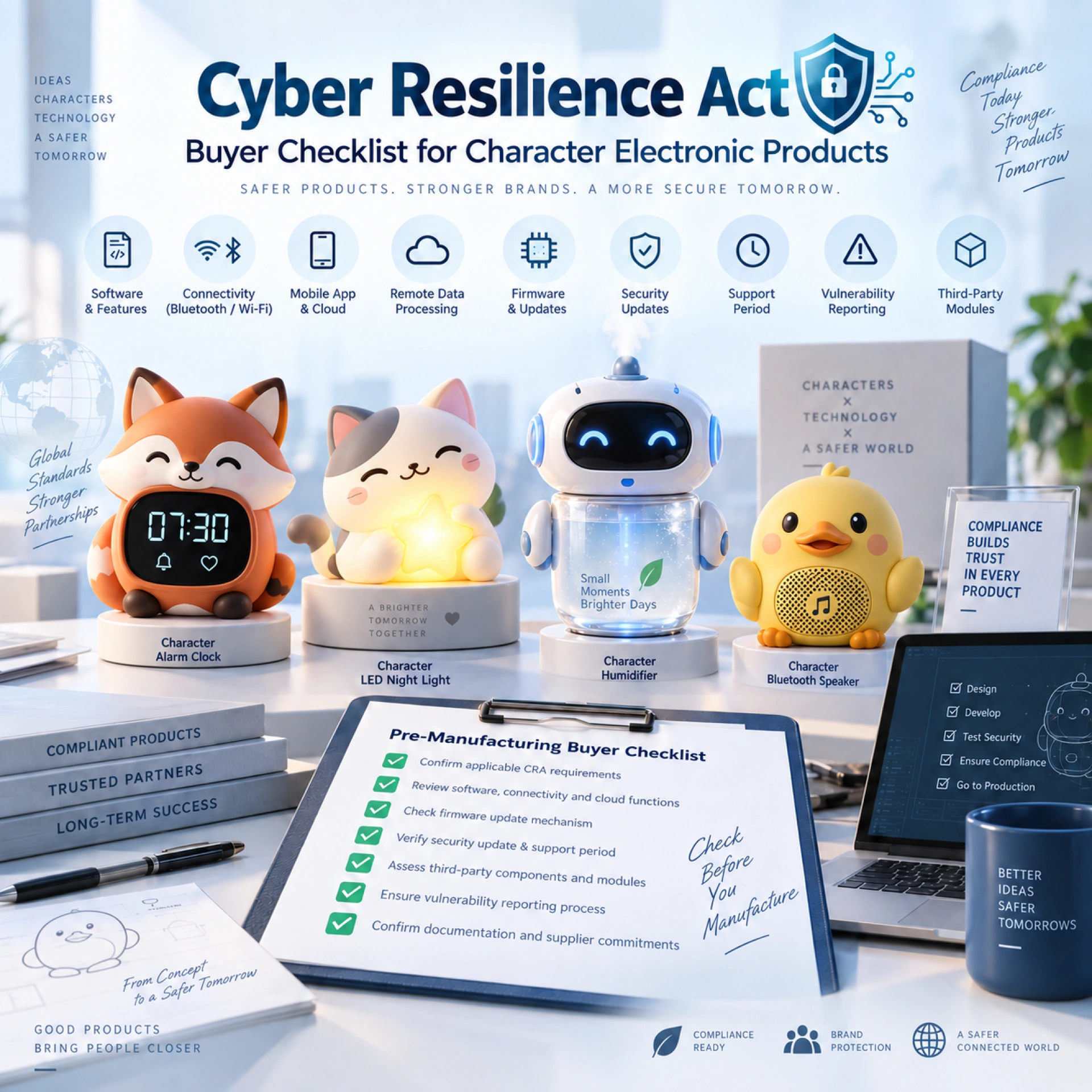
Before tooling or mass production, buyers should be able to answer these ten questions:
- Does the product contain software or firmware?
- Does it use Bluetooth, Wi-Fi, an app, or another data connection?
- Does any function depend on remote data processing?
- Who owns and controls the firmware?
- Who owns and controls the mobile app?
- Who is responsible for security updates?
- What is the product support period?
- How will vulnerability reports be received and handled?
- Which third-party software and hardware modules are included?
- What must the factory manage, and what must the brand manage?
If your project already includes Bluetooth, an app, cloud control, or other connectivity, our guide to Connected Character Products provides a broader UK and EU pre-manufacturing checklist. This article focuses specifically on how Cyber Resilience Act for Character Electronic Products changes supplier and development decisions.
Quick Buyer Checklist for Cyber Resilience Act for Character Electronic Products
| Buyer Question | What to Confirm Before Manufacturing | Document or Evidence to Request |
|---|---|---|
| Does the product contain software? | MCU firmware, embedded software, bootloader, update logic | Firmware description and version |
| Bluetooth / Wi-Fi / App? | Connection type, module, protocol, app dependency | Module specification and architecture |
| Remote data processing? | Cloud API, database, login, remote control | Data-flow diagram |
| Firmware ownership | Who holds source code and can modify it | Source-code / update responsibility agreement |
| App ownership | Developer, source code, app-store account | App ownership and maintenance agreement |
| Security updates | Who creates, signs, distributes, and tests patches | Update process |
| Support period | How long vulnerabilities will be handled | Written support commitment |
| Vulnerability reporting | Contact point and escalation process | Vulnerability disclosure process |
| Third-party modules | Bluetooth stack, SDK, libraries, cloud SDKs | Component list / SBOM |
| Factory vs brand | Operational vs legal responsibilities | Responsibility matrix |
This table is the core of Cyber Resilience Act for Character Electronic Products procurement planning. Buyers should complete it before the product architecture is frozen.
First: Is Your Character Electronic Product Actually Connected?
Not every electronic character product should automatically be treated the same way.
The EU Cyber Resilience Act applies to products with digital elements whose intended purpose or reasonably foreseeable use includes a direct or indirect logical or physical data connection to a device or network.
That distinction matters.
For example:
| Character Product | CRA Relevance Should Be Reviewed? | Why |
|---|---|---|
| Simple battery night light with no data connection | Possibly outside scope | Firmware alone does not necessarily mean network/device connectivity |
| USB light with basic MCU only | Depends on interface | Confirm whether USB carries data or only power |
| Bluetooth character speaker | Yes, review early | Bluetooth creates a radio-based data connection |
| App-controlled alarm clock | Yes | App/device connection is central to product function |
| Wi-Fi character lamp | Yes | Direct network connectivity |
| Smart toy using cloud voice service | Yes | Connectivity and remote processing may be integral |
| Character humidifier with mechanical button control only | Possibly outside | No obvious device/network data connection |
| Character device updated through PC software | Review | Physical data interface and update path may matter |
The first procurement mistake is asking only:
“Does it contain a PCB?”
That is not enough.
The buyer needs to understand the product’s complete digital architecture.
If you are still deciding between a static character product and an electronic version, our guide on Character Figure vs Character Electronic Product explains how electronics add PCBA, firmware, wireless, testing, and support complexity to a character merchandise project.
1. Does the Product Contain Software?
The first question in Cyber Resilience Act for Character Electronic Products is whether the product contains software or firmware.
Many buyers do not think of simple consumer electronics as “software products.” However, even a small character device may contain embedded code.
Examples include:
- MCU firmware
- Bluetooth firmware
- Wi-Fi firmware
- LED control logic
- Touch-control software
- Alarm clock logic
- Sound playback logic
- Battery-management firmware
- OTA update functions
- Voice-control software
- App communication protocols
Before manufacturing, the buyer should ask the engineering team:
- Which chips contain firmware?
- What firmware version is being used?
- Who developed the code?
- Is the code original or based on a third-party SDK?
- Does the supplier have the source code?
- Can the code still be modified after mass production?
- Does the device support firmware updates?
- How is firmware loaded during production?
- Is firmware signed or otherwise protected?
- Is the production firmware version recorded by batch?
A buyer should not accept only:
“This PCBA is already mature.”
“Mature” does not explain software ownership, dependencies, update capability, or future support.
A better procurement record is:
MCU model → Firmware version → Firmware developer → Source-code owner → Update method → Third-party dependencies → Support contact
For character Bluetooth products, our Custom Bluetooth Speaker Manufacturer guide explains how Bluetooth modules, PCBA, batteries, antennas, firmware, controls, and character structure need to be coordinated during product development.
2. Does the Product Use Bluetooth, Wi-Fi, or an App?
Wireless connectivity is a major trigger for deeper Cyber Resilience Act for Character Electronic Products review.
Typical connections include:
- Bluetooth Classic
- Bluetooth Low Energy
- Wi-Fi
- NFC
- USB data
- Mobile app connection
- PC software
- Gateway connection
- Cloud connection
For each connection, buyers should map:
Product → Connection → Other Device → Software → Server, if any
For example:
Character speaker → Bluetooth → Smartphone
is much simpler than:
Character alarm clock → Wi-Fi → Cloud API → User account → Mobile app → Push notification service
The second architecture creates more software dependencies, more third-party suppliers, more credentials, and more long-term maintenance obligations.
For Bluetooth projects, buyers should also record the exact Bluetooth module and technology implementation. The Bluetooth SIG qualification and listing process is a separate issue from the CRA, but it is another reason why “Bluetooth module” should be documented properly rather than treated as an unnamed PCBA component.
Buyer questions
Ask:
- Which Bluetooth/Wi-Fi module is used?
- Who manufactures the module?
- What firmware runs on the module?
- What SDK is used?
- Can the module firmware be updated?
- How long will the module supplier support it?
- Does the module supplier issue security advisories?
- Can we replace the module later without redesigning the PCB?
- Does changing the module require new firmware development?
These questions should be answered before the PCB and mold structure are completely locked.
3. Does the Product Depend on Remote Data Processing?
Remote data processing deserves its own section because buyers often think only the physical product matters.
Under the CRA, remote data processing can form part of a product with digital elements where the remote processing was designed or developed by or under the responsibility of the manufacturer and the product would lose one of its functions without it.
The official Cyber Resilience Act text specifically addresses products with digital elements and integrated remote data processing.
Practical examples may include:
- Cloud alarm configuration
- User login
- Remote device control
- Cloud music or content service
- Server-based voice processing
- Cloud-stored device settings
- Remote child account management
- API-dependent mobile app functions
- Firmware update server
- Character content downloaded from a backend
A buyer should prepare a simple data-flow diagram.
Example:
Device
↓ Bluetooth/Wi-Fi
Mobile App
↓
API
↓
Cloud Database
Then record who owns each layer.
| Layer | Owner / Operator |
|---|---|
| Device hardware | Factory / Brand |
| Firmware | Factory / PCBA supplier / Brand |
| Mobile app | App developer / Brand |
| API | Software supplier / Brand |
| Cloud server | Brand / SaaS supplier |
| Database | Brand / Service provider |
| OTA update server | Firmware supplier / Brand |
Without this map, buyers may discover after launch that nobody has accepted responsibility for maintaining the backend.
4. Firmware Ownership
Firmware ownership is one of the most important procurement issues in Cyber Resilience Act for Character Electronic Products.
Imagine the product launches successfully.
Eighteen months later, a vulnerability is found in the Bluetooth stack.
The buyer contacts the factory.
The factory contacts the PCBA supplier.
The PCBA supplier says the firmware was written by an outside engineer.
The engineer is no longer working with them.
Nobody has the full source code.
This is exactly the type of supply-chain problem that should be prevented before manufacturing.
Buyers should confirm:
- Who owns the source code?
- Who has access to the source repository?
- Can the brand receive source code if needed?
- Who controls signing keys?
- Who controls firmware release versions?
- Who can build a new firmware image?
- Who can test the update?
- Who can distribute the update?
- What happens if the PCBA supplier stops business?
- What happens if the buyer changes factories?
For proprietary firmware, contractual terms matter.
Depending on the commercial model, a buyer may choose:
Factory-owned firmware
The supplier keeps the source code and agrees to maintain it.
Brand-owned firmware
The buyer owns the source code and appoints the factory to manufacture the product.
Licensed firmware
A third-party software supplier owns the code while the brand receives defined rights to use and maintain it.
There is no single structure suitable for every project.
The problem is having no structure at all.
Request a Software Bill of Materials
Cyber Resilience Act for Character Electronic Products also makes software component visibility more important.
The CRA’s vulnerability-handling requirements include documenting software components and preparing a software bill of materials in a commonly used, machine-readable format covering at least top-level dependencies.
Buyers should therefore discuss an SBOM during development.
The SBOM may identify:
- Bluetooth stack
- Wi-Fi stack
- RTOS
- Open-source libraries
- Encryption libraries
- Cloud SDK
- Mobile SDK
- OTA library
- Device-management library
- Third-party firmware components
This should not be confused with the physical electronics BOM.
A hardware BOM tells you:
MCU + resistor + battery + speaker + LED
A software BOM tells you:
Firmware + library + SDK + version + dependency
Both can matter.
5. App Ownership
Character products increasingly add an app because it looks attractive during product planning.
But an app creates a second product-development stream.
Before approving an app-controlled character product, buyers should know:
- Who developed the app?
- Who owns the app source code?
- Who owns the Apple Developer account?
- Who owns the Google Play developer account?
- Who controls app signing credentials?
- Who pays for future app maintenance?
- Who maintains compatibility with future iOS versions?
- Who maintains Android compatibility?
- Who operates backend services?
- Who responds when an app vulnerability is found?
A supplier saying:
“We can provide an app.”
is not enough.
For Cyber Resilience Act for Character Electronic Products, the buyer needs to understand whether the app remains maintainable after the initial order.
This is particularly important for private-label and licensed-IP projects. The physical product may remain in customers’ homes for years even if the initial production order lasted only two months.
A character-themed app should therefore be treated as a long-term software asset rather than free packaging around the hardware.
6. Who Is Responsible for Security Updates?
A product update strategy should be determined before mass production.
The CRA requires manufacturers to handle vulnerabilities during the support period and, where security updates are available to address identified issues, to distribute them without delay. The regulation also contains requirements around secure update mechanisms and, for consumer products where applicable, automatic security updating.
Buyers can review the official CRA manufacturer obligations before freezing the product architecture.
For procurement teams, the critical question is:
Can this product actually be updated?
A product can theoretically need a security fix while having no practical update path.
That creates a serious commercial problem.
Possible update methods include:
- OTA via Wi-Fi
- OTA via Bluetooth
- Update through the mobile app
- USB firmware upgrade
- Service-center flashing
- Factory-only reprogramming
These options are not equivalent.
A factory-only flashing process does little for 20,000 devices already in consumers’ homes.
Buyers should confirm:
| Update Question | Required Decision |
|---|---|
| Can users receive updates? | Yes / No / Method |
| Can firmware be updated remotely? | Define mechanism |
| Who creates security patches? | Named party |
| Who signs firmware? | Named party |
| Who hosts update files? | Named party |
| Who tests updates? | Factory / developer / brand |
| Who informs users? | Brand / legal manufacturer |
| Is rollback possible? | Engineering decision |
| What happens if update fails? | Recovery method |
| Is update infrastructure maintained long-term? | Contractual commitment |
Security update responsibility should not be left as “supplier support when necessary.”
It should name a party.
7. What Is the Support Period?
The support period is another important Cyber Resilience Act for Character Electronic Products purchasing issue.
The CRA generally requires the manufacturer to establish a support period based on expected product use. The support period is normally at least five years, unless the product is reasonably expected to be used for less than five years, in which case the support period can correspond to that expected use time.
The end date of the support period must also be communicated to users.
This creates a procurement question that many character-product buyers have never asked:
Will the Bluetooth module, firmware developer, app, cloud API, and server still be supported for as long as the finished product must be supported?
A five-year product support promise is meaningless if:
- The Wi-Fi module supplier supports the SDK for only two years.
- The firmware contractor disappears after production.
- The app server is shut down after one year.
- The brand does not control the app account.
- The cloud subscription is not budgeted.
- The OTA server belongs only to the OEM supplier.
Support period planning should therefore happen during component selection.
Support-period supplier checklist
Record:
- MCU support expectation
- Bluetooth/Wi-Fi module support
- SDK support
- Firmware maintenance
- Mobile app maintenance
- Cloud hosting
- Server API maintenance
- Security monitoring
- Vulnerability handling
- Update distribution
The official CRA text contains detailed support period requirements, so this should become part of supplier selection rather than a post-launch discussion.
8. Vulnerability Reporting
Cyber Resilience Act for Character Electronic Products does not end when the container leaves China.
Products can develop cybersecurity issues after launch.
From 11 September 2026, CRA reporting obligations apply for actively exploited vulnerabilities and severe incidents affecting the security of products with digital elements.
The European Commission’s official CRA reporting obligations describe an early warning within 24 hours and a fuller notification within 72 hours for relevant cases.
For buyers, however, the first problem is much simpler:
Who receives the first vulnerability report?
There should be an accessible vulnerability contact.
For example:
security@brand.com
Then create an escalation flow:
Researcher/User
↓
Brand Security Contact
↓
Engineering Review
↓
Firmware / Module Supplier
↓
Risk Assessment
↓
Patch Development
↓
Testing
↓
User Update / Required Reporting
Without this workflow, a security email may simply enter a customer-service inbox.
Buyers should define:
- Security contact email
- Responsible person/team
- Factory engineering contact
- Firmware supplier contact
- Module supplier contact
- Incident severity review
- Patch approval process
- Reporting responsibility
- User communication method
The CRA also requires coordinated vulnerability disclosure processes, so vulnerability intake is not something buyers should design only after the first security problem appears.
9. Third-Party Modules and Software
Most character electronic product manufacturers do not develop every digital component from zero.
A product may contain technology from multiple suppliers.
For example:
Character Bluetooth speaker
- MCU supplier
- Bluetooth chip supplier
- Bluetooth stack
- PCBA vendor
- Firmware developer
- Battery protection IC supplier
Smart character alarm clock
- Wi-Fi module
- MCU
- RTOS
- Cloud SDK
- App SDK
- OTA service
- Push notification provider
- Cloud database
Every third-party dependency creates a support dependency.
The buyer should request a third-party component list containing:
| Component | Supplier | Version | Support Contact | Update Capability |
|---|---|---|---|---|
| MCU | Supplier A | Model X | Supplier | Firmware flash |
| Bluetooth module | Supplier B | Rev 2 | Supplier | OTA / flash |
| Bluetooth stack | Supplier B | vX.X | Supplier | Firmware update |
| RTOS | Provider C | Version | Developer | Firmware update |
| Cloud SDK | Provider D | Version | App developer | App/server update |
| App framework | Provider E | Version | App developer | App release |
The CRA requires manufacturers to address vulnerabilities in integrated components and document relevant cybersecurity information. Its vulnerability-handling rules also specifically address third-party and open-source components.
That means the sentence:
“This Bluetooth module comes from our normal supplier.”
is not sufficient supplier documentation.
10. What the Factory vs Brand Must Manage
This is probably the most important procurement section in Cyber Resilience Act for Character Electronic Products.
Buyers often assume:
Factory makes product → Factory handles certification.
That assumption can be wrong.
Under the CRA, the term “manufacturer” does not simply mean the physical factory. The manufacturer definition in Regulation (EU) 2024/2847 includes a person or company that has a product designed, developed, or manufactured and markets it under its own name or trademark.
For private-label OEM projects, this can make the brand the legal manufacturer even though a Chinese factory physically produces the product.
The factory can support engineering and documentation, but contractual delegation does not automatically transfer the brand’s regulatory responsibility.
A practical responsibility matrix may look like this:
| Activity | Factory / Technical Supplier | Brand / CRA Manufacturer |
|---|---|---|
| Hardware BOM | Provide | Review / retain |
| Firmware version | Provide / control | Record |
| Source code access | As agreed | Ensure long-term access strategy |
| Third-party module data | Provide | Review |
| SBOM inputs | Provide | Maintain required documentation |
| Cybersecurity risk assessment data | Support | Responsible if legal manufacturer |
| Secure production flashing | Manage | Define requirement |
| Vulnerability patch engineering | Factory/software supplier may perform | Ensure it happens |
| Security update distribution | Technical support | Ensure process exists |
| Support period | Provide technical capability | Determine/declare |
| User cybersecurity information | Provide inputs | Approve / publish |
| Vulnerability contact | Support escalation | Maintain public contact |
| Incident reporting | Technical investigation | Legal reporting responsibility where applicable |
| CRA conformity documentation | Provide technical inputs | Manufacturer responsibility |
| Product CE / declaration process | Support | Manufacturer manages according to applicable role |
The exact division depends on the commercial structure.
The important rule is:
Factory responsibility and legal manufacturer responsibility are not automatically the same thing.
What Buyers Should Put in the RFQ
For Cyber Resilience Act for Character Electronic Products, buyers should add software and security questions to their normal RFQ.
Instead of only requesting:
- Product size
- Battery capacity
- Bluetooth version
- Speaker power
- LED function
- MOQ
- Mold cost
also request:
Software
- Firmware developer
- Firmware version
- Source-code ownership
- Firmware update method
- SBOM availability
Wireless
- Bluetooth/Wi-Fi module manufacturer
- Module model
- Module firmware
- Supplier support period
App
- App developer
- Source-code ownership
- App-store account owner
- Backend ownership
- API ownership
Support
- Security update responsibility
- Firmware maintenance period
- Module support period
- App support period
- Cloud service period
Vulnerability Handling
- Security contact
- Patch development process
- Third-party vulnerability escalation
- Update delivery method
These questions help turn vague “smart product capability” into a manageable procurement specification.
Example: Character Bluetooth Speaker
Consider a character Bluetooth speaker with:
- Bluetooth
- Rechargeable battery
- MCU firmware
- LED effects
- No app
- No cloud
The Cyber Resilience Act for Character Electronic Products checklist should still ask:
- Which Bluetooth chip is used?
- What stack version is installed?
- Who can patch the Bluetooth firmware?
- Is the firmware upgradeable?
- Who owns the source code?
- What third-party components are used?
- What is the support period?
- How will vulnerabilities be received?
- How can existing products receive an update?
The absence of an app does not automatically remove cybersecurity considerations because Bluetooth itself is a data connection.
Our character Bluetooth speaker manufacturing guide explains the physical development side, including PCBA, antenna, battery, speaker, character shell, packaging, and testing.
Example: App-Controlled Character Alarm Clock
Now consider a more complex product:
- Wi-Fi
- Bluetooth
- Mobile app
- User login
- Cloud API
- OTA updates
- Alarm schedules stored remotely
The buyer now needs to map:
Hardware + Firmware + Wireless Module + App + Account System + API + Cloud + OTA
The buyer should confirm who maintains every layer for the complete support period.
This type of project should not start tooling while app/backend ownership remains unclear.
If you are developing this category, our Sleep Training Alarm Clock Manufacturer article explains how character design, electronics, lighting, sound, PCBA, and product functions need to be coordinated before production.
When Should Cybersecurity Be Locked in the Development Timeline?
Cybersecurity should not be treated like packaging artwork that can be reviewed shortly before shipment.
For Cyber Resilience Act for Character Electronic Products, major decisions should be made at specific project stages.
| Development Stage | CRA-Related Decision |
|---|---|
| Product concept | Connected or non-connected product |
| Function specification | Bluetooth, Wi-Fi, app, cloud requirements |
| PCBA selection | MCU and wireless module |
| Software architecture | Firmware, app, backend responsibilities |
| Prototype | Connectivity and update path tested |
| Pre-tooling | Hardware architecture substantially frozen |
| Pre-production | Firmware version and documentation controlled |
| Mass production | Approved production firmware flashed |
| Shipment | Product/software version traceability |
| After launch | Support, updates, vulnerability handling |
The worst time to discover that firmware cannot be updated is after 50,000 finished units have shipped.
Do Not Ask Only “Is This CRA Compliant?”
This is too broad for a useful supplier conversation.
Instead, ask:
Who owns the firmware?
Can deployed units receive a security update?
Which Bluetooth/Wi-Fi module is used?
How long will the module supplier support it?
Can you provide a software component list?
Who owns the mobile app?
Who operates the backend server?
Who controls the OTA infrastructure?
What happens if a vulnerability is found two years after shipment?
Who is our engineering contact for security issues?
These questions tell the buyer much more about whether the supply chain is ready for Cyber Resilience Act for Character Electronic Products.
Manufacturing Still Matters
Cybersecurity does not replace normal product manufacturing.
A connected character product still needs:
- Character accuracy
- 3D engineering
- Mold development
- Injection molding
- PCBA assembly
- Battery integration
- Antenna positioning
- Painting
- Final assembly
- Functional testing
- Aging testing
- Packaging
- QC
The difference is that the product now also has a software lifecycle after shipment.
Jiahong Creative’s character electronic product manufacturing process combines character design with electronics, PCBA, molding, painting, assembly, packaging, and functional quality control.
For connected projects, buyers should add software architecture, firmware records, module traceability, update capability, and supplier responsibility to that normal manufacturing workflow.
Cyber Resilience Act for Character Electronic Products: Final Pre-Manufacturing Checklist
Before approving mass production, buyers should be able to check every line below.
Product Architecture
- Software/firmware identified
- Bluetooth/Wi-Fi/data connections identified
- Remote data processing mapped
- App dependency confirmed
- Cloud dependency confirmed
Ownership
- Firmware owner identified
- Source-code access agreed
- App owner identified
- App-store account owner identified
- Backend owner identified
- Signing-key responsibility defined
Components
- MCU recorded
- Wireless module recorded
- Third-party SDKs recorded
- Major software dependencies recorded
- SBOM preparation discussed
Updates
- Firmware update mechanism exists
- Patch developer identified
- Update testing responsibility identified
- Update distribution mechanism identified
- Update server responsibility identified
Lifecycle
- Product support period defined
- Module support aligns with product support
- Firmware support aligns with product support
- App/backend support aligns with product support
Vulnerabilities
- Vulnerability contact exists
- Escalation procedure exists
- Factory/software contacts documented
- Reporting responsibility identified
- Customer notification method planned
Legal / Compliance
- CRA manufacturer role identified
- Technical documentation owner identified
- Cybersecurity risk assessment responsibility identified
- Conformity assessment path reviewed
- User cybersecurity information planned
This checklist is much more useful than asking the supplier for a generic statement saying “CRA supported.”
How Jiahong Creative Supports Connected Character Product Development
Jiahong Creative supports character-based electronic product development from product concept, industrial design, 3D modeling, tooling, injection molding, PCBA coordination, firmware/function implementation, painting, assembly, testing, packaging, and mass production.
For Cyber Resilience Act for Character Electronic Products preparation, the manufacturing stage can support buyers by organizing:
- Hardware BOM
- PCBA specification
- MCU information
- Bluetooth/Wi-Fi module information
- Firmware version
- Production firmware control
- Third-party module details
- Software supplier contacts
- Update-method information
- Functional test records
- Batch traceability
- Technical manufacturing documents
For products with apps, cloud platforms, remote updates, or advanced connectivity, brands should also make sure the software developer and compliance team are involved early. The physical factory can provide essential engineering information, but cybersecurity lifecycle responsibilities must be clearly assigned between the brand, factory, PCBA supplier, firmware developer, app developer, and cloud provider.
If you are planning a character Bluetooth speaker, smart alarm clock, connected toy, Wi-Fi night light, or other character electronic product, share your character artwork, target functions, connectivity requirements, app requirements, target market, quantity, and expected support model through our character electronic product project inquiry.
Final Thoughts
Cyber Resilience Act for Character Electronic Products should change the questions buyers ask before manufacturing.
A connected character product is no longer only:
Character shell + Mold + PCBA + Battery + Packaging
It may also be:
Firmware + Wireless Module + App + Cloud + Software Dependencies + Update Infrastructure + Support Period + Vulnerability Process
The most important buyer decision is therefore not simply whether to add Bluetooth or Wi-Fi. It is whether the supply chain can support the feature throughout the product’s expected lifetime.
Before manufacturing, confirm software and firmware, map every connection, identify remote data processing, define firmware and app ownership, assign security update responsibility, establish the support period, create a vulnerability reporting process, document third-party components, and separate factory operational duties from the legal responsibilities of the brand or other CRA manufacturer.
When these points are agreed before tooling and mass production, Cyber Resilience Act for Character Electronic Products becomes a manageable product-development process rather than a last-minute compliance problem.
FAQ
1. What is Cyber Resilience Act for Character Electronic Products?
Cyber Resilience Act for Character Electronic Products refers to applying the EU Cyber Resilience Act requirements to connected character-based hardware or software products, such as Bluetooth speakers, smart character devices, app-controlled alarm clocks, connected toys, and Wi-Fi character products.
2. Does every electronic character product fall under the CRA?
Not automatically. Buyers should first determine whether the product is a product with digital elements whose intended or reasonably foreseeable use includes a direct or indirect logical or physical data connection to a device or network. A simple electronic product with no relevant data connection may require a different analysis.
3. Does a Bluetooth character speaker need CRA review?
Yes, it is sensible to review it early. Bluetooth creates a radio-based data connection to another device, so buyers should assess the product against the CRA scope and requirements rather than assuming a speaker without an app is outside the regulation.
4. Does firmware count as software?
Firmware contains computer code and should be included in the software architecture review. Buyers should identify its developer, version, dependencies, ownership, update method, and support responsibility.
5. Who should own the firmware?
There is no single required commercial ownership model. The important point is that the CRA manufacturer must have a reliable way to maintain the product. Buyers should therefore define source-code ownership or access, patch responsibility, build capability, signing keys, update infrastructure, and long-term support contractually.