

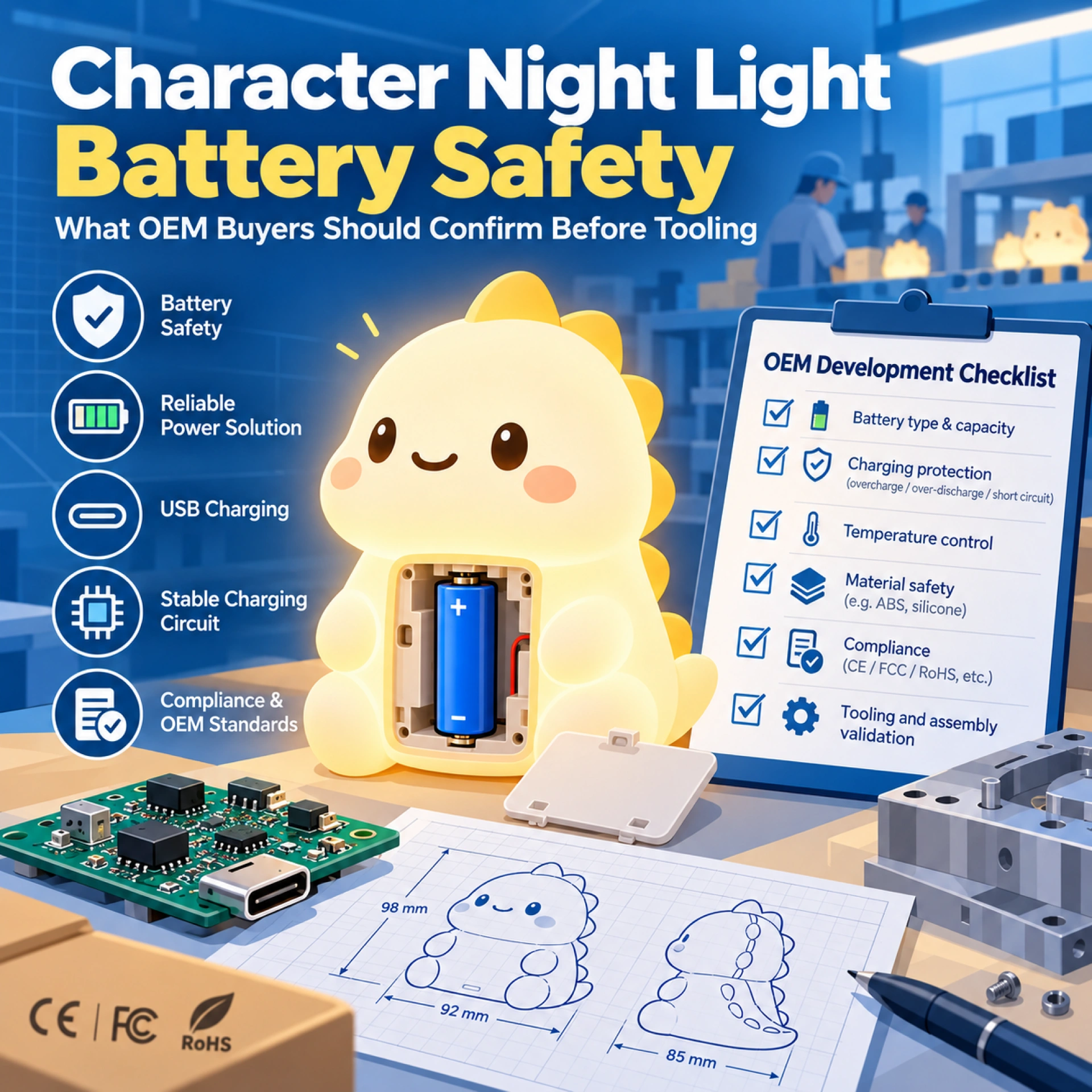
Character Night Light Battery Safety should be evaluated before mold tooling begins, not after the first production samples are assembled. OEM buyers must confirm the battery type and capacity, battery compartment structure, charging protection, PCBA design, enclosure materials, thermal performance, intended user age and target-market compliance requirements. These decisions directly affect product safety, mold design, manufacturing cost and the likelihood of passing the required tests.
For a rechargeable character night light, the most important engineering questions are straightforward: Is the battery suitable for the expected electrical load? Can the charging circuit prevent unsafe charging conditions? Is the battery securely positioned inside the housing? Can the product dissipate heat during charging and lighting? Can customers access the battery unintentionally? And can the finished design meet the requirements of its intended market?
A cute character-shaped lamp may look simple from the outside, but internally it can contain a rechargeable lithium battery, charging IC, protection circuit, LED driver, sensors, switches, PCBA and wiring. Poor coordination between these components may result in overheating, battery swelling, charging failure, damaged connections or an enclosure that is difficult to assemble safely.
For brands, importers, retailers and licensed IP owners, Character Night Light Battery Safety should therefore be treated as a product engineering requirement—not simply a battery supplier certification question.
This guide explains the nine areas OEM buyers should review before approving tooling for a custom character night light.
If your brand is preparing a broader lighting product project, our Custom Night Light Manufacturer guide explains the complete OEM/ODM development process, including character design, lighting functions, molding, electronics, assembly and packaging.
Character Night Light Battery Safety: Pre-Tooling Checklist
| Engineering Area | What Buyers Should Confirm | Main Risk if Ignored |
|---|---|---|
| Battery Type Selection | Chemistry, voltage, capacity, dimensions, supplier | Unsafe or unsuitable battery selection |
| Battery Compartment Design | Retention, protection, accessibility, replacement | Battery damage or unintended access |
| Charging Circuit Protection | Charging IC, current limits, voltage limits, protection | Overcharge, overheating, electrical failure |
| PCBA Integration | Power architecture, LED drivers, sensors, wiring | Electrical instability and component damage |
| Enclosure and Assembly | Silicone/ABS structure, internal supports, closure method | Mechanical damage or unsafe assembly |
| Heat and Aging Tests | Charging temperatures, full-brightness operation, endurance | Overheating or premature failure |
| Product Age Classification | Toy or lighting product, intended age and use | Incorrect product requirements |
| Target-Market Compliance | Battery, electrical, labeling and transport requirements | Failed testing or shipment problems |
| Buyer RFQ Checklist | Documents, specifications, ownership and approvals | Unclear engineering scope and costly revisions |
The purpose of this checklist is to identify problems while the product can still be redesigned without modifying finished molds.
1. Battery Type Selection: Choose the Battery Before Finalizing the Character Shape
Battery selection is the foundation of Character Night Light Battery Safety.
Many OEM buyers begin with character artwork and ask the manufacturer to install a rechargeable battery inside the finished design. However, the available internal space may not be suitable for the required battery capacity, protection circuit, wiring and mechanical support.
The better development sequence is:
Product Function → Power Requirement → Battery Selection → Internal Layout → Character Structure → Tooling
Common Battery Options
Character night lights may use different battery systems depending on the product’s intended function.
| Battery Type | Typical Application | Engineering Considerations |
|---|---|---|
| Rechargeable lithium-ion cylindrical cell | Larger rechargeable night lights | Fixed dimensions, mechanical retention, protection |
| Rechargeable lithium-polymer pouch cell | Compact or irregular-shaped products | Protection against bending, pressure and puncture |
| AA/AAA replaceable batteries | Simple portable lights | Battery-door security, contact design, polarity |
| Button/coin cell | Certain very small electronic functions | Ingestion hazards, access prevention and applicable regulations |
Battery selection should reflect the required operating voltage, current consumption, physical dimensions, user experience and applicable safety requirements.
For example, a silicone character tap light might use a single rechargeable lithium cell. A larger desktop lamp with brighter LEDs may require a different battery capacity or power architecture.
A manufacturer should not select a cell based only on which battery fits inside the character’s head or body.
Battery Capacity Must Match Actual Consumption
Buyers frequently request a particular battery capacity without first confirming the electrical load.
Battery operating time depends on several factors:
- Battery capacity
- LED power consumption
- LED brightness setting
- MCU consumption
- Sensor consumption
- Power conversion losses
- Standby current
- Battery age and operating conditions
For example, a night light with RGB LEDs, touch control and multiple brightness levels may consume different amounts of power depending on the selected mode.
An estimated runtime can be calculated during engineering, but the final claim should be validated using complete product samples.
What Battery Documentation Should Buyers Request?
Before tooling, request:
- Battery manufacturer and model
- Battery chemistry
- Nominal voltage
- Rated capacity
- Maximum charging voltage and current
- Discharge characteristics
- Battery dimensions
- Protection information
- Applicable battery safety test reports
- Supplier traceability information
For rechargeable lithium batteries, the international standard IEC 62133-2 battery safety requirements addresses safety requirements and tests for portable sealed secondary lithium cells and batteries under intended use and reasonably foreseeable misuse.
Buyers should confirm whether this standard or another relevant requirement applies to their selected battery and destination market.
A battery test report should correspond to the actual battery model being used—not simply another cell supplied by the same company.
2. Battery Compartment Design: Protect the Battery Inside the Character
The battery compartment is a structural engineering feature, not just an empty space inside the plastic housing.
Character night lights often use rounded shapes, large heads, small bases, soft silicone surfaces and decorative components. These features can complicate battery positioning and mechanical protection.
For Character Night Light Battery Safety, the battery should be protected against foreseeable damage during normal handling, assembly and transportation.
Battery Position and Mechanical Retention
The structural engineer should confirm:
- Battery location
- Internal fixing method
- Distance from sharp plastic ribs
- Clearance around the battery
- Wire routing
- Battery connector location
- Interaction with screws and fasteners
- Impact from dropping
- Assembly pressure
For a lithium-polymer pouch cell, particular attention should be paid to avoiding bending, compression or puncture by screws, sharp edges or internal components.
Any allowance for dimensional tolerances or cell expansion should follow the battery manufacturer’s engineering requirements rather than an arbitrary universal clearance.
Soft Silicone Night Lights Need Special Attention
Silicone tap lights are frequently squeezed, pressed or dropped.
A soft outer body may deform significantly during use.
If the battery or PCBA is placed directly behind a flexible surface without suitable internal support, external pressure may reach the electronics.
A safer engineering approach is to evaluate whether a rigid internal structure is needed to protect the battery and PCBA while allowing the outer silicone to provide the desired soft-touch experience.
This may affect:
- Inner ABS support
- Silicone wall thickness
- Structural ribs
- Component retention
- Mold parting lines
- Assembly sequence
The final design should be tested under the expected use conditions.
Battery Accessibility and Replacement
Battery accessibility should be evaluated according to the product classification, intended user and destination market.
A product intended for young children may require stronger protection against battery access than an adult desktop accessory.
At the same time, product engineers must also consider applicable repair and battery-replacement requirements.
For example, Article 11 of the EU Batteries Regulation (EU) 2023/1542 introduces requirements concerning the removability and replaceability of portable batteries, with relevant provisions applying from 18 February 2027.
Exceptions and other product-specific safety requirements may affect how these rules apply.
For OEM buyers, the critical decision is to review the appropriate battery access and replacement strategy before committing to a permanently sealed enclosure.
3. Charging Circuit Protection: USB-C Does Not Automatically Mean Safe Charging
Many buyers request USB-C charging because it is familiar to consumers.
However, USB-C is a connector and interface specification. It does not, by itself, guarantee battery charging safety.
A rechargeable character night light needs a charging system designed for its actual battery chemistry and electrical requirements.
What Does the Charging Circuit Need to Manage?
Depending on the battery system, the electrical design may need protection against:
- Overcharging
- Overdischarging
- Excessive charging current
- Excessive discharge current
- Short circuits
- Abnormal temperature conditions
- Reverse polarity or incorrect connections
- Relevant input power faults
Protection may involve the charging IC, battery protection circuit, temperature sensing and other hardware measures.
Firmware may provide additional monitoring or user-interface functions, but it should not be treated as a substitute for necessary independent hardware protection.
Charging IC Selection
Before finalizing the PCBA, the engineering team should identify:
- Charging IC model
- Battery charging profile
- Maximum charging current
- Input supply assumptions
- Termination behavior
- Temperature monitoring
- Status indication
- Fault response
These values must be compatible with the selected battery.
For example, charging a lithium cell using an unsuitable charging voltage or current can create serious safety risks.
The buyer does not need to design the charging circuit personally, but should request a clear technical description from the electronics engineering team.
Can the Night Light Operate While Charging?
This is an important pre-tooling question.
Some character night lights are designed to operate while charging. Others may limit certain functions or switch operating modes.
If the LEDs operate at full brightness during charging, the internal heat load may be different from charging while the lamp is off.
The engineering team should confirm:
- Whether simultaneous charging and lighting is supported
- Whether the charging circuit has suitable power-path management
- Maximum electrical and thermal load
- Charging behavior during operation
- What happens if the input supply is disconnected
- How the product responds to charging faults
A product that passes a basic battery charging check may still need additional evaluation when charging and lighting occur simultaneously.
Character Night Light Battery Safety depends on the complete charging system, not only the battery cell.
4. PCBA Integration: Battery Safety Depends on the Electronics Architecture
PCBA integration connects the battery with the LED system, controls, sensors, charging interface and embedded software.
For a character night light, the PCBA may include:
- MCU
- Charging IC
- Battery protection circuitry
- Voltage regulation
- LED driver
- Touch sensor
- Motion sensor
- Power switch
- USB-C interface
- Indicator LEDs
- Connectors
The PCBA layout should consider electrical safety, heat, assembly reliability and the available internal space.
PCBA and Battery Layout
A common development mistake is designing the character exterior first and forcing the PCBA into whatever space remains.
This can create:
- Poor battery placement
- Crowded wiring
- Difficult assembly
- Stress on solder joints
- Insufficient separation from heat-producing components
- Limited space for structural support
For Character Night Light Battery Safety, the battery and PCBA should be positioned together during the internal engineering review.
The team should check both the 3D assembly model and the actual electronic prototype.
Firmware Is Also Part of Power Management
Firmware may control:
- LED brightness
- Timer functions
- Automatic shutoff
- Sleep mode
- Battery level indication
- Low-battery behavior
- Sensor activation
- Charging status display
For example, a lamp may be programmed to reduce brightness when the battery reaches a defined low-voltage condition.
However, hardware and battery-level protection must remain appropriate for the design, including faults or failures that firmware alone cannot safely handle.
The three engineering layers should be clearly distinguished:
PCBA = Electronic Hardware
Firmware = Device Control Logic
App = Mobile Software Interface, if required
A normal rechargeable night light does not necessarily require a mobile app.
If Bluetooth, Wi-Fi or app control is added, the buyer should define the expanded software and connectivity scope separately.
Our PCBA Firmware App Development guide explains what OEM manufacturers handle at each development layer and why complete app development is different from PCBA engineering.
What Should Be Approved Before Tooling?
Buyers should request approval of:
- Preliminary PCBA schematic
- Main component list
- Battery model
- Charging architecture
- LED load
- PCBA dimensions
- Connector locations
- USB-C port position
- Thermal assumptions
- Firmware functions affecting power consumption
Any major change to the PCBA or battery after tooling may require adjustments to the internal housing, screw posts, supports or charging port.
5. Enclosure and Assembly: Character Appearance Must Not Compromise Battery Protection
Character night lights are different from standard rectangular electronic products.
They may include:
- Soft silicone bodies
- Decorative PVC features
- ABS inner structures
- Rounded character heads
- Thin ears or accessories
- Hidden charging ports
- Touch or tap-sensitive surfaces
The exterior must preserve the character’s visual identity while providing a reliable enclosure for the electronics.
Material Selection
Common materials include:
| Material | Possible Application | Engineering Concern |
|---|---|---|
| Silicone | Flexible diffuser or outer body | Deformation and component protection |
| ABS | Inner structure or rigid enclosure | Impact resistance, dimensional stability |
| PC | Light diffuser or structural part | Optical and mechanical properties |
| PVC | Decorative character components | Suitability near heat sources and electronics |
Material specifications must be selected according to the actual mechanical, electrical and thermal requirements.
For example, a soft silicone body may improve the tactile experience, but it does not replace the need for proper internal battery protection.
Assembly Should Not Damage the Battery
The manufacturer should review the complete assembly process.
Questions include:
- Is the battery inserted before or after the PCBA?
- Can assembly workers accidentally compress the cell?
- Are screws located safely away from the battery?
- Is wiring protected from pinching?
- Can the battery connector loosen?
- Is adhesive used appropriately?
- Can battery polarity or connector errors occur?
- Can the enclosure be reopened safely if necessary?
Assembly fixtures and work instructions may be needed to maintain consistency.
The approved engineering sample should demonstrate how the battery, electronics and enclosure fit together—not just how the character looks from the outside.
Tooling Freeze Decision
Before mold fabrication, confirm the final positions of:
Battery + PCBA + LED + Charging Port + Switch + Internal Supports + Enclosure Closures
These are critical internal features.
Changing the external paint color after tooling may be relatively straightforward.
Moving the battery compartment or charging port after tooling may require expensive mold modification.
6. Heat and Aging Tests: Check the Finished Product Under Real Operating Conditions
Heat management is an essential part of Character Night Light Battery Safety.
Although LEDs are efficient compared with many traditional light sources, the complete product can still generate heat through the LEDs, charging electronics, power conversion and battery operation.
The enclosure may also influence how that heat is retained or dissipated.
Thermal Test Scenarios
OEM buyers should ask the engineering team to evaluate relevant operating conditions, such as:
| Test Scenario | What Should Be Evaluated |
|---|---|
| Maximum brightness | LED, PCBA and enclosure temperature |
| Charging with lamp off | Battery and charging circuit temperature |
| Charging while operating | Combined electrical and thermal load |
| Extended operation | Stability over the intended operating period |
| High ambient temperature | Performance within rated environmental conditions |
| Repeated charge/discharge cycles | Battery operation and charging consistency |
| Relevant fault conditions | Protection response under controlled laboratory procedures |
| Storage and restart | Battery behavior after defined storage conditions |
The exact test conditions and acceptance limits should come from the applicable standards, cell specifications, product ratings and engineering risk assessment.
A buyer should not accept a universal claim that a night light is safe simply because it “does not feel hot.”
Aging Tests
Aging tests help identify manufacturing and component problems before large-scale shipment.
Depending on the product, the manufacturer may evaluate:
- Continuous lighting operation
- Charging function
- Button and sensor response
- LED consistency
- Power stability
- Intermittent faults
- Unexpected shutdown
- Charging indication
- Temperature stability
Aging does not replace formal product safety testing, but it is useful for detecting production-related reliability problems.
What Test Evidence Should Buyers Request?
Before mass production, ask for:
- Engineering test plan
- Sample identification
- Test conditions
- Temperature measurements
- Battery charging results
- Protection verification
- Functional aging results
- Failure analysis, if applicable
- Corrective action records
For finished lighting products, the international IEC 60598-1 luminaire safety standard provides general safety requirements covering relevant electrical and mechanical construction, among other matters.
The correct standard and any applicable particular requirements must be confirmed for the actual product category.
7. Product Age Classification: Is the Character Night Light a Toy or a Lighting Product?
Character Night Light Battery Safety also depends on how the product is classified.
A character night light may look like a toy because it uses:
- Cartoon characters
- Soft silicone
- Cute animal shapes
- Tap interaction
- Color-changing effects
However, a child-appealing appearance does not automatically make every product a toy.
Likewise, printing “14+” on a package does not automatically remove toy safety obligations if the product is genuinely intended for play by children.
Three Possible Product Positions
Decorative Character Lighting
A night light primarily intended as home decoration or general lighting.
Children’s Bedside Lighting
A lighting product intended for use in children’s spaces, potentially introducing additional child-related design considerations.
Electronic Toy With Lighting Functions
A product intended for play, where lighting may be one of several toy functions.
Classification should be based on the product’s design, intended use, presentation, marketing and applicable legal definitions.
Why Classification Matters
Classification can affect:
- Applicable safety standards
- Accessible battery requirements
- Small-parts assessment
- Mechanical testing
- Warnings and instructions
- Testing and certification documentation
For products that qualify as toys, the applicable toy safety requirements must be evaluated alongside relevant electrical and battery requirements.
The European Commission’s EU toy safety guidance provides official information about toys placed on the European market.
Special Concern: Button and Coin Batteries
For products sold in the United States, Reese’s Law and applicable CPSC requirements address button and coin battery hazards.
The official CPSC button and coin battery guidance explains requirements concerning battery compartments, accessibility, labeling and warnings.
Certain toys meeting applicable toy standards are treated differently under the relevant statutory provisions, so the exact product classification matters.
For buyers, the practical lesson is to avoid choosing a button or coin cell simply because it fits inside a small character housing.
Battery accessibility, user age and regulatory requirements should be evaluated before the structure is finalized.
8. Target-Market Compliance: Battery Safety Is Not One Universal Certificate
One of the most common mistakes in OEM electronic product sourcing is asking:
“Does this product have a battery certificate?”
There is no single battery certificate that automatically demonstrates complete compliance for every character night light in every destination market.
Different requirements may apply to the battery, finished electrical product, materials, packaging and transportation.
Battery and Product Compliance Overview
| Area | Relevant Reference or Requirement | Buyer Should Confirm |
|---|---|---|
| Rechargeable Lithium Battery | IEC 62133-2, where applicable | Correct cell/pack model and test evidence |
| Lighting Product Safety | Applicable IEC/EN/UL lighting or product standards | Finished-product evaluation |
| U.S. Coin/Button Batteries | Reese’s Law and applicable CPSC rules | Battery access and warning requirements |
| U.S. Children’s Toys | Applicable ASTM F963/CPSC requirements | Intended age and toy classification |
| EU Battery Rules | Regulation (EU) 2023/1542 | Applicable battery, documentation and replacement requirements |
| EU Electrical/Electronic Product | Relevant CE legislation, EMC, RoHS and other rules | Correct conformity assessment path |
| Lithium Battery Transport | UN 38.3 and applicable transport regulations | Valid test summary and shipping classification |
| Wireless Functions, if Any | Applicable radio/EMC requirements | Module and finished-product authorization |
The exact standards should be determined by the product’s design, intended use, voltage, battery chemistry, user age, wireless features and destination market.
Lithium Battery Transportation
For rechargeable night lights shipped with lithium batteries, transportation requirements should be considered during product development.
The U.S. Pipeline and Hazardous Materials Safety Administration provides official guidance on UN 38.3 lithium battery test summaries.
A battery’s UN 38.3 documentation relates to transport testing.
It does not replace finished-product electrical safety evaluation or every applicable battery safety requirement.
Before shipment, buyers should confirm:
- Battery model and energy rating
- Applicable UN 38.3 test summary
- Battery packing configuration
- Shipping mode
- Labeling and documentation
- Freight-forwarder requirements
Transport should not be treated as a problem to solve only when the goods are ready for collection.
EU Battery Removability Requirements
For EU-market products, battery-removal and replacement requirements can also influence tooling.
Under the EU Batteries Regulation, Article 11 requirements are scheduled to apply from 18 February 2027, subject to applicable exceptions and other relevant product legislation.
For a character night light with an integrated rechargeable battery, buyers should confirm whether the chosen enclosure and battery attachment method support the applicable requirements.
A permanently bonded battery or sealed shell may create compliance or serviceability difficulties if the product is subject to removal and replacement obligations.
The European Commission’s battery removability and replaceability guidance provides additional interpretation for this area.
This is one of the clearest examples of why Character Night Light Battery Safety must be considered before tooling.
CE Marking Does Not Replace Engineering Validation
Buyers should also distinguish between component-level evidence and finished-product compliance.
A battery with a relevant test report does not automatically establish that the complete night light satisfies all applicable requirements.
The final product still needs to be assessed based on its actual:
- Enclosure
- Charging circuit
- Battery installation
- Electrical architecture
- Materials
- Functions
- Intended use
The manufacturer and brand should agree on who is responsible for arranging applicable testing, reviewing the results and maintaining the required technical documents.
9. Buyer RFQ Checklist: What to Confirm Before Tooling
An OEM request for quotation should include more than the character artwork and expected unit quantity.
For Character Night Light Battery Safety, the RFQ should establish both the visible product requirements and the internal electronic design requirements.
Recommended OEM Buyer Checklist
| RFQ Item | Questions to Ask the Manufacturer |
|---|---|
| Product Concept | Is this a night light, toy, decorative lamp or another product type? |
| Character Design | Do approved 2D/3D files and dimensions exist? |
| Intended Age | Who is the product designed and marketed for? |
| Target Market | Which countries will the product be sold in? |
| Battery Type | What chemistry and cell format will be used? |
| Battery Capacity | What runtime is required at each brightness level? |
| Battery Supplier | Which manufacturer and model will be used? |
| Battery Documentation | What relevant safety and transport test evidence is available? |
| Charging Interface | USB-C or another interface? Which input ratings? |
| Charging Protection | What protection circuits are included? |
| PCBA | Who designs the electronics and approves the BOM? |
| Firmware | What controls lighting, timers and battery status? |
| Battery Position | Where is the battery located inside the enclosure? |
| Enclosure | Silicone, ABS, PVC decoration or other materials? |
| Battery Access | How is the battery secured and, where required, replaced? |
| Temperature | What thermal tests will be performed? |
| Functional Aging | What operating and charging checks are planned? |
| Product Testing | Which standards and laboratories apply? |
| Packaging | What warnings, instructions and transport requirements apply? |
| Engineering Approval | What must be approved before mold fabrication? |
| MOQ | What quantity is expected per product design? |
| Development Cost | Which design, PCBA, prototype and tooling costs are separate? |
A complete RFQ allows the manufacturer to evaluate whether the desired character appearance, product functions and safety requirements can work together.
Documents Buyers Should Request Before Tooling Approval
A practical pre-tooling engineering package may contain:
- Approved external 3D design
- Internal structural 3D layout
- Battery model and specification
- Preliminary electrical schematic
- PCBA component list
- Charging and protection design description
- LED power and runtime calculations
- Battery and PCBA positioning drawings
- Preliminary product risk assessment
- Target-market testing plan
- Engineering prototype test results
- Approved assembly concept
Not every document will have the same level of detail at the beginning of the project.
However, the critical information affecting battery placement, charging, heat and enclosure design should be sufficiently mature before the molds are ordered.
What Should Be Frozen Before Mold Development?
Tooling is a major financial commitment.
For custom character electronics, the buyer should approve a clear set of engineering requirements before authorizing mold production.
| Before Tooling | Approval Required |
|---|---|
| Character Shape | Approved 3D appearance |
| Battery | Selected cell/pack model and dimensions |
| PCBA | Board outline, key components and mounting positions |
| Charging Port | Final location and clearance |
| Internal Structure | Battery retention, supports and wiring paths |
| LED Position | Light diffusion and electrical layout |
| Assembly | Installation and closure method |
| Heat | Initial thermal feasibility validated |
| Compliance | Target-market requirements reviewed |
| Prototype | Critical electrical and structural functions demonstrated |
A cosmetic model is useful for reviewing character appearance, but it cannot prove the complete product’s battery or charging safety.
The most valuable pre-tooling sample is an engineering prototype that demonstrates the selected battery, electronics, charging function and internal arrangement sufficiently to support the tooling decision.
What Happens If the Battery Changes After Tooling?
Suppose a buyer approves a character lamp using one battery model but later requests a higher-capacity battery.
A larger battery might require:
- Increased internal space
- Different retaining structure
- New wire routing
- A revised PCBA position
- Different screw or support locations
- Additional thermal evaluation
These changes may affect the existing mold.
A higher-capacity battery is therefore not always a simple component substitution.
This is why a reliable OEM product engineering process should define battery and internal structural requirements before tooling is released.
Common Character Night Light Battery Safety Mistakes
Several recurring mistakes can create avoidable development problems.
Selecting Battery Capacity Without Measuring Power Consumption
The brand requests a large battery without validating whether it is necessary or physically suitable.
A better approach is to calculate expected consumption and confirm runtime using functional prototypes.
Assuming USB-C Includes Charging Protection
The buyer sees a USB-C charging port and assumes the battery system is safe.
In reality, charging safety depends on the complete circuit and selected components.
Using a Soft Silicone Shell Without Internal Protection
The exterior may feel soft and attractive, but the electronics still require appropriate mechanical support.
Ignoring Simultaneous Charging and Operation
The design may be evaluated while charging or lighting separately, without considering the combined operating condition where it is supported.
Deciding Product Age Classification Too Late
Marketing a product for young children can affect the applicable safety requirements.
This should be considered before product architecture and enclosure design are frozen.
Assuming a Battery Report Covers the Finished Product
Battery component evidence does not eliminate the need to evaluate the complete electronic night light.
Changing the Battery Supplier Without Engineering Review
A substitute battery may have a different specification, physical size or protection arrangement.
Any material or component change affecting safety should go through an appropriate engineering and compliance review.
How Jiahong Creative Supports Character Night Light Battery Safety
Jiahong Creative supports OEM/ODM character night light and character electronic product development, combining appearance design, structural engineering, molding, electronics integration, assembly and quality control.
Our manufacturing capabilities include:
- Character design review
- 3D modeling and structural engineering
- Prototype development
- Mold design and manufacturing
- ABS and other plastic injection molding
- Silicone product manufacturing
- PCBA assembly
- SMT production
- Embedded electronic function integration
- LED and battery integration
- Assembly and functional testing
- Product painting and surface finishing
- Packaging and final QC
For Character Night Light Battery Safety, we can work with buyers to evaluate the internal battery space, structural layout, charging function, PCBA integration, component assembly and production feasibility before tooling.
The project can also include coordination of relevant battery documentation and third-party testing requirements according to the destination market and final product specification.
Jiahong Creative supports character-themed lighting products for licensed IP owners, gift brands, product development teams, retailers and consumer electronics companies.
For projects requiring Bluetooth, Wi-Fi or more advanced software functionality, the development scope should also define embedded firmware and any external software partners.
Our Character Electronic Gift Manufacturer guide explains how character appearance, molded components, PCBA, electronics and assembly can be coordinated within an OEM/ODM manufacturing workflow.
Request a Character Night Light Manufacturing Evaluation
If your brand is developing a custom character night light, share:
- Character artwork or 3D files
- Target dimensions
- Intended age group
- Target market
- Preferred material
- Lighting functions
- Battery or runtime requirements
- Charging method
- Expected order quantity
- Packaging concept
- Product launch timeline
Our engineering team can review the requirements and discuss the appropriate development process before the project moves into tooling.
Contact Jiahong Creative for Custom Night Light OEM Development.
Final Thoughts
Character Night Light Battery Safety should begin with product architecture, not final inspection.
A character night light may appear to be a simple silicone or plastic lamp, but its reliability depends on the relationship between the battery, charging circuit, PCBA, LEDs, firmware, enclosure and assembly process.
For OEM buyers, nine areas deserve particular attention:
Battery selection, battery compartment design, charging protection, PCBA integration, enclosure construction, thermal and aging tests, product age classification, target-market compliance and pre-tooling RFQ documentation.
The most expensive mistakes often occur when the external character design is approved before the internal electronics have been properly evaluated.
Changing a paint color is one thing.
Changing the battery size, charging port, PCBA position or internal structural supports after tooling is another.
By reviewing these requirements during the engineering stage, brands can reduce unnecessary mold revisions, improve supplier communication and establish a stronger technical basis for formal safety testing and mass production.
The central rule is simple: validate the battery and electronic architecture before freezing the character enclosure.
That is how Character Night Light Battery Safety becomes part of the product development process rather than a problem discovered after manufacturing has started.
FAQ
1. What is Character Night Light Battery Safety?
Character Night Light Battery Safety refers to the engineering and testing measures used to manage battery selection, charging protection, electrical integration, enclosure design, heat and product safety for character-shaped night lights.
2. What battery is commonly used in rechargeable character night lights?
Many rechargeable night lights use lithium-ion or lithium-polymer batteries. The appropriate battery depends on the product’s electrical consumption, internal space, runtime, charging design and safety requirements.
3. Is a lithium-polymer battery automatically safer than a cylindrical lithium-ion battery?
No. Safety depends on the specific cell, chemistry, manufacturing quality, protection design, mechanical installation, charging conditions and operating environment. Both battery formats require appropriate engineering and evaluation.
4. Does USB-C charging guarantee battery safety?
No. USB-C identifies an interface, not the complete battery charging protection system. The product still needs a charging circuit compatible with its battery and appropriate electrical safeguards.
5. Why should battery selection happen before tooling?
The battery determines required internal space, mounting features, wiring, PCBA position and potentially thermal design. Changing the battery after tooling may require mold modification and additional validation.
6. What protection functions should a rechargeable night light include?
Depending on the battery architecture, appropriate measures may include overcharge, overdischarge, overcurrent, short-circuit and temperature-related protection. The exact implementation should be determined by the electronics engineering team.
7. Can a character night light operate while charging?
It can if the electrical and thermal design supports that function. The manufacturer should confirm power-path behavior, heat generation, charging conditions and applicable safety requirements.