

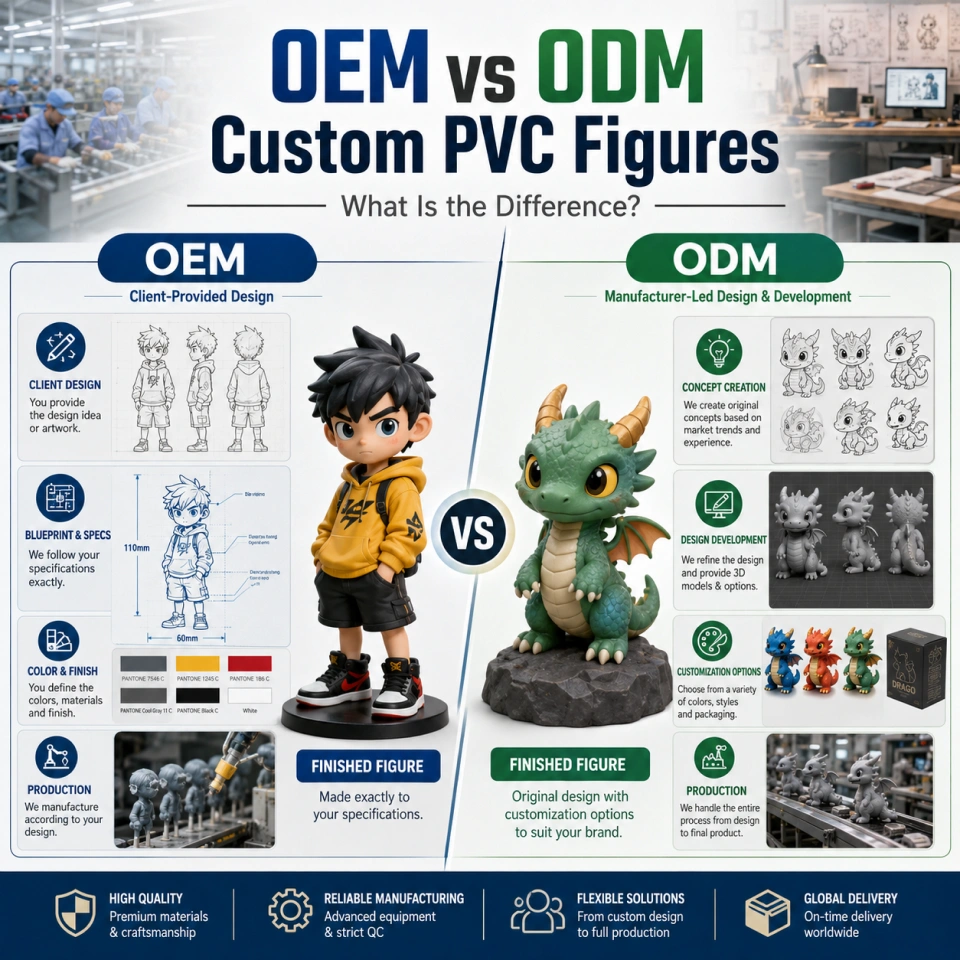
If buyers want a direct answer, the difference between OEM vs ODM custom PVC figures is simple: OEM usually means the buyer provides the product concept, design direction, or complete development files, and the factory produces according to those requirements. ODM usually means the factory takes a larger role in product development, structure design, and sometimes even concept refinement, then manufactures the final product for the buyer’s brand or project.
That is the shortest way to understand OEM vs ODM custom PVC figures. However, in real custom manufacturing, the difference is not only about who makes the product. It affects design ownership, development workload, production speed, flexibility, cost structure, and how the project is managed from beginning to end.
For buyers working on custom collectibles, blind box figures, mascot figures, or branded character merchandise, understanding OEM vs ODM custom PVC figures is extremely important. A project can run much more smoothly when the development model is chosen correctly from the start. A mismatch between project needs and manufacturing model often leads to confusion, slower communication, repeated revisions, and higher cost.
This article explains OEM vs ODM custom PVC figures in a practical way, so buyers can clearly understand the difference and decide which model is better for their project.
Quick Answer: OEM vs ODM Custom PVC Figures at a Glance
Before going deeper, here is a simple comparison table.
| Factor | OEM Custom PVC Figures | ODM Custom PVC Figures |
|---|---|---|
| Who provides the main idea | Usually the buyer | Usually the factory, or the factory works from a rough buyer concept |
| Who handles product development | Mainly based on buyer files or buyer-defined direction | Factory usually plays a stronger design and engineering role |
| Design flexibility | High if buyer has a clear concept | Medium to high, depending on factory capability |
| Development speed | Faster if files are complete | Can be faster for buyers with limited design resources, but depends on revision scope |
| Tooling and sampling logic | Based on buyer-approved design route | Based on factory-led development route |
| Best for | Buyers with finished artwork, 3D files, or clear design control | Buyers who need support with structure, function, or product creation |
| Communication focus | Manufacturing accuracy and execution | Joint development plus manufacturing |
| Common use case | Licensed character projects, mature brand concepts, detailed buyer-led development | Brand collaboration, concept-to-product development, buyers with only rough ideas |
This is the practical framework buyers should use when comparing OEM vs ODM custom PVC figures.
What does OEM mean in custom PVC figure manufacturing?
In the context of OEM vs ODM custom PVC figures, OEM usually means the buyer already has a clearer product direction and wants the factory to produce according to that plan.
For example, the buyer may provide:
- complete TSL files
- 2D artwork with structure direction
- 3D files
- character references
- size and packaging requirements
- target colors
- accessory list
- retail positioning
In an OEM model, the factory still plays an important role in engineering review, mold planning, production feasibility, and quality control, but the original design direction is more strongly defined by the customer.
This makes OEM especially suitable for:
- licensed products
- established IP brands
- buyers with internal design teams
- customers who want tighter control over design output
- projects where the final look is already clearly decided
In OEM vs ODM custom PVC figures, OEM is usually better when the buyer already knows exactly what they want and needs a capable factory to turn that design into a manufacturable product.
What does ODM mean in custom PVC figure manufacturing?
ODM is different because the factory usually contributes more to the product development stage.
In OEM vs ODM custom PVC figures, ODM often works well when the buyer has:
- only a rough concept
- a character image but no production files
- a reference style but no detailed development plan
- a market idea but limited product engineering capacity
- a need for structural and design support
Under an ODM model, the factory may help with:
- concept refinement
- 3D development
- structure design
- function integration
- production-friendly adjustments
- packaging suggestions
- finishing recommendations
This is why ODM can be very useful for buyers who want a custom result but do not yet have a complete product-development system in place.
For projects involving IP homeware, electronic gifts, or integrated character products, ODM is often more practical than a pure OEM model because the factory can help bridge the gap between idea and manufacturable product.
The biggest difference in OEM vs ODM custom PVC figures: who leads development?
The clearest difference in OEM vs ODM custom PVC figures is development leadership.
In OEM:
- the buyer leads more of the original design direction
- the factory focuses more on execution, engineering conversion, and manufacturing
In ODM:
- the factory usually participates more deeply in concept shaping and product development
- the buyer guides branding, market direction, and approval
This difference affects the whole workflow.
That is why buyers should not choose between OEM vs ODM custom PVC figures based only on habit. They should choose based on how ready the project actually is.
If the buyer already has a complete structure and visual direction, OEM may be more efficient. If the buyer still needs help turning an idea into a workable product, ODM may be the better route.
OEM vs ODM custom PVC figures: which model is better for lead time?
Lead time depends a lot on how complete the buyer’s files are.
In OEM vs ODM custom PVC figures, OEM can be faster when the buyer already provides complete and production-ready files. In that case, the factory may be able to move more quickly into sample development, engineering review, and tooling planning.
But if the buyer calls a project OEM while still lacking usable files, then the timeline may not actually be faster. The factory still needs to spend time resolving development gaps.
ODM can be slower at the beginning because the factory needs to participate more in concept and structure creation. However, for buyers who have limited internal resources, ODM may still be more efficient overall because it reduces confusion and avoids weak self-managed development.
If you want to understand how file readiness changes timing, you can also read Custom PVC Figure Lead Time: How Long Does It Take to Make a Custom PVC Figure?.
OEM vs ODM custom PVC figures: which model is better for cost control?
Many buyers think OEM always means lower cost, but that is not always true.
In OEM vs ODM custom PVC figures, cost depends more on project clarity and manufacturability than on the label itself.
OEM can control cost well when:
- the buyer’s files are complete
- the design is already optimized
- revisions are limited
- tooling and painting requirements are realistic
ODM can control cost well when:
- the buyer has only a rough idea
- the factory helps simplify structure early
- the development route is made more production-friendly from the beginning
In other words, a poorly prepared OEM project can easily become more expensive than a well-managed ODM project.
That is why the smarter question is not which one is cheaper, but which model gives this project a cleaner path from concept to production.
If you also want to understand how project structure affects pricing, you can read What Affects the Unit Price of a Custom PVC Figure?.
OEM vs ODM custom PVC figures: which model gives more control?
In OEM vs ODM custom PVC figures, OEM usually gives the buyer more direct control over:
- character appearance
- part design
- product positioning
- packaging direction
- visual consistency
- development approval standards
That is why OEM is often preferred for buyers who already have brand assets, internal designers, or licensing requirements.
ODM gives the buyer less direct control at the earliest stage, but it often provides more support. This can be a major advantage when the buyer wants speed, engineering guidance, or market-ready adaptation.
So in OEM vs ODM custom PVC figures, OEM usually gives more control, while ODM usually gives more development support.
Which buyers should choose OEM custom PVC figures?
OEM is usually better for buyers who already have a clearer project structure.
Typical OEM buyers include:
- IP owners
- licensing companies
- established toy brands
- buyers with internal design teams
- customers who already have 3D or TSL development files
- projects with strict visual approval requirements
For these buyers, OEM vs ODM custom PVC figures is often not a difficult decision. They already know the design route they want, so OEM is more natural.
Which buyers should choose ODM custom PVC figures?
ODM is usually better for buyers who want a custom result but still need deeper factory support.
Typical ODM buyers include:
- startups launching new collectible products
- promotional clients with only a concept image
- brands exploring new character merchandise categories
- buyers who want structural, functional, or packaging suggestions
- customers with limited in-house product development capability
For these buyers, ODM can reduce risk because the factory helps turn a rough concept into a real production plan.
OEM vs ODM custom PVC figures and sampling process
The sampling process also looks different under OEM and ODM.
In OEM:
- sampling usually follows buyer-provided direction more closely
- sample approval focuses on execution accuracy
- revisions often compare the sample against the buyer’s original files
In ODM:
- sampling may involve more development discussion
- revisions may include concept refinement and engineering adjustments
- approval often includes both design decision-making and manufacturing review
This is one of the most practical differences in OEM vs ODM custom PVC figures. OEM sampling is often more execution-driven. ODM sampling is often more collaborative.
OEM vs ODM custom PVC figures and production risk
Every custom project has risk, but the type of risk changes depending on the model.
In OEM, the biggest risks often come from:
- incomplete buyer files
- unrealistic design expectations
- manufacturability issues hidden in the original design
- too many late revisions
In ODM, the biggest risks often come from:
- unclear development boundaries
- buyer and factory not aligning on style direction
- approval standards changing during development
- over-dependence on factory-side interpretation
That is why successful OEM vs ODM custom PVC figures projects always need one thing in common: clear communication.
A practical comparison of OEM vs ODM custom PVC figures
| Project Situation | Better Choice | Why |
|---|---|---|
| Buyer has complete files and clear design control | OEM | Faster execution and stronger buyer control |
| Buyer has only a concept or flat artwork | ODM | Factory can support development and structure creation |
| Licensed product with strict approval rules | OEM | Buyer needs tighter control over execution |
| New product category with limited internal design support | ODM | Factory support reduces development pressure |
| Buyer wants to test product ideas quickly | ODM or hybrid | Depends on how much development work is still needed |
| Buyer already knows exact packaging, pose, and details | OEM | Cleaner production path |
This is often the most useful way to think about OEM vs ODM custom PVC figures in real sourcing work.
OEM vs ODM custom PVC figures and project delay
Another important point is timing risk.
If buyers choose OEM but do not actually have complete development files, the project may slow down because the factory still has to fill the missing gaps. If buyers choose ODM but do not define approval standards clearly, the project may also slow down because too many creative revisions happen during development.
That is why OEM vs ODM custom PVC figures is not only a commercial label. It is a project management decision.
If you want to understand how delays happen in custom development, you can also read Custom PVC Figure Production Delay: Why Do Custom PVC Figure Projects Get Delayed?.
How to decide between OEM vs ODM custom PVC figures
If you are deciding between OEM vs ODM custom PVC figures, ask these questions first.
1. Do you already have usable development files?
If yes, OEM may be a better fit.
2. Do you need help turning a concept into a real product?
If yes, ODM may be more suitable.
3. Is design ownership and strict visual control your priority?
If yes, OEM is usually stronger.
4. Is speed to development support more important than full early control?
If yes, ODM may help more.
5. Does the project include complicated structure or function?
If yes, ODM support may be valuable unless the buyer already has strong technical files.
One more practical point: many real projects are hybrid
In real manufacturing, OEM vs ODM custom PVC figures is not always completely black and white.
Some buyers start with a rough design and ask the factory to develop the structure. That looks more like ODM at first. Later, the buyer tightens approvals and treats execution like OEM. Other projects begin as OEM but still need strong factory-led optimization to become manufacturable.
So in practice, many successful projects are hybrid. The important thing is not the label alone. The important thing is whether both sides clearly define who is responsible for concept, design revision, engineering, approval, and production execution.
For a general background reference on OEM and ODM in manufacturing, you can also see this overview of OEM manufacturing.
Final thoughts
The best direct answer to OEM vs ODM custom PVC figures is that OEM usually means the buyer leads the original design direction and the factory manufactures according to that plan, while ODM usually means the factory plays a larger role in product development before production begins.
In real projects, the right choice depends on development readiness. If the buyer already has complete files and clear control requirements, OEM is usually the better option. If the buyer only has a concept and needs more support with structure, engineering, or manufacturability, ODM is often the better path.
That is why buyers should not choose between OEM vs ODM custom PVC figures based only on terminology. They should choose based on what the project actually needs.
Need help deciding between OEM vs ODM custom PVC figures?
If you are planning a new custom figure project, the best first step is to review what materials you already have and how much development support you still need.
At Jiahong Creative, project planning can start from either direction. If you already have development-ready files, the team can review manufacturability and move toward sample and tooling planning more efficiently. If you only have concept artwork or a rough idea, the team can help assess structure, production route, and development logic before the project goes too far.
You can send your artwork, 3D files, TSL files, target size, expected quantity, and packaging direction, and we can help you determine whether OEM vs ODM custom PVC figures is the better model for your project.
FAQ
Q1:What is the main difference between OEM vs ODM custom PVC figures?
The main difference is who leads product development. In OEM, the buyer usually provides the design direction or files and the factory manufactures accordingly. In ODM, the factory usually takes a larger role in development before production.
Q2:Is OEM better than ODM for custom PVC figures?
Not always. OEM is better when the buyer already has clear files and wants more control. ODM is better when the buyer needs more help with structure, design development, or manufacturability.
Q3:Which is faster, OEM or ODM custom PVC figures?
OEM can be faster if the buyer already has complete files. ODM can still be more efficient overall if the buyer has limited development resources and needs factory support.
Q4:Is ODM cheaper than OEM for custom PVC figures?
Not necessarily. Cost depends more on project clarity, part complexity, revisions, and manufacturability than on whether the project is labeled OEM or ODM.
Q5:Which model is better for licensed character projects?
OEM is often better for licensed projects because the buyer usually needs tighter control over design, approval, and brand consistency.
Q6:Can a project be partly OEM and partly ODM?
Yes. Many real custom figure projects are hybrid. The buyer may provide the concept while the factory helps refine structure, manufacturability, and production planning.