

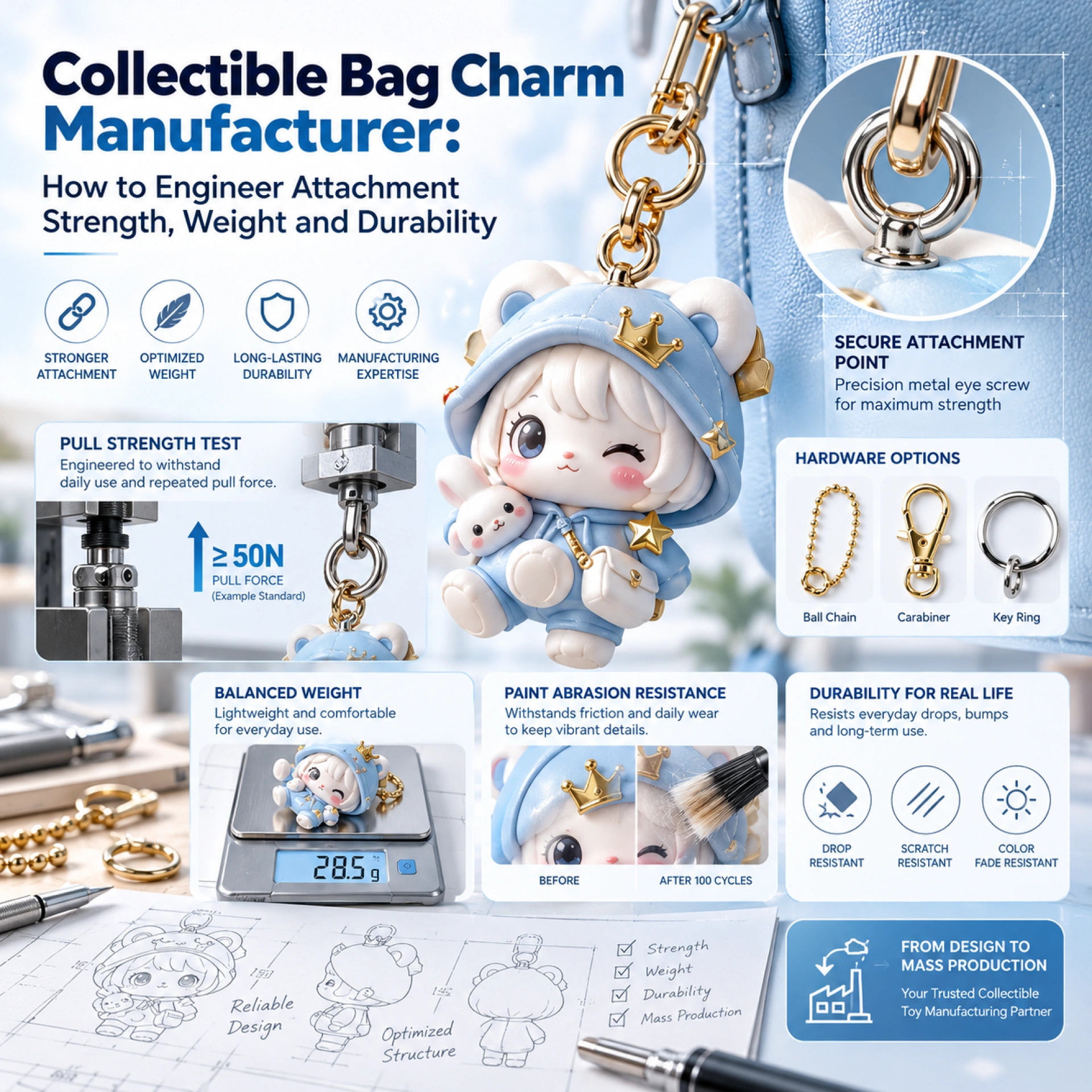
A 12 cm display figure cannot simply be scaled down into a 5 cm bag charm because the two products have completely different structural requirements. A display figure is designed primarily for visual accuracy, stability and shelf presentation, while a bag charm must withstand pulling, swinging, twisting, rubbing, dropping and repeated contact with bags or clothing. When a figure becomes smaller, its attachment points, wall thickness, decorative details and assembly structures must be redesigned to support portable use.
A professional Collectible Bag Charm Manufacturer should therefore treat a bag charm as a separate engineered product rather than a miniature version of an existing PVC figure. The character’s face, colors and visual identity can be reused, but the attachment structure, metal hardware, product weight, paint durability and mechanical performance need independent evaluation.
For brands developing licensed character merchandise, game accessories, anime collectibles or promotional products, these decisions directly affect product reliability, manufacturing cost and customer satisfaction.
This guide explains the engineering decisions buyers should confirm before developing a custom PVC bag charm, from molded loops and metal eye screws to pull strength, ball chains, carabiners, paint abrasion and prototype validation.
1. Why Can’t a 12 cm Display Figure Simply Be Scaled Down Into a 5 cm Bag Charm?
The biggest difference is the way customers use the product.
A 12 cm display figure normally stands on a shelf or display base. Its structure mainly needs to support its own weight and maintain its intended pose.
A 5 cm bag charm experiences a completely different environment.
It may be:
- Pulled when someone picks up a bag.
- Swinging while the customer walks.
- Twisted when caught on clothing.
- Rubbed against zippers and other accessories.
- Dropped onto hard surfaces.
- Compressed inside a backpack.
- Exposed to repeated contact with metal hardware.
These conditions create mechanical stresses that a conventional display figure does not normally experience.
Scaling Changes More Than Appearance
Consider reducing a 12 cm figure to 5 cm.
The linear scaling factor is approximately 41.7%.
Under ideal geometric scaling, cross-sectional areas would decrease to approximately 17.4% of their original size, while volume would decrease to approximately 7.2%.
These figures are mathematical illustrations, not predictions of actual product strength. Real products also depend on material properties, geometry and manufacturing methods.
More importantly, the external pulling forces experienced by a bag charm do not automatically decrease in proportion to its size.
A small attachment loop that looks acceptable on a miniature 3D model may become too weak when exposed to repeated pulling.
Details Also Need Structural Adjustment
A 12 cm figure may have:
- Thin ears.
- Extended arms.
- Small hair tips.
- Separate accessories.
- Delicate decorative parts.
- Multiple painted details.
When reduced to 5 cm, some of these features may become too fragile to manufacture reliably or survive everyday use.
A Collectible Bag Charm Manufacturer should evaluate whether these details need to be:
- Thickened.
- Simplified.
- Integrated into the main body.
- Repositioned.
- Converted into molded details instead of separate components.
Display Structure vs Portable Structure
| Engineering Area | 12 cm Display Figure | 5 cm Bag Charm |
|---|---|---|
| Main Purpose | Display and collection | Portable accessory |
| Structural Priority | Shape and standing stability | Attachment and pulling strength |
| Weight | Can be relatively heavy | Should be controlled |
| Connection | Optional base or stand | Loop, eye screw or metal attachment |
| Surface | Display appearance | Abrasion resistance |
| Accessories | Decorative details | Must resist repeated handling |
| Testing | Visual and structural inspection | Pull, drop, abrasion and hardware testing |
The most important principle is to reuse the character design, not blindly reuse the original figure structure.
2. Molded Loop vs Metal Eye Screw: Which Attachment Structure Is Better?
The attachment point is one of the most important engineering decisions for a custom bag charm.
There are two common approaches: an integrated molded loop and a metal eye screw or embedded metal loop.
Neither option is automatically stronger. The right solution depends on the PVC formulation, product weight, attachment geometry, intended pulling direction and manufacturing process.
Option A: Molded Loop
A molded loop is integrated directly into the PVC character body during molding.
The loop becomes part of the product rather than a separate metal component.
Advantages include:
- Fewer separate components.
- No metal insert required.
- Consistent appearance with the character body.
- Reduced risk of metal-to-painted-surface contact.
- Potentially lower hardware cost.
However, the molded loop must be designed carefully.
If the loop is too thin, pulling force can concentrate around its root and cause tearing.
If the connection area is too close to the edge of the character’s head, the surrounding PVC may not provide enough support.
A suitable design should consider:
- Loop thickness.
- Root width.
- Internal radius.
- Distance from the body edge.
- Material flexibility.
- Pulling direction.
- Product weight.
The loop should be designed as a structural feature, not simply as a decorative extension.
Option B: Metal Eye Screw
A metal eye screw is a small metal fastener with a circular attachment eye.
It can be installed into a properly engineered connection area or integrated into the product structure during manufacturing.
Advantages include:
- Compact attachment design.
- A relatively clean external appearance.
- Direct connection to a metal ring or chain.
- Potentially easier integration with certain character shapes.
However, the main risk is pull-out or loosening.
If an eye screw is simply inserted into a soft PVC section without sufficient mechanical retention, repeated pulling may cause it to rotate or gradually loosen.
The surrounding PVC can also tear if the attachment area is too thin.
For this reason, the engineering team should evaluate the insertion depth, anchoring method, surrounding material thickness and pull direction.
Molded Loop vs Metal Eye Screw Comparison
| Item | Molded Loop | Metal Eye Screw |
|---|---|---|
| Material | Integrated PVC | Metal hardware |
| Appearance | Fully integrated | Visible metal eye |
| Components | Fewer | Additional hardware |
| Main Risk | PVC tearing | Pull-out or loosening |
| Weight | Usually lighter | Adds weight |
| Cost | Depends on mold complexity | Depends on hardware and assembly |
| Design Flexibility | Limited by molded geometry | More attachment options |
| Validation | Loop deformation and tearing | Pull-out, rotation and retention |
Which Should Buyers Choose?
For lightweight character charms with a suitable body structure, an integrated molded loop can be a practical solution.
For compact designs that require a metal attachment, an appropriately engineered metal insert may be considered.
However, neither design should be approved based on appearance alone.
A Collectible Bag Charm Manufacturer should validate the complete connection system using actual production-intent materials and hardware.
3. Ball Chain vs Carabiner: Choosing the Right Hardware
After selecting the attachment structure, buyers need to decide how customers will attach the charm to their bags.
Two common choices are ball chains and carabiner-style clips.
They offer different advantages in appearance, convenience, weight and cost.
Ball Chain
A ball chain consists of connected metal balls with a matching connector.
It is commonly used for lightweight charms and promotional accessories.
Advantages:
- Lightweight.
- Flexible.
- Compact.
- Simple appearance.
- Generally economical.
- Easy to connect through suitable loops.
Potential disadvantages:
- The connector can become a weak point.
- Individual chain components can separate if the connection fails.
- The chain may rub against the PVC surface.
- Small metal components require appropriate safety consideration.
- The appearance may be less premium for certain products.
For a small 5 cm PVC charm, a ball chain may be sufficient when the total product weight and intended use are relatively light.
However, the chain and connector must be evaluated together.
Carabiner-Style Clip
A small carabiner-style clip provides a more convenient attachment mechanism.
Customers can attach and remove the charm from:
- Backpacks.
- Handbags.
- Belt loops.
- Zippers.
- Other compatible accessories.
Advantages:
- Convenient attachment and removal.
- More substantial appearance.
- Suitable for certain premium merchandise.
- Can support different product styles.
Potential disadvantages:
- Higher hardware weight.
- Greater material and assembly cost.
- Spring-gate wear.
- Possible scratching from metal contact.
- More space required.
- Potential failure of the gate or connection.
Importantly, decorative mini carabiners should not be assumed to have climbing or load-rated performance. Their actual strength must be established for the intended product application.
Ball Chain vs Carabiner Comparison
| Item | Ball Chain | Carabiner-Style Clip |
|---|---|---|
| Weight | Usually lighter | Usually heavier |
| Cost | Generally lower | Depends on metal and mechanism |
| Attachment | Simple connector | Opening and closing gate |
| Appearance | Minimalist | More substantial |
| Convenience | Suitable for simple attachment | Easy to remove and reposition |
| Main Risk | Connector separation | Gate or spring failure |
| Best Application | Lightweight charms | Premium or frequently removed charms |
What Should Buyers Confirm?
Before choosing the hardware, confirm:
- Total product weight.
- Expected attachment frequency.
- Required hardware length.
- Metal material and plating.
- Connector strength.
- Whether the hardware can scratch the PVC body.
- Whether the hardware contains detachable small components.
The Collectible Bag Charm Manufacturer should also evaluate the complete hardware assembly rather than approving the chain or clip as an isolated component.
4. Attachment Pull Strength: How Strong Should a Bag Charm Be?
Pull strength is one of the most important performance requirements for a portable collectible.
A bag charm can look perfect when it leaves the factory but fail after repeated use if the attachment structure is weak.
The main connection system includes:
PVC Body → Attachment Point → Metal Ring → Chain or Clip
Every connection in this system must be evaluated.
Common Attachment Failure Modes
| Component | Possible Failure |
|---|---|
| Molded PVC Loop | Tearing or deformation |
| Metal Eye Screw | Pull-out or rotation |
| Embedded Insert | Loosening |
| Jump Ring | Opening or deformation |
| Ball Chain | Separation or breakage |
| Chain Connector | Disconnection |
| Carabiner Gate | Failure to close or retain |
| Metal Joint | Corrosion or wear |
A strong metal chain does not guarantee a strong product if the PVC loop tears.
Likewise, a reinforced PVC body does not help if the jump ring opens.
What Pull Tests Should Buyers Request?
A suitable engineering validation plan may include:
1. Axial Pull Test
Apply a controlled pulling force in the main direction of the attachment.
Evaluate whether the loop, eye screw or embedded insert becomes loose or damaged.
2. Side Pull Test
Apply force from different directions.
This is important because bag charms do not always experience force in one straight direction.
3. Repeated Pulling Test
Apply repeated loading to simulate regular attachment and handling.
Check whether the PVC gradually tears or the metal connection becomes loose.
4. Twisting Test
Evaluate whether repeated rotation causes the eye screw, ring or attachment point to loosen.
5. Post-Test Inspection
After mechanical testing, inspect:
- PVC cracks.
- Loop deformation.
- Metal movement.
- Opened rings.
- Detached connectors.
- Surface damage.
Is There a Universal Pull Strength Requirement?
No. There is no single pull-force value that is appropriate for every bag charm.
The required force depends on:
- Product weight.
- Intended use.
- Attachment design.
- Target age.
- Material properties.
- Hardware selection.
- Applicable safety requirements.
Buyers should agree on the test method, loading direction, minimum acceptance criteria and failure definition before mass production.
For products classified as toys, relevant mechanical testing requirements may apply. The ASTM F963 Toy Safety Standard includes tension and torque tests for the removal of components.
The applicable testing requirements should be confirmed according to the product’s intended use and target market.
5. Product Weight: Why Lightweight Design Matters
A bag charm is carried rather than displayed.
This means excessive weight can reduce comfort and increase mechanical stress.
A heavier charm may:
- Pull on the bag attachment.
- Swing with greater momentum.
- Put additional load on the metal hardware.
- Increase stress around the PVC loop.
- Cause more frequent impact against surrounding objects.
Total Weight Is More Important Than PVC Weight Alone
Buyers sometimes focus only on the weight of the PVC character.
However, the final product may contain:
- PVC body.
- Metal eye screw.
- Jump ring.
- Ball chain.
- Carabiner.
- Decorative accessories.
- Additional metal components.
The combined weight determines the actual load carried by the attachment system.
For example, replacing a lightweight ball chain with a larger metal clip may significantly change the total weight of a small charm.
Weight and Center of Gravity
The attachment position also matters.
If the center of gravity is far away from the attachment point, the charm may swing and rotate more during movement.
This can increase repeated loading around the attachment area.
A good Collectible Bag Charm Manufacturer should review:
- Total finished weight.
- Hardware weight.
- Center of gravity.
- Attachment position.
- Character orientation when hanging.
- Potential contact with the bag.
The product should hang naturally without excessive twisting or an awkward appearance.
How Can Buyers Reduce Weight?
Possible engineering options include:
- Simplifying oversized accessories.
- Reducing unnecessary solid material.
- Optimizing the character’s thickness.
- Selecting lighter hardware.
- Reducing chain length.
- Integrating decorative features into the main body.
However, weight reduction must not compromise the structural strength of the attachment area.
The goal is not simply to make the charm as light as possible. It is to achieve the right balance between portability, appearance and durability.
6. Paint Abrasion: Bag Charms Experience More Surface Contact
Painting requirements for bag charms are different from those for display figures.
A display figure usually stays on a shelf.
A bag charm repeatedly contacts:
- Fabric.
- Zippers.
- Keys.
- Other metal accessories.
- Clothing.
- Hands.
- Backpack surfaces.
This increases the risk of paint abrasion, scratches and coating damage.
Common Paint Abrasion Problems
Common defects include:
- Paint rubbing off.
- Color transfer onto fabric.
- Scratches around raised details.
- Clear-coat peeling.
- Metallic finish wear.
- Paint damage caused by chain contact.
- Surface discoloration.
For a character charm with multiple painted colors, these problems can become particularly noticeable.
How Should Buyers Improve Paint Durability?
The manufacturing team should evaluate several options.
Molded-In Base Colors
Where suitable, the base color can be achieved through the PVC material itself rather than relying entirely on surface paint.
This can reduce the amount of exposed paint on high-contact areas.
Controlled Paint Areas
The design can minimize unnecessary painted surfaces around the attachment and other high-friction regions.
Protective Coating
A suitable clear coating may improve surface protection, depending on the paint system and substrate.
However, the compatibility of the coating must be verified. It should not create a sticky surface, alter the approved color or produce unwanted gloss.
Hardware Clearance
The chain or metal clip should not continuously scrape against the most visible painted surfaces.
Recommended Abrasion Validation
Before production, buyers can request:
- Repeated dry-rub testing.
- Contact testing against representative bag fabrics.
- Metal-to-PVC contact evaluation.
- Color transfer inspection.
- Post-test visual inspection.
- Coating adhesion evaluation where appropriate.
The actual test conditions and acceptance limits should be agreed with the manufacturer and testing laboratory.
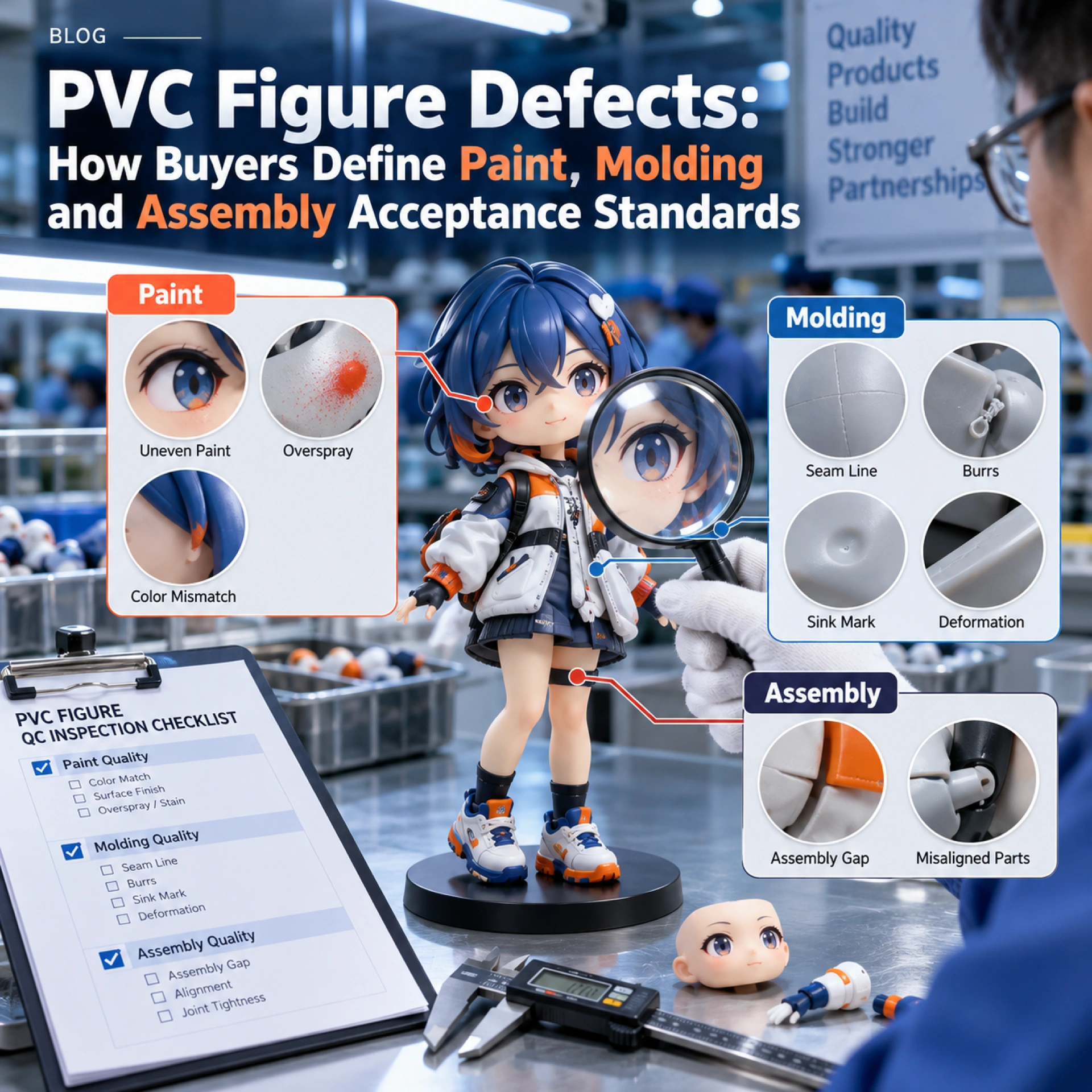
Our PVC Figure Defects acceptance standards guide explains how buyers define paint, molding and assembly defects. For bag charms, those visual standards should be supplemented with additional abrasion testing.
7. Metal Hardware: Material, Plating and Durability
Metal hardware is not simply a decorative accessory.
It is part of the product’s functional structure.
A Collectible Bag Charm Manufacturer should evaluate the hardware as carefully as the PVC character itself.
Common Metal Hardware Options
| Material | Typical Application | Buyer Considerations |
|---|---|---|
| Stainless Steel | Rings and certain attachment components | Grade, corrosion resistance and finish |
| Zinc Alloy | Decorative clips and clasps | Weight, casting quality and plating |
| Brass | Small rings and hardware components | Material specification and surface finish |
| Plated Steel | Chains and connectors | Coating quality, wear and corrosion |
| Carbon Steel | Certain clips and rings | Plating and corrosion protection |
The appropriate material depends on product positioning, budget, appearance and intended use.
What Should Buyers Inspect?
1. Plating Quality
Check for:
- Uneven plating.
- Color differences.
- Scratches.
- Peeling.
- Exposed base metal.
2. Corrosion Resistance
Hardware may experience moisture, sweat and environmental exposure.
The buyer should define the expected corrosion-resistance requirements and testing method according to the intended market and use.
3. Sharp Edges and Burrs
Metal components should not have sharp edges that can scratch customers, clothing or bags.
4. Ring Closure
Jump rings should have appropriate closure and alignment.
A poorly closed ring may allow the chain or charm to detach.
5. Spring Mechanism
For carabiner-style clips, the gate should open and close consistently.
The spring should return properly and the gate should not remain unintentionally open.
6. Metal-to-PVC Contact
The hardware should not continuously damage the painted character body.
The engineering team may need to adjust the ring orientation, chain length or connection position.
Hardware approval should include the actual production component, not only a supplier photograph.
8. Small Parts Risk: What Happens If a Metal Component Detaches?
Small parts are an important consideration for character bag charms, particularly when products are marketed to children.
Potential detachable components include:
- Metal balls from ball chains.
- Small jump rings.
- Decorative beads.
- Metal eye screws.
- Small clips.
- Decorative PVC accessories.
- Broken pieces of the character body.
The key question is whether any component can detach during reasonably foreseeable use or applicable use-and-abuse testing.
Target Age and Product Classification Matter
A collectible bag charm is not automatically classified as a toy.
However, if it is designed, manufactured or marketed as a toy for children, applicable toy safety requirements must be considered.
For the United States, the CPSC Small Parts and Choking Hazard Guidance explains the small-parts ban for applicable children’s products intended for children under three and relevant choking-hazard labeling requirements.
The CPSC Toy Safety Guidance also explains the applicable ASTM F963 testing and certification framework for children’s toys.
For the European market, buyers should review the applicable toy classification and mechanical requirements, including EN 71-1 mechanical and physical properties, where relevant.
What Should Buyers Confirm?
Before approving the product, confirm:
- Intended age group.
- Whether the product is a toy or fashion accessory.
- Whether metal hardware can detach.
- Whether the PVC body can break.
- Whether small components remain accessible.
- Whether the product needs relevant mechanical testing.
- Whether applicable warnings or labels are required.
A small charm should not be considered safe simply because its overall size is small.
The smallest detachable components may present the greatest risk.
9. Prototype Validation: What Should Be Tested Before Mass Production?
A 3D rendering can show how a bag charm looks.
It cannot prove that the attachment will survive repeated use.
This is why prototype validation is essential.
A professional Collectible Bag Charm Manufacturer should distinguish between a visual prototype and a functional engineering prototype.
Visual Prototype
A visual prototype helps evaluate:
- Character proportions.
- Overall size.
- Facial details.
- Color.
- Appearance.
- Hardware position.
- Hanging orientation.
It is useful for confirming the design direction.
However, a 3D-printed prototype may not reproduce the mechanical behavior of the final PVC material.
Functional Engineering Prototype
A functional prototype should use production-intent materials and actual hardware wherever possible.
It should be used to evaluate:
- PVC flexibility.
- Attachment structure.
- Metal insert retention.
- Chain connection.
- Product weight.
- Pull performance.
- Paint durability.
- Hardware operation.
A prototype made from a different material may be useful for visual evaluation, but it cannot automatically validate the strength of the final PVC attachment.
Recommended Prototype Validation Matrix
| Test Item | What to Evaluate | Expected Result |
|---|---|---|
| Attachment Pull Test | PVC loop or metal insert | No unacceptable detachment or tearing |
| Side Pull Test | Off-axis loading | Attachment remains secure |
| Repeated Pull Test | Repeated loading | No progressive structural failure |
| Twisting Test | Ring and eye screw | No unacceptable loosening |
| Chain Test | Ball chain and connector | No unintended separation |
| Clip Test | Carabiner gate | Consistent opening and closing |
| Drop Test | Complete assembled charm | No unacceptable damage or detachment |
| Abrasion Test | Paint and surface coating | Meets agreed appearance standard |
| Hardware Inspection | Plating and metal edges | No unacceptable defects |
| Small Parts Evaluation | Detachable components | Meets applicable safety requirements |
The actual test force, cycle count, drop conditions and acceptance criteria must be determined for the product.
There is no reason to invent one universal test value for every 5 cm charm.
Why Prototype Testing Saves Money
Suppose a brand approves the 3D design, pays for tooling and starts mass production.
Only after shipment does the buyer discover that the metal eye screw loosens during normal use.
The problem may require:
- Structural redesign.
- Mold modification.
- New hardware.
- Additional sampling.
- New testing.
- Production delays.
By testing the attachment during prototype development, the manufacturer can identify the problem before the tooling and production investment becomes much larger.
10. Buyer RFQ Checklist: What Should You Send to a Collectible Bag Charm Manufacturer?
A complete RFQ should contain more than a character image and target size.
The buyer should provide enough information for the engineering team to evaluate the product’s actual use.
| RFQ Information | What Buyers Should Provide |
|---|---|
| Character Artwork | 2D artwork or approved 3D files |
| Product Size | Target height, width and thickness |
| Product Weight | Target total weight, if available |
| Intended Use | Bag charm, backpack accessory or keychain |
| Target Age | Intended consumer group |
| Target Market | USA, UK, EU or other markets |
| Attachment Type | Molded loop, metal eye screw or embedded insert |
| Hardware | Ball chain, carabiner or other clip |
| Metal Finish | Silver, gold, black or custom plating |
| Paint | Pantone colors and special finishes |
| Durability | Pull, abrasion and drop requirements |
| Packaging | Card, pouch, blister or gift box |
| Quantity | Expected MOQ and order quantity |
| Testing | Required mechanical and safety evaluation |
| Timeline | Prototype and mass-production schedule |
Questions Buyers Should Ask the Factory
- Can the existing character figure design be adapted into a bag charm?
- Which attachment structure is recommended?
- Can the attachment be integrated into the PVC mold?
- What PVC thickness is required around the attachment?
- Which metal hardware options are available?
- Can the factory coordinate pull and abrasion testing?
- How will the product weight be controlled?
- Can the actual production hardware be used for prototype validation?
- What are the MOQ and tooling requirements?
- What quality inspection standards will apply to mass production?
These questions help a Collectible Bag Charm Manufacturer evaluate the project before quotation and tooling.
11. How Jiahong Creative Supports Custom PVC Bag Charm Development
Jiahong Creative supports custom character merchandise development, including PVC figures, blind boxes, keychains, accessories and character-based products.
Our manufacturing workflow can support:
- Character artwork review.
- 3D modeling and engineering adjustment.
- Prototype development.
- Mold design and manufacturing.
- PVC injection molding.
- Painting and pad printing.
- Metal hardware integration.
- Product assembly.
- Packaging.
- Quality inspection.
For bag charm projects, the engineering review should pay particular attention to the attachment structure, product weight, PVC thickness, hardware selection and surface durability.
The objective is to make sure the finished product is not only visually accurate but also suitable for repeated portable use.
Our custom PVC toy manufacturer guide explains the wider manufacturing capabilities and production considerations for custom PVC products.
For brands expanding from figures into accessories, our Character Figure to Lifestyle Product guide also explains how one licensed character can be adapted into multiple merchandise categories.
Request a Custom Bag Charm Manufacturing Evaluation
If you are developing a custom character bag charm, you can share:
- Character artwork or 3D files.
- Target size.
- Preferred PVC material.
- Target weight.
- Attachment preference.
- Metal hardware preference.
- Target quantity.
- Packaging concept.
- Target market.
- Intended customer age.
Our team can review the design and discuss the appropriate development and manufacturing process before tooling.
Contact Jiahong Creative for Custom PVC Merchandise Development.
Final Thoughts
A successful character bag charm is more than a small PVC figure with a metal chain.
It is a portable product that must combine character accuracy, lightweight construction, secure attachment, suitable hardware and resistance to everyday wear.
For brands, the most important engineering decisions include:
- Molded loop vs metal eye screw.
- Ball chain vs carabiner.
- Attachment pull strength.
- Total product weight.
- Paint abrasion resistance.
- Metal hardware quality.
- Small parts risk.
- Prototype validation.
The most important lesson is that a display figure and a bag charm have different structural priorities.
A display figure needs to look good on a shelf.
A bag charm needs to look good while being carried, pulled, swung, dropped and handled repeatedly.
A professional Collectible Bag Charm Manufacturer should therefore redesign the connection structure and validate the complete product before mass production.
Reuse the character identity, redesign the attachment, and validate the product for real-world use.
That is the foundation of reliable custom collectible bag charm manufacturing.
FAQ
1. What should buyers look for in a Collectible Bag Charm Manufacturer?
Buyers should evaluate the manufacturer’s PVC molding capability, structural engineering, attachment design, metal hardware sourcing, painting, assembly, prototype testing and quality control. The manufacturer should understand that bag charms require different structural considerations from ordinary display figures.
2. What is the difference between a PVC figure and a PVC bag charm?
A PVC figure is mainly designed for display and collection. A PVC bag charm is designed for portable use and needs additional attention to attachment strength, product weight, hardware, abrasion resistance and repeated handling.
3. Can a 12 cm PVC figure be reduced to a 5 cm bag charm?
The original 3D model can be used as a starting reference, but the structure should be redesigned. The attachment point, thickness, decorative details, weight distribution and assembly need to be reviewed for portable use.
4. Is a molded loop stronger than a metal eye screw?
Not necessarily. A molded loop avoids a separate metal insert but can tear if its root is too thin. A metal eye screw provides a different attachment structure but may loosen or pull out if not properly anchored. Both require prototype testing.
5. Is a ball chain or carabiner better for bag charms?
Ball chains are generally lighter and more economical, making them suitable for many lightweight charms. Carabiner-style clips offer convenient attachment and a more substantial appearance but may increase weight and cost. The correct choice depends on the product design and intended use.
6. How is bag charm attachment strength tested?
A validation plan may include axial pull, side pull, repeated pulling, twisting, connector inspection and post-test structural evaluation. The exact force and acceptance criteria should be agreed based on the product and intended market.
7. Why does product weight matter for bag charms?
Excessive weight can increase the load on the attachment, cause more swinging and create additional stress around the PVC connection point. Buyers should evaluate the complete product weight, including chains, rings and clips.