

Introduction
One of the most common questions buyers ask at the beginning of a project is simple: how long will it take? On the surface, that sounds like a straightforward scheduling question. In reality, pvc figure lead time is not a single number. It is the result of multiple connected stages, each influenced by product complexity, revision speed, internal approvals, tooling readiness, and production planning.
This is why buyers often receive very different answers from different suppliers. One factory may quote a very short development window based on ideal conditions. Another may give a longer estimate because it is including engineering review, mold testing, paint confirmation, and production preparation more realistically. A custom figure project does not move forward in one straight line. It moves through a chain of decisions, and the total pvc figure lead time depends on how smoothly those decisions are made.
For brands, creators, distributors, and licensing teams, understanding pvc figure lead time matters for more than delivery planning. It affects launch schedules, sales coordination, packaging deadlines, preorder timing, and inventory preparation. A figure that looks like a small collectible product on paper may still require weeks of design adjustment and sampling before it is safe to move into tooling.
If you want a deeper look at the full production workflow behind that timeline, your article on How PVC Toys Are Manufactured is a natural companion read. Your blog also already includes related topics such as PVC Figure Tooling Cost and Custom PVC Figure MOQ Explained, which fit this subject naturally because lead time, tooling, and quantity planning are closely connected in real projects. (jiahongcreative.com)
PVC Figure Lead Time Is a Chain, Not a Single Stage
A common misunderstanding is to treat pvc figure lead time as the production time only. Buyers often ask when the finished goods can ship, but that question usually skips the most important part of the schedule: everything that happens before the first production batch begins.
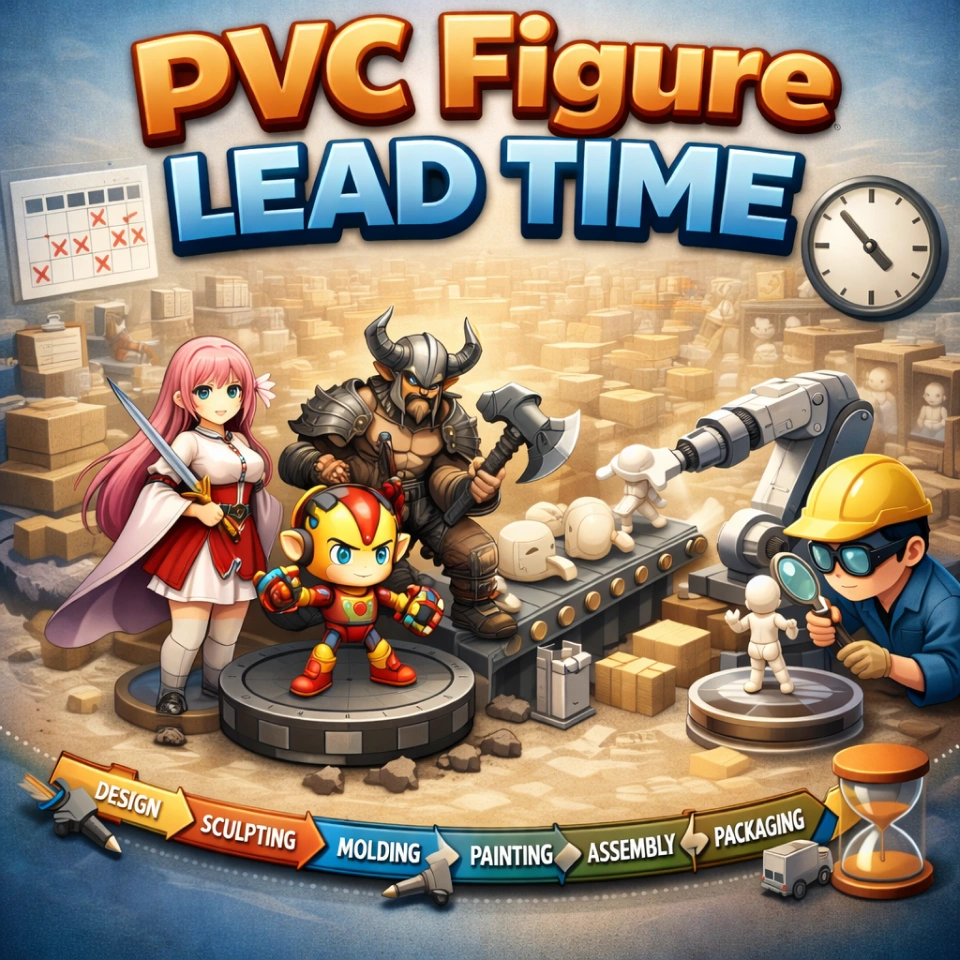
In a real custom project, pvc figure lead time is usually built from several layers:
- concept review
- engineering adjustment
- prototype or sample preparation
- mold development
- trial and correction
- painting approval
- packaging confirmation
- mass production
- final inspection
- shipment preparation
If any one of those stages slows down, the full pvc figure lead time moves with it.
That is why a “30-day production lead time” is not the same as “30 days from design to shipment.” For many custom figure projects, the front-end development stages are what really shape the timeline.
What Buyers Usually Want to Know — and What Factories Actually Mean
When buyers ask about pvc figure lead time, they are usually asking one of three different questions without realizing it:
1. How long until I can see a sample?
This is a sampling question, not a full project question.
2. How long until mass production can start?
This usually includes design review, sample approval, and tooling completion.
3. How long until finished goods can ship?
This is the broadest version and usually includes almost the full project chain.
These are very different questions, but many conversations treat them as one. That is one reason why lead time confusion happens so often.
A more useful way to discuss pvc figure lead time is to break the project into milestones instead of asking for a single broad number too early.
A More Realistic Way to Look at PVC Figure Lead Time
Instead of thinking of the project as one long waiting period, buyers should think of it as four timing blocks:
Block 1: Design Readiness
This is the time needed before the factory can even make a serious development plan.
Block 2: Validation
This includes engineering review, physical sample work, and approval decisions.
Block 3: Industrialization
This is where tooling, mold trial, and production preparation happen.
Block 4: Execution
This includes mass production, packaging, inspection, and shipment readiness.
This way of looking at pvc figure lead time is more useful because it shows where delay risk really sits. In many projects, the longest part is not production itself. It is the approval and revision stage before production begins.
The 5 Biggest Factors That Affect PVC Figure Lead Time
1. How Complete the Project Information Is at the Start
The fastest projects usually begin with the clearest briefs.
If a buyer provides:
- final artwork or solid references
- target size
- quantity expectation
- accessory details
- packaging direction
- finish expectations
- target market
then the supplier can evaluate pvc figure lead time much more accurately.
If the project starts with only a rough image and many open questions, development usually slows down because the team has to clarify structure, finish, proportions, and production logic during the project instead of before it.
So one of the most practical ways to improve pvc figure lead time is simple: prepare better before inquiry.
2. Sample and Approval Speed
A lot of delay in pvc figure lead time does not come from the factory alone. It comes from slow approval cycles.
For example:
- the sample is sent for brand review
- the buyer wants internal feedback
- a licensor asks for adjustments
- packaging direction changes after the figure is reviewed
- color comments come back in multiple rounds
Every round may be reasonable by itself, but together they extend the total pvc figure lead time.
This is especially true in licensed or brand-managed projects. A factory may finish a sample on time, but if approval takes two or three extra rounds, the timeline expands immediately.
That is why buyers should think of approval efficiency as part of pvc figure lead time, not something separate from it.
3. Tooling Complexity
Tooling does not only affect cost. It also affects time.
A simple figure with limited parts and straightforward release structure will generally move through mold development faster than a figure with:
- complicated undercuts
- many accessories
- difficult part splits
- fragile support structures
- multiple assembly points
This is one reason your article on PVC Figure Tooling Cost connects naturally here. The same features that increase tooling investment often increase pvc figure lead time as well.
If the design creates more mold complexity, then mold fabrication, testing, and correction may all take longer.
4. Paint and Finish Requirements
Painting is one of the easiest areas for buyers to underestimate when thinking about pvc figure lead time.
A figure with simple broad colors may move through paint development quickly. But if the project includes:
- detailed facial expression painting
- metallic effects
- gradients
- layered costume colors
- sharp edge boundaries
- licensed color matching requirements
then paint confirmation can become a major part of pvc figure lead time.
This is because paint is not only a production step. It is also an approval step. Buyers often need to confirm that the final visual feel matches the product intention before mass production begins.
5. Packaging and Market Preparation
In many custom figure projects, packaging is treated too late. That can be a mistake.
If the packaging structure, insert method, warning labels, carton format, or retail presentation is not considered until after the figure is already approved, the project may lose time in the final stages. A figure may technically be ready, but shipment still cannot move because the packaging side is not.
For products intended for children’s toy markets, packaging and labeling preparation may also connect to safety compliance planning. CPSC’s toy safety guidance is a useful reference here because it helps businesses understand when toy rules, testing, and product classification become relevant. (cpsc.gov)
That means packaging readiness is part of pvc figure lead time too, not only a final shipping detail.
What a Realistic PVC Figure Lead Time Might Look Like
There is no universal number, but buyers usually benefit from seeing pvc figure lead time in milestone form instead of one flat estimate.
A typical project might include:
Project evaluation and design review
Often several days to one week, depending on how complete the input is.
Sample development and revision
Often one to several weeks, depending on complexity and approval rounds.
Tooling and mold trial
Often several weeks, depending on mold difficulty and correction needs.
Mass production and packing
Often several more weeks, depending on quantity, painting complexity, and packaging readiness.
Inspection and shipment preparation
Usually the final stage before dispatch, but still important enough to affect the full pvc figure lead time.
The main point is this: the shorter and cleaner the decision chain is, the shorter pvc figure lead time becomes.
Why Buyers Often Get Unrealistic Lead Time Expectations
Some buyers assume that once the 3D file is ready, the rest of the project will move quickly and predictably. But custom figure development rarely works that way.
The most common reasons pvc figure lead time becomes longer than expected are:
- artwork is not fully finalized
- structure changes during sample review
- tooling issues appear during trial
- paint comments come back in multiple rounds
- packaging is confirmed too late
- quantity changes after planning has started
- shipment timing depends on external schedules
None of these are unusual. They are part of real project development. The problem comes when the original schedule did not allow room for them.
So the goal should not be to ask for the shortest possible pvc figure lead time. The goal should be to ask for a realistic one.
How Buyers Can Shorten PVC Figure Lead Time Without Creating New Problems
There are smart ways to improve pvc figure lead time, but they usually come from preparation and coordination, not pressure alone.
Send a clearer RFQ
The more complete the project brief is, the fewer clarification loops are needed.
Decide what must be approved early
Some teams delay because every minor detail is left open too long.
Reduce avoidable revisions
Late visual changes often cost both time and money.
Confirm packaging direction sooner
Do not treat packaging like something that can be solved after the figure is done.
Match timeline expectations to product complexity
A small mascot and a licensed collectible should not be expected to move at the same speed.
Use milestone-based scheduling
Instead of asking only for one final delivery date, ask for milestone timing:
- sample timing
- tooling timing
- production timing
- packing timing
This gives buyers a better way to manage pvc figure lead time and internal planning.
Lead Time, MOQ, and Cost Are Closely Connected
A buyer may want:
- faster pvc figure lead time
- lower unit cost
- smaller MOQ
- higher visual detail
But those goals do not always align neatly.
This is where your article on Custom PVC Figure MOQ Explained fits naturally. Lower quantities may affect how efficiently the project can be scheduled. Likewise, more complex structures and finishes may increase both lead time and cost.
In practice, pvc figure lead time is rarely an isolated topic. It connects directly to:
- MOQ
- sample planning
- tooling logic
- paint complexity
- packaging strategy
- production capacity
That is why buyers should evaluate timeline together with the full project model, not as a separate question.
What Buyers Should Prepare Before Asking About PVC Figure Lead Time
If you want a serious answer about pvc figure lead time, send more than a simple image and a target date.
A better inquiry usually includes:
- concept artwork, sketches, or 3D files
- target figure size
- estimated order quantity
- accessory or base requirements
- preferred finish style
- packaging needs
- target market
- whether the product is collectible or children’s toy related
- expected launch timing
The clearer the starting information is, the easier it is for the supplier to estimate pvc figure lead time realistically.
Conclusion
PVC figure lead time is not only about how fast a factory can produce parts. It reflects the full rhythm of a project, from design readiness and sample approval to tooling, painting, packaging, and shipment preparation.
That is why the most useful timeline conversations are not based on one broad promise. They are based on milestones, approval speed, and realistic expectations about complexity. A short quote means very little if it ignores the real work required before mass production begins.
For buyers, the smartest way to manage pvc figure lead time is to prepare better, approve faster, and look at the project as a connected chain instead of a single deadline. When development, tooling, and packaging are aligned early, the timeline usually becomes much more predictable.
FAQ
1. What does pvc figure lead time usually include?
PVC figure lead time usually includes the combined timing for design review, sample development, tooling, production preparation, mass production, packing, and shipment readiness.
2. Why do different factories give different pvc figure lead time estimates?
Different suppliers may define the timeline differently. Some quote only production time, while others include sample approval, tooling, and correction more realistically.
3. What affects pvc figure lead time the most?
The biggest factors are project readiness, approval speed, tooling complexity, paint requirements, packaging preparation, and revision frequency.
4. Can pvc figure lead time be reduced?
Yes, but usually through better preparation, faster approval cycles, earlier packaging planning, and clearer project information rather than by pushing for unrealistic shortcuts.
5. Does pvc figure lead time change with MOQ?
Yes. Quantity planning can affect production scheduling, cavity planning, and overall execution timing, especially when balanced against tooling and cost expectations.
6. Is sample approval part of pvc figure lead time?
Yes. In real projects, sample review and approval are often one of the most important parts of pvc figure lead time.
7. Do compliance and toy safety planning affect lead time?
They can. For products intended for regulated toy markets, early planning around classification, testing, packaging, and labeling may influence the overall schedule. CPSC’s toy safety guidance is a useful reference for that. (cpsc.gov)